Homilies
Homilies
March 8, 2026
March 22, 2026
5th Sunday of Lent (A)

⬅️  ➡️
➡️

Core Charism: Interiority (searching for God within), community life (“one mind and one heart on the way to God”), and the restless heart that finds repose only in God.
5th Sunday of Lent (A)
This Sunday’s Hook: The restless, urgent grief of Martha running to meet Jesus, contrasted with the deep groanings of Christ’s own spirit in the face of death.
The Approach with Application: Augustinians focus on the restless heart, the necessity of grace, and the journey inward. The homily would frame Lazarus’s death as the ultimate symbol of the human condition apart from God. We cannot revive ourselves; we are entirely dependent on the voice of Christ to awaken us from the sleep of sin. The application focuses on humility and grace. We must acknowledge our total dependence on God to pull us out of our self-made tombs of selfishness and pride, allowing His love to finally bring our restless hearts to life.
Key Phrase: “Awakening the Restless Heart: Grace calling us from the sleep of sin.”

Core Charism: Ora et Labora (Prayer and Work), Stability, Hospitality, Lectio Divina, Listening with the “ear of the heart.”
5th Sunday of Lent (A)
This Sunday’s Hook: Martha and Mary sent word, “Lord, the one you love is ill.” And then… Jesus delayed. He waited two more days.
The Approach with Application: Benedictine spirituality revolves around the daily rhythm of work, prayer, and stability. This homily would explore the difficult tension of waiting on the Lord. God’s timing is rarely our timing, and stability requires trusting God even when He seems absent or late. The application encourages the faithful to find peace in their daily, ordinary fidelity to prayer and community. It is often the community—the brothers and sisters around us—whom Christ commands to “roll away the stone” and unbind us when we are paralyzed by despair.
Key Phrase: “Waiting on the Lord: Obedience and trust in God’s timing.”
Core Charism: Contemplation, The Desert, Prayer as Friendship, The Dark Night, Elijah, St. Teresa of Avila.
5th Sunday of Lent (A)
This Sunday’s Hook: The absolute silence and darkness Lazarus experienced before the piercing voice of the Bridegroom finally called him into the light.
The Approach with Application: Carmelite spirituality dives deep into contemplation, interior silence, and navigating the “Dark Night.” This homily would reframe the painful delay of Jesus as a dark night of the soul for Martha and Mary—a period of seeming absence designed to purify and deepen their faith. The application reminds the congregation that when God feels silent or distant in our suffering, He is often preparing a deeper revelation of His glory. We are called to cultivate an interior silence so that we can clearly hear the Beloved when He whispers, “Come out.”
Key Phrase: “The Light in the Darkness: Hearing the Voice of the Beloved.”
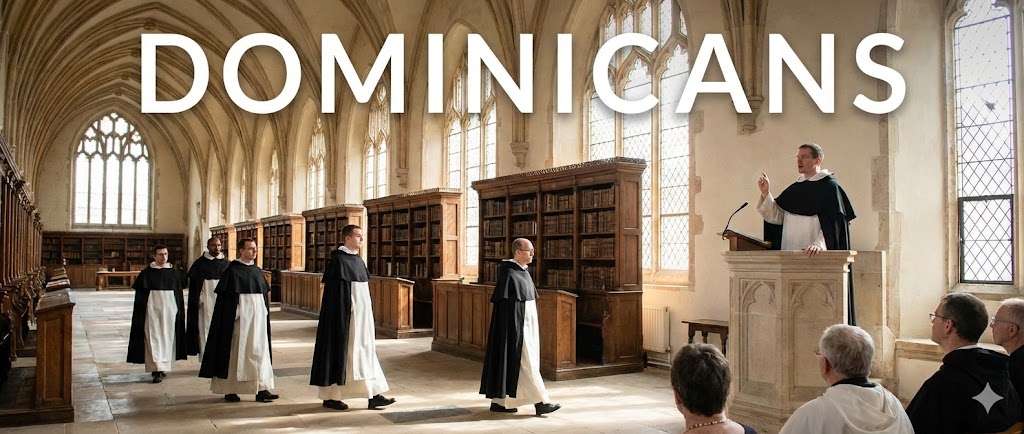
Core Charism: Veritas (Truth), Preaching, Study, Combatting Error with Clarity, Contemplation passed on to others.
5th Sunday of Lent (A)
This Sunday’s Hook: The bold, unmistakable theological claim made to Martha: “I am the resurrection and the life.” He does not say He will bring the resurrection; He says He is it.
The Approach with Application: The Order of Preachers focuses on Truth (Veritas) and theological clarity. The homily would beautifully unpack the dual nature of Christ displayed here: fully human in His weeping, fully divine in His power over death. The physical raising of Lazarus points to two truths: our future bodily resurrection, and the immediate spiritual resurrection available right now through Grace. The application is a call to the Sacraments, particularly Reconciliation, as the objective encounter with the Truth that restores dead souls to the life of grace.
Key Phrase: “I am the Resurrection: The Truth that conquers the grave.”

Core Charism: Poverty, Minority (being “lesser”), Fraternity, and finding God in the grit of humanity and creation.
5th Sunday of Lent (A)
This Sunday’s Hook: Jesus wept. The God of the universe stands outside a tomb and breaks down in tears alongside Mary and Martha.
The Approach with Application: Franciscans emphasize the Incarnation—the profound reality that God became flesh and entered fully into the messiness of the human condition. The homily would focus on solidarity. Jesus does not stand far off and shout a magic spell; He feels the raw pain of human loss. The application challenges the congregation to practice Franciscan fraternity: How do we walk with those who are grieving, marginalized, or suffering? We must first “weep” with our brothers and sisters in radical empathy before we try to fix their problems.
Key Phrase: “Jesus wept: The God who suffers with us.”

Core Charism: Ad Maiorem Dei Gloriam (For the Greater Glory of God), Discernment of Spirits, Finding God in All Things, Imaginative Contemplation.
5th Sunday of Lent (A)
This Sunday’s Hook: Place yourself in the tomb with Lazarus. It is dark, it is quiet, and you are bound tightly. What are the “burial bands” tying you down right now?
The Approach with Application: Rooted in Ignatian contemplation and the Spiritual Exercises, this homily would invite the faithful into an imaginative prayer experience. Jesus is calling your name, commanding you to “Come out!” The application focuses on discernment and spiritual freedom. The congregation is urged to identify their attachments, desolations, or habitual sins—the things that keep them entombed—and ask Jesus for the grace to be untied and set free for greater service (Magis).
Key Phrase: “Unbind him, and let him go: The call to spiritual freedom.”
March/April 2026

Core Charism: Preaching “Plentiful Redemption” (Copiosa Redemptio), especially to the abandoned and sinners; Moral Theology (St. Alphonsus Liguori).
5th Sunday of Lent (A)
This Sunday’s Hook: “Lord, by now there will be a stench; he has been dead for four days.”
The Approach with Application: Redemptorists are preachers of plentiful redemption and profound mercy, particularly to the most abandoned. The homily would highlight that Jesus does not shy away from the stench of the tomb. He walks right up to the most broken, shameful, and “smelly” parts of our lives. No sin is too great, and no soul is too far gone for His abundant mercy. The application is a passionate, urgent invitation to the Sacrament of Confession before Easter. Bring your deadness to Christ, no matter how rotten you feel your situation has become.
Key Phrase: “Plentiful Redemption: No tomb is too sealed for Christ’s mercy.”
Bishop Robert Barron

2026 HOMILIES | ARCHIVE: 2023 | 2020 | 2017 | 2014 | 2011 | 2005
5th Sunday of Lent (A)
Is Death the End?

Friends, on this Fifth Sunday of Lent, our Gospel is John’s story of Jesus raising Lazarus from the dead. Let’s face it: we are all haunted by death. No matter what we accomplish in this life, we know that it will all be swallowed up in the end. The fear of death broods over the whole of life. But does death have the final say?
5th Sunday of Lent (A)
Featured Homily
A Catholic View of Salvation

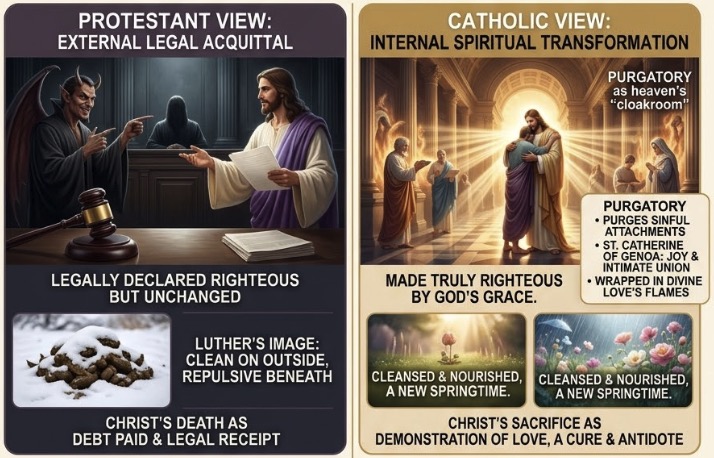
Fr. Don’s 2011 homily explores the profound Catholic understanding of salvation as an internal transformation rather than a mere legal transaction. Drawing on Ezekiel 37, Romans 8, and the raising of Lazarus in John 11, it contrasts the Protestant “courtroom” view of justification—where a sinner is legally acquitted but remains inwardly unchanged—with the Catholic reality of being made truly righteous by God’s purifying grace.
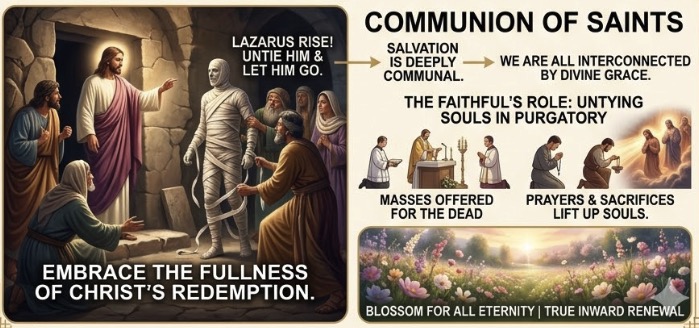
He describes Purgatory as heaven’s “cloakroom,” where God’s intense love cleanses the soul of lingering sinful attachments. A focal point of the message is Christ’s command to the community to “untie” Lazarus from his burial bands. This powerful moment illustrates the Communion of Saints, highlighting that salvation is deeply communal. Ultimately, it calls the faithful to actively participate in liberating the souls in Purgatory through prayer, sacrifice, and the offering of the Mass.

GO DEEPER
PROMPTS TO KEEP YOU WRITING
Copy/paste one of these command prompts into the Catholic Assistant (bottom right corner). This tool can help you brainstorm and provide you with further ideas to keep you writing.
_
- Write a theological reflection connecting winter's end to Ezekiel's open graves and Lazarus's resurrection. Explain how Christ transforms death into life, contrasting Protestant and Catholic views of divine saving grace.
- Describe the Protestant view of justification using a courtroom metaphor. Detail Satan as accuser and Jesus as defense attorney paying legal debts, referencing Luther's snow-covered manure imagery for external righteousness.
- Explain the Catholic view of salvation using Romans eight. Contrast external justification by illustrating divine grace as an internal medicine that truly transforms, cures, and makes the soul entirely righteous.
- Illustrate Purgatory as heaven’s purifying cloakroom. Describe how God's intense love cleanses souls of lingering sins, revealing ripple effects of past wrongs while bringing immense joy and deep spiritual healing.
- Analyze the Gospel scene where Lazarus emerges bound in grave clothes. Explain how these bindings symbolize a soul in Purgatory, possessing eternal life but still tangled in lingering earthly attachments.
- Explore Christ’s command to untie Lazarus. Show how this illustrates the Communion of Saints, proving salvation is a communal effort where believers help liberate departed souls across the spiritual veil.
- Detail how earthly believers assist souls in Purgatory. Emphasize offering Masses, rosaries, and personal sacrifices as the spiritual hands that untie the grave clothes of the dead for heavenly joy.
- Conclude a reflection on Ezekiel by comparing heavenly entrance to an April shower. Describe how Christ’s blood and Spirit bring internal renewal, letting the truly cleansed soul blossom for eternity.
- Contrast Protestant legal justification with Catholic internal transformation. Use a courtroom analogy for the former and a medicinal cure for the latter, demonstrating how divine grace actively changes human nature.
- Summarize the spiritual journey from death to springtime. Connect Ezekiel’s promise, the courtroom contrast, Purgatory’s purifying cloakroom, and the communal unbinding of Lazarus into a cohesive theology of transformative grace.
5th Sunday of Lent (A)
Fr. Michael Chua
2026 HOMILIES | ARCHIVE: 2023 | 2020 | 2017 | 2014 | 2011
This will end in God’s glory

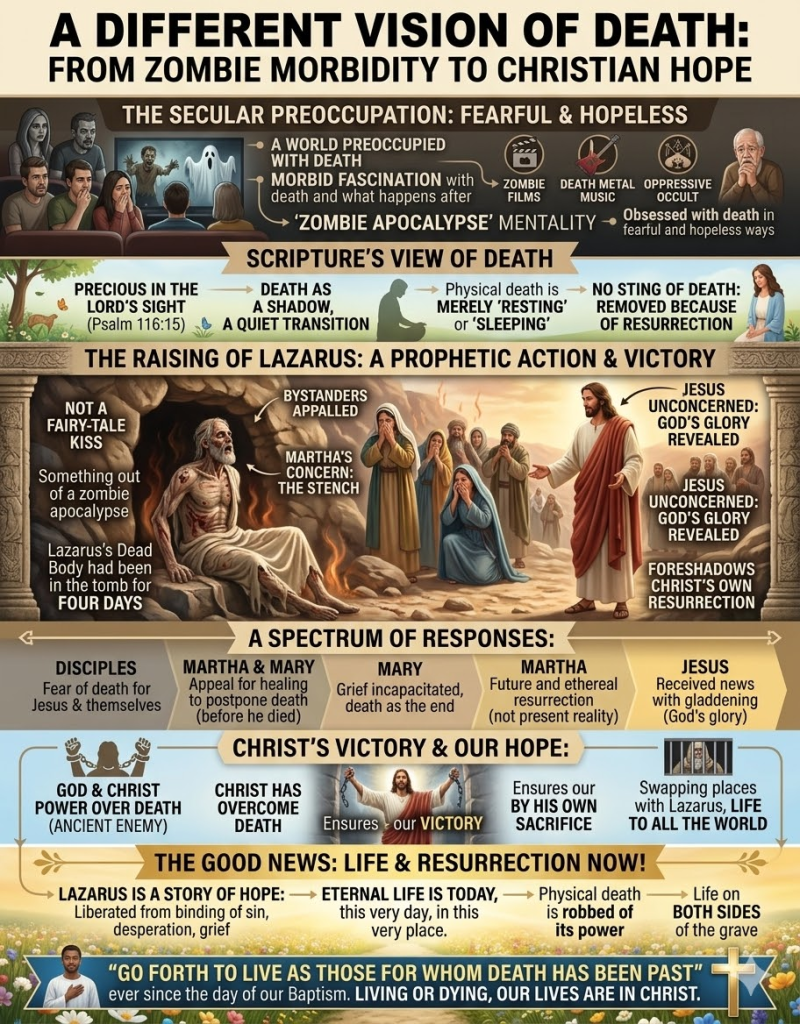
While contemporary culture often fixates on death with morbid fear and hopelessness—evident in zombie films and occult fascination—Scripture offers a radically different perspective. In his 2023 homily, Fr. Chua contrasts humanity’s natural dread of mortality with Christ’s triumphant power over it, using the raising of Lazarus in John 11 as the central focus. Though Lazarus’s death brought immense grief and varied responses of doubt from his community, Jesus viewed it as an opportunity to reveal God’s glory.
The visceral reality of the tomb serves not as an end, but as a prophetic anticipation of Christ’s own resurrection and His ultimate victory over humanity’s ancient enemy. Ultimately, we cannot conquer death on our own, but through Christ, the “sting of death” is removed. The miracle stands as a beacon of hope, reminding the faithful that eternal life begins not at the end of time, but today through our baptism.
GO DEEPER
PROMPTS TO KEEP YOU WRITING
Copy/paste one of these command prompts into the Catholic Assistant (bottom right corner). This tool can help you brainstorm and provide you with further ideas to keep you writing.
_
- Contrast modern culture's hopeless obsession with death, seen in zombie movies and the occult, against the biblical perspective where physical death is merely a peaceful transition into eternal, joyous life.
- Explain why Jesus rejoiced at His friend's passing, describing mortality not as a final destruction but as a temporary sleep. Emphasize that Christ removes the painful sting of dying.
- Describe the visceral reality of a four-day-old corpse in a warm climate. Contrast this gruesome decay with fairy tales to highlight the shocking, miraculous nature of moving the tombstone.
- Detail the various human reactions to mortality: the disciples' fear, the sisters' limited faith, and Mary's incapacitating grief. Contrast these with Christ's divine vision of ultimate victory and glory.
- Analyze the miraculous resuscitation as an active prophecy. Show how defeating mankind's ancient enemy foreshadows Christ’s own impending resurrection while anticipating the glorious, eternal liberation of all righteous souls.
- Write a message of profound hope portraying resurrection as a true rebirth. Explain how divine intervention liberates seemingly lost souls from their desperate bindings of sin, grief, and pain.
- Acknowledge human powerlessness when battling mortality despite medical help. Reassure the audience that true victory comes only through divine intervention, which completely robs physical death of its final power.
- Illustrate the theological concept of substitution. Explain how the Savior willingly swapped places with a condemned man, ultimately offering endless life to the entire world through His own sacrifice.
- Proclaim the good news that faithful believers experience life on both sides of the grave. Encourage listeners to boldly declare their faith and embrace their present, eternal spiritual reality.
- Conclude the reflection by connecting present salvation to baptism. Urge the congregation to live fearlessly today, knowing that their spiritual union effectively moves them completely past any final destruction.
5th Sunday of Lent (A)
Dominican Blackfriars
2026 HOMILIES | ARCHIVE: 2023 | 2020 | 2017 | 2014 | 2011 | 2008 | 2005 | 2002

Arise and Be Free

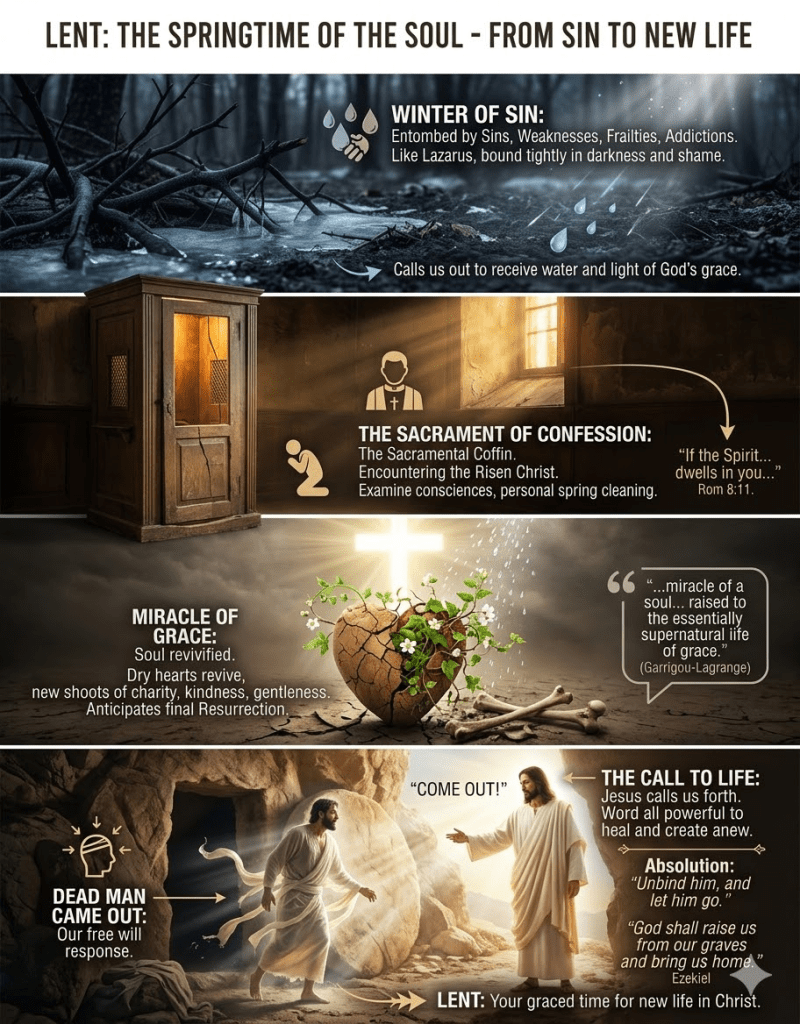
Lent, rooted in the Old English word for “spring,” is a season of profound spiritual revival, calling believers out of the winter of sin into the light of God’s grace. Drawing powerful parallels to the raising of Lazarus, Fr. Lawrence Lew, O.P. parallels the raising of Lazarus with the sacrament of confession. Just as catechumens find new life in Baptism at Easter, the already baptized are invited to experience spiritual resurrection through Penance. The wooden confessional acts as a tomb where Christ’s spoken words of absolution unbind the soul from the shame, anxiety, and spiritual death of sin. While Christ weeps for our fallen state and commands our release, we must voluntarily respond to His call to “Come out.” Ultimately, Confession restores us to the supernatural life of grace, anticipating our final resurrection and securing our eternal friendship with the Blessed Trinity.
GO DEEPER
PROMPTS TO KEEP YOU WRITING
Copy/paste one of these command prompts into the Catholic Assistant (bottom right corner). This tool can help you brainstorm and provide you with further ideas to keep you writing.
_
- Write a Lenten reflection comparing the season to springtime. Describe how divine grace calls believers out of the dark winter of sin to flourish, grow, and become fully spiritually alive.
- Draw a parallel between the Easter baptism of new converts and the spiritual renewal of the already baptized. Explain how human frailties and addictions entomb believers exactly like dead Lazarus.
- Urge the faithful to use this holy season for personal spring cleaning. Describe examining consciences and seeking the sacrament of Penance to transform hidden shame into flourishing charity and gentleness.
- Compare the wooden confessional box to a tomb where sinners meet the resurrected Lord. Explain how His spoken absolution sends the Holy Spirit to miraculously revivify spiritually dead human souls.
- Develop a theological argument that raising a physical corpse is nothing compared to resurrecting a soul from sin. Show how sacramental grace anticipates our ultimate bodily resurrection at the end.
- Illustrate how Christ actively works through church sacraments today. Explain that even deadly spiritual sins are conquered in Penance, fulfilling His promise that believers who live in grace never die.
- Describe the Savior weeping over humanity trapped in dark addictions and shame. Emphasize how His powerful, divine creating word commands spiritual unbinding and transforms ordinary people into wonderfully renewed saints.
- Highlight the absolute necessity of personal free will in salvation. Explain that Jesus did not drag Lazarus out, meaning sinners must voluntarily step into the confessional to hear absolving words.
- Connect the Old Testament prophecy of opening graves to the modern experience of Penance. Conclude by illustrating how divine absolution literally raises believers from spiritual death and brings them home.
- Craft a pastoral invitation urging parishioners to leave their tombs of guilt. Contrast the fear of approaching the sacrament with the profound, eternal joy of hearing Christ command their unbinding.
5th Sunday of Lent (A)
Fr. Austin Fleming
2026 HOMILIES | ARCHIVE: 2023 | 2020 | 2017 | 2014 | 2011 | 2008
Life After Loss, Life After Death…
In his 2011 Lenten homily on the Gospel of the man born blind, Fr. Fleming explores the narrative as a profound lesson on spiritual illumination, centered on Jesus as the “light of the world.” He challenges listeners to examine the foundational “light” they use to discern truth and reality. Fleming contrasts the spiritual blindness of the Pharisees, whose strict legalism obscured God’s work, with modern culture’s dangerous reliance on subjective truth. To cure this inherent blindness, he urges viewing the world through the “corrective lenses” of God’s word, compassion, and Church wisdom instead of distorted worldly lenses. The homily concludes by linking this spiritual sight to recognizing Christ beneath the physical elements of the Eucharist.
GO DEEPER
PROMPTS TO KEEP YOU WRITING
Copy/paste one of these command prompts into the Catholic Assistant (bottom right corner). This tool can help you brainstorm and provide you with further ideas to develop your homily.
_
- The True Healing: Write a reflection contrasting physical blindness with spiritual darkness. Describe Jesus curing a blind man not just to restore physical sight, but to reveal himself as the ultimate light.
- The Illusion of Sight: Expand on the irony of religious leaders who claim to see clearly but remain trapped in darkness. Highlight how strict adherence to rules blinded them to miraculous divine joy.
- Subjective Truth vs. Divine Reality: Rewrite a narrative exploring how modern society dangerously equates personal opinion with infallible truth. Contrast this chaotic individualism with the clarifying, objective wisdom found in divine compassion and love.
- Lenses of Faith: Create a piece utilizing the metaphor of spiritual corrective lenses. Detail how scripture, ancient wisdom, and divine love act as glasses to fix our distorted, media-driven, profit-focused worldview.
- By What Light: Structure a meditation using repeated, challenging questions about the "light" guiding daily decisions. Force the reader to choose between worldly priorities—like prejudice and profit—and divine wisdom.
- Stripping Away Illusions: Describe a mid-season journey of fasting, prayer, and charity. Explain how these specific disciplines intentionally strip away worldly illusions, allowing believers to step out of darkness and embrace truth.
- Seeing Beyond the Surface: Write a conclusion set during a sacred meal. Explain how true spiritual sight allows believers to look past the physical appearance of bread and wine to find divine presence.
- Formed from the Earth: Expand on the gritty detail of mud and saliva used for healing. Connect this physical, earthy act of recreation to the broader spiritual recreation of the human soul.
- The Heart of the Matter: Contrast looking at the world through a lens of judgment and profit with seeing through divine compassion. Urge the reader to look past superficial appearances directly into the heart.
- Stepping Out of Shadows: Craft a narrative arc following a soul moving from profound spiritual ignorance into brilliant divine illumination. Emphasize that abandoning personal pride is the required first step toward true vision.and loves us anyway. us anyway.
5th Sunday of Lent (A)
Monsignor Peter Hahn


Can I Help?
In a world that pulls us in every direction, the simple question, “Can I help?” carries profound power. Msgr. Peter Hahn’s 2017 homily transitions from human generosity to the divine assistance offered throughout Lent. Whether we feel success in our Lenten fidelity or the frustration of broken promises, the Lord continuously approaches us with that same offer of help.
Drawing from the Sunday readings, Msgr. Hahn see this divine initiative in action:
- Ezekiel: God promises to open graves and put His Spirit within His people, proving that holiness is His work, not ours.
- The Gospel: In the raising of Lazarus, we encounter the “late” arrival of Jesus. Like Martha, we often face crises where God seems silent, yet these moments are opportunities for His power to “burst forth.”
Jesus reveals Himself as the Resurrection and the Life, inviting us to recommit to our spiritual journey. By accepting His help—His mercy, grace, and strength—we are raised to new life.

GO DEEPER
PROMPTS TO KEEP YOU WRITING
Copy/paste one of these command prompts into the Catholic Assistant (bottom right corner). This tool can help you brainstorm and provide you with further ideas to develop your homily.
_
- The duality of sight. Expand on the phrase "I see," contrasting mere physical vision with the deeper spiritual understanding and faith required to grasp truths that are invisible to the eye.
- The Gospel paradox. Retell the encounter between Jesus and the man born blind, highlighting the irony that physical healing leads to spiritual sight, while the sighted Pharisees remain spiritually blind due to pride.
- Sin as spiritual blindness. Explain how the Gospel connects physical infirmity to sin, illustrating that the Pharisees' self-sufficiency and opposition to God's love reveal their true, hidden spiritual impairment.
- Prayers for the elect. Connect the Gospel theme of sight to the Lenten scrutinies for baptisimal candidates, focusing on the prayer to free them from blinding false values and make them "children of light."
- God’s standard of judgment. Incorporate the Old Testament account of Samuel anointing David to illustrate that God does not judge by outward appearance or stature, but by His own divine standards.
- Unexpected grace. Reflect on how God's choice of the unlikely David demonstrates that grace is continually poured out as an unexpected gift, despite human weakness, sin, and unworthiness.
- Living as children of light. Expound on St. Paul’s call for believers to embrace their baptismal identity as "children of light," purging themselves of the fruitless works of darkness during the Lenten season.
- The danger of self-sufficiency. Warn against the spiritual danger of imitating the Pharisees, who, believing they already understand everything, arrogantly claim they have no need for God's healing or forgiveness.
- The necessity of Confession. Emphasize the indispensable need for the Sacrament of Confession during Lent as the primary means to receive Christ's healing touch and restore spiritual sight, rejecting the denial of sin.
- Invitation to healing. Conclude with an exhortation to open oneself to Jesus's healing gift, so that, having been washed and restored to sight, believers may boldly proclaim Christ's light and truth.
5th Sunday of Lent (A)
Fr. Charles E. Irvin

Combating the Spirit of Defeatism

Fr. Irvin’s homily addresses the modern “spirit of defeatism” that acts as a spiritual prison, contrasting it with the liberating power of the Resurrection. He identifies four sources of this defeat: extremism (all-or-nothing thinking), constant comparison to others, passive resignation (labeling despair as “fate”), and over-reliance on self rather than God.
Fr. Irvin argues that these attitudes serve as “sacraments of the devil,” binding us like Lazarus in his shroud. However, the Word of God through Ezekiel and the Gospel challenges us to stop dwelling on past failures. Christ’s command to “untie him” is a call to throw open the doors of our self-made tombs. By relying on the Sacraments—God’s own acts of renewal—we transition from the darkness of pain to the joy of Easter. Ultimately, for the Christian, there is no ultimate defeat, only the opportunity for God to “do something new” within us.

GO DEEPER
PROMPTS TO KEEP YOU WRITING
Copy/paste one of these command prompts into the Catholic Assistant (bottom right corner). This tool can help you brainstorm and provide you with further ideas to develop your homily.
_
- Address the modern decline in faith alongside varied human motives for seeking divine help, forgiveness, or sheer duty. Expand on heavenly hopes. AI, rewrite this focusing entirely on spiritual longing.
- Connect prophetic themes of opening ancient graves to transforming worldly pain into joyful renewal. Detail what this deep promise means today. AI, generate a reflection emphasizing this divine restoration process.
- Explore the modern plague of defeatism, where doubt, depression, and victim mentalities hold people in bondage despite surrounding optimism. AI, write an inspiring text directly countering these pessimistic cultural attitudes.
- Analyze the first source of spiritual defeat: extreme, rigid thinking that distorts occasional mistakes into absolute failures. AI, expand on this concept by highlighting the vital need for balanced perspectives.
- Describe the second trap of endless social comparison fueled by advertising, which guarantees frustration by convincing people they lack enough. AI, craft a message urging readers to reject consumerist envy.
- Detail the third pitfall of passive resignation, where individuals surrender to dark feelings and falsely label their suffering as destiny. AI, write a persuasive argument challenging this fatalistic worldview directly.
- Examine the final source of defeat: relying excessively on worldly success instead of trusting divine care and heavenly promises. AI, rewrite this section to deeply emphasize profound trust in God.
- Pose a challenging question about what absorbs our hearts, urging a shift from past events to fresh, divine renewals. AI, develop an engaging narrative focusing on embracing new spiritual beginnings.
- Explain how sacred rites offer fresh starts, drawing parallels to overcoming national depression by defeating fear itself. AI, write a compelling paragraph highlighting how spiritual rituals restore personal inner confidence.
- Illustrate the ultimate victory over the devilish sacraments of doubt by comparing our spiritual liberation to Lazarus leaving his tomb. AI, draft a joyous conclusion celebrating this glorious resurrection freedom.
5th Sunday of Lent (A)
Fr. Joe Jagodensky, SDS
“The End?”

Fr. Joe Jagodensky’s homily explores the tension between life’s inevitable “endings” and the Christian promise of a prelude to something greater. He observes that while the world is obsessed with “The End”—from movie credits to funeral directors—death in the Christian faith is not a finality but a transition. This ties directly into the 5th Sunday of Lent (Year A) readings, where the “ending” of Lazarus’s life is revealed to be merely a scene-break in God’s larger narrative.
Just as the prophet Ezekiel speaks of God opening graves to bring forth new life, and Jesus calls Lazarus out of the tomb, Fr. Jagodensky suggests that our “befores” are cherished memories that find their ultimate “after” in the grandeur of eternal life. The homily mirrors the Gospel’s movement from the finality of the tomb to the “unfolding” of a story only God can truly finish, reminding us that our life’s ending continues to breathe in a life that is still breathing in Christ.

GO DEEPER
PROMPTS TO KEEP YOU WRITING
Copy/paste one of these command prompts into the Catholic Assistant (bottom right corner). This tool can help you brainstorm and provide you with further ideas to develop your homily.
_
- The Deception of Perception: Rewrite the Grace Kelly anecdote, focusing on how Hitchcock's preconceived notion of her appearance led him to see a non-existent change. Explore the broader implication of how easily human perception can be deceived by expectations.
- The Root of Sin as Blindness: Expand on the idea that sin's root lies in "tainted eyes" and "wax-ladened ears." Connect this concept to the Grace Kelly story, illustrating how selective perception and stubbornness hinder spiritual clarity.
- Listening vs. Formulating a Response: Create a relatable scenario about a political conversation where one person is busy formulating their response while the other is still speaking. Highlight the missed opportunity for understanding and the potential for agreement that goes unnoticed.
- Seeking a Common Vision: Discuss the challenge of "wide open" eyes seeing differences and seeking a "common vision." Use the example of a political conversation to illustrate how people often miss God's message, which may be completely different from their own petty views.
- The Unheard Pleas: Write a reflective piece on the importance of opening our ears to the subtle pleas of children and the unspoken feelings behind their words. Emphasize the need for sensitivity and active listening during Lent.
- The Inner Voice of Conscience: Explore the concept of the "inner voice" that warns us when we are wrong, but we often ignore it. Use the Grace Kelly story as a metaphor for how we can be deceived by our own desires and ignore the truth.
- The Quiet Grief of Others: Write a compassionate reflection on the importance of hearing the whisperings of someone's grief, even when there is nothing we can do but offer a silent prayer. Connect this to the Lenten theme of opening our ears and hearts.
- Escaping Silence: Discuss the modern tendency to escape the "annoyingly noisy silence" of personal reflection through distractions like television, alcohol, drugs, video games, and social media. Contrast this with the Lenten call to open our eyes and ears to God.
- Redemption Through Listening: Expand on the story of David, the youngest and "ruddy" son chosen as King, who found redemption by listening more and seeing God's greatness and forgiveness. Use this as an example for Lenten transformation.
- A Lenten Call to Action: Craft a concluding call to action for the Lenten season, urging readers to "keep rubbing those eyes" to search for God's perspective and to "keep cleaning out that wax," because God is actively speaking and listening.
5th Sunday of Lent (A)
Deacon Greg Kandra
The Walking Dead
Deacon Greg Kandra’s 2017 homily draws a profound parallel between the biblical resurrection of Lazarus and the spiritual journey of Lent. He describes Lazarus not merely as a reanimated corpse, but as a “second chance” made possible because he responded to Christ’s authoritative command. Kandra suggests that, like Lazarus, we often exist as “The Walking Dead”—bound by the burial cloths of sin, human weakness, and spiritual lethargy.
The core of the message is Christ’s persistent cry: “Come out!” This is an invitation to leave the dark, familiar tombs of our personal failings and step into the light of reconciliation. As Lent nears its end, Kandra challenges the faithful to conduct a “spiritual inventory,” urging them to rediscover the penitential zeal of Ash Wednesday. By embracing the Sacrament of Reconciliation and God’s mercy, we move from being prisoners of our own brokenness to living as people truly alive in Christ.

GO DEEPER
PROMPTS TO KEEP YOU WRITING
Copy/paste one of these command prompts into the Catholic Assistant (bottom right corner). This tool can help you brainstorm and provide you with further ideas to develop your homily.
_
- The Divine Shout Jesus stands before the tomb and cries out to his dead friend, transforming a corpse into a living man. The AI must expand on the visceral power of Christ’s voice.
- Personal Tomb Walls We often hide in the dark caves of our own sin, becoming spiritually dead while still walking. The AI must focus on identifying the "familiar" shadows we refuse to leave.
- Untying the Bandages Lazarus emerges bound in burial cloths, representing the wounds and brokenness that still restrict our movement. The AI must emphasize Christ’s command to be set free and walk in light.
- God’s Holy Tears Jesus weeps for those he loves, showing that our human weakness and grief are shared by the Divine. The AI must write a section on God’s empathy for the suffering.
- The Lenten Inventory With the forty-day journey ending, we must examine what we have truly given to God and the poor. The AI must create a checklist for a deep spiritual self-audit.
- From Dust to Life The ashes of Ash Wednesday marked us as "the walking dead," but the call of Christ offers a second chance. The AI must focus on the transition from penitence to renewal.
- The Daylight Metaphor Daylight Saving Time has granted us an extra hour of physical light to mirror our spiritual journey. The AI must emphasize the importance of using this remaining time for growth.
- Reconciliation and Mercy The doors of the church stand open, offering a final opportunity to shed our burial cloths through confession. The AI must focus on the beauty of God’s restorative mercy.
- The Faltering First Step Leaving the tomb requires a courageous response to Christ’s cry, even if our steps are shaky. The AI must write an encouraging passage about taking the first step toward grace.
- The Acceptable Hour St. Paul reminds us that the moment of salvation is right now, not a distant future event. The AI must focus on the urgent need to recommit before Easter morning.
5th Sunday of Lent (A)
Fr. Langeh, CMF

Looking for fresh ideas? Copy/paste one of these command prompts into the Catholic Assistant (bottom right corner). This tool can help you refine your homily.
_
NOT AVAILABLE
The command prompts above were created using the homily below as a foundation. Please note that Fr. Langeh's homily itself is entirely human-written and was NOT generated by AI.
Death Where Is Your Sting?
5th Sunday of Lent (A)
Deacon Peter McCulloch
2026 HOMILIES | ARCHIVE: 2023 | 2020
A Modern-Day Lazarus
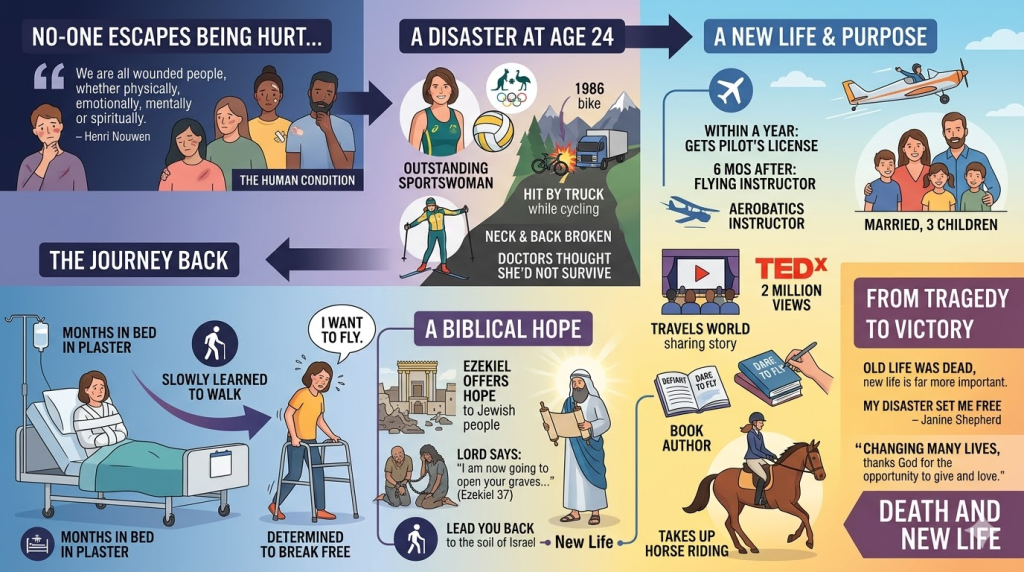
Deacon Peter McCulloch’s 2023 homily frames the Resurrection of Lazarus through the contemporary lens of “The Wounded Healer,” using the harrowing and triumphant story of Australian athlete Janine Shepherd. After a near-fatal accident left her broken and encased in a “plaster straitjacket,” Shepherd’s journey to becoming an aerobatics instructor serves as a modern-day parallel to the dry bones of Ezekiel and the bound body of Lazarus. McCulloch emphasizes that while physical or emotional pain is an inevitable “price for being human,” it does not have to be a permanent prison.
The homily’s theological heart lies in the realization that true strength is not found in the physical body, but in the “intangible spirit.” McCulloch highlights that Jesus calls for belief—a word repeated six times in the Gospel—as the key to unbinding ourselves from the things that stifle our growth. By responding to Christ’s command to “come out,” we are invited to emerge like butterflies from cocoons, shedding our metaphorical bandages to embrace a “brand-new life” of freedom and light, right here and now.

GO DEEPER
PROMPTS TO KEEP YOU WRITING
Copy/paste one of these command prompts into the Catholic Assistant (bottom right corner). This tool can help you brainstorm and provide you with further ideas to develop your homily.
_
- Begin with the universal truth that everyone carries deep wounds. Instruct the AI to explore how human pain is inescapable, but it never actually dictates our ultimate and final destiny.
- Relate a modern survival story of a broken athlete recovering from a severe accident. Have the AI emphasize her fierce determination to break free from an agonizing plaster medical straitjacket.
- Draw a powerful biblical parallel between a bedridden survivor and the ancient Jewish people in exile. Guide the AI to show how God promises to open graves and restore futures.
- Detail the pursuit of flight as a metaphor for spiritual rebirth. Instruct the AI to describe the transition from physical paralysis to becoming a licensed, confident, soaring aerobatics flight instructor.
- Focus on the profound realization that true strength is completely independent of the physical body. Have the AI explain that authentic power originates from the intangible, indestructible inner human spirit.
- Connect the bandaged man emerging from his tomb to the modern woman casting off her plaster cast. The AI must vividly illustrate how both individuals experienced literal second spiritual births.
- Highlight the repetition of belief found six times in the scriptural text. Instruct the AI to define this belief as the active mechanism required to untie suffocating internal spiritual bindings.
- Examine the concept of resurrection as a present reality rather than a future promise. Guide the AI to write about embracing new life today by releasing our old paralyzing fears.
- Use the metaphor of butterflies emerging from dark cocoons to symbolize ultimate spiritual freedom. The AI should encourage the listener to step out of their darkness and into bright light.
- Synthesize the call to emerge from the tomb with the modern triumph over physical tragedy. Have the AI conclude by challenging readers to hear God's voice commanding them constantly outward.
5th Sunday of Lent (A)
Msgr. Charles Pope
Untie Him and Let Him Go Free
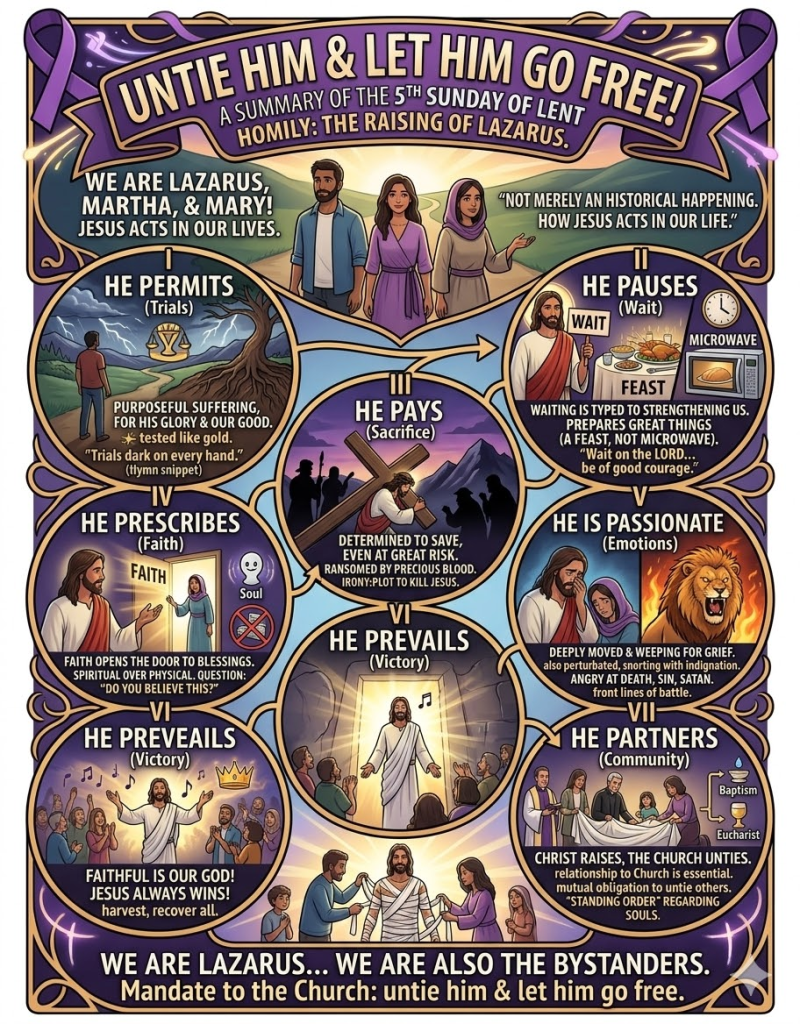
Msgr. Pope’s homily presents the raising of Lazarus as a multifaceted template for how Christ acts in our lives today. Rather than a simple miracle, the author breaks the event into seven distinct stages to explain the “mysterious design” of God’s providence. The message begins with the difficult truth that God permits trials and pauses His response not out of indifference, but out of love—delaying a smaller healing to prepare a greater “feast” of resurrection that manifests His glory.
The narrative shifts to the cost of grace, noting how Christ pays for our life with His own, as this miracle directly triggers the plot to kill Him. To receive this life, Christ prescribes faith as the only door. The author highlights Jesus’ passion, specifically his indignation (Greek: embrimaomai) toward the tragedy of death itself. Ultimately, Christ prevails over the grave and partners with the Church. This final stage is crucial: while Jesus provides the life, He commands the community to “untie” the person from the lingering burial cloths of sin through the sacraments and mutual support.
GO DEEPER
PROMPTS TO KEEP YOU WRITING
Copy/paste one of these command prompts into the Catholic Assistant (bottom right corner). This tool can help you brainstorm and provide you with further ideas to develop your homily.
_
- Expand on the mystery of divine permission in human suffering. Write a reflection explaining why God temporarily allows trials like illness, emphasizing that faithful endurance ultimately manifests His eternal glory.
- Explore the painful paradox of God's delayed rescue. Describe Jesus waiting two days to heal his friend, illustrating how divine patience prepares believers for a greater miracle of ultimate resurrection.
- Detail the ultimate sacrifice required for salvation. Narrate Christ’s conscious decision to return to a dangerous Judea, highlighting the profound irony that raising a friend seals His own inevitable death.
- Focus on the prerequisite of spiritual trust. Dramatize the dialogue between Jesus and the grieving sister, showing how declaring faith in the resurrection must precede the physical miracle of life.
- Depict the deep sorrow of a weeping Savior. Write a scene where Christ confronts the grave, experiencing profound human grief alongside the mourning community before He performs the great miracle.
- Describe the righteous anger of the Son of God. Explain the Greek concept of embrimaomai, portraying His intense indignation against the unnatural intrusion of sin and death into human creation.
- Illustrate the absolute victory of divine power over the grave. Describe the dramatic moment the dead man is called forth, emphasizing that God cannot fail and always overcomes utter darkness.
- Highlight the crucial mandate given to the community. Explain the command to untie him, showing how the Church uses sacraments and fellowship to free souls from lingering spiritual earthly bondage.
- Rewrite the biblical narrative as a modern personal journey. Frame the listener as the man in the tomb, illustrating how Christ calls us individually from spiritual death to new life.
- Examine the spiritual obligation of the faithful bystanders. Write a call to action urging believers to actively help unbind their neighbors, supporting one another in the ongoing healing spiritual process.
5th Sunday of Lent (A)
Father Kevin Rettig

2026 HOMILIES | ARCHIVE: 2023 | 2020
Untie the Knots
Fr. Kevin Rettig’s homily connects a beloved Baroque devotion with the story of Lazarus to explore the “complex mess” of human existence. It traces the history of the painting Mary, Undoer of Knots from an obscure Bavarian church to its global popularity sparked by Pope Francis. The homily suggests that life is often a series of “tangled knots”—debt, loneliness, medical struggles, and the “am nots” of self-doubt—where trying to fix one problem often pulls another knot tighter.
The theological turning point argues that there is a “wisdom that unties by tying.” Using Lazarus as the ultimate example, the author posits that the only way to undo the knot of death is to be bound by an even stronger cord: the knot of divine love. By tying our souls to Christ, the “burial cloths” of our lives are systematically loosened. The message concludes with a call to replace our internal “could nots” and “should nots” with a singular, freeing bond to God, reminding us that we learn the “rope of life” only through the grace-filled process of its unraveling.

GO DEEPER
PROMPTS TO KEEP YOU WRITING
Copy/paste one of these command prompts into the Catholic Assistant (bottom right corner). This tool can help you brainstorm and provide you with further ideas to develop your homily.
_
- Introduce the Marian imagery of a Baroque painting where the Virgin Mary calmly unties a knotted ribbon. Have the AI link this visual to Pope Francis’s personal spiritual devotion.
- Contrast the Bavarian landscape with the internal "tangled macrame" of human struggle. Direct the AI to describe how life's complexities—like debt and loneliness—create seemingly impossible, tightening knots.
- Explore the cyclical nature of human problem-solving, where fixing one issue often creates a larger hole. The AI should argue that human wisdom fails where divine intervention is required.
- Develop the paradoxical theme of "untying by tying." Instruct the AI to explain how binding one’s soul tightly to Christ serves as the ultimate solution for unraveling the bonds of death.
- Connect the Lazarus narrative to the image of the "Undoer of Knots." Have the AI portray Lazarus’s burial cloths as the physical representation of the knots strangling our own spirits.
- Utilize Father Ronnie’s prayer to deconstruct the "have-nots" and "can-nots" of the mind. The AI should write about releasing the mental obstructions that prevent us from moving toward the light.
- Focus on the "am-nots" as the most dangerous spiritual knots. Direct the AI to address the specific lie that one is "not good enough" to receive God’s transformative mercy.
- Describe the angelic roles in the process of healing. The AI should narrate how our knots are presented to Mary and returned to us as a smooth, freed, white ribbon.
- Synthesize the Rumi quote regarding the wisdom that unties. Have the AI explain that this wisdom is not a philosophy but the living presence of Christ acting within the soul.
- Conclude with the singular "knot of divine love." The AI must invite the reader to exchange their suffocating bonds for the one beautiful, all-encompassing bond that provides true freedom.
5th Sunday of Lent (A)
Fr. George Smiga
The Need to Surrender

Fr. George Smiga’s 2005 homily centers on the transformative lesson Martha learns at the tomb of Lazarus: that life is not a future event, but a present person. Smiga argues that we often mimic Martha’s mistake by postponing our joy and peace, placing conditions on our happiness such as “once I lose weight,” “once I retire,” or “once I find success.” These conditions, he suggests, move life away from us, creating a “futile and useless chase” for a future that never arrives.
The heart of the message is a call to surrender. Smiga posits that our life is not about our accomplishments, but about our status as children of God. To illustrate this, he uses the famous comparison between Richard Burton and Bishop Fulton Sheen reciting the 23rd Psalm: while Burton knew the psalm, Sheen knew the Shepherd. Real life, peace, and dignity are available in this very moment, independent of our failures or goals, if we only stop seting conditions and accept the unconditional love God offers us today.

GO DEEPER
PROMPTS TO KEEP YOU WRITING
Copy/paste one of these command prompts into the Catholic Assistant (bottom right corner). This tool can help you brainstorm and provide you with further ideas to develop your homily.
_
- Analyze the theological shift from future hope to present reality. Instruct the AI to dramatize Martha’s conversation with Jesus, emphasizing how he redirects her focus from the "last day" to "now."
- Deconstruct the human tendency to postpone joy until specific life conditions are met. Have the AI list modern milestones—like weight loss or retirement—contrasting them with Christ’s offer of immediate peace.
- Examine the radical concept that life is not earned through personal success. Guide the AI to explore the "futile chase" of conditional happiness versus the grace found in total spiritual surrender.
- Illustrate the profound difference between knowing scripture and knowing God. Use the narrative of the actor and the Bishop reciting Psalm 23 to show that intimacy outweighs professional religious performance.
- Highlight the inherent dignity that flows from being a child of God. The AI should argue that self-worth is available in this moment, regardless of one’s current failures or achievements.
- Challenge the listener's perspective on their own importance. Have the AI expand on the "shocking" idea that we are about life, rather than life being a commodity centered around us.
- Describe the transformative power of the word "now" in the Gospel of John. The AI must explain why accessing peace in Christ's presence is the most difficult scriptural challenge.
- Portray the spiritual inventory of "once I..." statements as barriers to grace. The AI should write a persuasive piece on how these mental conditions move life into a reachable future.
- Reflect on the Shepherd's unconditional love as the secret to existence. The AI should encourage the reader to stop waiting for life to start and instead embrace God’s immediate love.
- Synthesize the call to surrender with the story of the raising of a friend. The AI should explain how the miracle proves that the deepest parts of life require belief.
5th Sunday of Lent (A)