MAR 23, 2025

SOURCE: Fr. Kieren J. O'Mahony


Liturgy Planning
Liturgy Planning
- NOTES
- ENVIRONMENT
- LECTORS
- MUSIC
Weekday
Masses

MON | TUE | WED
THUR | FRI | SAT
Lent
2025
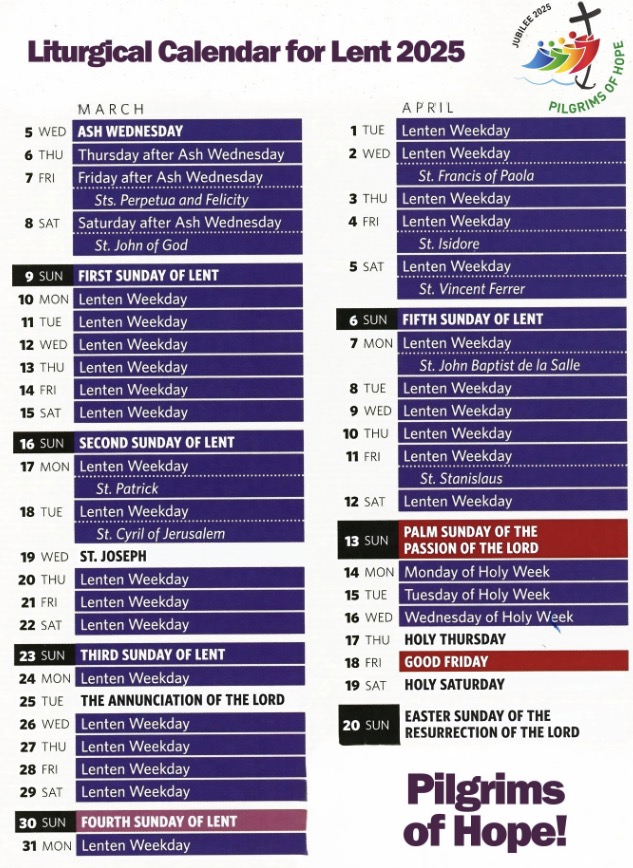
Lent 2025 begins on Ash Wednesday, March 5, 2025. To help you on your Lenten Journey during this Jubilee Year as Pilgrims of Hope, this Lenten eBook contains 67 Ideas and Suggestions for Prayer, Fasting and Almsgiving and a 2025 Lenten Liturg
JUBILEE 2025

The Jubilee Year begins on Christmas Eve in Rome. Here are 16 pages with Resources to help you understand and celebrate the Jubilee and Holy Year of 2025!
3rd Sunday of Lent C

SOURCE: Basilica of the The National Shrine. Crypt Church (TV Mass)
March 20, 2022 – 3 years ago
Celebrant & Homilist: Rev. Thomas Kalita
Choir: Basilica of the National Shrine of the Immaculate Conception Cantor & Organist, Washington, D.C.

⬇️ Planning Notes
3rd Sunday of Lent C
God Calls Us to Repentance

Los Angeles Fires (2025)
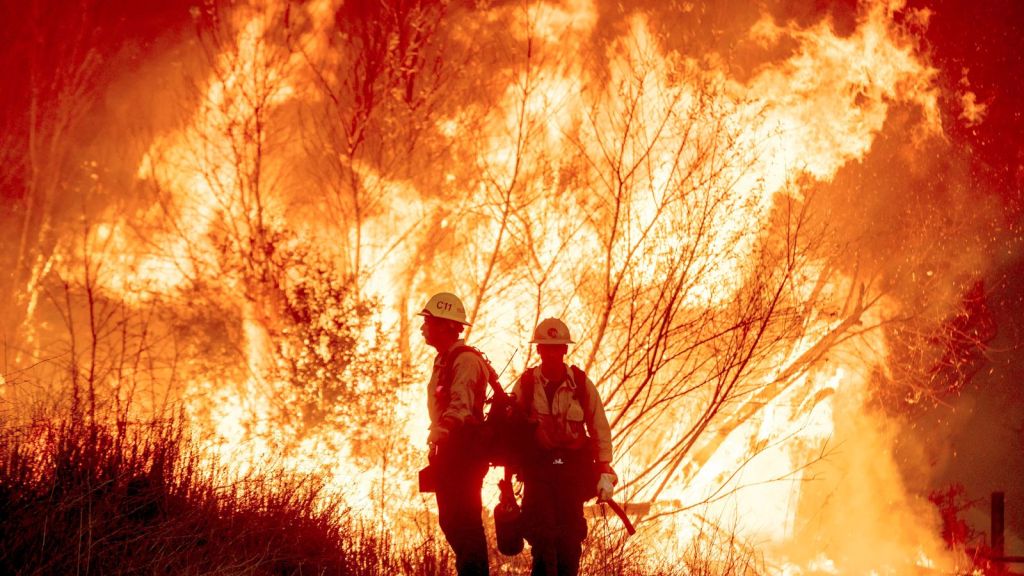
Though we read the same readings every time we cycle through the three-year Lectionary, our lives and our world are not the same each time… [Currently, California is recovering from the devastating January 2025 Los Angeles wildfires. These fires, fueled by drought conditions, low humidity, and severe Santa Ana winds, took lives, destroyed homes, and impacted thousands of residents.]
I wonder how the story of the Burning Bush will be heard this year by those who have suffered the ravages of such fires. Will they be able to see that bush as a sign of God’s presence, despite the contrast posed by the frequency and intensity of wildfires…?
The following text has been generated by AI
In light of the devastating fires, some religious leaders and community members have used the biblical narrative of the burning bush as a point of reflection, drawing parallels between the fire's destruction and God's presence, offering comfort and hope during a time of crisis.
Here's a breakdown of how the burning bush narrative has been used in relation to the Los Angeles fires:
- Reflecting on Loss and Resilience:The fires have caused immense loss, and the burning bush narrative, which symbolizes God's presence amidst destruction, is used to acknowledge the pain and to offer a message of hope and resilience.
- Finding God in the Flames:Some have interpreted the fires as a way to seek God in the midst of destruction, drawing parallels between the burning bush and the fires, suggesting that even in the face of devastation, God's presence can be found.
- The Burning Bush as a Symbol of Divine Presence:The burning bush, where God spoke to Moses, is a powerful symbol of God's presence in the midst of fire, and its use in homilies and reflections during the Los Angeles fires serves to remind people of God's enduring presence, even in times of crisis.
- Drawing on Biblical Themes:The burning bush story, with its themes of God's power and guidance, is used to offer comfort and guidance to those affected by the fires, encouraging them to find strength in faith and to look for God's presence in the midst of the flames.
- Jewish and Christian Perspectives:Both Jewish and Christian leaders have used the burning bush narrative to address the fires, offering reflections on the meaning of home, resilience, and God's presence in times of hardship.
- Examples of Homilies and Reflections:
- Rabbi Sharon Brous, in a sermon on forward.com, spoke about the Jewish meaning of home in the context of the LA fires, drawing parallels to the burning bush.
- Rob Goldberg, in an article on the Buffalo Jewish Federation website, reflected on the fires and the burning bush, suggesting that God is revealed in the heroism of first responders and the leadership of everyday Angelenos.
- Diana Butler Bass, in an article on her Substack, wrote a prayer for those affected by the fires, drawing on the burning bush and the pillar of fire to seek comfort and support.
- An article on Angelus News discussed how God's voice is still speaking to us from the midst of these fires, referencing the burning bush and the story of Moses.
Click on banner to show/hide text
Lenten Prayer Service
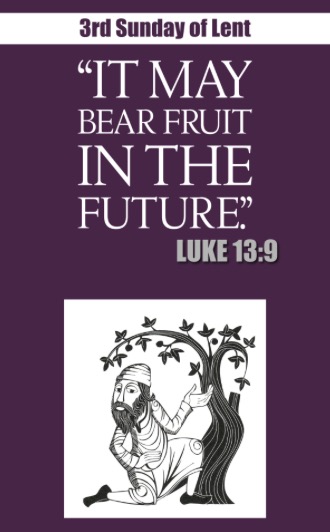
This is a good week for a Lenten penance service, and the readings today could become the basis of such a service. If using the Cycle A readings, the story of the woman at the well calls us to conversion. If the Cycle C readings are used, the Gospel parable of the fig tree does the same. Build on whichever readings are utilized Sunday or perhaps use the opposite set for the penance service.
In any case, there is surely a need to encourage people to take part in such a service. Too many Catholics find no use for this sacrament in their spiritual lives. The call to repentance is not a call to wallow in guilt but an invitation to enter more fully into a joyful life in covenant with God and one another. Can you find ways, in preaching, in petitions, in songs, and/or in the bulletin or on your parish social media channels to make that invitation come alive in your parish?
Click on banner to show/hide text
⬇️ Greeting
3rd Sunday of Lent C
As we enter the midpoint of Lent, our readings become more uncompromising and candid about how we are to live our lives. Through our Lenten practices of prayer, fasting and almsgiving, we must continue to cultivate good habits that will last long after Lent has ended. How is your Lenten journey going?
OPTION C: CELEBRATION
⬇️ Kyrie
3rd Sunday of Lent C
- Lord Jesus, you call us to live and love as you did: Lord, have mercy.
- Christ Jesus, we perish when we cut ourselves off from you: Christ, have mercy.
- Lord Jesus, continue to call us back to your ways of mercy and kindness: Lord, have mercy.
SOURCE: CELEBRATION
⬇️ Collect
3rd Sunday of Lent C
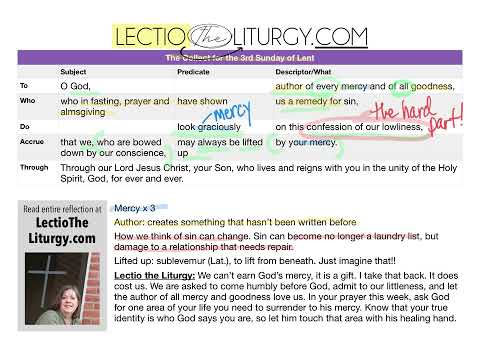
SOURCE: Julie Storr
⬇️ Prayers of the Faithful
3rd Sunday of Lent C
Discover a vast collection of over 100 petitions that are thoughtfully updated each week, ensuring a strong connection to the Sunday Readings. These petitions, designed for the Prayers of the Faithful during Mass, provide a relevant and meaningful way for your parish community to unite in prayer and intercession.
CHURCH | WORLD | SPECIAL NEEDS | COMMUNITY
Presider We are nurtured through God’s word and sacrament. Let us unite our minds and hearts with those of the angels and saints to pray for the needs of our world, our church and our community.
Minister That we as church might be faithful witnesses who respond generously to the needs of the world; for equality and inclusion of women’s voices in the magisterium; for religious leaders to be transparent and accountable for their actions; for an ecumenical response to the issues plaguing our world today, we pray:
- For our world, in thanksgiving for the renewed hope and beauty brought by each new season; for increased awareness of our effect on the Earth’s ecological health and stability; for more mindful ecological practices in our homes and businesses, we pray:
- For compassionate hearts especially when we grumble and judge others; for the tenacity to reach out to the marginalized and work tirelessly for the equality and dignity of every human being, we pray:
- For full and active participation in our faith; for the ability to live and find joy in the present moment; for the cultivation of spiritual practices that will endure after the Lenten season, we pray:
- For a spirit of true repentance and reconciliation; for an ability to see ourselves as God sees us; for the spiritual insight to change those parts of us that do not bear good fruit, we pray:
- For the sick and suffering, the homeless, orphan and widow, the forgotten; for all who die from war and violence; for all who die alone without hope, we pray:
Presider God of our ancestors, hear our prayer. Saints, intercede for us. In Jesus’ name, we pray. Amen.
SOURCE: CELEBRATION
RESOURCES
General Instruction of the Roman Missal
A Simple Guide to Liturgical Enviornment (DIocese of New Ulm PDF)
Common Questions on Liturgical Norms – by Father Edward McNamara, professor of liturgy at the Regina Apostolorum Pontifical Athenaeum
DIRECTORY OF
POPULAR PIETY
AND THE LITURGY
Directory (Vatican)
Lent (PDF)
Holy Week (PDF)
Eastertide (PDF)
GUIDELINES AND RESOURCES
3rd Sunday of Lent C
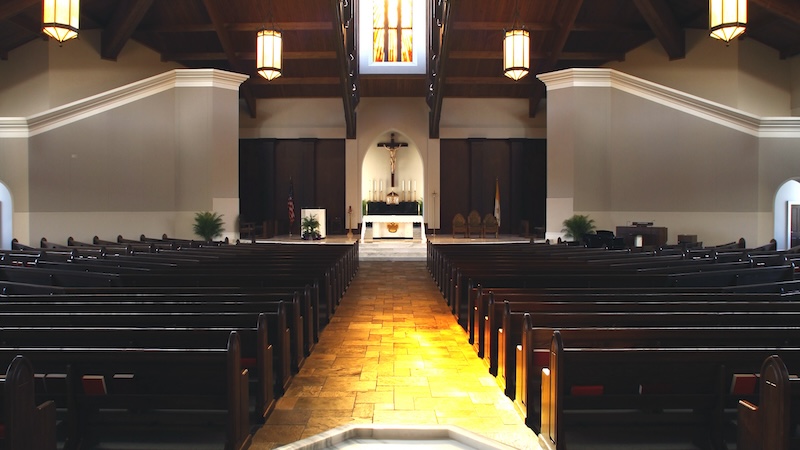

Diocese of Phoenix (4:21) – 2025
OCIA Introduction
Name Change: From RCIA to OCIA
The Order of Christian Initiation for Adults (OCIA), formerly known as the Rite of Christian Initiation of Adults (RCIA), has undergone a name change to more accurately reflect its Latin roots and emphasize the continual faith formation journey for those seeking to become full members of the Catholic Church. Though the name has changed, the essence of this vital ministry remains the same, fostering spiritual growth and community since its inception in the 1970s.

Diocese of Phoenix (4:21) – 2025
OCIA Scrutines 1-3
Download PDF – Courtesy of Diocese of Crookston, Minnesota
The scrutinies are a series of rites celebrated during the period of the Elect in the Order of Christian Initiation of Adults (OCIA) on the third, fourth, and fifth Sundays of Lent. The scrutinies are aimed at examining, purifying, and enlightening the Elect (those preparing to be baptized at the Easter Vigil) as they journey toward initiation into the Catholic Church. These rites include the following:
- First Scrutiny (Third Sunday of Lent): The first scrutiny focuses on the power of baptism to free the Elect from the influence of sin and evil. The Elect are prayed over, and the Gospel passage often relates to the temptation of Jesus in the desert or the Samaritan woman at the well, highlighting the need for inner conversion.
- Second Scrutiny (Fourth Sunday of Lent): The second scrutiny draws inspiration from the Gospel account of Jesus healing the man born blind, emphasizing the importance of spiritual enlightenment and the ability to see with the eyes of faith. During this scrutiny, the Elect are prayed over and encouraged to deepen their relationship with Christ as the light of the world.
- Third Scrutiny (Fifth Sunday of Lent): The third scrutiny, occurring on the fifth Sunday of Lent, revolves around the resurrection of Lazarus and the life-giving power of Christ. This rite invites the Elect to reflect on the new life they will receive through baptism and their incorporation into the Church as full members.
These scrutinies serve as a period of spiritual growth and reflection for the Elect as they prepare to enter fully into the life of the Church through the sacraments of initiation: Baptism, Confirmation, and the Eucharist.

St Mary Church, Mt Angel, Oregon (1:14)


3rd Sunday of Lent C
Lector’s Notes
Greg Warnusz’s tips for the Sunday readings,
focusing on the lector’s understanding
and proclamation

It will help your proclamation if you divide the passage into three sections (which may not match the paragraph divisions in your lectionary):
- God's astonishing self-revelation and Moses' ritualistic responses (removing his sandals and covering his face). Read slowly so that your listeners can let the images form in their own imaginations, but treat these vivid images, even the image of the burning bush, only as fanfare for God's solemn self-description, "I am the God of your fathers, The God of Abraham, the God of Isaac, the God of Jacob."
- God's announcement of the plan to rescue the Hebrews, from "I have witnessed the affliction ..." to "a land of milk and honey." Pause before you start this section. In the plan of the book of Exodus, this sets the stage for all that follows. In the plan of modern Christian Lent, this prepares us to hear, at the Easter Vigil, the chapter of Exodus that fulfills the promise, and to let the same God lead us out of our bondages into a new life in the risen Christ.
- The dialogue about God's name and its meaning. Pause again, to let the solemnity of prior promise sink in. Using a different tone of voice, represent Moses asking an innocent, practical question, "What should I say is your name?" When you assume God's voice again, sound like God saying something mysterious (it is; see below). Say distinctly, slowly and solemnly each of the three variants of the name (your translations may differ):
- I AM WHO AM
- I AM
- The LORD
The first few repetitive sentences, up to "and the rock was Christ," all prepare the recipients for the bad news, "God was not pleased ..." So, unusual for Lector's Notes, I recommend you go through those sentences in a repetitive pattern, but break the pattern at "Yet God was not pleased ..." which should sound conclusive.
In the remaining sentences, don't be afraid to sound stern (Paul wasn't). Pronounce the last sentence slowly and with foreboding. Someone's life may depend on hearing this warning and taking it to heart.e must learn from the past and strive to remain focused on our relationship with God, avoiding the temptations that may lead us astray.
If your church is doing the scrutinies, part of the Rite of Christian Initiation of Adults, See this Lector’s Notes page, even in years B and C.
Lisa M. Bellecci
FIRST
READING

SECOND READING

Lector Series
The following lector videos were produced by the Los Angeles Archdiocese:


3rd Sunday of Lent C






What Wondrous Love
Traditional; arr. by Josh Blakesley
3rd Sunday of Lent C
What Wondrous Love
Traditional; arr. by Josh Blakesley


3rd Sunday of Lent C
Mercy on Me
Sarah Hart

3rd Sunday of Lent C
Tend the Ground
Curtis Stephan

Purify My Heart
Brian Doerksen
3rd Sunday of Lent C
Purify My Heart
Brian Doerksen
