MAR 30, 2025


Liturgy Planning
Liturgy Planning
- MASS PLANNING
- LITURGY NOTES
Weekday
Masses

MON | TUE | WED
THUR | FRI | SAT
Lent
2025
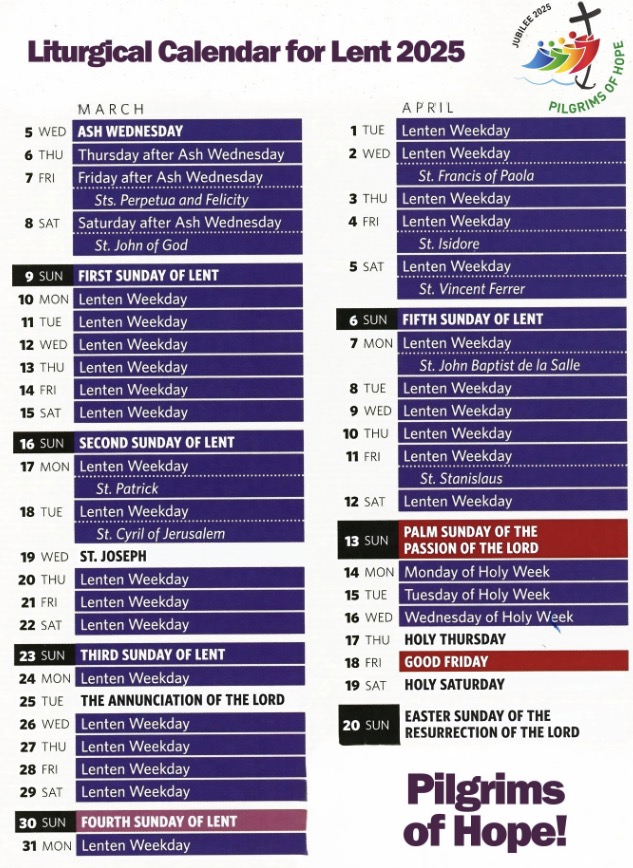
Lent 2025 begins on Ash Wednesday, March 5, 2025. To help you on your Lenten Journey during this Jubilee Year as Pilgrims of Hope, this Lenten eBook contains 67 Ideas and Suggestions for Prayer, Fasting and Almsgiving and a 2025 Lenten Liturg
JUBILEE 2025

The Jubilee Year begins on Christmas Eve in Rome. Here are 16 pages with Resources to help you understand and celebrate the Jubilee and Holy Year of 2025!
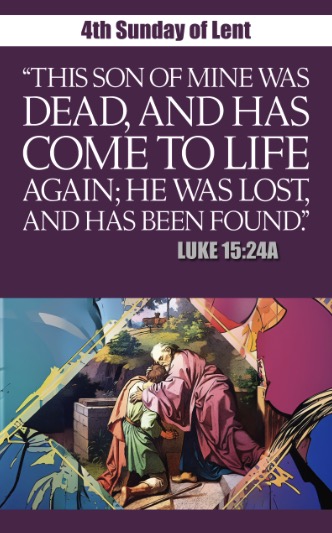
4th Sunday of Lent C

SOURCE: Basilica of the The National Shrine. Crypt Church (TV Mass)
March 27, 2022 – 3 years ago
Celebrant & Homilist: Rev. Robert Cilinski
Choir: Basilica of the National Shrine of the Immaculate Conception Cantor & Organist, Washington, D.C.
Fr. Lawrence Mick
4th Sunday of Lent C
Laetare Sunday
NCR Online Celebration Archive

Today is the 4th Sunday of Lent, also known as Laetare Sunday. Remember that this marks the center of Lent and offers a glimpse of Easter joy. This is a day when you can use some flowers in the worship space and when musical accompaniment can be fuller than during the rest of Lent. Don’t overdo, of course; it is still Lent. But people should notice the difference in tone this Sunday.
If You are Celebrating the Scrutinies…
If you are celebrating scrutinies this Lent, be sure to take time to evaluate how the ritual is being carried out. Catechumenate leaders should be helping the elect to unpack the experience each week to foster a deeper conversion. Could liturgy planners join in those sessions to see how the ritual is actually being experienced by the elect? Perhaps talk with some other parishioners to see how the assembly is experiencing the scrutiny? Do they welcome this chance to share in the conversion journey of the elect, or is it just an inconvenience that makes the Mass last a couple of minutes longer? That may depend on how well the community has gotten to know the elect throughout their catechumenate.
Certainly, some folks will always object to anything extra in the Mass, but what is the general experience? Is the assembly fully engaged in the rite? If not, what can be done to increase their involvement? Have they been taught whatever acclamations are being sung? Can they see the faces of the elect during the ritual? Would it help to seat the elect at several places within the assembly rather than all up front? What will work in your space and with your community?
Also evaluate the petitions that are part of the scrutiny. Do they address the real concerns of the elect? Do they also include areas that the whole assembly needs to pray about? How can you make them more powerful? Would singing them with a sung response help?
All of this presumes ongoing cooperation between liturgy planners and the RCIA team. Too often the two groups barely interact, which can lead to conflicts and missteps when it comes time to celebrate any of the initiation rituals during the Sunday liturgies. The rite insists that the initiation of new members is the business of all the baptized, but it takes practical efforts to make that statement true in fact. How well do you interface with the RCIA team in your parish? How could communication and planning be improved?
Greeting
4th Sunday of Lent C
Today’s readings focus on reconciliation, forgiveness and moving forward. Forgiveness is one-sided; one can choose to forgive, but reconciliation requires two people in the act of coming together. God offers us both forgiveness and reconciliation and does not hold our sins against us once we have asked for forgiveness. Are we able to do the same with one another?
OPTION C: CELEBRATION
Kyrie
4th Sunday of Lent C
- Lord Jesus, you feed and nurture us: Lord, have mercy.
- Christ Jesus, you call us to be reconciled with you and with one another: Christ, have mercy.
- Lord Jesus, forgive us and call us back when we fail to love and forgive as you do: Lord, have mercy.
SOURCE: CELEBRATION
Collect
4th Sunday of Lent C

SOURCE: Julie Storr
Prayers of the Faithful
4th Sunday of Lent C
Discover a vast collection of over 100 petitions that are thoughtfully updated each week, ensuring a strong connection to the Sunday Readings. These petitions, designed for the Prayers of the Faithful during Mass, provide a relevant and meaningful way for your parish community to unite in prayer and intercession.
CHURCH | WORLD | SPECIAL NEEDS | COMMUNITY
PPresider In the spirit of forgiveness and reconciliation, we lift up our prayers to God, the healer of all division.
Minister For our church and the divisions within; for unity among all religions, we pray:
- For peace and reconciliation among nations, among leaders and among individuals; for a fervent desire to work toward unity and understanding with other cultures and celebrate our diversity, we pray:
- For healing of broken relationships within families; unreconciled losses due to death or alienation; children of divorce and abuse; the sins inherited from our ancestors, we pray:
- For reconciliation with creation, for the abuses we inflict on our planet to meet our earthly desires; for the waste we mindlessly create and discard; for forgiveness for our gluttony, we pray:
- For the pride that keeps us from confessing our sins; for fear that binds us; for reconciliation between those we have hurt and those who have hurt us, we pray:
- In thanksgiving for those who work to protect and mend bodies, minds, spirits and relationships; for peacekeepers in foreign lands, we pray:
- For all who suffer mental and physical illnesses and disabilities; for forgiveness and peace for all who will soon draw their last breath; and for all who have died, we pray:
Presider God of many chances, hear and answer our prayers if they be in accord with your will. We ask this in the name of Jesus, who reconciled himself to the world. Amen.
SOURCE: CELEBRATION
RESOURCES
General Instruction of the Roman Missal
A Simple Guide to Liturgical Enviornment (DIocese of New Ulm PDF)
Common Questions on Liturgical Norms – by Father Edward McNamara, professor of liturgy at the Regina Apostolorum Pontifical Athenaeum
DIRECTORY OF
POPULAR PIETY
AND THE LITURGY
Directory (Vatican)
Lent (PDF)
Holy Week (PDF)
Eastertide (PDF)
GUIDELINES AND RESOURCES
4th Sunday of Lent C

ROME REPORTS (1:31) – 2023
Laetare Sunday
The Color is Rose, NOT Pink
The terms “pink” and “rose” are sometimes used interchangeably to describe the same liturgical color. However, there is a distinction between the shades that is important in maintaining liturgical tradition and symbolism.
The color “rose” used in the liturgy is a subdued, more muted tone, symbolizing the restrained joy and anticipation that characterizes Laetare Sunday within the penitential season of Lent. This shade of rose carries a certain solemnity, even as it represents the temporary respite from the austere practices of Lent.
On the other hand, the color “pink” in its more common, vibrant form might be seen as too bright and celebratory for the Lenten season. Using a vivid pink could potentially detract from the penitential spirit of Lent and the more subdued joy that Laetare Sunday intends to convey.
Ultimately, the goal is to maintain the appropriate liturgical symbolism and ensure that the vestments and decorations align with the overall tone and purpose of Laetare Sunday within the broader context of Lent. As long as the shade chosen reflects this restrained joy, it is suitable for the occasion.
Second Scrutiny

ST. PAUL CATHOLIC CHURCH (28:00)
Rite of Christian Initiation of Adults (RCIA) – GO TO PAGE 6 (Courtesy of Diocese of Crookston, Minnesota)
It includes the rites, prayers, and rubrics (instructions) for the various stages of the initiation process.
The scrutiny for the 4th Sunday of Lent, also known as Laetare Sunday, coincides with the Second Scrutiny in the Order of Christian Initiation of Adults (OCIA). The focus of this Sunday’s readings and scrutiny is the theme of spiritual blindness, represented by the healing of the man born blind in John 9:1-41.
As we reach the midway point of Lent, we are called to examine our own spiritual blindness, recognizing our inability to see what truly matters in life. Through the prayers of exorcism, we ask for the Holy Spirit to fill us with Christ’s light, leading us away from darkness and towards a deeper understanding of God’s will.
This scrutiny invites us to reflect on our spiritual journey thus far and encourages us to use the remaining time in Lent wisely, seeking to grow in faith and commitment to our baptismal promises. By acknowledging our limitations and relying on God’s grace, we can learn to see the world with new eyes, inspired by the transformative power of Christ’s healing touch.rough the sacraments of initiation: Baptism, Confirmation, and the Eucharist.