APR 6, 2025


Liturgy Planning
Liturgy Planning
- MASS PLANNING
- LITURGY NOTES
Weekday
Masses

MON | TUE | WED
THUR | FRI | SAT
Lent
2025
Lent 2025 begins on Ash Wednesday, March 5, 2025. To help you on your Lenten Journey during this Jubilee Year as Pilgrims of Hope, this Lenten eBook contains 67 Ideas and Suggestions for Prayer, Fasting and Almsgiving and a 2025 Lenten Liturg
JUBILEE 2025

The Jubilee Year begins on Christmas Eve in Rome. Here are 16 pages with Resources to help you understand and celebrate the Jubilee and Holy Year of 2025!
The Woman Caught
in Adultery
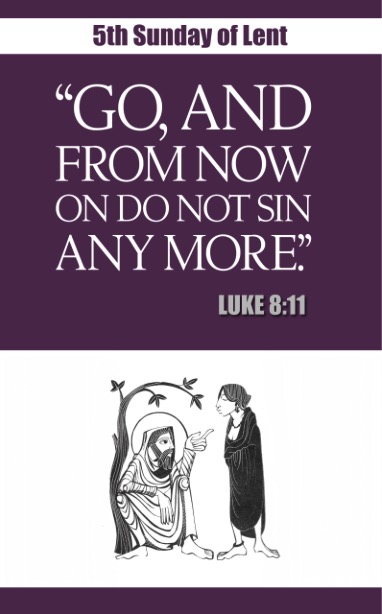
5th Sunday of Lent C

SOURCE: Basilica of the The National Shrine. Crypt Church (TV Mass)
April 3, 2022 – 3 years ago
Celebrant & Homilist: Rev. Thomas Kalita
Choir: Basilica of the National Shrine of the Immaculate Conception Cantor & Organist, Washington, D.C.
Greeting
5th Sunday of Lent C
Today’s readings are filled, not only with examples of God’s abundant mercy and love, but of right living. Paul reminds us that everything outside of the pursuit of Christ is rubbish. And if we are to call ourselves followers of Christ, we must keep our focus on what lies ahead. Let us begin by letting go of our judgments and our earthly desires so we may enter into this time with our minds and hearts lifted completely to God.
OPTION C: CELEBRATION
Kyrie
5th Sunday of Lent C
- Lord Jesus, when we sin, you love us back into relationship: Lord, have mercy.
- Christ Jesus, when we judge others, you show us our own transgressions: Christ, have mercy.
- Lord Jesus, when we cry out from the depths of our souls, you hear and answer us: Lord, have mercy.
SOURCE: CELEBRATION
Collect
5th Sunday of Lent C

SOURCE: Julie Storr
Prayers of the Faithful
5th Sunday of Lent C
Discover a vast collection of over 100 petitions that are thoughtfully updated each week, ensuring a strong connection to the Sunday Readings. These petitions, designed for the Prayers of the Faithful during Mass, provide a relevant and meaningful way for your parish community to unite in prayer and intercession.
CHURCH | WORLD | SPECIAL NEEDS | COMMUNITY
Presider Let us come before God praying for the needs of our world with our minds and hearts lifted, as Paul told Philemon, to God’s upward calling.
Minister For Pope Francis and his continued good health and strength to do the difficult work of shepherding the church toward the vision set forth by Jesus in his mission and message of mercy, we pray:
- For an awareness of the great things God has done for us; for a heightened ability to appreciate relationships over earthly treasures and desires, we pray:
- For an ability to forgive, to quickly and lovingly mend broken relationships, and to refrain from judgment and criticism, we pray:
- For safe passage for all migrants and refugees fleeing corrupt and war-torn countries, for a greater understanding of our Catholic social teaching so as to live in solidarity with the afflicted, we pray:
- For Francis’ April intention: for doctors and their humanitarian collaborators who work in war zones, risking their lives to save the lives of others; for all who are sick and for their caregivers; for compassion of others’ pain and suffering, we pray:
- For our deceased loved ones; for those who will die alone today; and for all who die without the faith of Christ, we pray:
Presider God of mercy, we lift these prayers to you, not that they will change you, but that you will change our hearts, so we may better respond to the needs of our brothers and sisters. We ask all this in the name of Jesus, our constant guide and companion. Amen.
SOURCE: CELEBRATION
RESOURCES
General Instruction of the Roman Missal
A Simple Guide to Liturgical Enviornment (DIocese of New Ulm PDF)
Common Questions on Liturgical Norms – by Father Edward McNamara, professor of liturgy at the Regina Apostolorum Pontifical Athenaeum
DIRECTORY OF
POPULAR PIETY
AND THE LITURGY
Directory (Vatican)
Lent (PDF)
Holy Week (PDF)
Eastertide (PDF)
GUIDELINES AND RESOURCES
The Woman Caught
in Adultery
5th Sunday of Lent C
“I am doing something new!“
NCR Online Celebration Archive

Cycle C Readings
The first reading includes this strong proclamation: “Remember not the events of the past, the things of long ago consider not; see, I am doing something new!”
Pope John XXIII
Perhaps that could be seen as a theme song for the last 50 years of our life as a church. When Pope John XXIII called the Second Vatican Council, he prayed for a new Pentecost, which suggests starting again from the beginning. The reforms of the council brought many new things into our lives, none more evident than the new liturgy.
But that quote from Isaiah was proclaimed long before Vatican II, centuries before the Gospels were written. God is always trying to create anew, to change things to bring them more in accord with God’s will from the beginning of creation. So we need to ask ourselves what newness is proclaimed in the Scriptures and especially, in the Gospels, which recount the life, ministry, death and resurrection of God’s Son.
Of course, just what God is doing new will vary depending on the situation. In Isaiah’s time, the newness was focused on the restoration of Israel after the exile. In our time, it was focused on the renewal mandated by Vatican II.
Pope Francis
More importantly, though, is the newness that was revealed in Jesus. Pope Francis has been helping us see how new and unexpected Jesus’ message was. And that message revolves around mercy. Jesus revealed a face of God that was striking, and even scandalous to many of his day. And that view of God is still rejected by many today, including many who call themselves Christians, even by some bishops and cardinals who oppose Francis. Some people are more comfortable with a judging and condemning God because that matches the way we tend to deal with others, especially those who offend us or differ from us. The woman caught in adultery in today’s Gospel account experienced the mercy of God and a new lease on life.
Cycle A Readings
The newness of Jesus’ message is also evident in the Cycle A readings. The theme there is newness of life, and that new life is based on God’s loving mercy toward us. The prophecy of Isaiah and the raising of Lazarus both speak of the dead coming back to life, and St. Paul speaks of God giving us new life through the Holy Spirit.

ST. MICHAEL’S ABBEY (5:00) – 2023
The Veiling of Images
While the practice of veiling images during Lent has become less common in recent decades, it remains a meaningful tradition in many Catholic communities, reinforcing the themes of repentance, renewal, and spiritual growth during this holy season. The crosses remain covered until the end of the Good Friday service, while images stay veiled until the Easter Vigil.
The fifth Sunday of Lent marks Passiontide, when we start to focus more on the Passion of Christ. It is also the time when, counterintuitively, the Church asks us to veil the images that depict Christ and the saints. Why, if we are focusing on His Passion, are we veiling these images? In the video above, Fr. Frederick helps untangle this puzzle by explaining how these covered images of Christ help demonstrate the significance, sorrow, and loss of His Passion.
Liturgical Symbolism
- During Passiontide, the Church veils images of Christ and saints to depict austerity and mourn His Passion, paradoxically while focusing on His glory and redemption.
- The purple veil shrouding Christ’s cross symbolizes mourning and remains until Easter, representing the loss of Christ’s presence during His Passion.
Historical Context
- A shift in understanding Christ’s Passion occurred in the 12th century Middle Ages, moving from viewing it as His glory to emphasizing His emotional and physical suffering.
Liturgical Practices
- Some orders unveil the processional crucifix on Palm Sunday, offering a glimpse of Christ’s glory amidst the veiled images of Passiontide.
Theological Significance
- Veiling ornate crucifixes helps believers experience loss and mourn Christ’s Passion, mirroring how He hid His Divinity in His Humanity during this time.
- The counterintuitive action of veiling images during Passiontide serves to deepen the faithful’s emotional connection to Christ’s suffering and sacrifice.
Third Scrutiny
ST. PAUL CATHOLIC CHURCH (28:16)
Rite of Christian Initiation of Adults (RCIA) – GO TO PAGE 6 (Courtesy of Diocese of Crookston, Minnesota)
It includes the rites, prayers, and rubrics (instructions) for the various stages of the initiation process.
Spiritual Renewal
- The raising of Lazarus symbolizes God’s power to grant eternal life to those who have faith and obey His voice.
- The white garment in baptismal rituals represents shedding the Shroud of Lazarus (death) and putting on Christ, symbolizing freedom from sin.
Divine Power and Promise
- Ezekiel 37 demonstrates the power of God’s Word through the revival of dry bones, promising that God will fulfill His declarations.
- The Holy Spirit provides life in the flesh and offers a foretaste of its power, as stated in Romans 8:8-11.
Overcoming Obstacles
- The stone image represents barriers to freedom and new life, which Christ’s voice helps remove by calling us out of death.
Transformation Through Prayer
- The scrutiny prayer seeks divine intervention for sin forgiveness, heart purification, truth discernment, and protection from evil.

ST. FRANCES DE SALES (5:43)


