DEC 29, 2024
"Poor Little Jesus Boy"
✨ The song "Poor Little Jesus Boy" from the Black Nativity album shares a powerful connection with the themes expressed in this Sunday's readings, particularly in the way it highlights the humble beginnings and tribulations faced by Jesus, mirroring the struggles of African Americans throughout history. As the song depicts the journey of Jesus from his lowly birth to his ultimate destiny, it serves as a poignant reminder of how African Americans have also persevered through adversity to carve a path of resilience and progress.
In the lyrics, the singer asks the "poor little Jesus boy" if he knows about the world's pain, sorrow, and injustice. This inquiry is deeply resonant with the African American experience, as the community has grappled with racism, discrimination, and systemic oppression for generations. The song's message underscores the importance of empathy, compassion, and faith in overcoming these obstacles, much like the virtues emphasized in the passages from Sirach and Colossians.
Furthermore, the song's focus on Jesus' divine purpose and his growth in wisdom and grace aligns with the themes explored in Luke 2:52, as well as the role of faith and spiritual guidance within the African American community. Just as Jesus matured in wisdom and favor, African Americans have cultivated their resilience and collective identity through shared struggles and strong communal bonds, often finding solace and strength in the church.
Ultimately, "Poor Little Jesus Boy" encourages listeners to seek hope and inspiration in the face of adversity, echoing the essay's call for Catholics to learn from the African American experience and work towards a more just and equitable society. By embracing the virtues of compassion, humility, and wisdom highlighted in the essay and the song, Catholics can actively contribute to the ongoing struggle for racial justice and the betterment of their communities.
More at CONNECTIONS
SCROLL TO READ MORE

ORIGINAL CAST OF BLACK NATIVITY (4:10) — ℗ 1962 Concord Music Group, Inc.


Liturgy Planning
Liturgy Planning
- PLANNING GUIDE
- Liturgical Environment
- MUSIC

Holy Family - YEAR C

SOURCE: Basilica of the The National Shrine. Crypt Church (TV Mass)
Celebrant & Homilist: Rev. Patrick A. Smith
Choir: Saint John Paul II Seminary Choir, Washington, D.C.
⬇️ Planning Notes
Holy Family - YEAR C
Fr. Lawrence Mick

EXCERPT: The feast of the Holy Family follows closely on the heels of Christmas Day. It also suffers from a similar problem. It is so easy to domesticate the feast. See how wonderful the Holy Family is, how perfectly they live together. Don’t we wish all our families were like theirs?
But this feast does not occur within Christmas because we love perfect families. It is a reminder that Christ came to experience our human life in its fullness, not springing fully formed into the world, but needing to grow and learn and develop, just as we all do.
If we recognize that Christ was born in human flesh in order to draw all people into unity with God and with one another, then this feast takes on a much broader scope. It celebrates the whole human family, not just the “nuclear family” we love to idealize. If celebrating the Holy Family merely reinforces our natural instinct to love those closest to us, then it hardly deserves to be a major feast. — READ MORE
SOURCE: CELEBRATION
Jubilee Holy Year 2025
The Jubilee Year begins on Christmas Eve in Rome. Be sure to download Fr. Horning’s 16 page e-book with Resources to help you understand and celebrate the Jubilee and Holy Year of 2025!
⬇️ Greeting
Holy Family - YEAR C
⬇️ Kyrie
Holy Family - YEAR C
- Lord Jesus, you were raised, like us, in the circle of your family: Lord, have mercy.
- Christ Jesus, early on you spread your wings and responded to your calling: Christ, have mercy.
- Lord Jesus, your family shows us how to live lovingly with one another: Lord, have mercy.
SOURCE: CELEBRATION
⬇️ Collect
Holy Family - YEAR C

SOURCE: Julie Storr
⬇️ Lectionary Readings
Holy Family - YEAR C
There are several choices available for the readings during the Feast of the Holy Family. You have the option to select either the first two readings from Cycle A, which includes both a long and a short form of the second reading, or from Cycle C, accompanied by their respective psalms. Please note that the Gospel reading remains the same, coming from Cycle C.
COMMENTARY | BIBLE STUDY | HOLY SEE
Weekly Series Videos
Fr. Andrew Ricci’s Podcast
Lector Prep
History / Society / Theology
Outlines w/ Clipart from Fr. Richard Lonsdale
Agape Bible Study
⬇️ Homily
Holy Family - YEAR C
POPE FRANCIS | POPE BENEDICT XVI
Here are some ideas for a homily on Luke 2:41-52:
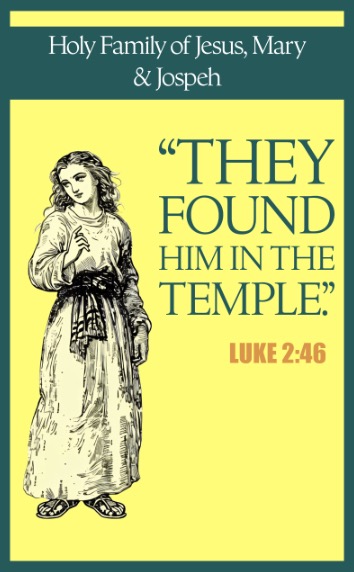
- Discuss the significance of Jesus’ first recorded words in the gospel of Luke, which are a question: “Did you not know that I must be in my Father’s house?” (Luke 2:49)
- Reflect on Mary and Joseph’s anxiety when they realize Jesus is missing, and how this relates to our own worries and concerns in life.
- Explore the theme of searching for Jesus, both literally in this story and figuratively in our own lives.
- Consider how Jesus’ response to Mary and Joseph’s concern reveals his understanding of his divine identity and mission.
- Discuss the importance of the temple in Jewish life and how this relates to our own spiritual practices and communities.
It’s important to keep in mind that the homily should be tailored to the specific context and needs of the congregation, and should also include relevant references to Catholic doctrine and tradition.
⬇️ Prayers of the Faithful
Holy Family - YEAR C
Discover a vast collection of over 100 petitions that are thoughtfully updated each week, ensuring a strong connection to the Sunday Readings. These petitions, designed for the Prayers of the Faithful during Mass, provide a relevant and meaningful way for your parish community to unite in prayer and intercession.
CHURCH | WORLD | SPECIAL NEEDS | COMMUNITY
Presider We pray now for all families and for all who attempt to live lovingly together.
Minister For the church that we may respect, honor and provide models of support for all families, in every culture throughout the world, we pray:
- For families of every configuration struggling to love and support one another; and for organizations, professions and ministries dedicated to helping them, we pray:
- For families torn apart by violence, illness, drugs, poverty or politics and for the patience and forbearance to deal with and accept our families as they are, we pray:
- For families who have given their children to the greater good through the military, law enforcement or other dangerous professions, we pray:
- For those working to strengthen neighborhoods or communities fraught with division, may they demonstrate wisdom, compassion and kindness, we pray:
- For those among us who have lost their families for whatever reason; for those who feel their families are not accepted by others; and for those who judge others’ families, we pray:
Presider God of love, we are grateful that your Son, Jesus, was born into a simple, humble family. Your love of families inspires us to forgive and care for our own and to extend ourselves to others that need our support. For this, we seek the guidance of the Holy Family and we pray in Jesus’ name. Amen.le. Keep our hope alive and show us how to share that hope with those who doubt you. We pray in the name of Jesus, whose coming is imminent. Amen.
SOURCE: CELEBRATION
⬇️ Preface
Holy Family - YEAR C
There isn’t a specific preface designated for the Feast of the Holy Family in the Roman Missal. However, it is common practice for priests to use one of the Christmas prefaces (Preface I, II, or III of the Nativity of the Lord) as they maintain a thematic connection to the Holy Family and the liturgical season. Preface II of the Nativity, in particular, emphasizes the significance of the incarnation and the divine nature of Christ, making it a suitable choice for this feast day.
Here is an excerpt from Preface II of the Nativity:
“It is truly right and just, our duty and our salvation, always and everywhere to give you thanks, Lord, holy Father, almighty and eternal God. For you have made a new covenant with your chosen people through your Son’s blood: a covenant of mercy, love, and communion in the Spirit. In the beginning your all-holy Word leapt down from heaven from your royal throne, into the midst of the land that is doomed, and you, the almighty Word, joined himself with a human body through the womb of a virgin.”
⬇️ Prayer After Communion
Holy Family - YEAR C

SOURCE: Julie Storr
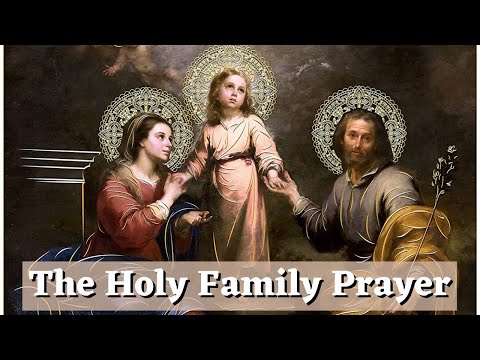
⬇️ The Holy Family Prayer
RESOURCES
General Instruction of the Roman Missal
How to Create the Liturgical Environment for Advent and Christmas – by Rev. Philip Horrigan
A Simple Guide to Liturgical Enviornment (DIocese of New Ulm PDF)
Common Questions on Liturgical Norms – by Father Edward McNamara, rofessor of liturgy at the Regina Apostolorum Pontifical Athenaeum
DIRECTORY OF
POPULAR PIETY
AND THE LITURGY
Directory (Vatican)
Advent (PDF)
Christmastide (PDF)
Lent (PDF)
Holy Week (PDF)
Eastertide (PDF)
GUIDELINES AND RESOURCES
Holy Family - YEAR C

SOURCE: Christian Media Center
SOURCE: Diocese of Greensburg
Directory on Popular Piety and the Liturgy
The Feast of the Holy Family
112. The feast of the holy family of Jesus, Mary and Joseph (Sunday in the Christmas octave) is a festive occasion particularly suitable for the celebration of rites or moments of prayer proper to the Christian family. The recollection of Joseph, Mary and Jesus’ going up to Jerusalem, together with other observant Jewish families, for the celebration of the Passover (cf. Lk 2, 41-42), should normally encourage a positive acceptance of the pastoral suggestion that all members of the family attend Mass on this day. This feast day also affords an opportunity for the renewal of our entrustment to the patronage of the Holy Family of Nazareth (120); the blessing of children as provided in the ritual (121); and where opportune, for the renewal of marriage vows taken by the spouses on their wedding day, and also for the exchange of promises between those engaged to be married in which they formalize their desire to found a new Christian family (122).
Outside of the feast, the faithful have frequent recourse to the Holy Family of Nazareth in many of life’s circumstances: joining the Association of the Holy Family so as to model their own families on the Holy Family of Nazareth (123); frequent prayers to entrust themselves to the patronage of the Holy Family and to obtain assistance at the hour of death (124).
Directory on Popular Piety and the Liturgy
During Christmastide, the Church celebrates the mystery of the Lord’s manifestation: his humble birth in Bethlehem which was made known to the shepherds, the first of Israel to welcome the Savior; the Epiphany to the three wise men who had “come from the East” (Mt 2,1), the first of the Gentiles who recognized and adored Christ the Messiah in the child of Bethlehem; the theophany at the river Jordan in which the Father declares that Jesus is His “well-beloved Son” (Mt 3, 17) at the outset of his messianic mission; the miracle of Cana in which Jesus “manifested his glory and his disciples believed in him” (John 2,11).
107. In addition to these celebrations recalling the primary meaning of Christmas, there are also other celebrations closely connected with the mystery of the Lord’s manifestation:
- the martyrdom of the Holy Innocents (28 December) whose blood was shed because of hatred for Jesus and because of Herod’s rejection of his lordship;
- the memorial of the Holy Name of Jesus, 13 January;
- the feast of the Holy Family (Sunday in the octave of Christmas) celebrating the holy family in which Jesus “grew in wisdom and grace before God and men” (Lk 2, 52);
- the solemnity of the 1E January which recalls the divine, virginal and salvific motherhood of the Blessed Virgin Mary; and, although outside of Christmastide,
- the feast of the Presentation of the Lord (2 February), celebrating the encounter between the Messiah and his people, represented by Simeon and Anna, and the prophecy of Simeon.
108. Much of the richness and complexity of the mystery of the Lord’s manifestation is reflected in displays of popular piety, which is especially sensitive to the childhood of Christ which reveals his love for us. Popular piety intuitively grasps:
- the importance of the “spirituality of gift”, which is proper to Christmas: “a child is born for us, a son is given to us” (cf. Is 9, 5), a gift expressing the infinite love of God, who “so loved the world that he gave his only Son” (John 3, 16);
- the message of solidarity conveyed by the event of Christmas: solidarity with sinful man, for whom, in Christ, God became man “for us men and for our salvation”(118); solidarity with the poor, because the Son of God “who” was rich but became poor for your sake, to make you rich out of your poverty” (2 Cor 8, 9);
- the sacredness of human life and the wonderful event that is every birth, since the Word of life came amongst men and was made visible through his birth of the Virgin Mary (cf. 1 John 1, 2);
- the messianic joy and peace to which man has aspired in every age: the Angels announce the birth of the Savior of the world to the shepherds, the “Prince of Peace (Is 9.5) and proclaim “peace on earth to men of good will” (Lk 2, 14);
- the spirit of simplicity and poverty, humility and trust in God, suggested by the events surrounding the birth of Christ.
Popular piety, precisely because it can intuit the values inherent in the mystery of Christ’s birth, is called upon to cooperate in preserving the memory of the manifestation of the Lord, so as to ensure that the strong religious tradition surrounding Christmas is not secularized by consumerism or the infiltration of various forms of neopaganism.
Liturgical Norms for Christmas:
The normal liturgical color for Christmas is white, but the General Instruction of the Roman Missal also states in n. 346:
- g) On more solemn days, festive, that is, more precious, sacred vestments may be used even if not of the color of the day.
- h) The colors gold or silver may be worn on more solemn occasions in the Dioceses of the United States of America.
These liturgical colors draw the parallel between the liturgical Times of Christmas and Easter, the two most important Times around which the Church Year turns.
From Universal Norms on the Liturgical Year and the General Roman Calendar:
- 32. After the annual celebration of the Paschal Mystery, the Church has no more ancient custom than celebrating the memorial of the Nativity of the Lord and of his first manifestations, and this takes place in Christmas Time.
- 33. Christmas Time runs from First Vespers (Evening Prayer I) of the Nativity of the Lord up to and including the Sunday after Epiphany or after January 6.
- 34. The Vigil Mass of the Nativity is used on the evening of December 24, either before or after First.

Holy Family - YEAR C

SOURCE: OCP Liturgy Podcasts
“The way we know that he remains in us is from the Spirit he gave us.”
The Holy Family inspires our families to be holy. journey from Advent to Christmas


⬇️ Entrance
Go Tell It
on the Mountain
The Feast of the Holy Family emphasizes the importance of family in our spiritual journey. “Go Tell It on the Mountain” speaks of “meek and the lowly” who are called to spread the good news. This connection highlights the role of the Holy Family in demonstrating humility and service to others.
Holy Family - YEAR C

Never Too Young #158;
Breaking Bread 2025 #85
⬇️ Responsorial
Blessed Are They Who Dwell in Your House
Iván Díaz
Mary and Joseph, together with Jesus, embarked on a journey to Jerusalem for the feast of Passover, and the song captures the essence of this spiritual journey by referring to those who “set their hearts upon the pilgrimage.”
Holy Family - YEAR C

Spirit & Psalm 2025: p. 52
⬇️ Presentation
Of the Father’s Love Begotten
Traditional; arr. by Curtis Stephan
The hymn speaks of Jesus as being “begotten” of the Father’s love, emphasizing his divine nature. This connects with the Feast of the Holy Family, as it celebrates the holy and unique family that Jesus was born into.
Holy Family - YEAR C

Spirit & Song #149;
Breaking Bread 2025 #92
⬇️ Communion
Angels We Have Heard on High
Traditional; arr. by Dean Baskerville
The hymn begins with the exclamation, “Angels we have heard on high,” referring to the angels who proclaimed the birth of Jesus to the shepherds. This joyful announcement resonates with the Feast of the Holy Family, as it celebrates the joy and hope that Jesus’ birth brings to the world.
Holy Family - YEAR C

Spirit & Song #145;
Breaking Bread 2025 #109
⬇️ Sending Forth
Love Has Come
Matt Maher
The lyrics emphasize the importance of presence and seeking, with lines such as “We’re chasing after something more / The love that we have been looking for.” This mirrors the actions of Mary and Joseph in the story, who seek Jesus with determination and perseverance until they find him.
Holy Family - YEAR C

Spirit & Song #329;
Never Too Young #155;
Breaking Bread 2025 #428