July 6, 2025
July 6, 2025


Intro to Readings
Intro to Readings


14th Sunday of Year C

Ensuring the Future
Outline of Word-Sunday Essay
by Larry Broding

EXCERPT: Despite the best efforts of people to insure the future, the author of these verses remind us of one fact. Only God can insure our destiny. Our attempts are, at best, only partially successful. That is why faith, not self-initiative is the answer. We can do our part, but we should trust in God and follow his will. In the end, he is the One in charge of the future.

What have you done to insure your future? Your retirement? Your lifestyle plans? Where does God fit into your future? How do you put God in charge of your future?
Clipart by Fr. Richard Lonsdale

Fr. Tim Peters
FIRST READING


Fr. Peters teaches at Saint John’s Seminary in Camarillo, CA.
Fr. Francis Martin
THE WORD PROCLAIMED

- Kieren O’Mahony OSA
- Fr. Conley Bertrand
- Fr. George Corrigan OFM
- Fr. Thibodeau
- St. Charles Borromeo
- Edriann Ezell
- Vince Contreras
- Bp. John P. Dolan
- Fr. Eamon Tobin
- Carmelite Lectio Divina
The Bible Project offers valuable resources that cater to Christians from diverse denominations, including Catholics. It is essential to note that the core message of the Bible remains consistent across various Christian traditions, even though there might be some differences in theology and interpretation. The Bible Project aims to help people engage with the Bible more deeply and experience it as a unified story that leads to Jesus.
Featured Commentary
14th Sunday of Year C
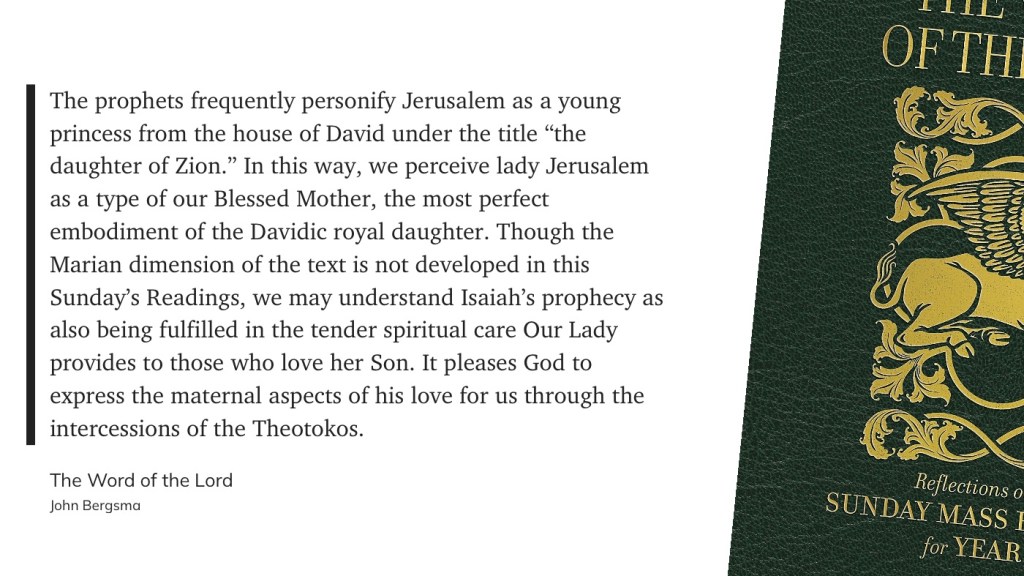
EXCERPT from Reflections on the Sunday Mass Readings for Year C
Bible Project
SOURCE: Bible Project
14th Sunday of Year C
Isaiah 66:10-14c holds significant theological relevance within the Roman Catholic tradition, offering insights into the relationship between God and His people and the ongoing journey towards salvation. The passage emphasizes God’s covenant with the Israelites, a theme that resonates with Catholic theology, which teaches that God’s love and mercy are enduring and everlasting.
In Catholic teachings, Jerusalem is often seen as a symbol of the Church, the community of believers united in faith and worship. Isaiah’s vision of a restored Jerusalem can therefore be interpreted as a foreshadowing of the Church, established by Christ and continually guided by the Holy Spirit. The passage’s reference to Jerusalem as a nurturing mother (Isaiah 66:13) also evokes the Catholic devotion to Mary, the Mother of the Church, who offers comfort and protection to all believers.
Furthermore, Isaiah’s message of hope and renewal in the face of adversity resonates with Catholic theology, particularly the understanding of redemptive suffering and the value of trusting in God’s divine plan. The passage reminds contemporary Catholics that, even amidst hardship and uncertainty, God remains faithful and is actively working to restore and renew His people.
Isaiah 66:10-14c can also be seen as an encouragement for Catholics to embrace the call to holiness and contribute to the building up of the Church. As Isaiah urges the Israelites to rejoice and participate in the restoration of Jerusalem, so too are Catholics called to participate actively in the life of the Church and promote unity, love, and spiritual growth within their communities.

14th Sunday of Year C
The Scars of the Christian Life
Outline of Word-Sunday Essay
by Larry Broding
EXCERPT: Paul’s self-defense presents us with a challenge: how do we measure our Christian life? Do we hide behind religion so we can make “potshots” at others? Or, do we show the scars we bear from a life lived in love, commitment, and suffering? One road is full of verbiage, the other is authentic Christian living. One creates enemies, the other creates converts.

Where are the scars you bear as a Christian? How can you help others bear their scars? How do your scars help you love and serve others?
Clipart by Fr. Richard Lonsdale
Fr. Tim Peters
SECOND READING
Fr. Peters teaches at Saint John’s Seminary in Camarillo, CA.
Fr. Francis Martin
THE WORD PROCLAIMED
- Kieren O’Mahony OSA
- Fr. Conley Bertrand
- Fr. George Corrigan OFM
- Fr. Thibodeau
- St. Charles Borromeo
- Edriann Ezell
- Vince Contreras
- Bp. John P. Dolan
- Fr. Eamon Tobin
- Carmelite Lectio Divina
Featured Commentary

14th Sunday of Year C
Galatians 6:14-18 contributes significantly to the Roman Catholic theological understanding of salvation, unity, and the Church’s identity. Paul’s message emphasizes the centrality of faith in Christ, reaffirming the Catholic belief that salvation is a gift received through faith, not earned through adherence to religious customs or practices.
The passage also highlights the importance of baptism as a means of incorporation into the Body of Christ. Catholics understand baptism as the sacrament of initiation, through which individuals become members of the Church and are united with Christ and one another. Paul’s reference to the “marks of Jesus” on his body (Galatians 6:17) can be seen as a symbol of this sacramental union.
Galatians 6:14-18 also has profound implications for the Church’s mission and identity in the modern world. As Catholics today grapple with issues of religious pluralism and cultural diversity, Paul’s message reminds us of the need for unity and mutual understanding within the Church. Just as Jewish and Gentile Christians were called to transcend their differences in faith and practice, so too are contemporary Catholics encouraged to embrace the diversity within the Church while maintaining unity in faith and love.
Furthermore, Paul’s emphasis on the cross as a symbol of unity challenges contemporary Catholics to follow Christ’s example of sacrificial love and self-giving. This message underscores the importance of social justice and service to the marginalized, who bear the “marks of Jesus” in their suffering.
In conclusion, Galatians 6:14-18 contributes to the Catholic theological understanding of salvation, baptism, and the Church’s identity while offering guidance for the contemporary Church in its efforts to foster unity and serve the needs of the world.

14th Sunday of Year C
Travel for the Lord
Outline of Word-Sunday Essay
by Larry Broding
EXCERPT: Any travel, including vacation, should have a purpose. For some, travel provides an escape and a diversion. For others, travel provides a way to reconnect with family and friends. Others travel for business. Luke’s gospel about the seventy missionaries challenges us, modern Christian travelers. No matter where we go, no matter what reason we have for travel, how can we bring the Good News to others we visit?

Take the last question to heart. When we travel this summer, how can we bring along the Good News and proclaim it to others?
Clipart by Fr. Richard Lonsdale
Fr. Tim Peters
GOSPEL

Fr. Peters teaches at Saint John’s Seminary in Camarillo, CA.
Fr. Francis Martin
THE WORD PROCLAIMED
- Kieren O’Mahony OSA
- Fr. Conley Bertrand
- Fr. George Corrigan OFM
- Fr. Thibodeau
- St. Charles Borromeo
- Edriann Ezell
- Vince Contreras
- Bp. John P. Dolan
- Fr. Eamon Tobin
- Carmelite Lectio Divina
Featured Commentary

14th Sunday of Year C
Luke 10:1-12, 17-20 holds significant theological importance within the Roman Catholic tradition, addressing themes of discipleship, mission, and the power of Christ over evil.
The passage highlights the essential role of discipleship in the life of the Church, with Jesus commissioning the seventy-two to go out and proclaim the kingdom of God (Luke 10:1, 9). This call to discipleship serves as a model for contemporary Catholics, who are likewise encouraged to participate actively in the Church’s mission to spread the Gospel and promote God’s love and justice in the world.
Moreover, the passage emphasizes the victory of Christ over the forces of evil, as demonstrated by the disciples’ authority to cast out demons (Luke 10:17-20). This theme is central to Catholic theology, which affirms the ultimate triumph of Christ over sin and death through his crucifixion and resurrection.
In addition, the passage highlights the importance of faith and reliance on God’s providence, as exemplified by Jesus’ instructions to the disciples regarding their reliance on the hospitality of others (Luke 10:5-7). This message remains relevant for contemporary Catholics, who are called to trust in God’s guidance and provision, particularly when facing challenges or uncertainty.
In conclusion, Luke 10:1-12, 17-20 contributes to the Roman Catholic theological understanding of discipleship, mission, and the victory of Christ over evil, offering guidance and inspiration for contemporary Catholics in their daily lives of faith and service.

Fr. Conley Bertrand
14th Sunday of Year C

Cycle C (PDFs)
📖 Old Testament (43 pp.)
📖 Epistles (87 pp.)
📖 Gospels (182 pp.)
📖 Daily Gospels (208 pp.)
SOURCE: Come, Lord Jesus
Fr. George Corrigan, OFM
14th Sunday of Year C

Mission
I have often wondered if this passage also presents a deeper difficulty in the sense that some people have the idea that “mission” is part of the realm of the “professionals” in the church. The Franciscans were the first religious order to have a specifically missionary charism in our rule of life. And that is good, but does it allow admirers of St. Francis to stay on the side line and let “the professionals” take care of mission? I would offer that this passage calls on all disciples to be part of mission.
R. Allen Culpepper holds that this passage contains 10 principles of mission by which every generation should be guided:
- affirms the world’s need for mission
- points to the importance of prayer in and in support of mission
- insists on the active participation of every disciple
- warns of the realistic dangers, barriers and uncertainty of mission
- singularity of purpose
- the goal of mission: peace upon this household
- the host sets the context for the missioner’s witness
- recognition that mission and witness will not always succeed
- nevertheless, perseverance is the hallmark of mission
- despite the evidence or no, be assured about the ultimate fulfillment of God’s redemptive mission.
Fr. Thibodeau
Bible Study Notes
Small Group Discussion Guide


Bp. John P. Dolan
Fr. Tobin
Carmelite Reflections and Prayers
Lectio Divina

90-page PDF with reflections and prayers for each day of the month
Lectio Divina JULY 2025 (PDF)
Lectio Divina JULY 2025 [Mobi]
Lectio Divina JULY 2025 [ePub]
______________
“Lectio divina is an authentic source of Christian spirituality recommended by our Rule. We therefore practise it every day, so that we may develop a deep and genuine love for it, and so that we may grow in the surpassing knowledge of Christ. In this way we shall put into practice the Apostle Paul’s commandment, which is mentioned in our Rule: “The sword of the Spirit, too, which is the word of God, is to dwell abundantly in your mouth and in your hearts; and whatever things you have to do, let them be done in the word of the Lord.” (Carmelite Constitutions (2019), n. 85.)
Source: Carmelites
FIRST READING | SECOND READING | GOSPEL