

34th Sunday of Year A
Jesus Christ, the king and judge of history and of the universe: this is the great ending of the liturgical year and of the history of salvation which we have traced back over this year. Christ is the king and judge of all nations and of each and every individual (Gospel). He is the king-shepherd pre-announced by the prophet Ezekiel to replace the bad kings who abuse the flock (First Reading). He is the King who, having subjected everything to himself, will deliver the kingdom to his Father in order for God to be all in all (Second Reading).
P. Antonio Izqeuirdo, L.C., Copyright © Dicastery for the Clergy
Solemnity of Our Lord Jesus Christ, King of the Universe
22 November 2020 | Saint Peter’s Square
34th Sunday of Year A
Today we celebrate the Solemnity of Our Lord Jesus Christ, King of the Universe, which closes the liturgical year, the great parable that unfolds the mystery of Christ: the entire liturgical year. He is the Alpha and the Omega, the beginning and the end of history; and today’s liturgy focuses on the “Omega”, that is, on the final goal. The meaning of history is understood by keeping its culmination before our eyes: the goal is also the end. And this is precisely what Matthew accomplishes in this Sunday’s Gospel (25:31-46), placing Jesus’ discourse on the universal judgement at the end of his earthly life: He, the one whom men are about to condemn is, in reality, the supreme judge. In his death and resurrection, Jesus will manifest himself as the Lord of History, the King of the Universe, the Judge of all. But the Christian paradox is that the Judge is not vested in the fearful trappings of royalty, but is the shepherd filled with meekness and mercy.
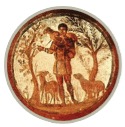
In fact, in this parable of the final judgement, Jesus uses the image of a shepherd, recalling images of the prophet Ezekiel who had spoken of God’s intervention in favour of his people against the evil shepherds of Israel (cf. 34:1-10). They had been cruel exploiters, preferring to feed themselves rather than the flock; therefore, God himself promises to personally take care of his flock, defending it from injustice and abuse. This promise God made to his people is fully accomplished in Jesus Christ, the Shepherd. He is indeed the Good Shepherd. He too says of himself: “I am the good shepherd” (Jn 10:11, 14).
In today’s Gospel passage, Jesus identifies himself not only with the king-shepherd, but also with the lost sheep, we can speak of a “double identity”: the king-shepherd, Jesus identifies also with the sheep: that is, with the least and most needy of his brothers and sisters. And he thus indicates the criterion of the judgement: it will be made on the basis of concrete love given or denied to these persons, because he himself, the judge, is present in each one of them. He is the judge. He is God-Man, but he is also the poor one. He is hidden and present in the person of the poor people that he mentions right there. Jesus says: “Truly, I say to you, as you did it (or did it not) to one of the least of these my brethren, you did it (you did it not) to me” (cf. vv. 40, 45). We will be judged on love. The judgement will be on love, not on feelings, no: we will be judged on works, on compassion that becomes nearness and kind help. Do I draw near to Jesus present in the persons of the sick, the poor, the suffering, the imprisoned, of those who hunger and thirst for justice? Do I draw near to Jesus present there? This is the question for today.
Therefore, at the end of the world, the Lord will inspect the flock, and he will do so not only from the perspective of the shepherd, but also from the perspective of the sheep, with whom he has identified. And he will ask us: “Were you a little bit like a shepherd as myself?” “Were you a shepherd to me who was present in those people who were in need, or were you indifferent?”. Brothers and sisters, let us look at the logic of indifference, of those who come to mind immediately. Looking away when we see a problem. Let us remember the parable of the Good Samaritan. That poor man, wounded by the brigands, thrown to the ground, between life and death, was there alone. A priest passed by, saw, and went on his way. He looked the other way. A Levite passed by, saw and looked the other way. Before my brothers and sisters in need, am I indifferent like this priest, like this Levite and look the other way? I will be judged on this: on how I drew near, how I looked on Jesus present in those in need. This is the logic, and it is not I who is saying this: Jesus says it. “What you did to that person and that person and that person, you did it to me. And what you did not do to that person and that person and that person, you did not do it to me, because I was there”. May Jesus teach us this logic, this logic of being close, of drawing near to him, with love, in the person who is suffering most.
When the Son of Man Comes in His Glory
26 November 2017 | Saint Peter’s Square
34th Sunday of Year A
On this last Sunday of the liturgical year we are celebrating the Solemnity of Christ, King of the Universe. His is a kingship of guidance, of service and also a kingship which at the end of time will be fulfilled as judgment. Today, we have Christ before us as King, shepherd and judge, who reveals the criteria for belonging to the Kingdom of God. Here are the criteria.
The Gospel passage opens with a grandiose vision. Jesus, addressing his disciples, says: “When the Son of man comes in his glory, and all the angels with him, then he will sit on his glorious throne” (Mt 25:31). It is a solemn introduction to the narrative of the Last Judgment. After having lived his earthly existence in humility and poverty, Jesus now shows himself in the divine glory that pertains to him, surrounded by hosts of angels. All of humanity is summoned before him and he exercises his authority, separating one from another, as the shepherd separates the sheep from the goats.
To those whom he has placed at his right he says: “Come, O blessed of my Father, inherit the kingdom prepared for you from the foundation of the world; for I was hungry and you gave me food, I was thirsty and you gave me drink, I was a stranger and you welcomed me, I was naked and you clothed me, I was sick and you visited me, I was in prison and you came to me” (vv. 34-36). The righteous are taken aback, because they do not recall ever having met Jesus, much less having helped him in that way, but he declares: “as you did it to one of the least of these my brethren, you did it to me” (v. 40). These words never cease to move us, because they reveal the extent to which God’s love goes: up to the point of taking flesh, but not when we are well, when we are healthy and happy, no; but when we are in need. And in this hidden way he allows himself to be encountered; he reaches out his hand to us as a mendicant. In this way Jesus reveals the decisive criterion of his judgment, namely, concrete love for a neighbour in difficulty. And in this way the power of love, the kingship of God is revealed: in solidarity with those who suffer in order to engender everywhere compassion and works of mercy.
The Parable of the Judgment continues, presenting the King who shuns those who, during their lives, did not concern themselves with the needs of their brethren. Those in this case too are surprised and ask: “Lord, when did we see thee hungry or thirsty or a stranger or naked or sick or in prison, and did not minister to thee?” (v. 44). Implying: “Had we seen you, surely we would have helped you!”. But the King will respond: “as you did it not to one of the least of these, you did it not to me” (v. 45). At the end of our life we will be judged on love, that is, on our concrete commitment to love and serve Jesus in our littlest and neediest brothers and sisters. That mendicant, that needy person who reaches out his hand is Jesus; that sick person whom I must visit is Jesus; that inmate is Jesus, that hungry person is Jesus. Let us consider this.
SOURCE: The Holy See Archive at the Vatican Website © Libreria Editrice Vaticana
Parable of the Last Judgment
23 November 2008
34th Sunday of Year A
Today, the last Sunday of the liturgical year, we are celebrating the Solemnity of Our Lord Jesus Christ, King of the Universe. We know from the Gospels that Jesus refused the title of king when it was meant in the political sense, by the standards of the “rulers of the Gentiles” (Mt 20: 25). On the other hand, during his Passion, he claimed a unique kingship before Pilate, who explicitly asked him “So you are a king?”, and Jesus answered, “You say that I am a king” (Jn 18: 37); however just previously he had declared, “My kingship is not of this world” (Jn 18: 36). Christ’s kingship is in fact a revelation and actuation of that of God the Father, who governs all things with love and justice. The Father entrusted to the Son the mission of giving mankind eternal life by loving it to the point of supreme sacrifice and, at the same time, conferred upon him the power of judging humanity, since he made himself Son of man, like us in all things (cf. Jn 5: 21-22, 26-27).
Today’s Gospel insists precisely on the universal kingship of Christ the Judge, with the stupendous parable of the Last Judgment, which St Matthew placed immediately before the Passion narrative (25: 31-46). The images are simple, the language is popular, but the message is extremely important: it is the truth about our ultimate destiny and about the criterion by which we will be evaluated. “I was hungry and you gave me food, I was thirsty and you gave me drink, I was a stranger and you welcomed me” (Mt 25: 35) and so forth. Who does not know this passage? It is part of our civilization. It has marked the history of the peoples of Christian culture: the hierarchy of values, the institutions, the multiple charitable and social organizations. In fact, the Kingdom of Christ is not of this world, but it brings to fulfilment all the good that, thank God, exists in man and in history. If we put love for our neighbour into practice in accordance with the Gospel message, we make room for God’s dominion and his Kingdom is actualized among us. If, instead, each one thinks only of his or her own interests, the world can only go to ruin.
Dear friends, the Kingdom of God is not a matter of honours and appearances but, as St Paul writes, it is “righteousness and peace, and joy in the Holy Spirit” (Rm 14: 17). The Lord has our good at heart, that is, that every person should have life, and that especially the “least” of his children may have access to the banquet he has prepared for all. Thus he has no use for the forms of hypocrisy of those who say: “Lord, Lord” and then neglect his commandments (cf. Mt 7: 21). In his eternal Kingdom, God welcomes those who strive day after day to put his Word into practice. For this reason the Virgin Mary, the humblest of all creatures, is the greatest in his eyes and sits as Queen at the right of Christ the King. Let us once again entrust ourselves to her heavenly intercession with filial trust, to be able to carry out our Christian mission in the world.