
Theology of Work
Theology of Work
Theology of Work

Different
Perspectives
on the Sunday
Readings
IMPORTANT: Commentary on this page is a creative synthesis of the biblical text with insights influenced by Catholic theologians and spiritual writers. For a comprehensive understanding of the readings, click on the links available at the top of the page which offer a more extensive biblical analysis.
Theology of Work
First Reading | Second Reading | Gospel
Commentary below written in collaboration with OpenAI’s GPT-3.5 model.
VERSE BY VERSE COMMENTARY
TOP OF PAGE First Reading | Second Reading | Gospel

FOCUS: Theology of Work
Verse 1: "The word of the LORD came to Jonah a second time:"
This verse marks the second time that God speaks directly to Jonah, following Jonah's disobedience and subsequent rescue from the belly of the great fish. The fact that God still speaks to Jonah demonstrates His unwavering love, grace, and patience towards His people, even when they falter.
God continues to call people back to their purpose, giving them second chances to fulfill the work He has ordained for them.
Verse 2: "Set out for the great city of Nineveh, and announce to it the message that I will tell you."
God instructs Jonah to go to Nineveh, a city known for its wickedness and ungodliness, to deliver His message. Here, we see that God assigns work to His people, even though it may be challenging or uncomfortable. The call to Nineveh represents God's desire for His people to engage with the brokenness and sinfulness of the world and bring His message of redemption.
Believers are called to enter various spheres of society, using their talents, skills, and resources to propagate God's message of love, justice, and mercy.
Verse 3: "So Jonah set out for Nineveh, in accord with the word of the LORD. Now Nineveh was an awesomely great city; it took three days to walk through it."
Jonah obeys God's command and embarks on his journey to Nineveh. The description of Nineveh as an "awesomely great city" highlights its vastness and significance. The city's expanse and complexity are reminiscent of the modern world's domains of work and labor.
Just as Nineveh was overwhelming for Jonah to navigate, the workplace can often be daunting, with various challenges and demands. However, Jonah's obedience teaches us that regardless of the scale or complexity of our work environments, God's call remains, and we are empowered to be His ambassadors even in the most challenging circumstances.
Verse 4: "Jonah began his journey through the city, and when he had gone only a single day’s walk announcing, 'Forty days more and Nineveh shall be overthrown,'"
Jonah starts his work of proclaiming God's message of judgment and repentance to the people of Nineveh. Despite Jonah's initial reluctance, he faithfully delivers the warning entrusted to him. Through his proclamation, Jonah presents an opportunity for the people of Nineveh to repent and turn towards God.
Our work is not always about personal success or fulfillment but is often a means to advance God's purposes and bring about transformation in the lives of others.
Verse 5: "when the people of Nineveh believed God; they proclaimed a fast and all of them, great and small, put on sackcloth."
The response of the Ninevites to Jonah's message illustrates the power of God's word and the impact of faithful work. Upon hearing the prophecy, the people of Nineveh believed God and initiated a fast, expressing their sincere repentance.
The work we undertake can have significant spiritual and societal implications. It reminds us that our work, when aligned with God's will, can influence hearts, minds, and cultures, leading to positive change and transformation.
Verse 10: "When God saw by their actions how they turned from their evil way, he repented of the evil he had threatened to do to them; he did not carry it out."
This final verse demonstrates the profound effect of the Ninevites' repentance and demonstrates God's mercy and willingness to relent from judgment. The Ninevites' response to Jonah's work resulted in a complete shift in their behavior and led to their salvation.
When we faithfully engage in God's work, we become participants in His divine plan to redeem and restore creation. Our work, when infused with His Spirit, can bring about radical change, giving individuals and communities an opportunity to experience His grace and mercy.
TOP OF PAGE First Reading | Second Reading | Gospel

FOCUS: Theology of Work
Verse 29: "I tell you, brothers, the time is running out. From now on, let those having wives act as not having them,"
In this verse, the apostle Paul acknowledges the temporary nature of the present age and urges believers to recognize the transience of their earthly relationships and responsibilities. This verse presents an opportunity to discuss the importance of maintaining a proper perspective on work.
Saint John Paul II, in his encyclical Laborem Exercens, emphasizes the idea that work should be viewed in the context of the eternal plan of God. While earthly relationships and work endeavors are significant, they should not overshadow the primacy of our relationship with God and the eternal realities that await us.
Verse 30: "those weeping as not weeping, those rejoicing as not rejoicing, those buying as not owning,"
Here, Paul calls believers to transcend the attachments and emotions associated with their present circumstances, including both sorrow and joy.
Applied to work, this verse invites reflection on finding a balance between the pursuit of material gain or worldly success and the deeper spiritual realities at play.
St. Josemaría Escrivá, in his book The Way, advises Christians to embrace their work wholeheartedly, not allowing it to consume them or become the sole source of satisfaction. Instead, one should recognize that work is a means to fulfill one's vocation and bring glory to God.
Verse 31: "those using the world as not using it fully. For the world in its present form is passing away."
Paul highlights the impermanence of this world and its finite nature. Similarly, in the context of work, this verse compels believers to adopt a perspective that goes beyond the temporary gains, status, or achievements of their vocational pursuits.
St. John Chrysostom reminds us that the purpose of work goes beyond mere economic necessity. Work provides an opportunity to participate in God's creative and redemptive work, allowing individuals to grow in virtue and cooperation with His plan of salvation.
TOP OF PAGE First Reading | Second Reading | Gospel

FOCUS: Theology of Work
Verse 14: "After John had been arrested, Jesus came to Galilee proclaiming the gospel of God:"
In this verse, we see Jesus taking up the mission of proclaiming the gospel of God after John the Baptist's arrest. This highlights the continuity of God's work and His call for His people to engage in it.
Work, whether it is in the context of ministry, vocation, or any other endeavor, should be driven by the proclamation of the good news.
Pope Benedict XVI encourages believers to view their work as an opportunity to participate in Christ's mission of salvation and share His message of love and redemption with others.
Verse 15: "This is the time of fulfillment. The kingdom of God is at hand. Repent, and believe in the gospel."
Jesus declares that the time of fulfillment has come and urges people to repent and believe in the gospel.
Our work is intertwined with the establishment of God's kingdom on Earth.
St. John Paul II emphasizes that work has a spiritual dimension and that believers are called to sanctify their labor by connecting it to the larger purpose of building God's kingdom. Repentance and faith are crucial in aligning our work with God's will, ensuring that we approach our tasks and interactions with a profound awareness of His presence and guidance.
Verse 16: "As he passed by the Sea of Galilee, he saw Simon and his brother Andrew casting their nets into the sea; they were fishermen."
Jesus encounters Simon and Andrew, who are fishermen going about their everyday work. This verse affirms that Jesus meets people in the midst of their ordinary vocations and calls them to a deeper purpose.
All legitimate work can be sacred and used by God.
St. Josemaría Escrivá highlights the concept of "sanctifying work" and encourages believers to recognize that their occupations, whether they are fishermen, doctors, or teachers, can become avenues of encounter with God's grace and channels of service to others.
Verse 17: "Jesus said to them, 'Come after me, and I will make you fishers of men.'"
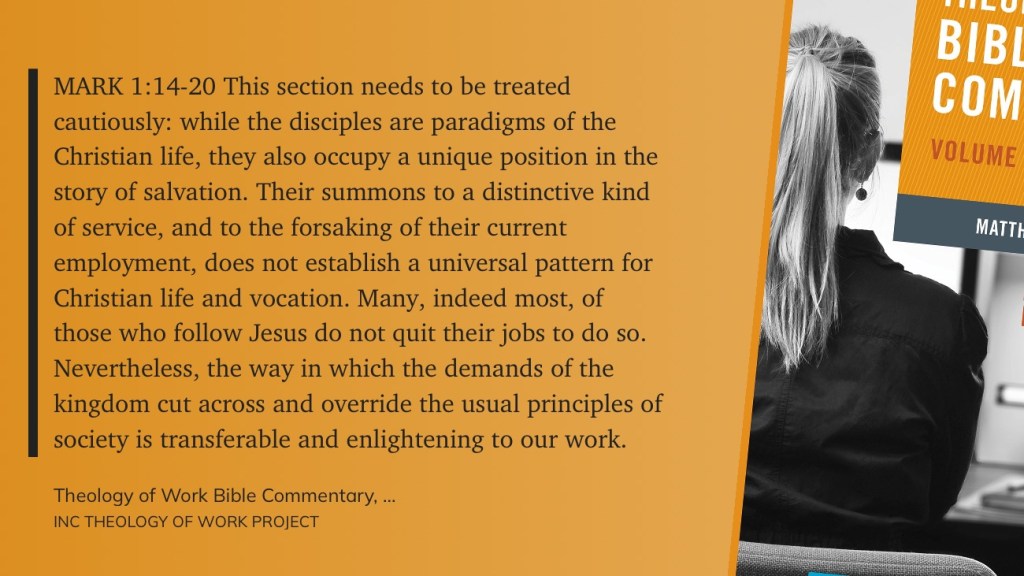
Jesus calls Simon and Andrew to leave their fishing occupation and become "fishers of men," signifying their new mission of spreading the gospel and bringing people into a relationship with God.
God calls individuals from their specific work contexts to engage in His mission.
Karl Rahner speaks of the divine call as an intimate personal encounter with God, which gives meaning and purpose to one's work. Responding to this call requires a willingness to leave behind worldly ambitions and embrace a life oriented towards serving others and participating in God's salvific plan.
Verse 18: "Then they abandoned their nets and followed him."
Simon and Andrew respond directly to Jesus' call and forsake their fishing nets to follow Him. This act of leaving behind their occupation signifies a profound response of trust and obedience.
This verse teaches believers the importance of detachment and surrender in following Christ's call.
St. Ignatius of Loyola illuminates the concept of detachment as an attitude that frees individuals from being overly attached to worldly success, recognition, or possessions, allowing them to prioritize God's will and His kingdom above all else in their work.
SOURCE: Content written in collaboration with OpenAI’s GPT-3.5 model. If you find an error or would like to add content or edit page, don’t hesitate to use contact button below. Excerpts from the Lectionary for Mass for Use in the Dioceses of the United States of America, second typical edition © 2001, 1998, 1997, 1986, 1970 Confraternity of Christian Doctrine, Inc., Washington, DC. Used with permission.
HOME | COMMENTARY | BIBLE STUDY | CONNECTIONS
