January 21, 2024
COMMENTARIESBIBLE STUDIESTERMSTOPIC STUDIES
Fr. Francis MartinHector MolinaKieran O'MahonyBrant Pitre
VIEW MORE

Creative synthesis with insights of Catholic theologians and spiritual writers.

Agape Bible Commentary

3rd Sunday of Year B

INTRODUCTION

1st Reading: The Repentance of Nineveh and God's Pardon

Jonah resisted God's command to go to Nineveh and preach repentance to Israel's great enemy, the Gentile people of the Assyrian capital.  The Assyrians were fierce enemies of Israel and the regional superpower.  God told him the people of Nineveh would experience His judgment of destruction if they failed to repent within forty days of hearing Jonah's message.  Instead, Jonah took passage on a sailing vessel in an attempt to run away from God, but humans are incapable of avoiding the God of the universe.  God caused a great fish to swallow Jonah, who then descended into the abode of the dead (Sheol), causing the reluctant prophet to repent and submit to his mission.  Accepting Jonah's repentance, God caused the beast to spit out the resurrected Jonah.

In verses 1-2, God repeats His command for Jonah to go to the Assyrians' capital city.  Jonah went and preached to the people his message to repent or face God's divine judgment in forty days.  The people of Nineveh, from peasant to king, repented their sins.  They demonstrated their sincere repentance through their actions by fasting and wearing sackcloth (a sign of repentance or grief).  God, in His mercy, accepted their repentance and withdrew His judgment.

When the inspired writer recorded that "it took three days to cross" the city (verse 3), he may have been using hyperbole to expresses the city's great size, or Jonah took his time preaching to various sections of the city.  However, the number three in Scripture is often a symbolic number to introduce a work of God, especially in His divine plan for humanity's salvation (i.e., three days in the great fish before Jonah's release and three days for Jesus in the grave before His resurrection).

Jesus recalls the Ninevites' exemplary conversion in response to the message of God's prophet in the Gospels (Mt 12:41, Lk 11:32).  He contrasts the Ninevites' response with the disbelief of many of the Jews to His Gospel message.  The Gentile Ninevites' repentance foreshadows the future repentance of the Gentile nations and their acceptance of Jesus as Lord and Savior in the Age of the Messiah and His Kingdom of the Church.

The wages of sin is death (Rom 6:23), but God in His mercy sent His Son as the unblemished Lamb of sacrifice to atone for the sins of the world (Jn 1:29).  Jesus' sacrifice is the only means open to humanity for receiving God's mercy and forgiveness for our sins when we repent and turn to Jesus Christ as our Lord and Savior.  Using the people of Nineveh as an example, Jesus said: "On Judgment Day the men of Nineveh will appear against this generation and be its condemnation because when Jonah preached, they repented; and, look, there is something greater than Jonah here" (Lk 11:32).

Michal E Hunt, Copyright © 2014; revised 2023 Agape Bible Study; used with permission

2nd Reading: Time is Short

St. Paul and the Apostles Sts. Peter and John remind us in their letters that life is short (cf. Rom 13:11-14; 2 Pt 3:8; 1 Jn 2:15-17).  They give us this warning to encourage us to make the best use of our time to serve Jesus Christ and carry His Gospel of salvation to others for His sake.  For this reason, a Christian should be detached from material things and never become a servant of the world (cf. 1 Cor 7:23; Lumen Gentium, 42).  Instead, the Christian must always have the goal of eternal life as his focus.  St. Teresa of Avila wrote it would help us: "... if we keep a very constant care of the vanity of all things, and the rapidity with which they pass away, so that we may withdraw our affections from everything and fix them on what will last forever.  This may seem to be a poor kind of help, but it will have the effect of greatly fortifying the soul" (Way of Perfection, chapter 10). 

St. Paul warned in verse 31: "the world in its present form is passing away."  We do not know when Christ will return to judge the world; therefore, we must not waste our time in selfish, worldly pursuits.  We must take up the mission Jesus gave every Christian to teach Christ's love, to call for the repentance of sins, and share Jesus' Gospel of salvation with our family, our community, and the world before it is too late (Mt 28:19-20; Lk 24:47; Acts 1:8).

Michal E Hunt, Copyright © 2014; revised 2023 Agape Bible Study; used with permission

Gospel: Jesus Calls the Galilean Fishermen to Discipleship

In the Gospel Reading, the Galilean fishermen hear Jesus' call to discipleship and give up everything to follow the Messiah.  They decided to follow Him without knowing where He would lead them.  Their response to the call of Jesus Christ is an example of how we should all trust God and follow our special calling because the reward merited for us by Jesus is eternal!

Michal E Hunt, Copyright © 2014; revised 2023 Agape Bible Study; used with permission

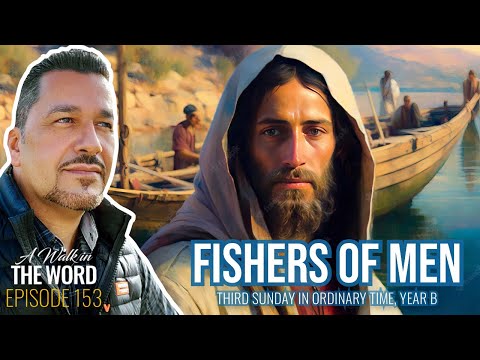
Featured: Call of the Disciples

In verses 16-20, Jesus called His first group of Galilean disciples.  The brothers Simon and Andrew, and the sons of Zebedee were fishermen on the Sea of Galilee who owned their boats.  They were not poor but were probably well-to-do since they had hired men who worked for them (verse 20), and after spending almost three years following Jesus, they still had a fishing business (see Jn 21:3).  Fishermen who owned their boats on the Sea of Galilee were usually under contract to supply fish to the Roman government, and any fish they caught beyond their contracted amount could be sold for a profit.

This encounter with Jesus was not the first time Simon, Andrew, and the Zebedee brothers had seen Him or been exposed to His message (see Jn 1:35-42 in last Sunday's Gospel reading).  They had all met him at the site of St. John's ritual baptisms of repentance and purification on the east side of the Jordan River.  At that time, the Baptist identified Jesus as the "Lamb of God who takes away the sins of the world" and the "Son of God" who will baptize men with "water and the Holy Spirit" (Jn 1:29, 33-34; Mk 1:8).

Andrew and another disciple (probably John Zebedee) spent an entire day talking with Jesus (Jn 1:35-39).  Later, Andrew brought his brother Simon to meet "the Messiah," and Jesus gave Simon the name/title Kepha in Aramaic, transliterated into the Greek text as Cephas (Jn 1:41-42).  It is a name that means "Rock" and translates into English as Peter from the Greek "Petros" (masculine form of the Greek word for rock that is petra).  It is a title/name for Simon that Jesus will repeat when Simon is the first of the Apostles to professes Jesus' divinity as the Messiah and the Son of God (Mt 16:16-18).  The fishermen's previous introduction to Jesus explains their decision to immediately leave their fishing boats to follow Him in verse 20.

The message of this passage for the reader is that knowing Jesus' true identity is not enough; one must be ready to give up everything to follow Him.  Notice that St. Mark uses the Greek word euthus twice in this passage.  Mark uses this term more in his Gospel than in the rest of the verses of the New Testament combined, and his use of this particular word is deliberate.  It points to the urgency of God's actions in and through Jesus and the importance of our response to Jesus' call to discipleship and service before it is too late.

The Galilean fishermen did not hesitate; they left everything and immediately followed Jesus.  Their decision to follow Jesus became their first steps on a journey to life in the Kingdom of Heaven.  Their response to the call of Jesus Christ is an example of how we should trust God and follow our special calling because the reward merited for us by Jesus is eternal!

Michal E Hunt, Copyright © 2014; revised 2023 Agape Bible Study; used with permission

LEARN MORE

Compiled by
St. Thomas
Aquinas


Thomas Aquinas compiled this opus from sermons and commentaries on the Gospels written by the early Church Fathers, arranging their thoughts in such a way that they form a continuous commentary on each Gospel.

Mark 1:16–20

16. Now as he walked by the sea of Galilee, he saw Simon and Andrew his brother casting a net into the sea: for they were fishers.
17. And Jesus said unto them, Come ye after me, and I will make you to become fishers of men.
18. And straightway they forsook their nets, and followed him.
19. And when he had gone a little farther thence, he saw James the son of Zebedee, and John his brother, who also were in the ship mending their nets.
20. And straightway he called them: and they left their father Zebedee in the ship with the hired servants, and went after him.

GLOSS. (non occ.) The Evangelist, having mentioned the preaching of Christ to the multitude, goes on to the calling of the disciples, whom he made ministers of his preaching, whence it follows, And passing along the sea of Galilee, &c.

THEOPHYLACT. As the Evangelist John relates, Peter and Andrew were disciples of the Forerunner, but seeing that John had borne witness to Jesus, they joined themselves to him; afterwards, grieving that John had been cast into prison, they returned to their trade. Wherefore there follows, casting nets into the sea, for they were fishers. Look then upon them, living on their own labours, not on the fruits of iniquity; for such men were worthy to become the first disciples of Christ; whence it is subjoined, And Jesus said unto them, Come ye after me. Now He calls them for the second time; for this is the second calling in respect of that, of which we read in John. But it is shewn to what they were called, when it is added, I will make you become fishers of men.

REMIGIUS. For by the net of holy preaching they drew fish, that is, men, from the depths of the sea, that is, of infidelity, to the light of faith. Wonderful indeed is this fishing! for fishes when they are caught, soon after die; when men are caught by the word of preaching, they rather are made alive.

BEDE. (in Marc. i. 6) Now fishers and unlettered men are sent to preach, that the faith of believers might be thought to lie in the power of God, not in eloquence or in learning. It goes on to say, and immediately they left their nets, and followed him.

THEOPHYLACT. For we must not allow any time to lapse, but at once follow the Lord. After these again, He catches James and John, because they also, though poor, supported the old age of their father. Wherefore there follows, And when he had gone a little farther thence, he saw James the son of Zebedee, &c. But they left their father, because he would have hindered them in following Christ. Do thou, also, when thou art hindered by thy parents, leave them, and come to God. It is shewn by this that Zebedee was not a believer; but the mother of the Apostles believed, for she followed Christ, when Zebedee was dead.

BEDE. (ubi sup.) It may be asked, how he could call two fishers from each of the boats, (first, Peter and Andrew, then having gone a little further, the two others, sons of Zebedee,) when Luke says that James and John were called to help Peter and Andrew, and that it was to Peter only that Christ said, Fear not, from this time thou shalt catch men; (Luke 5:10) he also says, that at the same time, when they had brought their ships to land, they followed him. We must therefore understand that that transaction which Luke intimates happened first, and afterwards that they, as their custom was, had returned to their fishing. So that what Mark here relates happened afterwards; for in this case they followed the Lord, without drawing their boats ashore, (which they would have done had they meant to return,) and followed Him, as one calling them, and ordering them to follow.

PSEUDO-JEROME. Further, we are mystically carried away to heaven, like Elias, by this chariot, drawn by these fishers, as by four horses. On these four corner-stones the first Church is built; in these, as in the four Hebrew letters, (יהוה) we acknowledge the tetragrammaton, the name of the Lord, we who are commanded, after their example, to hear the voice of the Lord, and to forget (Ps. 45:11) the people of wickedness, and the house of our fathers’ conversation, which is folly before God, and the spider’s net, in the meshes of which we, like gnats, were all but fallen, and were confined by things vain as the air, which hangs on nothing; loathing also the ship of our former walk. For Adam, our forefather according to the flesh, is clothed with the skins of dead beasts; but now, having put off the old man, with his deeds, following the new man we are clothed with those skins of Solomon, with which the bride rejoices that she has been made beautiful. (Cant. 1:4. Vulg.) Again, Simon, means obedient; Andrew, manly; James, supplanter;f John, grace; by which four names, we are knit together into God’s host;g by obedience, that we may listen; by manliness, that we do battle; by overthrowing, that we may persevere; by grace, that we may be preserved. (supplantatione) Which four virtues are called cardinal; for by prudence, we obey; by justice, we bear ourselves manfully; by temperance, we tread the serpent underfoot; by fortitude, we earn the grace of God.

THEOPHYLACT. We must know also, that action is first called, then contemplation; for Peter is the type of the active life, for he was more ardent than the others, just as the active life is the more bustling; but John is the type of the contemplative life, for he speaks more fully of divine things.

ORIGINAL: e-Catholic 2000

Richard Niell
Donovan

Mark 1:14-20 Exegesis

“The time (kairosis fulfilled, and the Kingdom of God is at hand” (v. 15a). The Greeks have two words for time:

• Chronos is chronological time—the kind of time that we measure on clocks and calendars—the kind of time by which we keep appointments.

• Kairos is significant time—the moment of truth—the decisive moment—the fork in the road that makes all the difference. A kairos moment divides past from future—ushers us into a new kind of life.

The number of days that a ship takes to go from one port to the next is chronos time, but when we say, “When my ship comes in,” we are talking about kairos time. If we are late for an appointment (chronos time), that might or might not turn out to be important. However, if “our ship came in” (kairos time) and we missed it, that will almost certainly be tragic.

Jesus says that the kairos “is fulfilled.” The decisive moment has arrived. God’s reign is at hand. Heads up! Pay attention! Don’t miss this one! Your life is at stake!

READ MORE