
Addiction and Recovery
Addiction and Recovery
Addiction and Recovery

Different
Perspectives
on the Sunday
Readings
IMPORTANT: This page offers a creative synthesis of the biblical text with insights influenced by Catholic theologians and spiritual writers. For a comprehensive understanding of the readings, click on the commentary and bible study links available at the top of the page which offer a more extensive biblical analysis.
Addiction & Recovery
First Reading | Second Reading | Gospel
Commentary below written in collaboration with OpenAI’s GPT-3.5 model.
VERSE BY VERSE COMMENTARY
TOP OF PAGE First Reading | Second Reading | Gospel

FOCUS: Addiction & Recovery
Verses 1-2: "Then the word of the LORD came to Jonah a second time: 'Set out for the great city of Nineveh, and announce to it the message that I will tell you.'"
These verses highlight God's persistence and second chances.
In the context of addiction and recovery, it reminds us of the importance of not giving up and seeking help, even if we have failed before. The Catholic Church teaches that no matter how often we stumble, God is always ready to forgive and guide us on the right path. Pope Francis, speaking on addiction, urges, "Overcoming addiction requires an act of courage. If we are to escape the enslavement of our passions, we need an initiation."
Verse 3: "So Jonah set out for Nineveh, in accordance with the word of the LORD. Now Nineveh was an enormously large city; it took three days to go through it."
Nineveh's enormous size signifies the vastness of addiction and the challenges faced during the recovery process.
The Catholic Church acknowledges that addiction can be overwhelming, but encourages individuals to persevere and seek support. The journey towards healing and freedom may seem long, but it is necessary for true transformation.
Verse 4: "Jonah began his journey through the city, and when he had gone only a single day’s walk announcing, 'Forty days more and Nineveh shall be overthrown,'"
Jonah's proclamation of the impending destruction of Nineveh can be likened to the moment of realization and acknowledgment of addiction's destructive nature. It is a call to repentance and a turning point in the recovery process. The Church teaches that one must recognize the harm caused by addictive behaviors to truly strive for change.
St. John Chrysostom reminds us, "It is not enough to have come to know addiction; we must also be fed up and disgusted with it."
Verse 5: "The people of Nineveh believed God; they proclaimed a fast and all of them, great and small, put on sackcloth."
The response of the people of Nineveh demonstrates a collective realization of the need for change and their willingness to take action.
Similarly, in addiction recovery, acknowledging the problem and committing to a new way of life is crucial. The Catholic Church emphasizes the importance of spiritual practices, such as fasting, to facilitate healing and transformation.
Pope Benedict XVI explains, "Fasting cleanses the soul, raises the mind, subjects one’s flesh to the spirit, renders the heart contrite and humble."
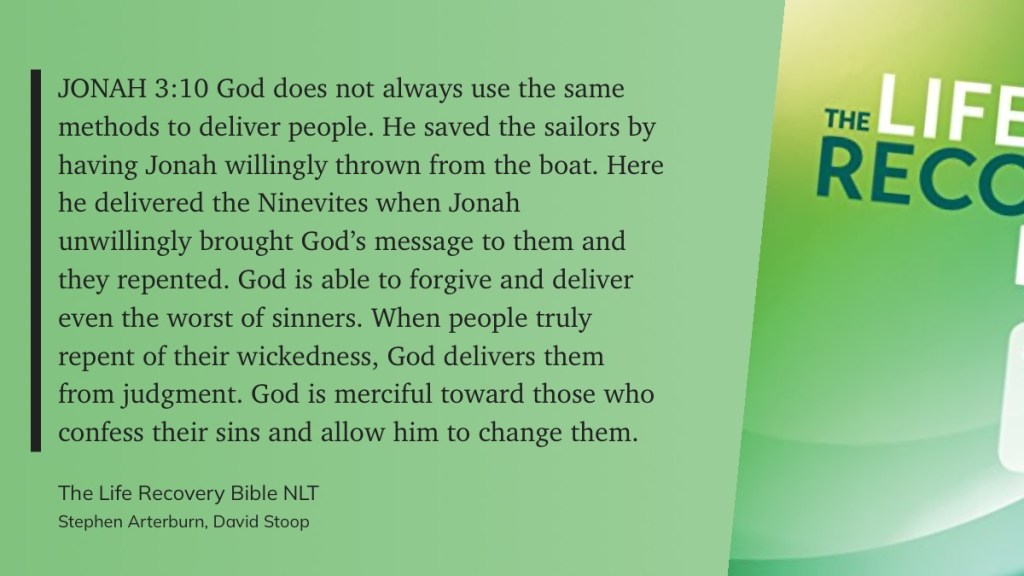
Verse 10: "When God saw by their actions how they turned from their evil way, he repented of the evil that he had threatened to do to them; he did not carry it out."
This verse reveals God's mercy and willingness to forgive those who sincerely turn away from their destructive ways.
In the context of addiction and recovery, it illustrates the loving and forgiving nature of God, who desires to liberate individuals from the bondage of addiction. The Catholic Catechism emphasizes that God's mercy is abundant and available to all who seek it.
SOURCE: Content written in collaboration with OpenAI's GPT-3.5 model. If you find an error or would like to add content or edit page, don't hesitate to use contact button below. Excerpts from the Lectionary for Mass for Use in the Dioceses of the United States of America, second typical edition © 2001, 1998, 1997, 1986, 1970 Confraternity of Christian Doctrine, Inc., Washington, DC. Used with permission.
TOP OF PAGE First Reading | Second Reading | Gospel

FOCUS: Addiction & Recovery
Verse 29: "I tell you, brothers, the time is running out. From now on, let those having wives act as not having them,"
St. Paul addresses the temporary nature of earthly matters.
The verse reminds us of the urgency to overcome our attachments and focus on spiritual growth. St. Augustine reflects on the importance of detachment, stating, "Desire nothing but God; cling to Him and cast yourself into the depths of His love. Abide in love, rooted and grounded in it."
Verse 30: "those weeping as not weeping, those rejoicing as not rejoicing, those buying as not owning,"
St. Paul highlights the need to detach ourselves from the excessive emotions and material possessions that can distract us from our spiritual journey.
Individuals in recovery are to find their joy, sorrow, and contentment in God rather than in addictive behaviors or worldly possessions.
Pope Francis encourages this detachment, stating, "Freedom from addiction is an experience of joy and liberation of the soul."
Verse 31: "those using the world as not using it fully. For the world in its present form is passing away."
Here, St. Paul emphasizes the impermanence of the world and the need to use its resources and pleasures with moderation and awareness.
Individuals are challenged to examine their relationship with the world and its temptations.
St. John Paul II reminds us, "The world, in all its false glamour, must be seen for what it is: temporary and passing."
SOURCE: Content written in collaboration with OpenAI's GPT-3.5 model. If you find an error or would like to add content or edit page, don't hesitate to use contact button below. Excerpts from the Lectionary for Mass for Use in the Dioceses of the United States of America, second typical edition © 2001, 1998, 1997, 1986, 1970 Confraternity of Christian Doctrine, Inc., Washington, DC. Used with permission.
TOP OF PAGE First Reading | Second Reading | Gospel

FOCUS: Addiction & Recovery
Verse 14: "After John had been arrested, Jesus came to Galilee proclaiming the gospel of God."
In this verse, we see Jesus' mission of proclaiming the Good News, even in the midst of difficulty and adversity.
This verse points to the hope of redemption and transformation offered by Christ.
Verse 15: "This is the time of fulfillment. The kingdom of God is at hand. Repent, and believe in the gospel."
Jesus' call to repentance and belief in the Gospel is an invitation to turn away from destructive behavior and embrace a new way of life in the Kingdom of God.
This verse emphasizes the need for a change of heart and a firm trust in God's mercy.
Pope Francis encourages this act of repentance, stating, "Self-esteem and the awareness of one’s dignity are born from the knowledge of Christ’s infinite love for each person."
Verse 16: "As he passed by the Sea of Galilee, he saw Simon and his brother Andrew casting their nets into the sea; they were fishermen."
Jesus' encounter with Simon and Andrew signifies His call to leave behind their former way of life and become disciples.
This verse highlights the need for individuals to abandon their old patterns of behavior and follow Christ towards a life of healing.
St. Gregory the Great reminds us, "No one reaches the summit of perfection unless he undertakes willingly what he had custody of unwillingly." This wisdom highlights the importance of taking ownership of our duties and approaching them with a positive mindset. By accepting what we have been entrusted with, whether it be personal or professional obligations, we open ourselves up to growth and development. The willingness to shoulder these responsibilities allows us to explore new paths, learn valuable lessons, and ultimately reach higher levels of excellence in all aspects of life.
Verse 17: "Jesus said to them, 'Come after me, and I will make you fishers of men.'"
Jesus' call to Simon and Andrew extends beyond their occupation as fishermen. He calls them to become evangelizers, drawing others towards the Kingdom of God.
This verse inspires individuals to share their own experiences of healing with others, becoming instruments of hope and support.
Pope Benedict XVI explains, "With Christ, God himself comes down among us and takes us by the hand, drawing us upwards on high."
Verse 20: "He called them, and immediately they left their boat and their father and followed him."
The response of Simon and Andrew, leaving behind their familial and occupational ties, demonstrates their immediate commitment to Christ.
This verse calls individuals to surrender their attachments and follow Jesus with unwavering dedication.
St. Augustine encourages this radical response, saying, "If we live well, we shall die well. God's Word tells us that we should follow Him, and that He is the Way." By heeding God's Word and choosing to follow Him, we align ourselves with the Way that leads us towards true fulfillment and eternal life. This verse invites us to reflect on our own attachments and priorities, urging us to prioritize our relationship with Christ above all else. It challenges us to consider if we are willing to let go of anything that may hinder our journey towards Him. Ultimately, this passage serves as an inspiring reminder of the transformative power of faith and the importance of prioritizing our commitment to Christ above all else in order to experience true fulfillment.
SOURCE: Content written in collaboration with OpenAI's GPT-3.5 model. If you find an error or would like to add content or edit page, don't hesitate to use contact button below. Excerpts from the Lectionary for Mass for Use in the Dioceses of the United States of America, second typical edition © 2001, 1998, 1997, 1986, 1970 Confraternity of Christian Doctrine, Inc., Washington, DC. Used with permission.
HOME | COMMENTARY | BIBLE STUDY | CONNECTIONS
