
Catholic
Catholic
Catholic

Different
Perspectives
on the Sunday
Readings
IMPORTANT: This page offers a creative synthesis of the biblical text with insights influenced by Catholic theologians and spiritual writers. For a comprehensive understanding of the readings, click on the commentary and bible study links available at the top of the page which offer a more extensive biblical analysis.
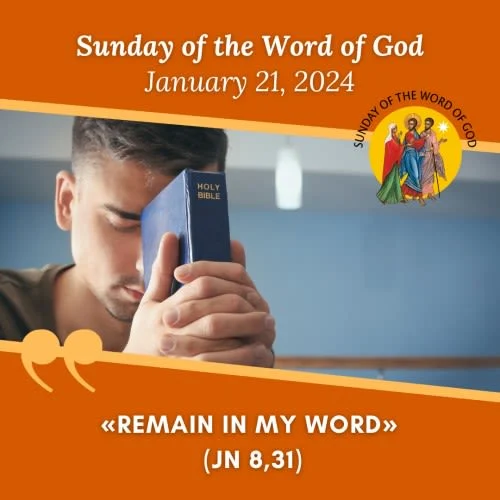
RESOURCES FOR THE SUNDAY OF THE WORD OF GOD (PDF)

©2022 Federation of Diocesan Liturgical Commissions
Catholic Culture
First Reading | Second Reading | Gospel
Commentary below written in collaboration with OpenAI’s GPT-3.5 model.
VERSE BY VERSE COMMENTARY
TOP OF PAGE First Reading | Second Reading | Gospel

FOCUS: Catholic Culture
Verse 1: "Then the word of the LORD came to Jonah a second time:"
In this verse, we witness the importance of the Word of God in Catholic faith. The Lord's word is the guiding force that directs Jonah to fulfill his mission. It demonstrates that God's communication is never a one-time event; rather, it is continuous and ongoing.
Similarly, in Catholicism, the Word of God is not restricted to the Bible alone but encompasses the teachings of the Church, delivered through Scripture, Tradition, and the Magisterium.
Verse 2: "Set out for the great city of Nineveh, and announce to it the message that I will tell you."
God instructs Jonah to proclaim a message to the people of Nineveh. This reflects the missionaries' role in Catholic culture.
Like Jonah, missionaries are called to go out into the world and announce God's message of love, repentance, and salvation to all nations and peoples. This verse emphasizes the universal nature of Catholicism, encouraging the faithful to share the richness of the Gospel without limit.
Verse 3: "So Jonah made ready and went to Nineveh, according to the LORD'S bidding. Now Nineveh was an enormously large city; it took three days to go through it."
Jonah promptly obeys the Lord's command and heads towards Nineveh. The mention of Nineveh's enormous size highlights the vastness of the mission and the formidable task that lies ahead.
This can serve as a reminder to Catholics that the Word of God should not be confined solely to their personal lives; instead, it should permeate every aspect of society, just as Nineveh was a vast city that required extensive efforts to reach entirely. Catholics are called to proclaim the Word of God in their communities, workplaces, and all spheres of influence.
Verse 4: "Jonah began his journey through the city, and had gone but a single day's walk announcing, 'Forty days more and Nineveh shall be overthrown,'"
As Jonah traverses Nineveh, he proclaims the message entrusted to him by God: the impending destruction of the city. This verse reflects the importance of prophetic proclamation in Catholic culture.
Like Jonah, the faithful are called to speak boldly and truthfully, even when facing resistance or reluctance. The Church, through its priests, bishops, and laity, has a prophetic role in society, encouraging all to recognize the need for repentance and conversion in the face of sin and injustice.
Verse 5: "When the people of Nineveh believed God, they proclaimed a fast and all of them, great and small, put on sackcloth."
Astoundingly, the people of Nineveh respond to Jonah's message with genuine repentance and conversion. This verse highlights the transformative power of the Word of God.
Similarly, in Catholic culture, the Word of God calls individuals to turn away from sin and embrace a life of faith and holiness. The reception of God's Word leads to action, as seen in the people of Nineveh who proclaimed a fast and donned sackcloth as signs of their contrition before God.
Verse 10: "When God saw by their actions how they turned from their evil way, he repented of the evil that he had threatened to do to them; he did not carry it out."
God's mercy and compassion are evident in this verse. Despite threatening the destruction of Nineveh, the people's response to His Word leads Him to relent. This verse emphasizes the transformative impact of the Word of God in Catholic culture.
It demonstrates that by sincerely embracing God's message and turning away from sin, individuals and communities can experience His merciful forgiveness and find salvation. The story of Jonah reminds Catholics of the power of God's Word to bring about change in themselves and in society, leading all towards repentance, conversion, and ultimately, God's loving mercy.
SOURCE: Content written in collaboration with OpenAI's GPT-3.5 model. If you find an error or would like to add content or edit page, don't hesitate to use contact button below. Excerpts from the Lectionary for Mass for Use in the Dioceses of the United States of America, second typical edition © 2001, 1998, 1997, 1986, 1970 Confraternity of Christian Doctrine, Inc., Washington, DC. Used with permission.
TOP OF PAGE First Reading | Second Reading | Gospel

FOCUS: Catholic Culture
Verse 29: "I tell you, brothers, the time is running out. From now on, let those having wives act as not having them,"
In this verse, St. Paul addresses the Corinthians, emphasizing the urgency of the times. He encourages believers to be detached from worldly concerns, including marital and family obligations. This does not mean rejecting or devaluing the institution of marriage, but rather recognizing the transient nature of earthly life in light of eternity.
Catholic culture, influenced by this message, embraces the call to focus on the eternal truths of faith and prioritize the pursuit of holiness over temporal pursuits. St. John Paul II, in his Apostolic Exhortation Familiaris Consortio, highlights the importance of this verse by stating, "The Sacrament of Marriage… is a fundamental dimension of the vocation to holiness and a real and proper path to sanctity" (FC, 56). He reminds the faithful that while the world may change, the truth and beauty of the sacrament of marriage remain steadfast.
Verse 30: "those weeping as not weeping, those rejoicing as not rejoicing, those buying as not owning,"
Continuing his exhortation, St. Paul urges the Corinthians to live in a way that transcends the fleeting emotions and possessions of earthly existence.
Catholic culture recognizes the call to detach from material possessions and worldly pleasures, seeking instead the lasting joy and peace found in God alone. This verse echoes the teachings of Jesus, who teaches in Matthew 6:19-21, "Do not store up for yourselves treasures on earth… but store up treasures in heaven." It reminds Catholics to focus on eternal values rather than temporal distractions.
St. Theresa Benedicta of the Cross (Edith Stein) echoes this sentiment, stating, "An authentic spirituality is always connected to concrete people and things. It translates the Gospel into life" (Essays on Women, 75). She emphasizes that Catholic spirituality is not an abstract concept but one that guides believers to live in detachment, finding true fulfillment in their relationships and actions.
Verse 31: "and those using the world as not using it fully. For the world in its present form is passing away."
In the final verse, St. Paul emphasizes the temporary nature of the world and its transient pleasures.
Catholic culture understands that while the world can offer temporary joys, its pursuits are limited and ultimately passing away. The faithful are called to use the world wisely and responsibly, recognizing its impermanence and instead focusing on eternal realities.
Hans Urs von Balthasar reflects on these concepts, stating, "The Christian lives in the world, but his ultimate aim is to serve God, the Creator and Redeemer. The world is not our ultimate home. It was made for God and for eternity; it is not a mere gathering place for the ephemeral" (Prayer, 112). His words affirm the Catholic understanding that believers are called to navigate the world with a heavenly perspective, valuing the eternal over the temporal.
SOURCE: Content written in collaboration with OpenAI's GPT-3.5 model. If you find an error or would like to add content or edit page, don't hesitate to use contact button below. Excerpts from the Lectionary for Mass for Use in the Dioceses of the United States of America, second typical edition © 2001, 1998, 1997, 1986, 1970 Confraternity of Christian Doctrine, Inc., Washington, DC. Used with permission.
TOP OF PAGE First Reading | Second Reading | Gospel

FOCUS: Catholic Culture
Verse 14: "After John had been arrested, Jesus came to Galilee proclaiming the gospel of God:"
In this verse, we see Jesus beginning His public ministry, proclaiming the gospel of God.
Catholic culture recognizes the importance of proclamation and evangelization as Jesus did. Just as Jesus initiated His ministry in response to John's arrest, Catholics are called to answer the call to spread the good news of the Gospel in a world often marked by challenges and opposition. This verse highlights the significance of the Word of God as the foundation of Catholic faith and the impetus for mission.
Pope Paul VI affirms this calling, stating, "Evangelizing is in fact the grace and vocation proper to the Church, her deepest identity. She exists to evangelize" (Evangelii Nuntiandi, 14). This quote recognizes the central role of evangelization in Catholic culture and the Church's mission to proclaim the Word of God to all nations.
Verse 15: "This is the time of fulfillment. The kingdom of God is at hand. Repent, and believe in the gospel."
Jesus announces the arrival of the kingdom of God and calls people to repentance and faith in the gospel.
Catholic culture emphasizes the need for ongoing conversion and belief in the saving power of God's Word. The kingdom of God is not merely a future reality but a present and active force in the lives of believers. Catholics are encouraged to cultivate a personal relationship with God and deepen their faith in the gospel message.
St. John Chrysostom reflects on the transformative power of the gospel, stating, "The word of God is a life-creating and life-giving word, the power of God for salvation" (Homilies on the Gospel of St. Matthew, 19). His words reinforce the importance of the Word of God as a source of life and salvation, urging Catholics to immerse themselves in Scripture and embrace its transformative power.
Verse 16: "As he passed by the Sea of Galilee, he saw Simon and his brother Andrew casting their nets into the sea; they were fishermen."
Jesus encounters Simon and Andrew, who are engaged in their daily occupation as fishermen. This verse indicates that Jesus calls people from all walks of life to follow Him and become fishers of men.
Catholic culture recognizes that every profession and vocation can be a means of serving God and spreading the Word of God. Whether as doctors, teachers, parents, or in any other profession, Catholics are called to live out their faith and share God's love through their daily activities.
St. Josemaría Escrivá emphasizes this universal call to holiness, stating, "We priests have triumphed today—each of you in your own way, whatever his job is." (The Forge, 9). His words inspire Catholics to see their daily lives as an opportunity to follow Christ and contribute to the building of His kingdom.
Verse 17: "Jesus said to them, 'Come after me, and I will make you fishers of men.'"
Jesus invites Simon and Andrew to follow Him and become "fishers of men." This verse illustrates the role of discipleship and the mission to spread the Word of God.
Catholic culture recognizes that all believers are called to imitate Christ and actively participate in the Church's mission of evangelization. By nurturing a personal relationship with Jesus, Catholics are empowered to share God's love and salvation with others, leading them to encounter the transformative power of the Word of God.
Blessed James Alberione reminds Catholics of their role as evangelizers, stating, "All the baptized have the commitment to take part in the Church's mission to evangelize… The proclamation of the Gospel is proper to the entire People of God" (On the Mission of the Holy Spirit and Teologia della Passione, 105). His words reinforce the importance of each Catholic's active participation in the mission of spreading the Word of God.
SOURCE: Content written in collaboration with OpenAI's GPT-3.5 model. If you find an error or would like to add content or edit page, don't hesitate to use contact button below. Excerpts from the Lectionary for Mass for Use in the Dioceses of the United States of America, second typical edition © 2001, 1998, 1997, 1986, 1970 Confraternity of Christian Doctrine, Inc., Washington, DC. Used with permission.
HOME | COMMENTARY | BIBLE STUDY | CONNECTIONS
