Catholic Digest, Homily Themes
Catholic Digest, Homily Themes
July 12, 2026
⭐⭐⭐ The Man and the Dog (Holy TV Ads)






Theology, Apologetics & Evangelization
These channels focus on explaining and defending the Catholic faith, often engaging with modern culture and other viewpoints.
- Bishop Robert Barron (Word on Fire): One of the most influential voices in the Church, offering cultural commentary, movie reviews, and deep theological deep-dives.
- Ascension Presents: A powerhouse channel featuring popular figures like Fr. Mike Schmitz (known for the “Bible in a Year” and “Catechism in a Year” podcasts) and Fr. Josh Johnson, offering accessible videos on faith and life.
- Catholic Answers: The premier channel for Catholic apologetics, featuring live Q&A shows where apologists answer tough questions from callers.
- Pints with Aquinas (Matt Fradd): Long-form interviews and discussions on theology, philosophy, and culture, often over a drink.
- The Counsel of Trent (Trent Horn): Trent Horn, a Catholic Answers apologist, provides rebuttals to atheist and Protestant arguments, as well as commentary on current events.
- Jimmy Akin: A senior apologist at Catholic Answers known for his fairness and deep knowledge, covering everything from bizarre questions to deep theology.
- Breaking In The Habit (Fr. Casey Cole, OFM): A young Franciscan friar who offers fresh, accessible reflections on faith, vocations, and everyday life.
- Thomistic Institute: Excellent, high-quality animated videos and lectures explaining the philosophy and theology of St. Thomas Aquinas.


JULY-AUGUST 2026
PDF (84 pages)
America Magazine: Published by the Jesuits, this leading national review is highly regarded for its thoughtful, nuanced commentary on religion, politics, and contemporary culture.

Commonweal: An independent, lay-edited journal of opinion that provides rigorous intellectual perspectives on faith, society, the arts, and public policy.

JULY-AUGUST 2026
PDF (48 pages)
Liguorian is an award-winning Catholic magazine published since 1913 by the Redemptorists to provide spiritual guidance, pastoral messages, and inspiring stories, helping readers navigate modern life through faith. It acts as a trusted resource for Catholic spirituality, offering insights on faith, social justice, and daily Christian living.

U.S. Catholic: This publication focuses on everyday faith, social justice, and practical insights for living out Catholic teachings in modern, daily life.
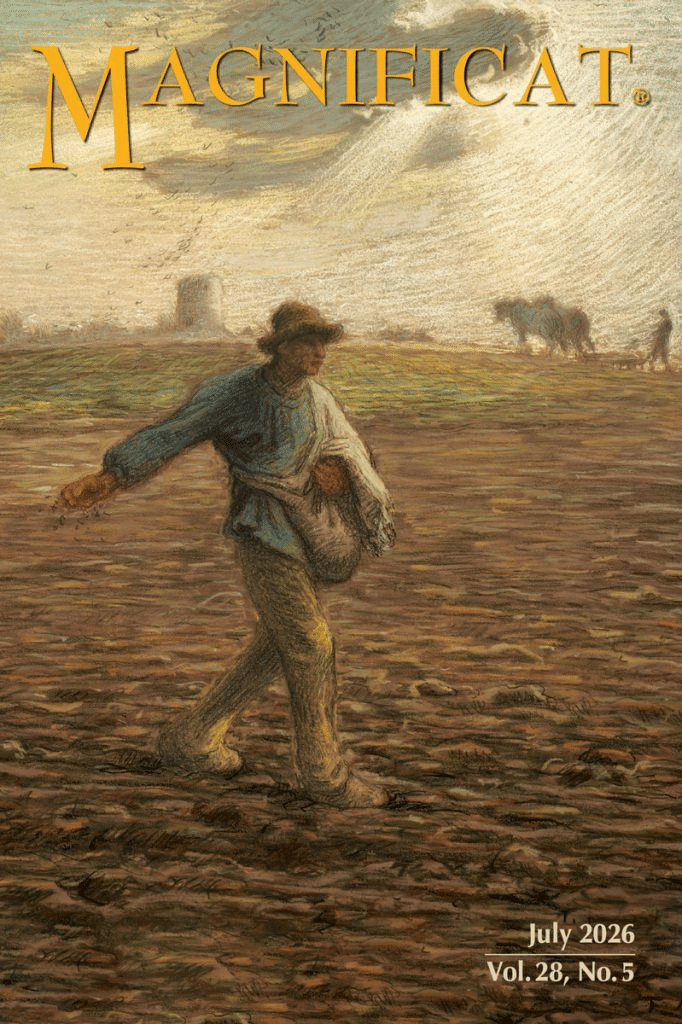
Magnificat: A beautifully designed monthly publication intended for daily use. It includes the texts of the daily Mass, morning and evening prayers, and spiritual reflections. Exploring its Spanish edition, Magnificat en Español, can also be an excellent way to weave language practice into a daily spiritual routine.
Catholic.com

15th Sunday of Year A
The Friction of Formation
SUMMARY: Discerning the priesthood requires guarding the soul against modern noise through silence. True vocation relies on the power of God’s Word, not personal perfection. By embracing daily formation and the sacraments, discerners cultivate the rich soil needed for the harvest.
Discerning the priesthood in the modern world is an act of quiet rebellion. You are trying to listen to a whisper in a culture that screams. The readings for the 15th Sunday in Ordinary Time (Year A) speak directly to the landscape of your heart right now, offering a map for the terrain you are walking.
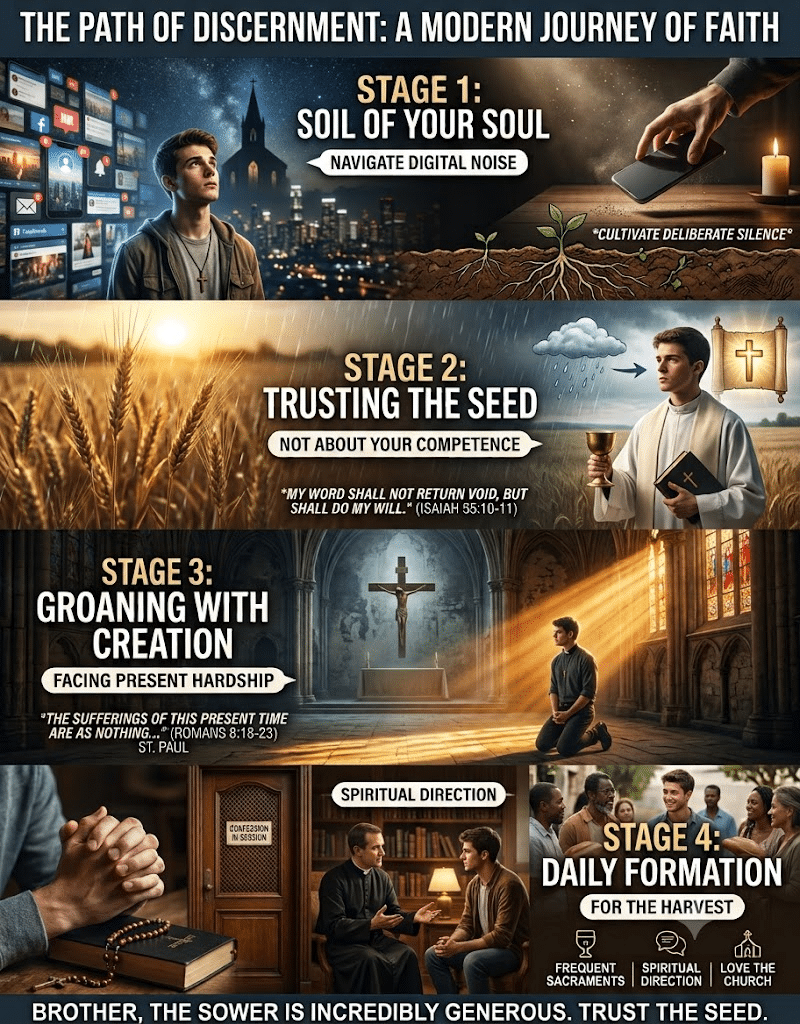
The Soil of Your Soul
In the Gospel of Matthew, Jesus shares the Parable of the Sower. It is easy to read this and immediately project yourself into the role of the harvest. But right now, your primary task is to look at your environment. The “path,” the “rocky ground,” and the “thorns” are not abstract concepts; they are the exact cultural pressures you face daily.
We live in an era of hyper-connectivity and endless scrolling. The “thorns” of our day are the anxieties of comparison, the constant demand for productivity, and the superficiality of digital validation. If your interior life is crowded out by the noise of notifications and the pressure to have an opinion on everything, the seed of your vocation cannot take root.
A Practical Application: Cultivate deliberate silence. If you want to know if God is calling you, you have to give Him a quiet room to speak in. Commit to a “digital fast” for an hour a day, or one evening a week. Leave your phone in another room when you pray. Let the soil of your heart settle so you can actually notice where the roots are trying to grow.assume you are disqualified. The flesh relies on its own optics.
Trusting the Seed
When you look at the state of the world—and the complex realities facing the Church today—it is completely normal to feel inadequate. You might ask yourself, “Am I holy enough? Am I smart enough? Can I actually carry this weight?”
Turn your eyes to the prophecy of Isaiah:
“Just as from the heavens the rain and snow come down… so shall my word be that goes forth from my mouth; it shall not return to me void, but shall do my will.”
This is the antidote to the imposter syndrome that plagues so many discerners. The efficacy of the priesthood does not depend on your personal perfection; it depends on the power of God’s Word. A vocation is not a performance review where you have to prove you are flawless. It is an invitation to be a vessel. When God speaks a call into your life, that Word carries the power to accomplish exactly what He intends. Your job is not to manufacture the growth; your job is to stay open to the rain.
Groaning with Creation
Discernment is rarely a straight line of peaceful clarity. It involves wrestling, doubt, and often a profound sense of isolation from peers who may not understand your path. St. Paul writes to the Romans that
“the sufferings of this present time are as nothing compared with the glory to be revealed to us.”
St. Paul describes all of creation “groaning in labor pains” as we wait for redemption. Right now, the Church is living through a season of labor pains, cleansing, and renewal. To say “yes” to the priesthood today means being willing to enter into that groaning. It means stepping into a broken world with a heart ready to suffer alongside God’s people. Do not be discouraged by the weight or the friction you feel in seminary or in your daily life. The tension you feel is not a sign that you are on the wrong path; it is the natural friction of a soul being formed for something eternal.
Daily Formation for the Harvest
To move from an abstract idea of priesthood to a lived reality, focus on the small, daily choices. The “rich soil” Jesus talks about is formed over time through consistency.
- Frequent the Sacraments: Make Confession a regular anchor, not just an emergency backup. Let yourself be forgiven so you can learn how to forgive others.
- Find a Spiritual Director: Do not discern in isolation. You need an objective, holy guide to help you distinguish between God’s voice, your own desires, and the psychological noise of daily life.
- Love the Church as She Is: It is easy to love an idealized version of the priesthood. Pray for the grace to love the real, messy, historical Church, and the specific people God places in your path right now.
Brother, the Sower is incredibly generous—He throws seed everywhere, including into the unique reality of your life in 2026. Trust the seed, guard the soil, and do not be afraid of the growth.
Essay and video created with AI tools and human editorial oversight.
Download PDF (High Resolution)
Non-profits have permission to use in their ministry.
15th Sunday of Year A

The Sower’s Farmhand
Gospel: Matthew 13:1–23
Theme: The sower went out to sow.
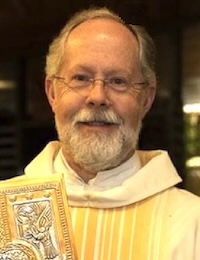
McCulloch
(Diocese of Broken Bay)
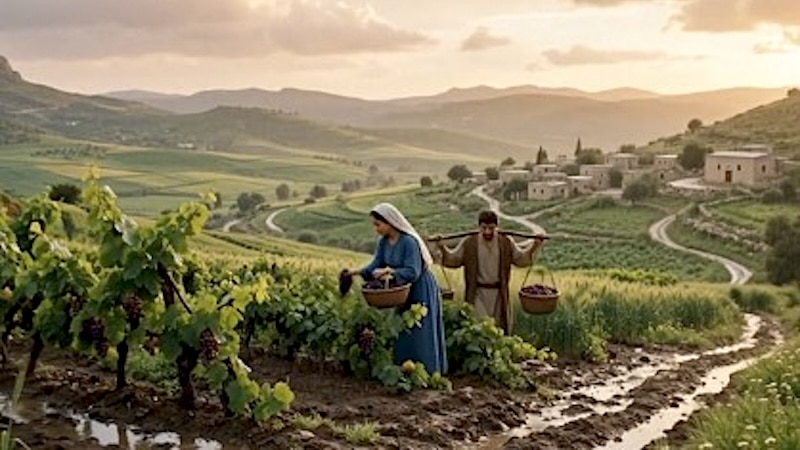
Jesus, the Master Teacher, takes his pulpit in a boat and speaks to the crowd in parables. His first and most foundational parable is that of the Sower. The seed is the Word of God, and Christ, the Sower, scatters it with extravagant generosity. He sows everywhere – on the hard path, the rocky ground, among the thorns, and on the good soil.
The variable is not the Sower or the seed, but the soil. The harvest depends on the receptivity of the ground.
The deacon’s entire ministry of diakonia can be understood in this agricultural light. He is not the Sower – that is Christ. He is the Sower’s farmhand, the one ordained to do the back-breaking work of preparing the soil. As St. Augustine said, “Work the soil of your heart, so that it may receive the rain of God’s mercy.” The deacon’s job is to work the soil of other’s hearts, so that the seed of the Word may find a home.
AT MASS
The Proclamation of the Seed
At the altar, the deacon is a primary agent of the Sower.
• Scattering the Seed: When the deacon proclaims the Gospel, he is the one scattering the seed. He is the voice of the Sower, casting the Word out over all the different soils present in the pews – the heart hardened by habit (the path), the one struggling with grief (the rock), the one choked by anxiety (the thorns), and the heart that is open (the good soil).
• The Homily as Tilling: The deacon’s preaching is the work of tilling the soil. He must break up the rocky ground of complacency. He must, with his words, try to clear the thorns of worldly anxieties and the lure of riches by connecting the Gospel to the real, lived experience of the people.
• Praying for the Soil: In the Universal Prayer, the deacon brings all the soils before the Lord. He prays for those on the path (the cynical and the lost), for those on rocky ground (the sick and the grieving), and for those among the thorns (the poor, the anxious, the overwhelmed), asking God to work the soil of their hearts.
IN THE PARISH
Clearing the Thorns
This is the very soul of diakonia. Jesus identifies the thorns as worldly anxiety and the lure of riches. The deacon’s ministry of charity is the Church’s direct, practical response to this.
• Freeing Hearts from Anxiety: The deacon’s service is the work of clearing the thorns. When he animates the parish food pantry, he is clearing the thorn of hunger. When he supports the St. Vincent de Paul conference, he is clearing the thorn of worldly anxiety over rent or utilities. This ministry is not just social work; it is pre-evangelization. It clears the ground so a person is free enough to hear the Word.
• Opening Hearts through Compassion: A heart that is rocky – hardened by loneliness, grief, or isolation – cannot receive the seed. The deacon’s pastoral presence – his visit to the sick, his time with a grieving family, his patient work in RCIA – is the plow of compassion that gently breaks up the soil, making it soft and receptive again.
AT THE MARGINS
Sowing in Hope
The Sower scatters seed with abandon, even on the path where it seems hopeless. The deacon’s ministry must mirror this extravagant, hopeful generosity.
• The Scattering of Service: The deacon’s diakonia at the margins – in the prison, the hospital, or the homeless shelter – is a scattering of seeds in what the world sees as bad soil.
• Unseen, Unacknowledged Sowing: Every visit to the sick, every homily, every act of justice is a scattering of seeds – often unseen, sometimes unacknowledged. The deacon’s work is often a hidden labour. He might never see the fruit of the seeds he scatters.
• The Harvest Belongs to the Lord: The deacon is not the Sower, and he is not the Harvester. He is the labourer. His vocation is to labour in hope, to faithfully till the soil and scatter the seed, trusting with profound confidence that the harvest – in God’s own time – belongs to the Lord.
15th Sunday of Year A

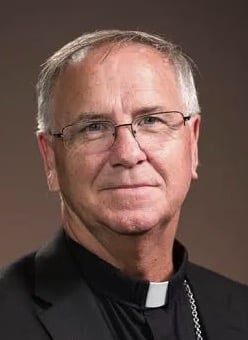
The Parable of the Sower
by Bishop John P. Dolan
Diocese of Phoenix
Pieter Bruegel the Elder’s painting “The Parable of the Sower” and the artist’s gift for finding God hidden in the ordinary
Today’s Gospel from Matthew 13 presents one of the most beloved images in all of Scripture: the parable of the sower. Jesus tells the crowd, “A sower went out to sow, and as he sowed, some seed fell on the path, and birds came and ate it up. Some fell on rocky ground, some seed fell among thorns, but some seed fell on rich soil and produced fruit a hundred or sixty or thirtyfold.”
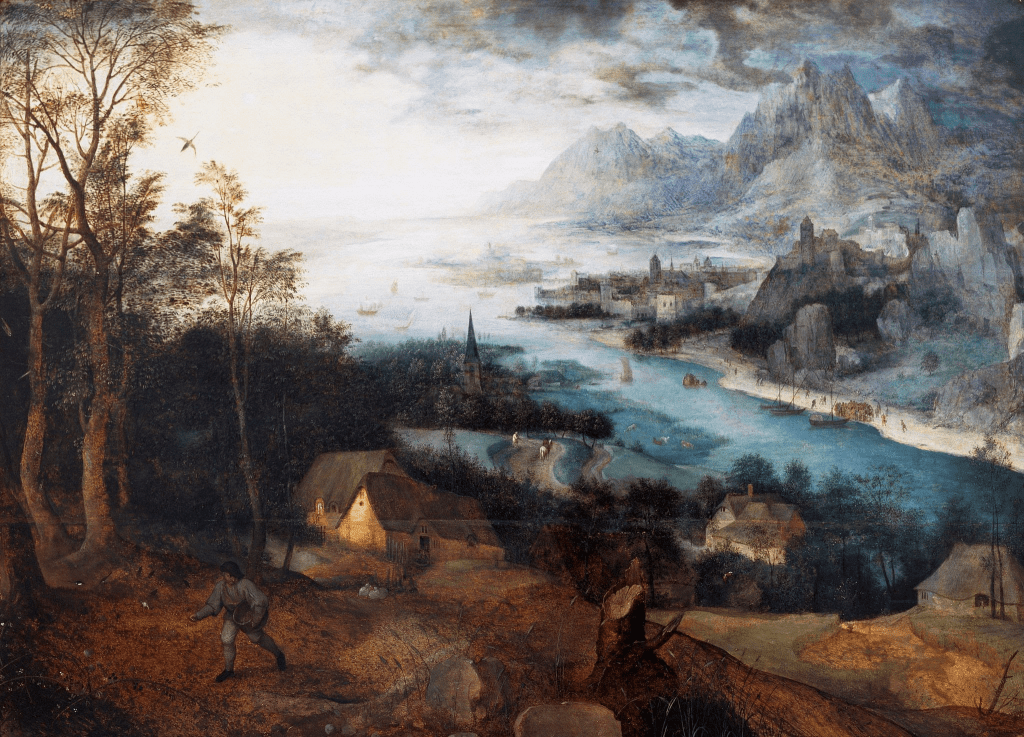
To reflect on this Gospel, we turn to a remarkable painting by Pieter Bruegel the Elder entitled The Parable of the Sower, painted in 1557 during the Northern Renaissance. Bruegel was a Flemish painter known for his detailed landscapes and his ability to reveal profound spiritual truths through scenes of ordinary life. Unlike many Renaissance artists who focused on kings, saints, and dramatic biblical moments, Bruegel often painted peasants, farmers, villages, and everyday people. He had a gift for finding God hidden in the ordinary.
The Hidden Sower

Only after careful observation do we discover the sower. He is not placed at the center of the canvas. In fact, he is relatively small. He occupies only a modest corner of the scene as he scatters seed across the field.
What a wonderful insight into the kingdom of God. Jesus tells us that God’s word is constantly being sown throughout the world. Yet God’s action is often quiet, unnoticed, and hidden amid the ordinary events of daily life. We may be captivated by the village, the roads, the commerce, or the busyness of life, while the divine sower continues his work almost unnoticed. Bruegel invites us to ask, “What are we paying attention to?”
Preparing the Soil of the Heart
The vast landscape itself becomes a symbol of the different soils Jesus describes. Somewhere in that landscape are the hard paths where seed cannot penetrate. Somewhere are rocky places where roots cannot grow. Somewhere are thorny fields where competing concerns choke the harvest. And somewhere is rich soil where the seed bears fruit beyond all expectation.
The Gospel reminds us that the generosity of the sower is never the problem. The seed is scattered everywhere. God never stops sowing grace, mercy, truth, and love. The real question is whether our hearts are prepared to receive what God is offering.
Perhaps that is why Jesus concludes, “Whoever has ears ought to hear.” Bruegel’s painting teaches us to look again, to see beyond the obvious, beyond the noise of daily life, and beyond the distractions that fill our vision. Hidden within the landscape is the sower. Hidden within our daily lives is God’s grace at work. The seed is always generous. The question is whether the soil is ready.
15th Sunday of Year A

WALL-E (2008)
Scripture Focus: Romans 8:21 – “…that the creation itself will be set free from its bondage to corruption and obtain the freedom of the glory of the children of God.”
Andrew Stanton’s WALL-E (2008) is a profound cinematic commentary on environmental stewardship and human isolation. Left alone on a desolate, garbage-smothered Earth, a solitary waste-allocation robot develops a soul through centuries of collecting remnants of human culture. When he discovers a fragile green seedling, he triggers a cosmic rescue mission to save a sedentary, technology-dependent human race living aboard a corporate starship. Seamlessly blending visual storytelling with theological undertones of cosmic exile and renewal, the film serves as a cautionary, yet hopeful fable about the restoration of creation, the necessity of physical labor, and the enduring power of connection.

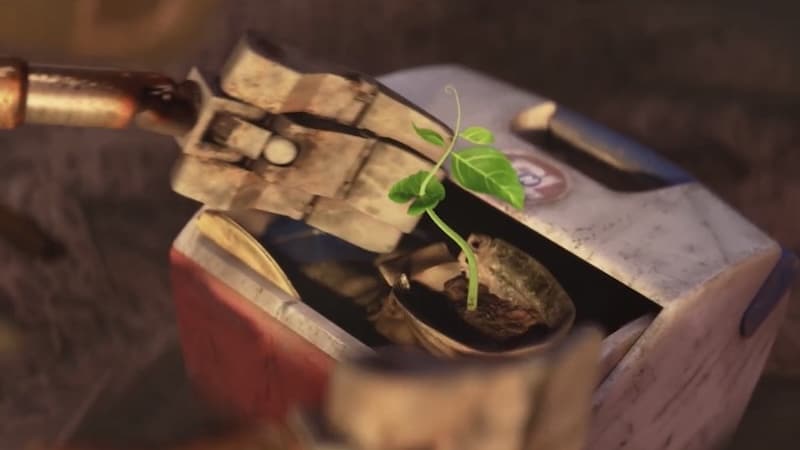
Green Inside the Metal Heart: On an abandoned, apocalyptic Earth completely smothered in mountains of synthetic garbage and toxic dust, the lonely waste-allocation robot, WALL-E, sifts through the debris of a forgotten civilization. Amidst the rusted metal and decaying plastic, his mechanical sensors spot a tiny, fragile green sprout pushing its way up through the dirt inside an old boot. He gently scoops up the plant, cradling it in his metal hands, shielding it from a sudden dust storm to protect the first sign of organic life on the planet in centuries.
Theological Connection: While a family film, WALL-E offers a stark theological portrait of creation’s “bondage to corruption.” The planet is literally suffocating under the physical weight of human greed and waste, left in a state of utter decay. WALL-E’s discovery of the green sprout is a beautiful manifestation of the “firstfruits” of a new creation. The boot holding the plant becomes a micro-ark, proving that the earth has not been entirely abandoned to its futility and signaling the beginning of a cosmic rescue mission that will eventually return humanity to its proper role as gardeners and stewards
The Anatomy of the Soil
In the Parable of the Sower, Christ warns of environments hostile to life: the hard path, the rocky ground, and the choking thorns of worldly care. The abandoned Earth in WALL-E seems, at first glance, to be the ultimate synthesis of these bad soils. It is a world entirely choked by the “deceitfulness of riches” and corporate consumerism (Matthew 13:22).
And yet, beneath the rusted metal and decaying plastic, a miracle of hidden hospitality occurs. Deep inside a cracked, dirty boot, a patch of good soil remains. Against all earthly odds, a seed takes root. It does not wither under the scorching heat of the toxic atmosphere, nor is it immediately choked out by the surrounding plastic wilderness.
The Firstfruits of the Spirit
This fragile green sprout is what Paul terms the “firstfruits of the Spirit” (Romans 8:23). It is a small, vulnerable down payment on a glorious future. The sprout does not instantly fix the planet; the dust storms still rage, and the mountains of trash still tower over the horizon. The present suffering remains intensely real.
But the presence of the sprout changes the meaning of the suffering. The earth is no longer a graveyard; it is a womb. Its groaning is no longer the final rattle of death, but the painful, agonizing labor pains of childbirth (Romans 8:22).
The boot holding the plant becomes a micro-ark, proving that the earth has not been entirely abandoned to its futility.
The Guarded Hope
When WALL-E gently scoops up the boot and shields the plant with his metal hands from the oncoming storm, he models the posture of eager longing and patient endurance outlined by Paul. Hope, in a broken world, looks like guarding what is fragile. It is the quiet conviction that the sufferings of this present time are not worth comparing with the glory to be revealed (Romans 8:18).
Ultimately, this intersection of scripture and story reminds us that redemption is a rescue mission that encompasses the entire cosmos. God does not abandon the defiled, hard-packed earth of our hearts or our world. He slips past our mountains of waste, finds the hidden good soil, and plants a seed of resurrection life—waiting for the day when the children of God are finally revealed, ready to tend the garden once more.
15th Sunday of Year A
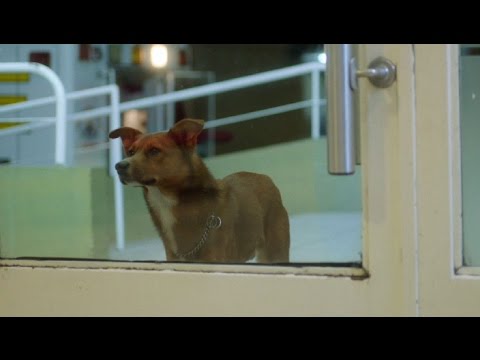
The Man and the Dog (2015)
Argentine Liver Transplant Foundation
Scripture Focus: Romans 8:19,23 – “For the creation waits with eager longing… we ourselves groan inwardly as we wait eagerly for adoption…”
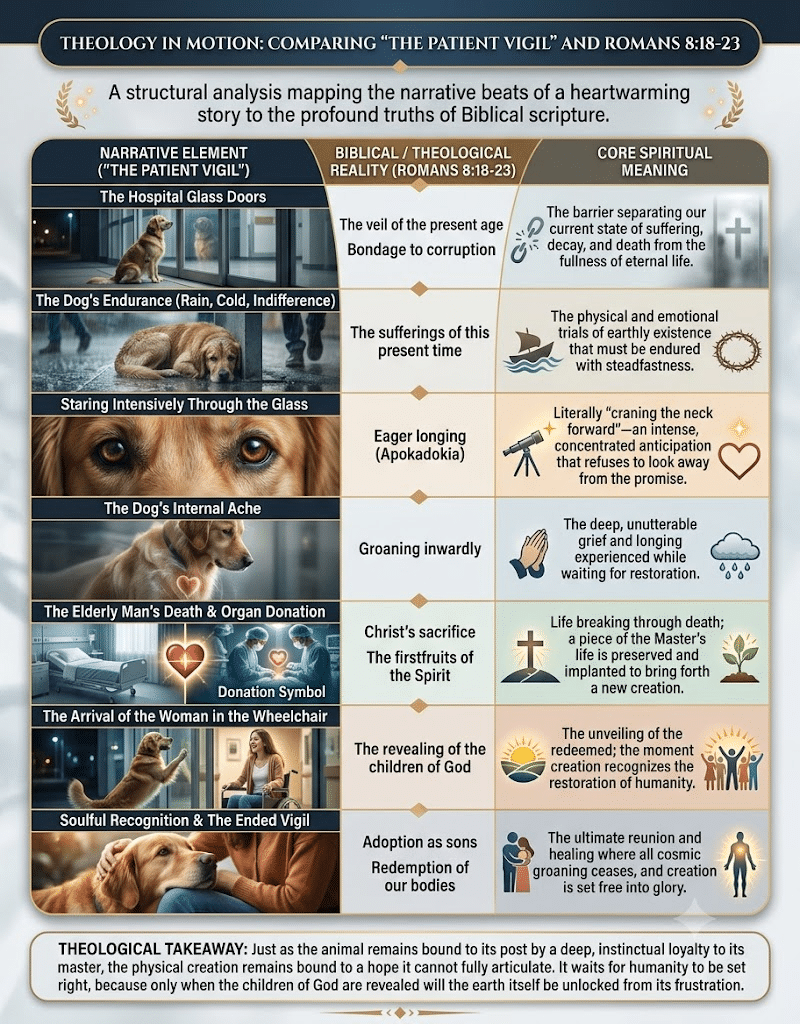
The Scene: “The Patient Vigil”
An elderly man is admitted to a hospital, and his faithful dog follows the ambulance, only to be left waiting outside the glass sliding doors. Days turn into weeks. The dog endures rain, cold nights, and the indifference of passersby, never leaving its post, staring intensely through the glass every time the doors open. Eventually, a young woman in a wheelchair exits the hospital. The dog jumps up, looking into her eyes with immediate, soulful recognition. The commercial reveals that the elderly man passed away, but his organs were donated to this young woman.
The Theological Exposition: Romans 8:18–23 Exegesis
This narrative serves as a poignant, contemporary allegory for the cosmic drama outlined by the Apostle Paul in his letter to the Romans.
1. The Present Suffering and the Bondage to Decay
“For I consider that the sufferings of this present time are not worth comparing with the glory that is to be revealed to us… For the creation was subjected to futility…” (Romans 8:18, 20)
The hospital exterior is a micro-cosmos of a world subjected to futility. The rain, the biting cold, and the social indifference endured by the animal represent the systemic brokenness of our current age. The automated glass doors stand as a stark visual metaphor for the veil of the present era—an impenetrable boundary separating our earthly space of decay and mortality from the unseen realm of ultimate healing and divine presence. The creation finds itself on the outside of the glass, bearing the brunt of a fractured ecosystem and a history scarred by death.
2. The Posture of Apokadokia
“For the creation waits with eager longing for the revealing of the sons of God.” (Romans 8:19)
Paul uses the profound Greek word apokadokia to describe creation’s anticipation. Derived from apo (away from), kara (the head), and dokein (to watch), it literally denotes craning the neck forward—concentrating one’s entire vision on a single point of the horizon while ignoring all distractions.
The dog’s behavior outside the sliding doors is the physical embodiment of apokadokia. It does not look at the food offered by strangers or the shelter of the awning; its head is perpetually snapped toward the opening doors. This is the posture the church and the cosmos are called to maintain: an intense, neck-craning expectation that refuses to accept the current broken reality as final.
3. The Inward Groaning and the Micro-Ark
“For we know that the whole creation has been groaning together in the pains of childbirth until now. And not only the creation, but we ourselves, who have the firstfruits of the Spirit, groan inwardly…” (Romans 8:22-23)
The dog’s silent, shivering endurance represents the inward groaning of the created order. This groaning is not a cynical complaint or a sigh of defeat; Paul categorizes it as the pains of childbirth. It is productive agony.
The animal’s body becomes a vessel of sustained hope. It carries the memory of the Master into a world that has forgotten him. Similarly, believers carry the “firstfruits of the Spirit”—a down payment of the new creation—which does not insulate them from suffering, but rather intensifies their longing for total redemption.
4. The Revealing and Cosmic Adoption
“…as we wait eagerly for adoption as sons, the redemption of our bodies.” (Romans 8:23)
The resolution of the narrative hinges on an unexpected revelation. The dog does not see the old Master return in the form it expected; instead, it recognizes the Master’s life hidden within a new recipient.
This perfectly mirrors the theological climax of Romans 8: the restoration of creation is completely bound up with the revealing of the children of God. The earth is not waiting for a destructive end, nor is it waiting for an abstract spiritual escape. It is waiting for humanity to be fully redeemed, resurrected, and restored to its rightful place. When the young woman steps through the doors carrying the master’s heart, the dog’s vigil ends. When the sons and daughters of God are finally unveiled in their resurrection glory, the groaning of the cosmos will cease, and creation itself will be swept into the freedom of that same glory.