Catholic Digest, Homily Themes
Catholic Digest, Homily Themes
March 8, 2026
March 15, 2026
4th Sunday of Lent (A)



Theology, Apologetics & Evangelization
These channels focus on explaining and defending the Catholic faith, often engaging with modern culture and other viewpoints.
- Bishop Robert Barron (Word on Fire): One of the most influential voices in the Church, offering cultural commentary, movie reviews, and deep theological deep-dives.
- Ascension Presents: A powerhouse channel featuring popular figures like Fr. Mike Schmitz (known for the “Bible in a Year” and “Catechism in a Year” podcasts) and Fr. Josh Johnson, offering accessible videos on faith and life.
- Catholic Answers: The premier channel for Catholic apologetics, featuring live Q&A shows where apologists answer tough questions from callers.
- Pints with Aquinas (Matt Fradd): Long-form interviews and discussions on theology, philosophy, and culture, often over a drink.
- The Counsel of Trent (Trent Horn): Trent Horn, a Catholic Answers apologist, provides rebuttals to atheist and Protestant arguments, as well as commentary on current events.
- Jimmy Akin: A senior apologist at Catholic Answers known for his fairness and deep knowledge, covering everything from bizarre questions to deep theology.
- Breaking In The Habit (Fr. Casey Cole, OFM): A young Franciscan friar who offers fresh, accessible reflections on faith, vocations, and everyday life.
- Thomistic Institute: Excellent, high-quality animated videos and lectures explaining the philosophy and theology of St. Thomas Aquinas.
Spiritual Growth, Prayer & Homilies
Channels dedicated to nurturing your prayer life, offering daily reflections, rosaries, and inspiring homilies.
- Fr. Mark Goring, CC: A charismatic priest who posts daily, short, and passionate videos on current events, prophecies, and spiritual encouragement.
- Divine Mercy (Marian Fathers): The official channel of the Marian Fathers of the Immaculate Conception, promoting the Divine Mercy devotion and message.
- EWTN: The global Catholic network’s channel, featuring daily Mass, the Rosary, news, and a vast library of classic Catholic programming.
- Grace Force (Fr. Richard Heilman): Focuses on spiritual warfare, prayer campaigns like the “54 Day Rosary Novena,” and strengthening the family.
- Sensus Fidelium: A treasure trove of traditional Catholic homilies and talks from various priests, emphasizing classical spirituality.
- Religious Hippie: A young Catholic woman sharing her journey and love for the traditional Latin Mass and pre-Vatican II spirituality.
Lifestyle, Family & Vocations
Resources for living out the faith in daily life, marriage, parenting, and discerning a vocation.
- A Catholic Mom’s Life: Heather Johnson shares practical tips, encouragement, and a glimpse into her life as a Catholic wife and mother.
- Jason & Crystalina Evert: The go-to resource for theology of the body, dating, and living a chaste life.
- The Culture Project: Missionaries who speak to young people about human dignity, sexual integrity, and social media.
- CFRs (Franciscan Friars of the Renewal): The friars share their life of prayer, community, and service to the poor in the Bronx.
- FOCUS Catholic: The Fellowship of Catholic University Students shares talks from their massive SEEK conferences and testimonies from college students.
Education, History & Scripture
Channels that offer deep-dive educational content on the Bible, Church history, and theology.
- St. Paul Center for Biblical Theology (Dr. Scott Hahn): In-depth biblical teaching from one of the world’s leading Catholic Scripture scholars.
- Catholic Productions (Dr. Brant Pitre): Excellent, scholarly yet accessible videos on the Jewish roots of Jesus, the Eucharist, and Mary.
- Augustine Institute: Producer of high-quality video series like “Symbolon” and a vast library of Catholic educational content.
- FORMED: Often called the “Catholic Netflix,” their YouTube channel features clips and trailers from their massive library of movies, studies, and audiobooks.
- Institute of Catholic Culture: Offers hundreds of hours of free, in-depth video lectures on theology, history, philosophy, and literature.
- What Every Catholic Should Know: A channel dedicated to teaching the basics of the Catechism and Catholic tradition.
- Catholic History: Documentaries and presentations on key figures and events in Church history.
40 Days of Spiritual Combat
LENTEN BULLETIN INSERTS SERIES

TWTW Lenten 2026 bulletin series was inspired by a 2020 homily given by Br Samuel Burke, O.P., Battle Ready. It was created with Gemini 3 using Nano Banana.
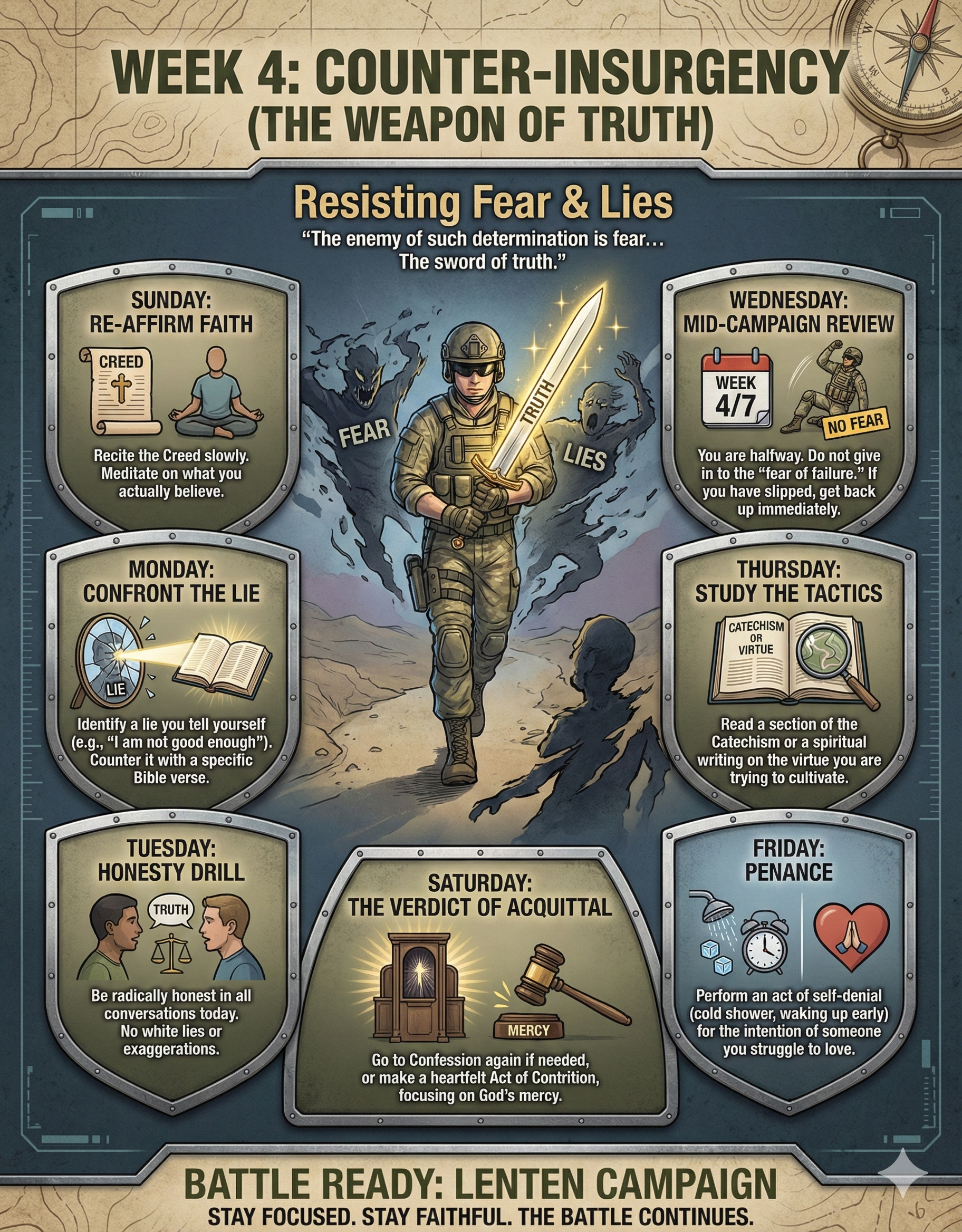
Week 4: Counter-Insurgency (The Weapon of Truth)
Theme: Resisting Fear & Lies
“The enemy of such determination is fear… The sword of truth.”
- Sunday: Re-affirm Faith. Recite the Creed slowly. Meditate on what you actually believe.
- Monday: Confront the Lie. Identify a lie you tell yourself (e.g., “I am not good enough,” “This sin doesn’t matter”). Counter it with a specific Bible verse.
- Tuesday: Honesty Drill. Be radically honest in all conversations today. No white lies or exaggerations.
- Wednesday: Mid-Campaign Review. You are halfway. Do not give in to the “fear of failure.” If you have slipped, get back up immediately.
- Thursday: Study the Tactics. Read a section of the Catechism or a spiritual writing on the virtue you are trying to cultivate.
- Friday: Penance. Perform an act of self-denial (cold shower, waking up early) for the intention of someone you struggle to love.
- Saturday: The Verdict of Acquittal. Go to Confession again if needed, or make a heartfelt Act of Contrition, focusing on God’s mercy.
Available for Download on March 16, 2026 for Week of March 22

Week 5: The Long March (Perseverance)
Theme: Faithfulness over “Winning”
“We don’t have to worry about being the best warrior, only a faithful one.”
- Sunday: Renewed Resolve. Pray for the grace of final perseverance.
- Monday: Embrace the Routine. When prayer feels dry or boring, do it anyway. This is the discipline of the soldier.
- Tuesday: Humility Check. Accept a criticism without being defensive.
- Wednesday: Offer it Up. When you feel tired or irritated, say silently, “Jesus, I join this small suffering to your Cross.”
- Thursday: Gethsemane Watch. Spend extra time in prayer tonight, remembering Jesus’ agony in the garden.
- Friday: Solidarity. Abstain from meat (if your tradition dictates) or a luxury, offering the sacrifice for the persecuted church.
- Saturday: The Shield of Faith. When you feel discouraged, repeat: “Jesus, I trust in You.”
Available for Download on March 23, 2026 for Week of March 29

Holy Week: The Final Assault
Theme: Victory through Surrender
“Victory is promised… to anyone who would fight sin, carry their cross, and follow Jesus.”
- Palm Sunday: Read the Passion narrative. Place yourself in the crowd.
- Monday: Clean House. Prepare your home and heart for Easter.
- Tuesday: Forgiveness. Is there anyone left you haven’t forgiven? Release the grudge today.
- Wednesday: The Betrayal. Reflect on the times you have betrayed Jesus for “silver” (comfort, money, approval).
- Holy Thursday: The Last Supper. Attend Mass/Service. Focus on the Eucharist as your sustenance.
- Good Friday: The Victory. Veneration of the Cross. Fast and abstain. Stand at the foot of the Cross in spirit.
- Holy Saturday: The Tomb. Wait in silence and hope.
Theology, Apologetics & Evangelization
These channels focus on explaining and defending the Catholic faith, often engaging with modern culture and other viewpoints.
- Bishop Robert Barron (Word on Fire): One of the most influential voices in the Church, offering cultural commentary, movie reviews, and deep theological deep-dives.
- Ascension Presents: A powerhouse channel featuring popular figures like Fr. Mike Schmitz (known for the “Bible in a Year” and “Catechism in a Year” podcasts) and Fr. Josh Johnson, offering accessible videos on faith and life.
- Catholic Answers: The premier channel for Catholic apologetics, featuring live Q&A shows where apologists answer tough questions from callers.
- Pints with Aquinas (Matt Fradd): Long-form interviews and discussions on theology, philosophy, and culture, often over a drink.
- The Counsel of Trent (Trent Horn): Trent Horn, a Catholic Answers apologist, provides rebuttals to atheist and Protestant arguments, as well as commentary on current events.
- Jimmy Akin: A senior apologist at Catholic Answers known for his fairness and deep knowledge, covering everything from bizarre questions to deep theology.
- Breaking In The Habit (Fr. Casey Cole, OFM): A young Franciscan friar who offers fresh, accessible reflections on faith, vocations, and everyday life.
- Thomistic Institute: Excellent, high-quality animated videos and lectures explaining the philosophy and theology of St. Thomas Aquinas.
Spiritual Growth, Prayer & Homilies
Channels dedicated to nurturing your prayer life, offering daily reflections, rosaries, and inspiring homilies.
- Fr. Mark Goring, CC: A charismatic priest who posts daily, short, and passionate videos on current events, prophecies, and spiritual encouragement.
- Divine Mercy (Marian Fathers): The official channel of the Marian Fathers of the Immaculate Conception, promoting the Divine Mercy devotion and message.
- EWTN: The global Catholic network’s channel, featuring daily Mass, the Rosary, news, and a vast library of classic Catholic programming.
- Grace Force (Fr. Richard Heilman): Focuses on spiritual warfare, prayer campaigns like the “54 Day Rosary Novena,” and strengthening the family.
- Sensus Fidelium: A treasure trove of traditional Catholic homilies and talks from various priests, emphasizing classical spirituality.
- Religious Hippie: A young Catholic woman sharing her journey and love for the traditional Latin Mass and pre-Vatican II spirituality.
Lifestyle, Family & Vocations
Resources for living out the faith in daily life, marriage, parenting, and discerning a vocation.
- A Catholic Mom’s Life: Heather Johnson shares practical tips, encouragement, and a glimpse into her life as a Catholic wife and mother.
- Jason & Crystalina Evert: The go-to resource for theology of the body, dating, and living a chaste life.
- The Culture Project: Missionaries who speak to young people about human dignity, sexual integrity, and social media.
- CFRs (Franciscan Friars of the Renewal): The friars share their life of prayer, community, and service to the poor in the Bronx.
- FOCUS Catholic: The Fellowship of Catholic University Students shares talks from their massive SEEK conferences and testimonies from college students.
Education, History & Scripture
Channels that offer deep-dive educational content on the Bible, Church history, and theology.
- St. Paul Center for Biblical Theology (Dr. Scott Hahn): In-depth biblical teaching from one of the world’s leading Catholic Scripture scholars.
- Catholic Productions (Dr. Brant Pitre): Excellent, scholarly yet accessible videos on the Jewish roots of Jesus, the Eucharist, and Mary.
- Augustine Institute: Producer of high-quality video series like “Symbolon” and a vast library of Catholic educational content.
- FORMED: Often called the “Catholic Netflix,” their YouTube channel features clips and trailers from their massive library of movies, studies, and audiobooks.
- Institute of Catholic Culture: Offers hundreds of hours of free, in-depth video lectures on theology, history, philosophy, and literature.
- What Every Catholic Should Know: A channel dedicated to teaching the basics of the Catechism and Catholic tradition.
- Catholic History: Documentaries and presentations on key figures and events in Church history.
Stations of the Cross, Station Six: Veronica Wipes the Face of Jesus
Veronica’s act of wiping Jesus’ face during crucifixion exemplifies the power of compassionate love and challenges us to reflect Christ’s image through tender deeds, demonstrating that even small acts of kindness can leave a lasting mark and have a profound impact.
- 00:00 Veronica wipes the face of Jesus in the sixth station of the cross, and her act of kindness is commemorated in St. Peter’s Basilica with a statue and a veil believed to hold the imprint of Jesus’ face.
- 00:39 Veronica’s courageous act of wiping Jesus’ face during crucifixion resulted in his image being imprinted on her veil, symbolizing the power of compassionate love.
- 01:50 When Veronica wipes Jesus’ face, she exemplifies the call to discipleship, recognizing Christ’s face in suffering and responding with mercy, a devotion echoed in St. Francis of Assisi’s love for Christ’s humanity.
- 02:42 Veronica’s tender act of wiping Jesus’ face embodies the selfless love that seeks intimacy with Christ, reflecting his image and transforming her own life.
- 03:45 Veronica’s quiet act of mercy, wiping Jesus’ face, shows that even small acts of love, especially those reaching out to the suffering, are significant to God and challenge us to approach and serve others.
- 04:40 Veronica’s act of wiping Jesus’ face shows that love can break through brutality, leaving a mark stronger than hatred, and reminding us to reflect Christ’s image through tender deeds.
- 05:40 Christ’s compassion calls us to show tenderness, and through prayer, we allow His kindness to shape our own, reflected in the Stations of the Cross, specifically Station Six, where Veronica wipes Jesus’ face.
- 06:34 The prayer invokes the Holy Trinity, glorifying God and seeking continuity from the beginning to the end of time.

Arts and Faith: Fourth Sunday of Lent, Cycle A
El Greco’s painting of Christ healing the blind man conveys the spiritual insight gained through Christ’s healing power and the artist’s own evolving artistic vision.
- 00:00 El Greco’s painting of Christ healing the blind man showcases both the spiritual sight gained by the blind man and the artist’s own developing artistic vision.
- 00:53 Christ’s healing of the blind man is contrasted with the suspicious and protesting Pharisees, highlighting their differing reactions to the miracle.
- 01:16 The composition of the artwork juxtaposes the Pharisees’ assured yet blinded perspective with Christ’s healing power, revealed in the contrast between the obscurity behind the Pharisees and the stable architectural elements behind Christ.
- 02:23 The story invites us to open wider our eyes of faith and become aware of the merciful healing and grace all around us.

Mother Angelica Live – SPIRITUAL BLINDNESS (CALL TO HOLINESS) – 11/19/96
Mother Angelica emphasizes the importance of being aware of and overcoming spiritual blindness in order to live a life of holiness, spread God’s love, and become great saints, by prioritizing obedience to God’s will over fear of human rejection and rigid attachment to rules and traditions.
- 00:00 Mother Angelica urges viewers to seize the opportunity to live in love, be proud to be Catholic, and spread God’s love and forgiveness to become great saints.
- 07:49 Mother Angelica emphasizes spiritual blindness, encouraging self-reflection on personal blind spots and stressing the importance of working towards holiness while we can.
- 12:35 Jesus heals a man born blind, exposing Pharisees’ spiritual blindness, prioritizing rules over miracle.
- 18:39 Spiritual blindness causes people to overlook God’s power and miracles due to rigid attachment to rules and traditions.
- 23:59 Many Catholics fall into spiritual blindness by fearing human rejection more than God’s judgment, and must instead prioritize obeying God’s will and standing up for their faith to live a life of holiness.
- 31:13 Despite being enlightened by God, people can still suffer from spiritual blindness, which Jesus came to heal, showing that true understanding and knowledge come from Him, not human claims to wisdom.
- 35:49 Mother Angelica emphasizes the importance of standing up for truth and the call to holiness amidst spiritual blindness and pressure to conform to worldly values.
- 40:46 Mother Angelica urges viewers to seek holiness, truth, and God’s eternal love, warning against spiritual blindness and deceit from half-truths and distorted doctrine.

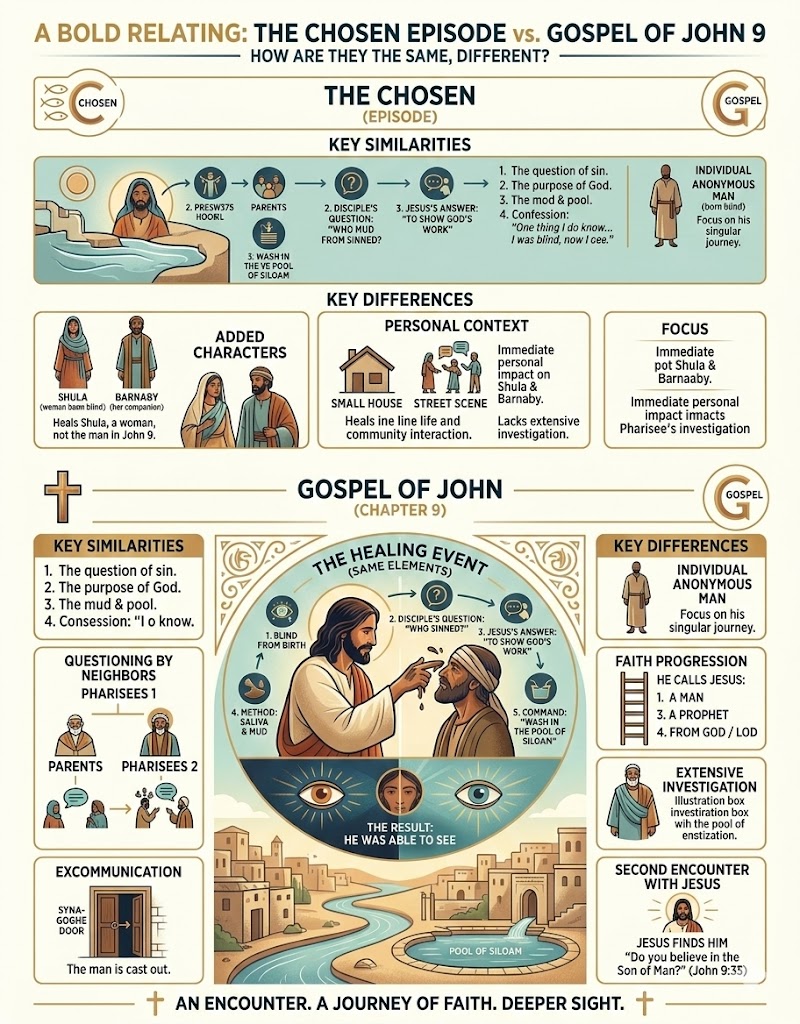
The Chosen

A Man for All Seasons (1966)
A compelling parallel exists between St. Thomas More in the film A Man for All Seasons and the biblical story of the blind man in John 9, highlighting the profound contrast between spiritual sight and worldly blindness. In both narratives, the established power structures—whether King Henry VIII’s court or the Pharisees—are spiritually blind, corrupted by ambition, fear, and the preservation of earthly power. Conversely, More and the blind man possess true vision. More sees eternal realities clearly, recognizing that state law cannot supersede an individual’s conscience before God.
Furthermore, both stories center on hostile interrogations by authorities who seek submission rather than truth. Despite immense pressure, More and the blind man bear unwavering witness to their beliefs. They refuse to bend to the preferred narrative of the powerful, standing firmly by the truth they “see.” Ultimately, this spiritual clarity exacts a severe toll. Just as the blind man is excommunicated from his community, More is systematically stripped of his status, wealth, and freedom. He embraces societal rejection and eventual martyrdom rather than betray his soul, proving that true spiritual sight requires absolute fidelity to the truth, regardless of the earthly cost.

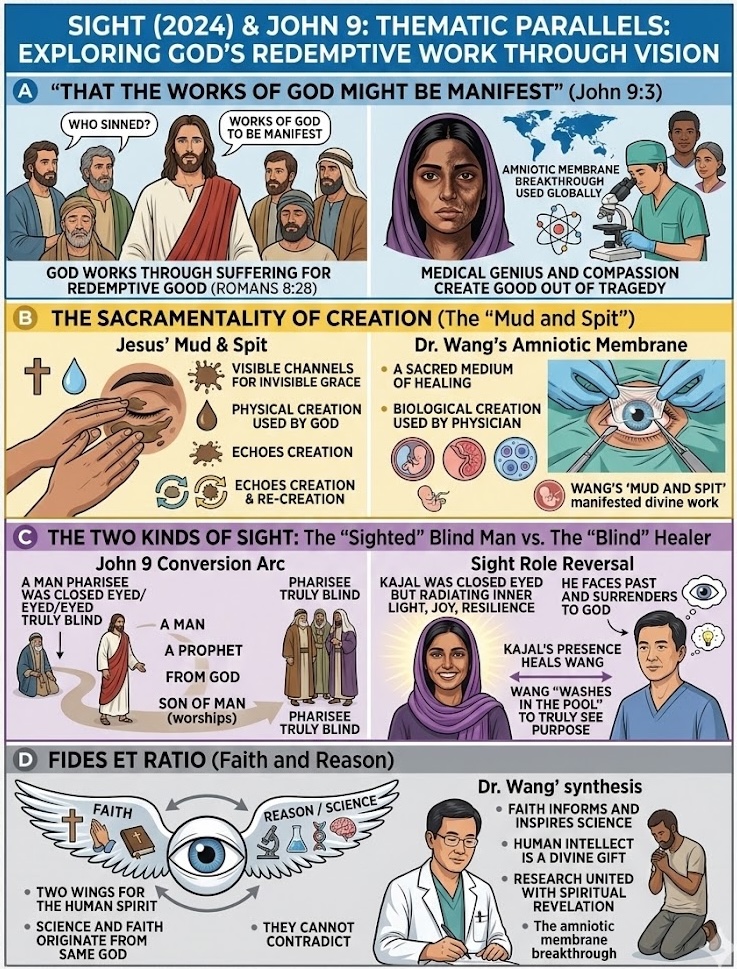
Sight (2024)
The 2024 film Sight serves as a profound modern allegory for the biblical narrative of the blind man in John 9, demonstrating how physical healing acts as a catalyst for spiritual conversion. The story centers on Kajal, a young girl tragically blinded by acid, and Dr. Wang, the brilliant but traumatized surgeon who treats her. Echoing Christ’s teaching, Kajal’s suffering is not portrayed as divine punishment, but rather as a canvas upon which God’s redemptive power and human compassion are made manifest.
The film highlights several key thematic parallels. It beautifully illustrates a sacramental worldview; just as Jesus used physical mud and spit to heal, Dr. Wang utilizes the amniotic membrane as a sacred, biological medium for medical restoration. Furthermore, a profound role reversal occurs: while Kajal lacks physical sight, she possesses radiant spiritual joy. Conversely, the physically sighted Dr. Wang is blinded by his past and must undergo his own spiritual healing before he can truly “see.” Finally, the film champions Faith and Reason (Fides et Ratio), showing that rigorous science and human intellect are divine gifts meant to cooperate with God’s ongoing work of healing creation.
The Light That Heals: A Deacon’s Reflection for the Fourth Sunday of Lent (Year A)
Gospel: John 9:1–41 Theme: I was blind, and now I see.
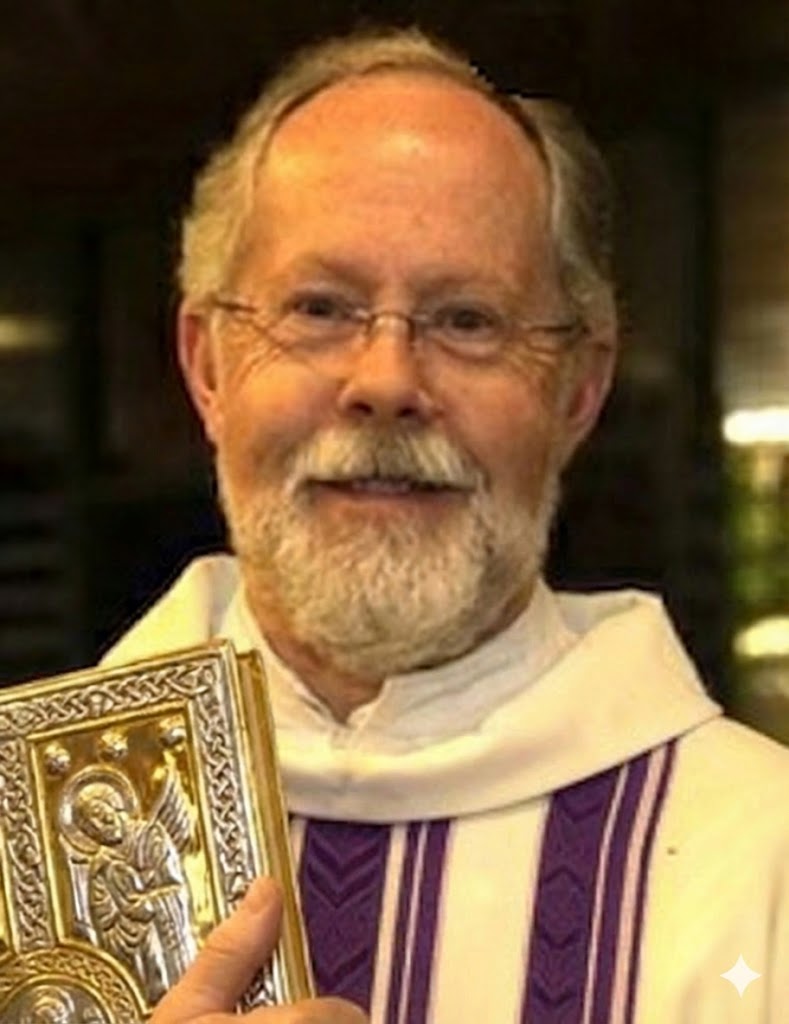
Deacon Peter
McCulloch
(Diocese of Broken Bay)
On this Laetare (Rejoice) Sunday, the liturgy gives us one of the most dramatic signs in John’s Gospel: the healing of the man born blind. This is not just a miracle; it’s a profound catechesis on the journey of faith. The story contrasts two kinds of blindness: the physical blindness of the
man and the spiritual blindness of the Pharisees, who, in their certainty, cannot see the Light of the World standing right in front of them.
Jesus does not just restore sight; He gives insight. The man’s journey moves from physical healing to a courageous public witness, culminating in a declaration of faith: “I do believe, Lord.”
The deacon’s mission is to be a servant of this very light. He is ordained to reflect Christ, in word and in action, to help a world clouded by judgment and fear to see with the clear, healing eyes of faith.

1. The Proclamation of the Light (At the Altar)
The deacon’s liturgical ministry is a direct participation in Christ’s work of illumination.
- Proclaiming the Journey: When the deacon proclaims this long, narrative Gospel, he gives voice to the entire journey of faith. He speaks for the man who “was blind but now I see,” but he also speaks for the “blind” Pharisees. He brings the central drama of Lent, the choice between light and darkness, into the midst of the assembly.
- The Homily of Seeing: The deacon’s preaching on this text is a call to examine the blind spots in the parish’s own vision. Where are we like the Pharisees, blinded by our own judgments, our gossip, or our refusal to see the person in need? The deacon must challenge the community to see with the eyes of Christ.
- The Universal Prayer: The deacon brings the blind of the community to the altar in prayer: those blinded by loneliness, by addiction, by despair, or by a lack of faith. He asks the Light of the World to shine on them.
2. The Ministry of Understanding (In the Parish)
St. Francis of Assisi prayed, “Lord, grant that I may not so much seek to be understood as to understand.” This is the deacon’s pastoral stance. While the Pharisees sought to be understood as the righteous authorities, the deacon must first seek to understand those he serves.
- The Beacon of Gentle Clarity: In parish life – in the RCIA, in pastoral counselling, in a parish council meeting – the deacon is called to be a beacon of gentle clarity. He is the one who must listen before he speaks, to understand the pain or the question behind the person’s words.
- Seeing the Person, Not the Problem: The disciples saw a problem to be analyzed (“Who sinned, this man or his parents?”). But Jesus saw a person to be healed. The deacon is the one who must see the person in the parish: the struggling family, the difficult volunteer, the estranged parishioner. His first act is not to judge, but to see and to serve.
3. The Mud and Spittle of Service (At the Margins)
Jesus healed the man with messy, incarnational things: spit, mud, and water. This is the nature of diakonia. It’s not abstract theory; it’s tangible, hands-on, humble service.
- The Tangible Act of Healing: The deacon’s service is the earthy mud that Jesus uses to open eyes. The bag of food from the pantry, the ride to a doctor’s appointment, the time spent visiting – these are the humble, tangible acts through which Christ’s healing light begins to shine.
- Restoring Sight to the Unseen: The deacon is called to the margins to serve those who are blind to their own dignity: the homeless, the unemployed, the refugee, the overlooked elderly person.
- Christ Still Says “See”: Through the deacon’s gentle, steady and practical service, Jesus is still touching the blind eyes of the world. His diakonia is living proof that the Light still shines in the darkness, healing, restoring, and inviting everyone to say, “I was blind, but now I see.”
Theology, Apologetics & Evangelization
These channels focus on explaining and defending the Catholic faith, often engaging with modern culture and other viewpoints.
- Bishop Robert Barron (Word on Fire): One of the most influential voices in the Church, offering cultural commentary, movie reviews, and deep theological deep-dives.
- Ascension Presents: A powerhouse channel featuring popular figures like Fr. Mike Schmitz (known for the “Bible in a Year” and “Catechism in a Year” podcasts) and Fr. Josh Johnson, offering accessible videos on faith and life.
- Catholic Answers: The premier channel for Catholic apologetics, featuring live Q&A shows where apologists answer tough questions from callers.
- Pints with Aquinas (Matt Fradd): Long-form interviews and discussions on theology, philosophy, and culture, often over a drink.
- The Counsel of Trent (Trent Horn): Trent Horn, a Catholic Answers apologist, provides rebuttals to atheist and Protestant arguments, as well as commentary on current events.
- Jimmy Akin: A senior apologist at Catholic Answers known for his fairness and deep knowledge, covering everything from bizarre questions to deep theology.
- Breaking In The Habit (Fr. Casey Cole, OFM): A young Franciscan friar who offers fresh, accessible reflections on faith, vocations, and everyday life.
- Thomistic Institute: Excellent, high-quality animated videos and lectures explaining the philosophy and theology of St. Thomas Aquinas.
Spiritual Growth, Prayer & Homilies
Channels dedicated to nurturing your prayer life, offering daily reflections, rosaries, and inspiring homilies.
- Fr. Mark Goring, CC: A charismatic priest who posts daily, short, and passionate videos on current events, prophecies, and spiritual encouragement.
- Divine Mercy (Marian Fathers): The official channel of the Marian Fathers of the Immaculate Conception, promoting the Divine Mercy devotion and message.
- EWTN: The global Catholic network’s channel, featuring daily Mass, the Rosary, news, and a vast library of classic Catholic programming.
- Grace Force (Fr. Richard Heilman): Focuses on spiritual warfare, prayer campaigns like the “54 Day Rosary Novena,” and strengthening the family.
- Sensus Fidelium: A treasure trove of traditional Catholic homilies and talks from various priests, emphasizing classical spirituality.
- Religious Hippie: A young Catholic woman sharing her journey and love for the traditional Latin Mass and pre-Vatican II spirituality.
Lifestyle, Family & Vocations
Resources for living out the faith in daily life, marriage, parenting, and discerning a vocation.
- A Catholic Mom’s Life: Heather Johnson shares practical tips, encouragement, and a glimpse into her life as a Catholic wife and mother.
- Jason & Crystalina Evert: The go-to resource for theology of the body, dating, and living a chaste life.
- The Culture Project: Missionaries who speak to young people about human dignity, sexual integrity, and social media.
- CFRs (Franciscan Friars of the Renewal): The friars share their life of prayer, community, and service to the poor in the Bronx.
- FOCUS Catholic: The Fellowship of Catholic University Students shares talks from their massive SEEK conferences and testimonies from college students.
Education, History & Scripture
Channels that offer deep-dive educational content on the Bible, Church history, and theology.
- St. Paul Center for Biblical Theology (Dr. Scott Hahn): In-depth biblical teaching from one of the world’s leading Catholic Scripture scholars.
- Catholic Productions (Dr. Brant Pitre): Excellent, scholarly yet accessible videos on the Jewish roots of Jesus, the Eucharist, and Mary.
- Augustine Institute: Producer of high-quality video series like “Symbolon” and a vast library of Catholic educational content.
- FORMED: Often called the “Catholic Netflix,” their YouTube channel features clips and trailers from their massive library of movies, studies, and audiobooks.
- Institute of Catholic Culture: Offers hundreds of hours of free, in-depth video lectures on theology, history, philosophy, and literature.
- What Every Catholic Should Know: A channel dedicated to teaching the basics of the Catechism and Catholic tradition.
- Catholic History: Documentaries and presentations on key figures and events in Church history.

Infographics were created using Google Gemini 3 and Nano Banana Pro. Inspiration take from Fr. Tony’s Homilies; Non-profits may freely use this infographic in their publications and/or ministry. Please give credit or a shout out to TheWordThisWeek.NET.