
Catholic
Catholic
Catholic

Different
Perspectives
on the Sunday
Readings
IMPORTANT: This page offers a creative synthesis of the biblical text with insights influenced by Catholic theologians and spiritual writers.
For a more comprehensive understanding of the readings, go to
COMMENTARIES
BIBLE STUDIES

LEPER
Leper (LEH-per): A person afflicted with leprosy, a dread disease mentioned in both the O.T. (Lv 13:8, 14:2; 2 Kgs 5:1, 6; 2 Chr 26:21) and the N.T. (Mt 26:6; Mk 1:40; Lk 5:13, 17:12) and subject to strict segregation by Jewish law. Jesus cured the condition often (cf. Lk 7:22), but many are convinced that it was an affliction other than the European malady (curable and only mildly infectious) now known as Hansen’s disease. Cf. CCC 2616
Commentary below, in part, written in collaboration with OpenAI’s GPT-3.5 model.
VERSE BY VERSE COMMENTARY
TOP OF PAGE First Reading | Second Reading | Gospel
Commentary below written in collaboration with OpenAI's GPT-3.5 model.
First Reading Commentary

Verse 1-2: "The Lord said to Moses and Aaron, 'If someone has on his skin a scab or pustule or blotch which appears to be the sore of leprosy, he shall be brought to Aaron, the priest, or to one of the priests among his descendants.'"
In these verses, the Lord instructs Moses and Aaron regarding the detection of leprosy and the role of the priest in examining those suspected of having the disease. This demonstrates the ancient cultural practices and the role of the priest in making determinations about a person's condition.
"The Church is hierarchical, just as Moses, Aaron, and the priests played key roles in the religious observances of the Israelites, so too do the bishops, presbyters, and deacons in the worship and service of Catholics today." - Fr. Robert Barron
"The priest stands between God and man. He knows all God's wonderful gifts to man, for he also knows man's sins." - Fulton J. Sheen
Verse 44-46: "The man is a leper: he is unclean. The priest shall declare him unclean; he is suffering from a sore of the head or chin. Anyone with a sore, or any bald man, or one who, having an uncleanness of the body caused by a sore or a scab, is marked by it, shall declare himself unclean. Such a one is suffering from an affliction of leprosy and shall be unclean. As long as the sore is on him he shall declare himself unclean, since he is in fact unclean. He shall dwell apart, making his abode outside the camp."
These verses describe the isolation and social exclusion that comes with being declared unclean due to leprosy. It reflects the cultural and theological significance of maintaining purity and holiness within the community. The act of dwelling outside the camp signifies the separation between the unclean and the clean, reflecting the importance of maintaining spiritual and physical boundaries.
This highlights the moral aspect of the law, emphasizing the need for separation from impurity and the importance of maintaining the sanctity of the community.
"Catholic culture emphasizes purity and the need to separate oneself from sin and impurity, just as the lepers were required to dwell apart. This reminds us of the need for repentance and spiritual healing in the Catholic Church." - Pope Benedict XVI
"Catholic morality is not a series of onerous obligations to subdue us, but rather the positive response to God's love, who calls us to seek the fullness of life in Christ." - Pope Francis
SOURCE: Content written in collaboration with OpenAI's GPT-3.5 model. If you find an error or would like to add content or edit page, don't hesitate to use contact button below. Excerpts from the Lectionary for Mass for Use in the Dioceses of the United States of America, second typical edition © 2001, 1998, 1997, 1986, 1970 Confraternity of Christian Doctrine, Inc., Washington, DC. Used with permission.
TOP OF PAGE First Reading | Second Reading | Gospel

Commentary below written in collaboration with OpenAI's GPT-3.5 model.
2nd Reading Commentary

Verse 10:31: "So whether you eat or drink, or whatever you do, do everything for the glory of God."
This verse emphasizes the importance of living a life fully directed towards God's glory in all aspects.
The Catholic Church, throughout its history, has emphasized the idea of offering one's actions, including the simplest and most routine ones, as a means of glorifying God and sanctifying oneself.
"The glory of God is the human person fully alive." - Saint Irenaeus of Lyons
"The Christian should be an alter Christus, another Christ who is in the world to sanctify all things and transform them into God's glory." - Saint John Paul II
Verse 32: "Avoid giving offense, whether to Jews or Greeks or the church of God."
This verse highlights the importance of avoiding actions that may cause scandal or offense to others, regardless of their religious background.
In Catholicism, this principle of respecting others and fostering unity has been a central aspect of evangelization and ecumenical dialogue throughout history.
The Catechism affirms this principle in paragraph 2284, stating that we should "become more watchful over ourselves and form a more exacting judgment of our own faults" in order to "avoid leading others into moral error."
"To live in peace, we must be peacemakers, and this begins within our own hearts and extends to others, regardless of their beliefs." - Pope Benedict XVI
Verse 33: "Just as I try to please everyone in every way, not seeking my own benefit but that of the many, that they may be saved."
Paul emphasizes his commitment to selflessly serve others, with the ultimate goal of bringing salvation to as many as possible.
This mirrors the mission of the Catholic Church throughout history, which has sought to proclaim the Gospel and lead souls to Christ through acts of love and self-sacrifice.
The Catechism reflects a similar sentiment in paragraph 1923, stating that "those who exercise authority should do so as a service."
"The Church exists for no other purpose but to draw souls to Christ, to make them share in eternal life, and to form them according to the model of the Divine Master." - Saint John Baptiste de La Salle
Verse 11:1: "Be imitators of me, as I am of Christ."
Paul calls the Corinthians to imitate his example, as he himself imitates Christ.
Catholicism recognizes the importance of having virtuous and holy role models within the faith. The saints, who have exemplified Christ's teachings throughout the centuries, are venerated and imitated as models of holiness and discipleship.
The Catechism echoes this call to imitate Christ in paragraph 1694, stating that "by our prayer and example, we perform the works of the Father who is in heaven." The Catechism further emphasizes the importance of imitating Christ and following the examples of the saints in paragraphs 2683 and 2685. It encourages us to look to their lives as models of holiness, following their virtuous actions and seeking to conform ourselve
"The saints are like living mirrors in a palace, reflecting the light of God to the world." - Saint John Vianney
SOURCE: Content written in collaboration with OpenAI's GPT-3.5 model. If you find an error or would like to add content or edit page, don't hesitate to use contact button below. Excerpts from the Lectionary for Mass for Use in the Dioceses of the United States of America, second typical edition © 2001, 1998, 1997, 1986, 1970 Confraternity of Christian Doctrine, Inc., Washington, DC. Used with permission.
TOP OF PAGE First Reading | Second Reading | Gospel
Commentary below written in collaboration with OpenAI’s GPT-3.5 model.
Gospel Commentary

Verse 40: “A leper came to him and kneeling down begged him and said, ‘If you wish, you can make me clean.'”
In this verse, we witness a leper approaching Jesus, humbling himself and begging for healing. This encounter reflects the culture of the time, where people affected by diseases, such as leprosy, were marginalized and considered unclean.
Catholic Church history recognizes the importance of compassion for the marginalized and the sick, and this verse reminds us of the Church’s ongoing mission to bring healing and restoration to those in need.
“The Church is not a museum for good people; it is a hospital for the wounded.” – Pope Francis
Father James Martin, S.J. has described LGBTQ people in the church as being treated like modern-day lepers, “mocked, insulted, excluded, condemned or singled out for critique, either privately or from the pulpit.”
Verse 41: “Moved with pity, he stretched out his hand, touched him, and said to him, ‘I do will it. Be made clean.'”
Here, we witness Jesus’ compassion and willingness to heal the leper. His act of stretching out His hand and touching the leper demonstrates the profound love and mercy of God.

In Catholic Church history, we see numerous instances of saints and religious figures imitating Christ’s example by reaching out to the sick and offering them care and healing.
“Jesus touches every person, without exception, with His healing and comforting hands.” – Saint Teresa of Calcuta
This act reflects the teaching of the Catechism in paragraph 1503, which explains that through His healing actions, Jesus proves His divine identity and reveals the merciful love of God, who desires to restore us to health and wholeness.
Verse 42: “The leprosy left him immediately, and he was made clean.”
This verse portrays the immediate healing power of Christ.
Just as the leper was instantly cleansed from his disease, Catholic Church history is filled with accounts of miraculous healings and conversions through the intercession of saints and the power of the sacraments.
“The Catholic Church, uniting the divine and the human, the eternal with time, always brings forth heroes.” – Ven. Fulton J. Sheen
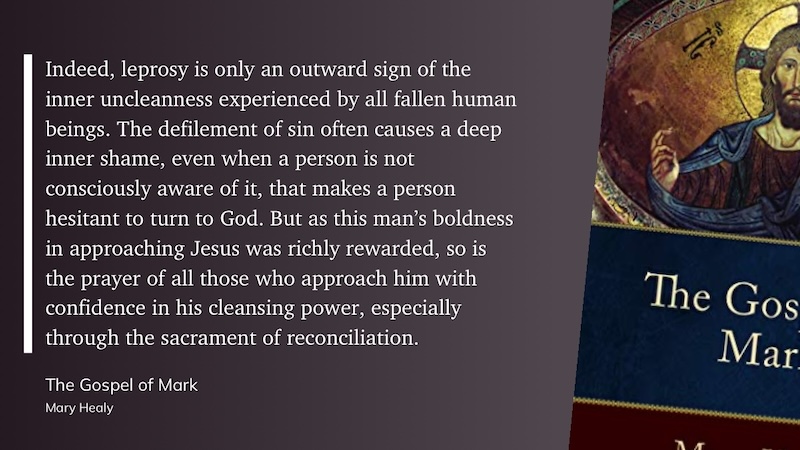
“Jesus, takes from us our diseased humanity and we take from him his sound and healing humanity. This happens each time we receive a sacrament with faith: the Lord Jesus “touches” us and grants us his grace. In this case we think especially of the Sacrament of Reconciliation, which heals us from the leprosy of sin.” – Pope Francis
Verse 43-45: “Then, warning him sternly, he dismissed him at once. He said to him, ‘See that you tell no one anything, but go, show yourself to the priest and offer for your cleansing what Moses prescribed; that will be proof for them.’ The man went away and began to publicize the whole matter.”
Jesus instructs the healed leper to follow the prescribed requirements of the Mosaic law by presenting himself to the priest for validation. However, the man disobeys and instead proclaims his healing to everyone he encounters. This reflects a tension between the legal requirements of the old covenant and the excitement and enthusiasm of encountering Christ in the new covenant.
In Catholic Church history, we observe shifts in emphasis between legalistic practices and more charismatic expressions of faith throughout different eras.
“The Church must never forget that its mission is the Kingdom of God, not a legalistic code or ethic.” – Cardinal Avery Dulles
In relation to the Catechism, this verse can serve as a reminder of the importance of adhering to Christ’s commands and respecting His authority, even when it may seem more convenient or appealing to do otherwise, as highlighted in CCC 832, which underscores the need for unity and communion with the Church in all aspects of our lives.
SOURCE: Content written in collaboration with OpenAI’s GPT-3.5 model. If you find an error or would like to add content or edit page, don’t hesitate to use contact button below. Excerpts from the Lectionary for Mass for Use in the Dioceses of the United States of America, second typical edition © 2001, 1998, 1997, 1986, 1970 Confraternity of Christian Doctrine, Inc., Washington, DC. Used with permission.
HOME | COMMENTARY | BIBLE STUDY | CONNECTIONS
