February 11, 2024
COMMENTARIESBIBLE STUDIESVOICES
Fr. Francis MartinHector MolinaKieran O'MahonyBrant Pitre
Jesus, the VictimThe Real Leprosy' FootstepsReconciliationJesus Heals with His Body

SOURCE: The Word of the Lord: Reflections on the Sunday Mass Readings for Year B

Commentary Summary

The Word of the Lord: Reflections on the Sunday Mass Readings for Year B, John Bergsma (pp. 255-256)

In his commentary on the Gospel reading, John Bergsma focuses on the story of the leper who is healed by Jesus. After being healed, the leper disobeys Jesus' instruction to remain quiet and instead spreads the word about his healing, causing Jesus to become a "celebrity" and attracting crowds who are more interested in witnessing miracles than in the content of Jesus' teachings.

Bergsma suggests that Jesus may have initially wanted to quietly heal the leper in order to provide a persuasive witness to the Temple priests and other public authorities who would be more impressed by discreet acts of healing and adherence to divine regulations for worship. Jesus was strategic in his ministry, investing most of his time and effort in training his small group of Apostles rather than attracting crowds.

The commentator notes that Jesus displays ambivalence toward working miracles and often tries to keep them quiet. He shares a personal anecdote of witnessing a miracle that initially led to a man's fervent devotion but later did not bear lasting fruit, as the man eventually stopped attending church. Bergsma suggests that miracles, while they can provide consolation, do not always lead to a transformed and holy life.

Bergsma argues that the real leprosy is internal, not external. He emphasizes that what separates us from communion with God and others is something within ourselves. He suggests that Christ's presence in the Eucharist, if we have faith, has the power to heal the internal disease and transform us to live lives of love and selflessness for the benefit of others.

SOURCE: The Gospel of Mark (Catholic Commentary on Sacred Scripture)

Commentary Summary

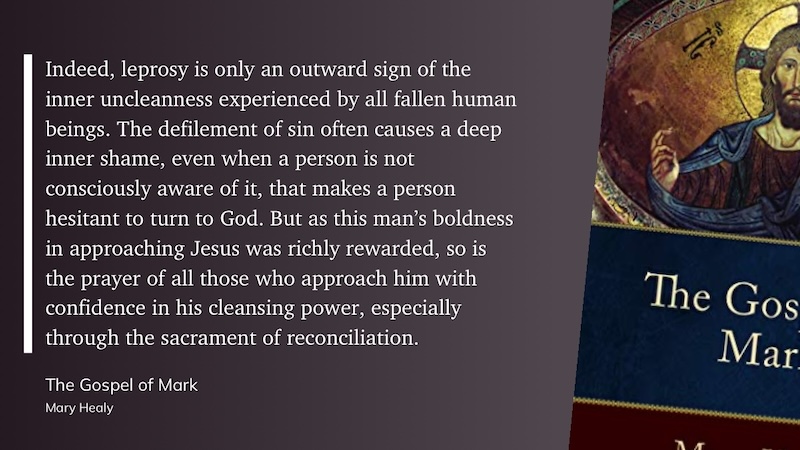
Gospel of Mark, The (Catholic Commentary on Sacred Scripture, Mary Healy

Mary Healy discusses the significance of leprosy in the Gospel of Mark. She notes that while leprosy may no longer be prevalent in developed nations, the social stigma and loneliness experienced by those with various physical or interior afflictions, such as AIDS or mental illnesses, remains widespread.
Healy argues that leprosy serves as an outward symbol of the inner uncleanness experienced by all fallen human beings due to sin. This defilement of sin often leads to a deep inner shame that makes individuals hesitant to turn to God. However, she highlights that just as the man with leprosy in the Gospel approached Jesus with boldness and was rewarded, all those who approach Him with confidence in His cleansing power, especially through the sacrament of reconciliation, will be heard.

Healy emphasizes that Jesus is not dismayed, scandalized, or contaminated by any human defilement. He willingly removes this defilement through the power of His own holiness, restoring our communion with others and making us fully qualified to enter into God's presence. This highlights the profound mercy and healing that can be found in approaching Jesus with trust and confidence in His ability to cleanse and restore.

SOURCE: Word Made Flesh: A Companion to the Sunday Readings (Cycle B)

Commentary Summary

Word Made Flesh: A Companion to the Sunday Readings (Cycle B), Christopher West

In his book "Word Made Flesh," Christopher West reflects on the story of the leper who approached Jesus and begged to be made clean. He highlights the immense isolation and rejection that lepers faced in biblical times, as they were forced to live outside the camp. Moreover, because people believed leprosy was a consequence of sin, lepers would also bear a deep sense of shame.

Despite these cultural taboos, the leper’s heartfelt cry compelled him to approach Jesus, who was moved with pity. Jesus stretched out His hand, broke societal norms, and touched the leper, saying, "I do will it. Be made clean." This physical touch was significant because lepers were never touched by others. Jesus heals us by physically touching our bodies with His own.

West draws a parallel between the leper's experience and our own struggles. He posits that we all have leprous places in our hearts—areas of isolation, rejection, and shame that we hide and feel unworthy of anyone's attention. West challenges us to break the taboos that prevent us from coming to Jesus, kneeling before Him, and begging Him to touch those wounded areas. He acknowledges our desperate need for the power of Jesus' loving touch.

Fr. George Corrigan, OFM

RECENT
YEAR B


Fr. Corrigan, OFM

2024 - RECENT2018MARK (COMMENTARIES)

This page is an easy place to access the commentaries that I have prepared for the Gospel of Mark. The commentaries are arranged by Liturgical Year B order. It is not a complete coverage of the Gospel… but who knows… maybe one day. You are free to download and use for Bible Study, to evangelize, or anything that gives Glory to God. Enjoy.

Agape Bible Commentary

6th Sunday of Year B

INTRODUCTION

1st Reading: The Law Concerning Leprosy

In the First Reading, God commands Moses and Aaron to judge whether a skin lesion was contagious. It was a tragedy for a covenant member to be diagnosed with a skin disease like leprosy. They were expelled from the community and forced to live alone or in groups with others in the same physically "unclean" state (Lk 17:12). They were required to show physical signs of their forced separation by shaving their heads, wearing torn garments, and covering their beards, all signs of death, penance, and mourning (Lev 10:6; Ez 24:17). They could not offer sacrifices in the desert Sanctuary, nor, in Jesus' time, could they join the congregations of the local Synagogues or worship in the Jerusalem Temple because their unclean condition made them "unfit" for communal worship.

Michal E Hunt, Copyright © 2014; revised 2023 Agape Bible Study; used with permission

Responsorial: Turn to God for Restoration from Sin

Like the psalmist in the Responsorial Psalm, we come before the Lord in the liturgy of worship to express repentance for our sins and, through His priestly representative, to offer God our sincere confession in the Penitential Rite. We seek forgiveness for our venial sins and the restoration of fellowship (mortal sins are forgiven in the Sacrament of Reconciliation). We acknowledge that sin is both the act and its injurious consequences. The psalmist reminds us that the humble contrition of the penitent sinner leads to forgiveness, and blessed is the sinner who experiences God's mercy and forgiveness, allowing fellowship with a cleansed soul and a sincere heart.

Michal E Hunt, Copyright © 2014; revised 2023 Agape Bible Study; used with permission

2nd Reading: For the Glory of God

In the Second Reading, St. Paul reminds us that every Christian is morally responsible for his actions and the negative or positive influence his actions might have on others. All human efforts should give glory to God by living "in imitation of Christ." In this way, others who view your life as sanctified to God may be encouraged to follow your example, which could lead them to a relationship with Christ and their eternal salvation.

Michal E Hunt, Copyright © 2014; revised 2023 Agape Bible Study; used with permission

Gospel: Jesus Heals and Cleanses a Leper

In the Gospel Reading, Jesus stretches out His hand, pronounces His divine word, and cleanses a leper, restoring him to his community and making him fit to offer God worship in the Temple.  The same miracle happens in the Sacrament of Reconciliation (Penance).  We confess our sins to the Lord, and through the outstretched hand and divine word spoken by the priest in Jesus' name, the Lord God takes away the "uncleanness" of our sins and restores us to fellowship with Him and the covenant community.

Like the repentant sinner in our Psalm Reading, we should rejoice in the Lord because He has forgiven us.  And like the lepers in the First and Gospel Readings, we should show our gratitude by praising God, sharing the good news of His mercy and forgiveness, and by making a personal commitment to believe in Him and obedience to His commands.  We should testify to our spiritual healing by living in holiness, renouncing sin, and demonstrating in our actions our love for God and our neighbor (Mt 22:36-40).  As St. Paul wrote in the Second Reading, we should show our gratitude to the Lord by doing even the littlest acts that give glory to God so that others who see our example might believe and be saved.

Michal E Hunt, Copyright © 2014; revised 2023 Agape Bible Study; used with permission

Gospel in Depth

Notice that there is a sacramental quality to Jesus healing the man. Jesus stretches out His hand (verse 41), just as God, by His "outstretched hand," performed mighty acts to save the Israelites in the Exodus experience and in other glorious deeds in the history of the covenant people (Ex 13:9; 14, 16; 15:6; etc., and as Jesus' disciples prayed in Acts 4:30). His divine word accompanies this ritual sign as Jesus says, "I will do it. Be made clean." And like God's divine words that brought about the Creation event (Gen 1:3, 6, 9, 11, 14, 20, 24, 26, 28, 29; Ps 33:9; Is 48:13), Jesus' words brought about what He commanded (Jn 1:1-5), whether in healing a leper, raising the dead (Mt 9:24-26/Mk 5:41-42; Lk 7:14-15; Jn 11:43-44), or changing bread and wine into His Body and Blood (Mt 26:26-28; Mk 14:22-25; Lk 22:19-20).

44 Then he said to him, "See that you tell no one anything, but go, show yourself to the priest and offer for your cleansing what Moses prescribed; that will be proof for them."

Jesus asks the man to keep secret the source of his healing.  This event is the first instance of what Biblical scholars call the "messianic secret" in Mark's Gospel, where Jesus insists on concealing His true identity until the time He chooses to make the revelation.

Notice that Jesus tells the man to show himself to a priest (according to the Law in Lev 14:1-20). The old Sinai Covenant and its laws are still in place and will remain until Jesus fulfills the old and replaces it with the New Covenant (Lk 22:20; Heb 8:7, 13). In the meantime, Jesus is obedient to the old covenant Law (Mt 5:17-20). Jesus told the man to show himself to a priest because he has the power under the Law to confirm the man's healing. Then, under the priest's direction, on the eighth day after his examination, the man could return to the Temple to perform the ritual of purification, offer the necessary sacrifices, be restored to the community, and returned to fellowship with God (Lev 14:10).

Michal E Hunt, Copyright © 2014; revised 2023 Agape Bible Study; used with permission

LEARN MORE

Compiled by
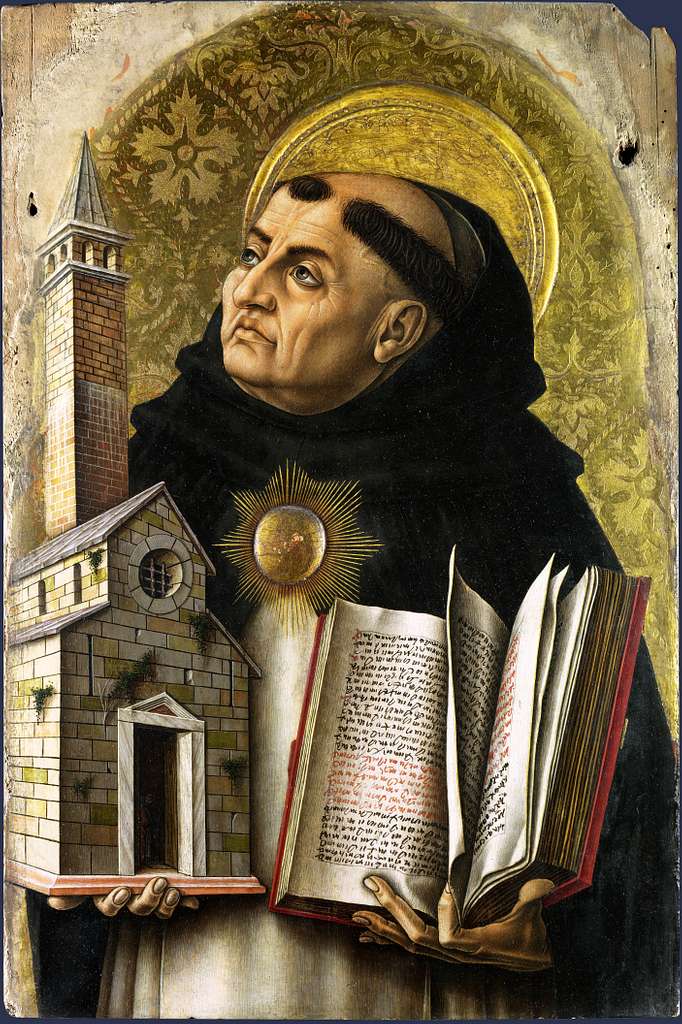
St. Thomas
Aquinas


Thomas Aquinas compiled this opus from sermons and commentaries on the Gospels written by the early Church Fathers, arranging their thoughts in such a way that they form a continuous commentary on each Gospel.

1:40–45

40. And there came a leper to him, beseeching him, and kneeling down to him, and saying unto him, If thou wilt, thou canst make me clean.

41. And Jesus, moved with compassion, put forth his hand, and touched him, and saith unto him, I will; be thou clean.

42. And as soon as he had spoken, immediately the leprosy departed from him, and he was cleansed.

43. And he straitly charged him, and forthwith sent him away;

44. And saith unto him, See thou say nothing to any man: but go thy way, shew thyself to the Priest, and offer for thy cleansing those things which Moses commanded, for a testimony unto them.

45. But he went out, and began to publish it much, and to blaze abroad the matter, insomuch that Jesus could no more openly enter into the city, but was without in desert places: and they came to him from every quarter.

BEDE. (in Marc. i. 7) After that the serpent-tongue of the devils was shut up, and the woman, who was first seduced, cured of a fever, in the third place, the man, who listened to the evil counsels of the woman, is cleansed from his leprosy, that the order of restoration in the Lord might be the same as was the order of the fall in our first parents; whence it goes on: And there came a leper to him, beseeching him.

AUGUSTINE. (de Con. Evan. ii. 19) Mark puts together circumstances, from which one may infer that he is the same as that one whom Matthew (Matt. 8:2) relates to have been cleansed, when the Lord came down from the mount, after the sermon.

BEDE. (in Marc. i. 9) And because the Lord said that He came not to destroy the Law but to fulfill, (Matt. 5:17) he who was excluded by the Law, inferring that he was cleansed by the power of the Lord, shewed that that grace, which could wash away the stain of the leper, was not from the Law, but over the Law. And truly, as in the Lord authoritative power, so in him the constancy of faith is shewn; for there follows, Lord, if thou wilt, thou canst make me clean. He falls on his face, which is at once a gesture of lowliness and of shame, to shew that every man should blush for the stains of his life. But his shame did not stifle confession; he shewed his wound, and begged for medicine, and the confession is full of devotion and of faith, for he refers the power to the will of the Lord.

THEOPHYLACT. For he said not, If thou wilt, pray unto God, but, If thou wilt, as thinking Him very God.

BEDE. (ubi sup.) Moreover, he doubted of the will of the Lord, not as disbelieving His compassion, but, as conscious of his own filth, he did not presume. It goes on; But Jesus, moved with compassion, put forth his hand, and touched him, and saith unto him, I will, be thou clean. It is not, as many of the Latins think, to be taken to mean and read, I wish to cleanse thee, but that Christ should say separately, I will, and then command, be thou clean.

CHRYSOSTOM. (Hom. 25. in Matt) Further, the reason why He touches the leper, and did not confer health upon him by word alone, was, that it is said by Moses in the Law, that he who touches a leper, shall be unclean till the evening; that is, that he might shew, that this uncleanness is a natural one, that the Law was not laid down for Him, but on account of mere men. Furthermore, He shews that He Himself is the Lord of the Law; and the reason why He touched the leper, though the touch was not necessary to the working of the cure, was to shew that He gives health, not as a servant, but as the Lord.

BEDE. (ubi sup.) Another reason why He touched him, was to prove that He could not be defiled, who freed others from pollution. At the same time it is remarkable, that He healed in the way in which He had been begged to heal. If thou will, says the leper, thou canst make me clean. I will, He answered, behold, thou hast My will, be clean; now thou hast at once the effect of My compassion.

CHRYSOSTOM. (Hom. 25. in Matt) Moreover, by this, not only did He not take away the opinion of Him entertained by the leper, but He confirmed it; for He puts to flight the disease by a word, and what the leper had said in word, He filled up in deed; wherefore there follows, And when he had spoken, immediately, &c.

BEDE. (ubi sup.) For there is no interval between the work of God and the command, because the work is in the command, for He commanded, and they were created. (Ps. 148:5) There follows: And he straitly charged him, and forthwith, &c. See thou tell no man.

CHRYSOSTOM. (Hom. 25) As if He said, It is not yet time that My works should be preached, I require not thy preaching. By which He teaches us not to seek worldly honour as a reward for our works. It goes on: But go thy way, shew thyself to the chief of the priests. Our Saviour sent him to the priest for the trial of his cure, and that he might not be cast out of the temple, but still be numbered with the people in prayer. He sends him also, that he might fulfil all the parts of the Law, in order to stop the evil-speaking tongue of the Jews. He Himself indeed completed the work, leaving them to try it.

BEDE. (ubi sup.) This He did in order that the priest might understand that the leper was not healed by the Law, but by the grace of God above the Law. There follows: And offer for thy cleansing what. Moses, &c.

THEOPHYLACT. He ordered him to offer the gift which they who were healed were accustomed to offer, as if for a testimony, that He was not against the Law, but rather confirmed the Law, inasmuch as He Himself worked out the precepts of the Law.

BEDE. (ubi sup.) If any one wonders, how the Lord seems to approve of the Jewish sacrifice, which the Church rejects, let him remember, that He had not yet offered His own holocaust in His passion. And it was not right that significative sacrifices should be taken away, before that which they signified was confirmed by the witness of the Apostles in their preaching, and by the faith of the believing people.

THEOPHYLACT. But the leper, although the Lord forbade him, disclosed the benefit, wherefore it goes on: But he having gone out, began to publish and to blaze abroad the tale; for the person benefited ought to be grateful, and to return thanks, even though his benefactor requires it not.

BEDE. (ubi sup. v. Greg. Moral. 19:22) Now it may well be asked, why our Lord ordered His action to be concealed, and yet it could not be kept hid for an hour? But it is to be observed, that the reason why, in doing a miracle, He ordered it to be kept secret, and yet for all that it was noised abroad, was, that His elect, following the example of His teaching, should wish indeed that in the great things which they do, they should remain concealed, but should nevertheless unwillingly be brought to light for the good of others. Not then that He wished any thing to be done, which He was not able to bring about, but, by the authority of His teaching, He gave an example of what His members ought to wish for, and of what should happen to them even against their will.

BEDE. Further, this perfect cure of one man brought large multitudes to the Lord; wherefore it is added, So that he could not any more openly enter into the city, but could only be without in desert places.

CHRYSOSTOM. (non occ.) For the leper every where proclaimed his wonderful cure, so that all ran to see and to believe on the Healer; thus the Lord could not preach the Gospel, but walked in desert places; wherefore there follows, And they came together to him from all places.

PSEUDO-JEROME. Mystically, our leprosy is the sin of the first man, which began from the head, when he desired the kingdoms of the world. For covetousness is the root of all evil; wherefore Gehazi, engaged in an avaritious pursuit, is covered with leprosy.

BEDE. (ubi sup.) But when the hand of the Saviour, that is, the Incarnate Word of God, is stretched out, and touches human nature, it is cleansed from the various parts of the old error.

PSEUDO-JEROME. This leprosy is cleansed on offering an oblation to the true Priest after the order of Melchisedec; for He tells us, Give alms of such things as ye have, and, behold, all things are clean unto you. (Luke 11:41) But in that Jesus could not openly enter into the city, it is meant to be conveyed, that Jesus is not manifested to those, who are enslaved to the love of praise in the broad highway, and to their own wills, but to those who with Peter go into the desert, which the Lord chose for prayer, and for refreshing His people; that is, those who quit the pleasures of the world, and all that they possess, that they may say, The Lord is my portion. But the glory of the Lord is manifested to those, who meet together on all sides, that is, through smooth ways and steep, whom nothing can separate from the love of Christ. (Rom. 8:35)

BEDE. (in Marc. i. 10) Even after working a miracle in that city, the Lord retires into the desert, to shew that He loves best a quiet life, and one far removed from the cares of the world, and that it is on account of this desire, He applied Himself to the healing of the body.

ORIGINAL: e-Catholic 2000

Richard Niell
Donovan

Mark 1:40-45 Exegesis

RICHARD NIELL DONOVAN was a Disciples of Christ clergyman who published SermonWriter, for a paid subscription, from 1997-2020. After he died, his family has generously provided his resources without subscription.