Children’s Liturgy of the Word and catechetical resources for 1st Sunday of Lent A Sunday Readings; perfect for families, bible study, religion teachers, and Catholic schools!

Children, Catholic Home School, Children’s Liturgy of the Word, Catholic Home School

Children, Catholic Home School, Children’s Liturgy of the Word, Catholic Home School

February 22, 2026

February 22, 2026

1st Sunday of Lent (A)

BIBLE BAGHEIDI WITTEUGANDA UTVFATHER GLENNBIG AL & FR. JOEMARK 10 MISSION
YouTube player
TIMESTAMPED SUMMARY
KEY THEMES: INFOGRAPHIC

THE WORD THIS WEEK infographics are created using using GOOGLE’S AI Gemini 3 Pro. You are free to use the above infographic in any non-profit ministry. Please give credit to TheWordThisWeek.net and Mary Jo Cole which contributed content.

YouTube player
TIMESTAMPED SUMMARY
KEY THEMES: INFOGRAPHIC

This TWTW infographics was created using Nano Banana Pro with Gemini 3.0. It ihighlights key themes of the video from Jared Dees (above), but is not officially associated with or endorsed by him. It may be copied for personal use or for use in any non-profit ministry. Please give credit to TheWordThisWeek.net and Heidi Witte - Kid's Liturgy.

YouTube player
TIMESTAMPED SUMMARY
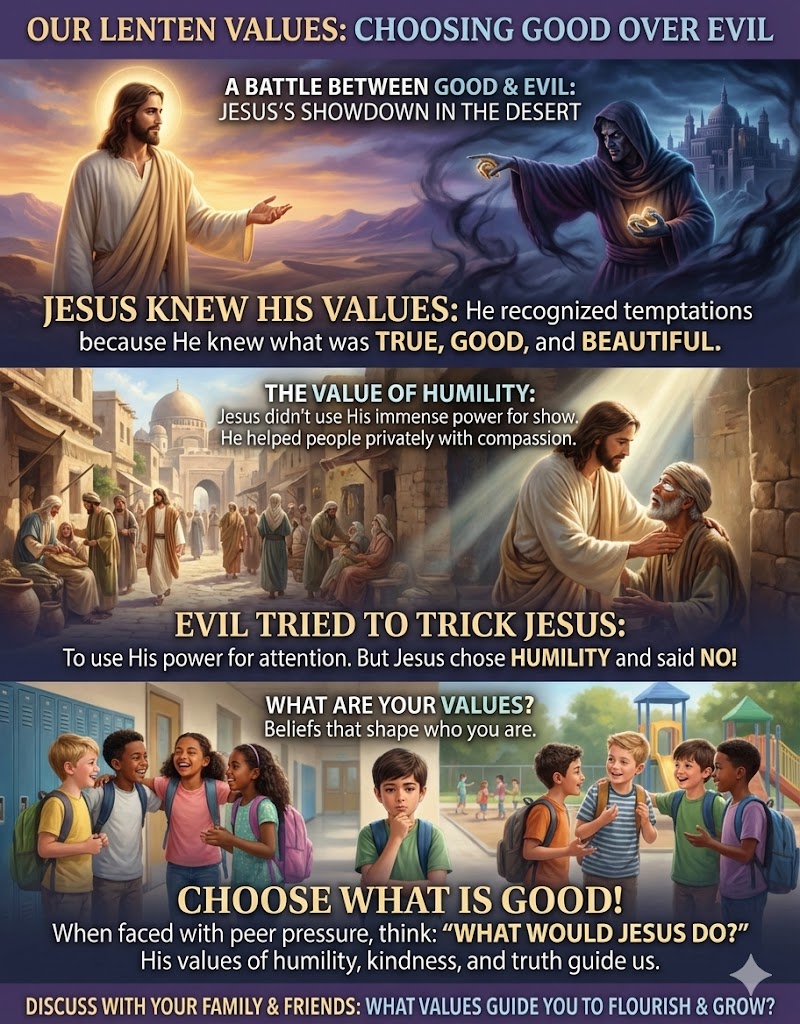
KEY THEMES: INFOGRAPHIC

THE WORD THIS WEEK infographics are created using using GOOGLE’S AI Gemini 3 Pro. You are free to use the above infographic in any non-profit ministry. Please give credit to TheWordThisWeek.net and Uganda Catholic Television which contributed content.

YouTube player
TIMESTAMPED SUMMARY
KEY THEMES: INFOGRAPHIC

THE WORD THIS WEEK infographics are created using using GOOGLE’S AI Gemini 3 Pro. You are free to use the above infographic in any non-profit ministry. Please give credit to TheWordThisWeek.net and Father Glenn who contributed content.

YouTube player
TWTW LESSON PLAN

Create a lesson plan based on Use the following or a similar format: Lesson Plan Title:

Grade Level:

Estimated Time:

Theme:

I. Learning Objectives

II. Materials Needed

III. Key Vocabulary

IV. Lesson Procedure

A. Introduction: The Big Game Excitement (10 Minutes)

Hook:

Discussion:

Anticipated answers:

Transition:

B. Direct Instruction: The Story of Big Al and Fr. Joe (15 Minutes)

Use the infographic as your visual aid during this section.

Set the Scene (Top Half of Infographic):

The Conflict:

The Question:

The Shift (Bottom Half of Infographic):

The Main Point:

Examples:

The Resolution:

C. Guided Activity: Temporary vs. Lasting Sort (10 Minutes)

D. Application Activity: Goodness Cheerleaders (15 Minutes)

V. Closing Prayer (5 Minutes)

The Sand vs. The Water: Choosing What Really Matters in Lent

Grade Level: 1st – 3rd Grade (Elementary)

Estimated Time: 55 Minutes

Theme: Lent, Temptation, Making Good Choices

I. Learning Objectives By the end of this lesson, students will be able to:

  1. Understand the analogy of temptation as "drinking sand" (something that looks satisfying but doesn't give real life).
  2. Identify the three Lenten practices: praying, sharing, and fasting.
  3. Distinguish between choices that offer temporary satisfaction (sand) versus those that provide lasting goodness (water).

II. Materials Needed

  • A clear plastic bottle filled with dry sand.
  • A clear plastic bottle filled with fresh water.
  • The "Sand vs. Water" Infographic Visual Aid: (Teacher Preparation: Draw this on a whiteboard or large poster paper beforehand based on the transcript concepts).
    • Top Half (Red background): Title "Drinking Sand (Temptation)." Shows cartoon drawings of: An angry face clobbering someone; A selfish stick figure hoarding toys; A mean face. A big "X" over a heart. Text: "Doesn't give life."
    • Bottom Half (Blue background): Title "Drinking Water (Real Life)." Shows cartoon drawings of: Praying hands; Two figures sharing; A plate with less food on it (fasting). A big glowing heart. Text: "Always good."
  • Sorting Cards (Index cards with actions written/drawn on them: e.g., Hitting, Sharing toys, Yelling, Praying for grandma, Eating all the cookies, Helping set the table).
  • Two small bins or baskets labeled "SAND Basket" and "WATER Basket."
  • Paper, crayons, and markers for the Application Activity.

III. Key Vocabulary

  • Temptation: Wanting to do something that seems fun or good right now, but actually hurts us or others later.
  • Lent: The time before Easter when we prepare our hearts to become closer to God.
  • Fasting: Giving up something we like for a short time to remind us that we need God more than things.
  • Lasting: Something that stays good for a long time.

IV. Lesson Procedure

A. Introduction: The Big Game Excitement (10 Minutes)

  • Hook: Ask the students: "Raise your hand if you have ever played in a really big sports game, or watched an exciting game on TV, like the Super Bowl or World Cup! When the athletes are playing hard, running fast, and sweating, how do they feel at halftime or the end of the game?"
  • Discussion: Encourage students to describe the physical feeling after intense activity.
  • Anticipated answers: "Tired!" "Hot!" "Really thirsty!"
  • Transition: "Exactly, they are incredibly thirsty. Now, imagine if the coach ran out onto the field to help the thirsty players, holding this." (Hold up the bottle of sand). "Would this help them?" (Students will yell No!). "Why not? It looks like it's in a bottle." (Wait for responses about how dry and gross sand is). "Today, we are going to learn why sometimes we try to 'drink sand' in our own lives, and what we should drink instead."

B. Direct Instruction: The Story of Big Al and Fr. Joe (15 Minutes)

  • Use the prepared Infographic as your visual aid during this section.
  • Set the Scene (Top Half of Infographic): Point to the top half of your infographic. "In our story today, a character named Big Al told Fr. Joe he was thirsty. Fr. Joe offered him a bottle of sand! Big Al thought that was crazy. Fr. Joe was using it as an example of what a 'Temptation' is."
  • The Conflict: "Fr. Joe explained that a temptation is something we think will 'give us life' or make us feel better right away. Like when you are thirsty, you just want to grab the first bottle you see."
  • The Question: "But what happens if you drink sand?" (Point to the angry/selfish drawings on the infographic). "Fr. Joe says when we get mad and want to 'clobber' someone, or when we get selfish and mean, we think it will make us feel better. But does being mean really make you feel happy inside for a long time?"
  • The Shift (Bottom Half of Infographic): (Hold up the real water bottle and point to the bottom half of the infographic). "No! It's like drinking sand. It doesn't give us real life. We need real water. Fr. Joe tells Big Al that we have the season of Lent to remind us what really matters."
  • The Main Point: Briefly define the three Lenten practices on the infographic:
    1. We Pray more. (Connecting to God).
    2. We Share with others in need. (Helping).
    3. We Fast from some things to remind us what gives us real life.
  • Examples: "Fr. Joe says that being loving and kind are things that are always good. They always give life. They are like cool, fresh water for our hearts."
  • The Resolution: "At the end of the story, Big Al finally understood, and he got to drink some real water. During Lent, we want to choose the water, not the sand."

C. Guided Activity: Temporary vs. Lasting Sort (10 Minutes)

  • Place the "SAND Basket" and the "WATER Basket" at the front of the room.
  • Hold up the stack of pre-made sorting cards.
  • Call students up one by one. Read the scenario on the card to the class.
  • Ask the student: "Is this action like drinking sand (feels okay for a second but doesn't last) or drinking water (gives real, lasting life)?"
  • Have the student place the card in the correct basket.
    • Examples: "Saying a mean word because you're mad" (Sand). "Sharing your crayons with a friend" (Water). "Ignoring Mom when she calls you" (Sand). "Saying a prayer before bed" (Water).

D. Application Activity: Goodness Cheerleaders (15 Minutes)

  • "Remember how we talked about the Big Game at the beginning? What do cheerleaders do at a big game? They cheer for the good things to happen! They yell 'Go Team!' and encourage the players to do their best."
  • "During Lent, we need to be 'Goodness Cheerleaders.' We need to cheer for ourselves and others to choose the 'water' actions—being loving and kind."
  • Give students paper and markers.
  • Task them to create a "Cheer Poster." On the poster, they should draw one example of a "Water Choice" (something loving and kind) they will try to do this week.
  • They should write a short "cheer" on it. Examples: "Go Team Kindness!", "Choose Water, Choose Love!", "Share and Care!"
  • Teacher circulates to help with spelling and ideas.

V. Closing Prayer (5 Minutes)

Prayer: "Dear God, sometimes when we are mad or selfish, it feels like we want to drink sand. We know that being mean doesn't make us truly happy. During this season of Lent, help us to be Goodness Cheerleaders. Help us to choose to pray, to share, and to be loving and kind. These are the choices that give us real life, just like fresh water. Amen."

Gather students back together. Have them hold their Cheer Posters.

"Let's close by asking God to help us choose the water instead of the sand this week."

KEY THEMES: INFOGRAPHIC

Command Prompt:

"Create a two-column infographic in a friendly, cartoon illustration style with a clear layout.

Header: At the top, a large, bold title banner reading '[YOUR MAIN TITLE HERE]'. Below it, a subtitle banner that says '[YOUR SUBTITLE HERE]'.

Central Divider: The main body is divided down the middle by a decorative, wavy vertical line with an arrow pointing from left to right at the top, labeled '[TRANSITION LABEL, e.g., SHIFT IN PERSPECTIVE]'.

Left Column: Title this section '[LEFT COLUMN HEADING, e.g., INITIAL THOUGHTS]'. In the center, illustrate a character '[DESCRIBE CHARACTER & POSE, e.g., sitting at a desk with a long list]'. Surround them with [NUMBER] thought bubbles or icons, each with a label, representing '[DESCRIBE LEFT SIDE ITEMS, e.g., personal wants, specific objects]'. At the bottom of this column, add a rectangular text box with a summary caption starting with 'FOCUS:'.

Right Column: Title this section '[RIGHT COLUMN HEADING, e.g., BIGGER PICTURE]'. Illustrate the same character '[DESCRIBE CHARACTER & NEW POSE, e.g., standing happily, holding a heart]'. Surround them with [NUMBER] icons and labels representing '[DESCRIBE RIGHT SIDE ITEMS, e.g., sharing, community, abstract concepts like love and kindness]'. Below the character, add a large, prominent banner with a central, bold concluding statement. At the bottom of this column, add a rectangular text box with a summary caption starting with 'FOCUS:'.

Footer: At the very bottom, place a horizontal bar divided into three equal segments.

Left Segment: An icon of '[ICON NAME]' with the title '[SEGMENT TITLE]' and a short sentence below it.

Middle Segment: An icon of '[ICON NAME]' with the title '[SEGMENT TITLE]' and a short sentence below it.

Right Segment: An icon of '[ICON NAME]' with the title '[SEGMENT TITLE]' and a short sentence below it.

Ensure the overall composition is balanced, with clear visual separation between the sections and a cohesive color palette."

THE WORD THIS WEEK infographics are created using using GOOGLE’S AI Gemini 3 Pro. You are free to use the above infographic in any non-profit ministry. Please give credit to TheWordThisWeek.net and Fr. Joe Kempf who contributed content.

YouTube player
TIMESTAMPED SUMMARY
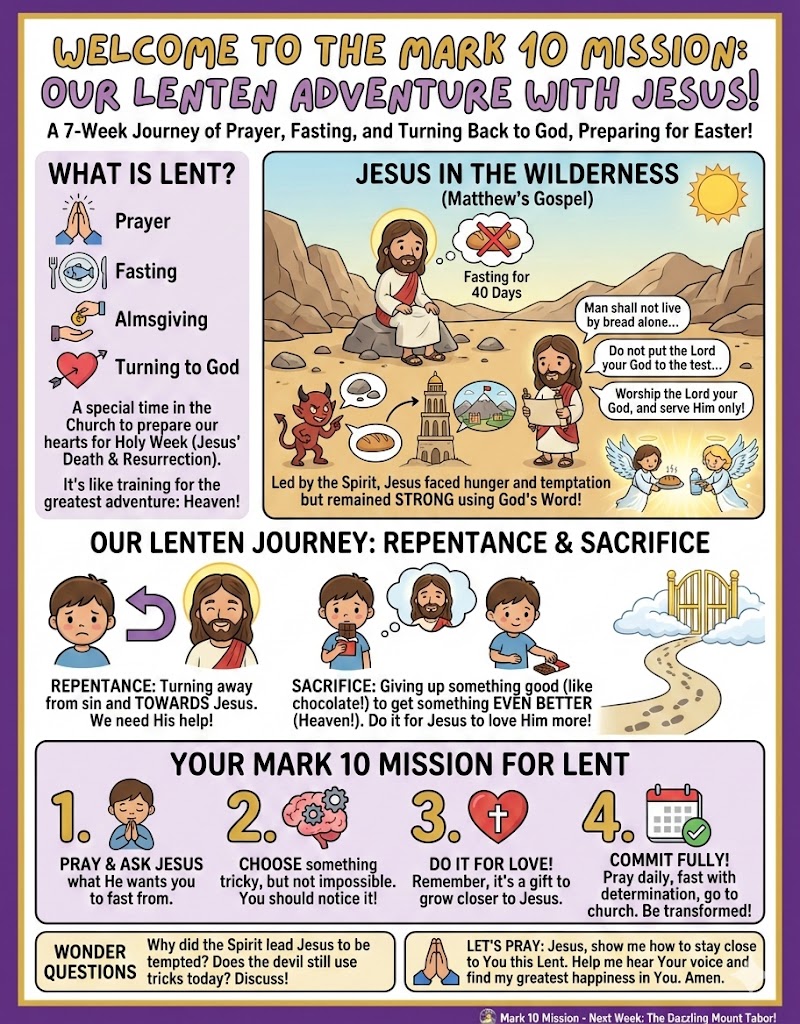
KEY THEMES: INFOGRAPHIC

THE WORD THIS WEEK infographics are created using using GOOGLE’S AI Gemini 3 Pro. You are free to use the above infographic in any non-profit ministry. Please give credit to TheWordThisWeek.net and Ministry to Children which contributed content.

GOSPEL WEEKLIES— +100 Online Resources! | Archive


Free Bible Images

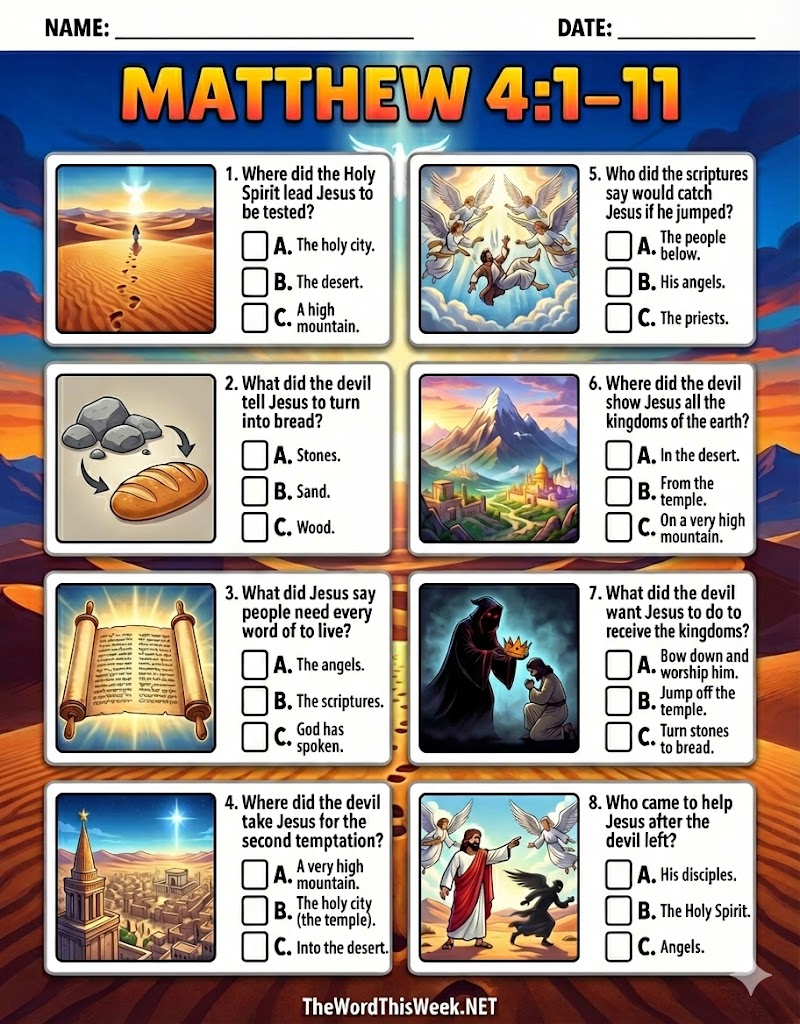
Check for Understanding (PDFs)

create a colorful eye popping striking 8.5×11 infographic for children with a title giving the scripture verse provided. No need to identify it though, just give book, chapter and verses. No subtitle. For the background create an appropriate bible image. Infographic should have 8 multiple choice questions evenly spaced and aligned in two columns. Four in each column. Card panels with thin grey borders and slight drop shadows. Questions should be numbers 1,2,3 followed by a period. In the questions do not refer to source content with phrases such as “based on the provided text” or “According to the analysis”. Just state the question. Place white boxes in front of the answers (not the question) for students to check or fill in. These boxes should have black borders and white background. for some of the panels have related images. Following each box should be large capital leters A, B, C, followed by a period. Do not provide the answers. On the bottom footer it should say TheWordThisWeek.NET No other words should appear in the footer. At the top left corner in the header area, in plain black text, appear the words: NAME: ________________________________. At the top right in the header area appear the words: DATE: __________________ What follows is the scripture reference and text to use to base your questions off of:

DOWNLOAD PDF

400×400

The Kids Bulletin

Sunday Worksheet