Sunday Reading Connections and Life-Application
Sunday Reading Connections and Life-Application

Scripture & Art

Poetry

Movies & Film


1) 🎬 “If you bungle raising your children…”

In a rare personal interview, granted not long before her death, Jacqueline Kennedy Onassis remarked: “If you bungle raising your children, I don’t think whatever else you do will matter very much” (Good Housekeeping, July 1994). For a woman whose wealth, education, background, and connections could have assured her a prestigious career in academia, politics or diplomacy, her statement may seem surprising. However, despite all the possibilities she could have pursued for herself, Mrs. Kennedy was convinced that family was ultimately the most important entity in her life; to her credit, she lived by that conviction. (Sanchez Files)
2) 🎬 60 years of separation:

The story of Boris and Anna Kozlov is very touching. Boris and Anna Kozlov were married in 1946. After three days Boris had to ship out with his Red Army unit. By the time he returned, Anna was gone, consigned by Stalin’s purges to internal exile in Siberia with the rest of her family. Nobody knew where the family was, or what had happened to Anna... Boris became frantic. He tried everything he could to find his young bride, but it was in vain. She was gone. After 60 years, one day, Anna Kozlov caught sight of the elderly man clambering out of a car in her home village of Borovlyanka in Siberia. There, in front of her, was Boris. An extraordinary coincidence had led them both to return to their home village on the very same day. 60 years of separation had made their reunion inexpressibly joyful.
In today’s Gospel we heard Mathew’s account that Jesus’ family had to be separated from their kinsmen due to Herod’s decision to annihilate Jesus. (Fr. Bobby).
3) “Daddy, could you please sell me one hour of your time?”
A little boy greets his father as he returns from work with a question: “Daddy, how much do you make an hour?” The father is surprised and says, “Look, son, not even your mother knows. Don’t bother me now, I’m tired.” “But Daddy, just tell me please! How much do you make an hour?” the boy insists. The father finally gives up and replies, “Twenty dollars.” “Okay, Daddy,” the boy continues, “Could you loan me ten dollars?” The father yells at him, “So that was the reason you asked how much I earn, right? Now, go to sleep and don’t bother me anymore!” At night the father thinks over what he said and starts feeling guilty. Maybe his son needed to buy something. Finally, he goes to his son's room. “Are you asleep, son?” asks the father. “No, Daddy. Why?” replies the boy. “Here's the money you asked for earlier,” the father said. “Thanks, Daddy!” replies the boy and receives the money. The he reaches under his pillow and brings out some more money. “Now I have enough! Now I have twenty dollars!” says the boy to his father, “Daddy, could you sell me one hour of your time?”
Today’s readings have a message for this man and for all of us, and the message is that we need to invest more of our time in our family life.
4)"Paco, meet me at the Hotel Montana noon Tuesday. All is forgiven."
In Ernest Hemingway’s short story, a Spanish newspaper carried a poignant story about a father and his son. It goes like this. A teen-aged boy, Paco, and his very wealthy father had a falling out, and the young man ran away from home. The father was crushed. After a few days, he realized that the boy was serious, so the father set out to find him. He searched high and low for five months to no avail. Finally, in a last, desperate attempt to find his son, the father put an ad in a Madrid newspaper. The ad read, "Dear Paco, Meet me at the Hotel Montana noon Tuesday. All is forgiven. I love you. Signed, Your Father. On Tuesday, in the office of Hotel Montana, over 800 Pacos showed up, looking for love and forgiveness from their fathers!!
What a magnet that ad was. Over 800 Pacos!! The feast of the Holy Family reminds us that we need more loving, forgiving fathers and mothers.
5) Don’t humiliate them!
As a student, Daniel Webster (US Senator, noted 19th century American political orator) was particularly marked for being untidy. Finally, the teacher, in exasperation, told him that if he appeared again with such dirty hands she would thrash him. He did appear in the same condition. “Daniel”, she said, “hold out your hand.” Daniel spat on his palm, with an intention to clean it, rubbed it on his trousers and held it out. The teacher surveyed it in disgust. “Daniel”, she said, “if you can find me another hand in this school that is dirtier than that, I will let you off.” Daniel promptly held out his other hand!
Many children with an eccentric trait blossom into geniuses. The teachers and parents should not underestimate them or humiliate them. (G. Francis Xavier in The World’s Best Inspiring Stories).
6) “Am I not a family valuable?”
Rabbi Neil Kurshan in his book Raising Your Child to be a Mensch (a Yiddish word for a person having admirable characteristics such as fortitude and firmness of purpose), tells this real story: A young woman about to be married had come to the Rabbi for counseling. When she told the Rabbi that she hoped she would not make the same mistakes her parents had made, he pressed her to elaborate. The woman explained that each summer her wealthy parents traveled to Europe while she remained behind with a nanny. One year, when the girl was 11, the housekeeper suddenly quit just shortly before her parents’ annual trip to Europe. Upset that their vacation might be jeopardized, the parents quickly found a replacement. A few days before their departure, the girl noticed that her mother had wrapped the family jewels and silverware and placed them in the safe. Since this had never been done before, she asked why. Her mother explained that she could not trust the new housekeeper with the family valuables.
Though certainly not intended, that insensitive remark so shocked and hurt the little girl that she never forgot it. Wasn’t she a family valuable? Didn’t she have more value than silver knives and silver forks? That is a question all of us could ask about our attitudes toward dependent family members, young, old, or in-between, this Holy Family Day.
7) "I never hugged my dad"!
In his book My Father, My Son, Dr. Lee Salk describes a moving interview with Mark Chapman, the convicted slayer of Beatle John Lennon. At one point in the interview, Chapman says: "I don’t think I ever hugged my father. He never told me he loved me…I needed emotional love and support. I never got that.” Chapman’s description of how he would treat a son if he had one is especially tragic, because he will probably never get out of prison and have a family of his own. He says: “I would hug my son and kiss him…and just let him know…he could trust me and come to me…and (I would) tell him that I loved him.”
Dr. Salk ends his book with this advice to fathers and sons. It applies equally well to mothers and daughters. “Don’t be afraid of your emotions, of telling your father or your son that you love him and that you care. Don’t be afraid to hug and kiss him. “Don’t wait until the deathbed to realize what you’ve missed.” (Mark Link in Sunday Homilies).
8) “We are all equal in the eyes of God:”
Former President Jimmy Carter recently decided to leave the Baptist Church to which he had belonged for sixty years. The reason was doctrinal disagreement. The Southern Baptist Convention had just codified that women are responsible for original sin and hence subservient to their husbands. President Carter disagreed. He said: “This was in conflict with my belief - confirmed in the Holy Scripture – that we are all equal in the eyes of God. … This view that women are somehow inferior to men is not restricted to one religion or Faith. Consequently, they are prevented from playing a full and equal role in many Faiths and led to some of the most pervasive, persistent, flagrant, and damaging examples of human-rights abuses.” So, Jimmy Carter’s conscience could no longer allow him to be part of his lifelong Church.
The Feast of the Holy Family challenges the spouses to love and respect each other.
9 Grandfather’s wooden bowl:
A frail old man went to live with his son, daughter-in-law, and four-year-old grandson. The old man's hands trembled, his eyesight was blurred, and his step faltered. The family ate together at the table. But the elderly grandfather's shaky hands and failing sight made eating difficult. Peas rolled off his spoon onto the floor. When he grasped the glass, milk spilled on the tablecloth. The son and daughter-in-law became irritated with the mess. "We must do something about father," said the son. "I've had enough of his spilled milk, noisy eating, and food on the floor." So the husband and wife set a small table in the corner. There, Grandfather ate alone while the rest of the family enjoyed dinner. Since Grandfather had broken a dish or two, his food was served in a wooden bowl. When the family glanced in Grandfather's direction, sometimes he had a tear in his eye as he sat alone. Still, the only words the couple had for him were sharp admonitions when he dropped a fork or spilled food. The four-year-old watched it all in silence. One evening before supper, the father noticed his son playing with wood scraps on the floor. He asked the child sweetly, "What are you making?" Just as sweetly, the boy responded, "Oh, I am making a little bowl for you and Mama to eat your food in when I grow up." The four-year-old smiled and went back to work. The words so struck the parents that they were speechless. Then tears started to stream down their cheeks. Though no word was spoken, both knew what must be done. That evening the husband took Grandfather's hand and gently led him back to the family table. For the remainder of his days he ate every meal with the family. And for some reason, neither husband nor wife seemed to care any longer when a fork was dropped, milk spilled, or the tablecloth soiled.
10) “Have you ever seen a Saint praying?"
St. Teresa of Lisieux and St. Teresa of Avila have their own stories about the influence their fathers had on their lives as role models. The Little Flower used to ask an innocent question of her first grader classmates: “Have you ever seen a Saint praying?" She would add: "If you haven't, come to my house in the evening. You will see my dad on his knees in his room with outstretched arms, praying for us, his children, every day.” She states in one of her letters from the convent: “I have never seen or heard or experienced anything displeasing to Jesus in my family.” St. Teresa of Avila was admitted against her will, by her father, to a boarding house conducted by nuns in the final year of her high school studies, as soon as he detected bad books and yellow magazines hidden in her box. They were supplied by her spoiled friend and classmate, Beatrice. St. Teresa later wrote as the Mother Superior: “But for that daring and timely action of my father, I would have ended up in the streets, as a notorious woman.”
The feast of the Holy Family challenges Christian fathers to be role models to their children.
11) “Those God makes six-eight have to look out for those He makes three-three.”
(Jesse Jackson tells the story of a visit he made to the University of Southern Mississippi). While touring the campus with the university president, he saw a towering male student, six-feet, eight-inches tall, holding hands with a fidgety coed barely three-feet tall. What a contrast, six-feet, eight-inches tall and only three-feet tall. His curiosity piqued, Jackson watched as the young man, dressed in a warm-up suit, tenderly kissed the tiny coed, and sent her off to class. The president said that the student was a star basketball player. Both parents had passed away when he was a teenager, and he made a vow to look after his sister. Many scholarships came his way, but only Southern Mississippi offered one to his sister, too. Jackson went over to the basketball star, introduced himself, and said he appreciated the way he was looking out for his sister. The athlete shrugged and said, “Those of us who God makes six-eight have to look out for those He makes three-three.” (3)
Don’t you wish every young person could have that kind of love for his or her siblings? We live lives of Faith and we look out for those we love. (Rev. Duncan).
12) The morning after.
A cartoon in the New Yorker magazine says it all. In the middle of the floor is a dried up, withered, Christmas tree. The calendar on the wall reads December 26. Dad is sitting in his chair with an ice pack on his head. Mom is in a bathrobe and her hair in rollers. The floor is a virtual mountain of torn wrappings, boxes, and bows. Junior is reaching in his stocking to be sure that there is no more candy. In the background we see a table with a thoroughly picked turkey still sitting there. The caption on the cartoon reads simply: The morning after.
It is to normalize our lives in our families that we celebrate the feast of the Holy Family and invite its holy members to our families.
13) “Scatter my ashes in the local Wal-Mart"
A single mother who raised her only child, lavished all her love on the girl, and spent her health and wealth, time and talents on the child’s upbringing. But the daughter dated and married a drug addict, against her mother’s warnings and wishes. As a well-employed girl, she never cared to visit her mother. So on her deathbed the mother instructed her attorney to cremate her body and to scatter the ashes in the local Wal-Mart of the city where her daughter lived. He enquired why. The mother said: “Then I will be able to see my daughter visiting me every week!”
14) "Louis, this morning you met your real self.”
Rabbi Gafni recalls one of the first bar mitzvahs he ever performed. (bar mitzvah is acoming-of-age ritual for Jewish boys. When a Jewish boy reaches 13 years old, he becomes accountable for his actions and becomes a bar mitzvah, a son of the Law) This bar mitzvah was for a boy named Louis. Louis was awkward and sad. His insensitive parents did little to encourage his self-esteem. They implied that he was too dumb to learn the traditional Hebrew passages a boy recites for his bar mitzvah. Gafni was determined to bring out the best in Louis. He spent extra time teaching him the songs and prayers. He discovered that Louis was smart, and had a fantastic singing voice. On the day of his bar mitzvah, Louis performed beautifully. At the end of the ceremony, Rabbi Gafni stood and spoke directly to Louis. He said, "Louis, this morning you met your real self. This is who you are. You are good, graceful, talented, and smart. Whatever people told you yesterday, and Louis, whatever happens tomorrow, promise me one thing. Remember . . . this is you. Remember, and don't ever lose it." A few years later, Louis wrote to Rabbi Gafni. The boy whose parents predicted that he was too dumb to perform a traditional bar mitzvah was studying for his medical degree at an Ivy League university. He was also engaged to be married. Louis ended his letter by saying, ". . . I kept my promise---I always remembered my bar mitzvah morning when you said that this is who I am. For this, I thank you." [Marc Gafni, The Mystery of Love (New York: Atria Books, 2003), pp. 123-124.]
I wish all of us could have an affirming adult like that in our lives. Some of you know about that kind of love. That was the kind of love you experienced from your parents. And you know how precious it is.
15) "My mother told me that I was the ugliest little girl she knew."
A few years ago, Rabbi Marc Gafni gave a talk at a children's camp in New York. At one point in the afternoon, Rabbi Gafni asked the children, "When was the last time someone told you that you were beautiful?" The children's response devastated him. Few of them could recall true, encouraging words from their parents. So many of them heard only words of condemnation and shame. One young girl said, "My mother told me on Saturday that I was the ugliest little girl she knew." Another boy related a heartbreaking conversation with his mother. He said, "My mother was in the Holocaust. And she says that if she had known that I would be her son, she wouldn't have worked so hard to survive." [Marc Gafni, The Mystery of Love (New York: Atria Books, 2003), pp. 120-121.]
Parents like that need to stop and consider the impact of their words. It is hard to imagine a more hurtful thing to say to a child.
16) The Messiah is one of you.”
The following fable offers a powerful example of the contagious grace of change. The membership of a once numerous order of monks had dwindled over the years, until there were only five brothers left in what had been a thriving community. For years, people from the surrounding area had been drawn to the monastery in search of the learning and spiritual renewal they found there. Now, no one ever visited as the spirit of the place and its inhabitants seemed to be slowly dying.
One day, however, a rabbi happened by to visit. When he was about to leave, one of the brothers asked the rabbi if he had any advice on how they could revitalize themselves and make their monastery a spiritual center once again. After a few moments, the rabbi replied, “The only thing I can tell you is that the Messiah is one of you.” Flabbergasted, the brothers replied, “The Messiah among us? Impossible!” As the weeks passed, the brothers puzzled over the rabbi’s startling revelation. If the Messiah were here, who would it be? Maybe, Brother Timothy . . . he’s the abbot and in his capacity as leader, he could surely be chosen to be the Messiah. It couldn’t be Bro. Mark; He’s always so argumentative, but, he’s usually right . . . Or maybe, it’s Bro. Pius who tends the garden and the animals. He could probably nourish a troubled world if he were the Messiah. Surely, it could be Bro. Dominic; he’s studious, learned and familiar with all the great spiritual writers. It couldn’t be Peter, could it? Certainly, the Messiah couldn’t be the one who cleaned toilets, dirty laundry and scrubbed the pots and pans each day. Or, could it? Since the monks were unable to determine which one of them was the Messiah, they began to treat one another as though each were the one. Moreover, just in case he himself might be the Messiah, each monk began to treat himself with new respect and to conduct himself with greater dignity. Within a few weeks, the monastery’s occasional visitors were awed by the love, goodness and revitalized spirituality they experienced. They returned again and again and brought new friends along. Soon, a few young men asked to be admitted to the order and the monastery thrived again.
Imagine the possibilities for growth and renewal if each family were to take to heart the rabbi’s words, “the Messiah is one of you.” How much more might spouses love and cherish one another . . . how much more might parents value their children, protect them, teach them, and lovingly attend to their needs . . . how much more might children honor and appreciate their parents. If each member of every family were to reverence one another as the Messiah, i.e., as Jesus who is our Savior and brother, how much might that strengthen and secure those familial bonds that are the infrastructure, without which our society has no future. (Sanchez Files)
17) “But…But…..you tell better lies Mum!”
A mother was shocked to hear her son tell a lie. Taking the youngster aside for a heart-to-heart talk, she graphically explained what happened to liars. “A tall black man with red fiery eyes and two sharp horns grabs little boys who tell lies and carries them off at night. He takes them to Mars where they have to work in a dark canyon for fifty years! Now” she concluded, “you won’t tell a lie again, will you, dear?” “No, Mum,” replied the son, gravely, “But…But…..you tell better lies Mum!”
Children learn to tell lies from the elders. With them it does not work to say, ”Do as I tell and not as I do.” (G. Francis Xavier in Inspiring Stories; quoted by Fr. Botelho).
18) Attachment:
In the middle of the night a young boy wakes up in a hospital bed. He feels very frightened and very alone. He is suffering intense pain: Burns cover forty percent of his body. Someone had doused him with alcohol and then had set him on fire. He starts crying out for his mother. The nurse leaves her night-post to comfort him; she holds him, hugs him, whispers to him that the pain will go away sooner than he thinks. However, nothing that the nurse does seems to lessen the boy’s pain. He still cries for his mother. And the nurse is confused and angry: it was his mother who set him on fire.
The young boy’s pain at being separated from his mother, even though she had inflicted such cruelty on him, was greater than the pain of his burns. That deep attachment to the mother makes separation from her the worst experience a child can undergo. (Denis McBride in Seasons of the Word; quoted by Fr. Botelho).
19) The Cosby Show:
One of TV’s highest rated program of all time was The Cosby Show. It was a weekly sitcom about an upper-middle-class black family, which for all practical purposes, had become America’s First Family. In a feature article about Bill Cosby, Newsweek magazine said that his show about the Huxtables is endearing not cutesy, its parents are hassled but never hapless and there is clowning but no guff. The Cosby Show was popular because the family situations it portrayed had an air of universality and reality about them. Any family could identify with both the irritations and misunderstandings that arise on the show, and with the truly humorous and heartwarming things that happen. While Dr. Cliff Huxtable, his lawyer-wife Clair and their four children may not be the perfect counterpart of the Holy Family, they do picture for us in modern terms what some of the qualities of family life should be.
The seven ‘C’s of family life are: commitment, communication, compatibility, compassion, confession, conviviality, and children. They sum up today’s readings about how to become a holy family instead of a broken family. (Albert Cylwickiin His Word Resounds; quoted by Fr. Botelho).
20) “We wanted to stay together…”:
In his new book, All Rivers Run to the Sea, Elie Wiesel recalls the terrible moment when his family had to make a critical choice. The war was coming to an end, but the deportation of Jews continued. Elie, his parents and three sisters faced deportation from their village in Hungary to the concentration camp in Berkenau. Maria, a Christian and the family’s house-keeper, begged the Wiesels to hide in her family cabin in the mountains. At first the Wiesels declined, but Maria persisted. The family gathered at the kitchen table for a family meeting: should they go with Maria, or stay and take their chances. The family decided to stay. Elie Wiesel remembers: “But why?” Maria implored us, her voice breaking. “Because” my father replied, “a Jew must never be separated from his community. What happens to everyone happens to us as well.” My mother wondered aloud whether it might not be better “to send the children with Maria.” We protested: “We’re young and strong. The trip won’t be as dangerous for us. If anyone should go with Maria, it’s you.” After a brief discussion, we thanked Maria. “My father was right. We wanted to stay together, like everyone else. Family unity is one of our most important traditions… the strength of the family tie, which has contributed to the survival of our people for centuries….”
The war did not end soon enough for the Wiesels. Only Elie and two of his sisters survived. His mother, father, and youngest sister died in camps. (Quoted in Connections Newsletter).
21) Obedient Child Jesus:
A few centuries before Christ, Alexander the Great conquered almost all the known world through military strength, intelligence, and diplomacy. Legend has it that one day Alexander and a small company of soldiers approached a strongly defended, walled city. Alexander, standing outside the walls, raised his voice, demanding to see the city's king. The king, approaching the battlements above the invading army, agreed to hear Alexander's demands. ”Surrender to me immediately," commanded Alexander. The king laughed. "Why should I surrender to you?" he called down. "We have you far outnumbered. You are no threat to us!" Alexander was ready to answer the challenge. "Allow me to demonstrate why you should surrender," he replied. Alexander ordered his men to line up single file and start marching. He marched them straight toward a sheer cliff that dropped hundreds of feet to rocks below. The king and his soldiers watched in shocked disbelief as, one by one, Alexander's soldiers marched without hesitation right off the cliff to their deaths. After ten soldiers had died, Alexander ordered the rest of his men to stop and to return to his side. The king and his soldiers surrendered on the spot to Alexander the Great.
Even on a human level, obedience is powerful. But when the one we are obeying is God Himself, our Lord and Savior Jesus Christ, obedience is truly a life-changing virtue. It leads not just to temporary victories here on earth, but to the everlasting victory of the Resurrection, as Jesus himself proved by his obedience unto death on a cross. (Adapted from Hot Illustrations; E- Priest)
22) Child Jesus guided by Mary and Joseph:
On October 14, 1943, Jewish slave laborers in Sobibor concentration camp, on the border of Poland and Russia, executed a well-planned revolt. Of the 700 prisoners who took part in the escape, 300 made it through the minefield between the barbed wire fence of the prison and the dense forest beyond. Of those, fewer than 100 are known to have survived the Nazi search parties. One of them, Thomas Blatt, was 15 years old when his family was herded into Sobibor. His parents were executed in the gas chamber, but Thomas, young and healthy, was sent to slave labor. Thomas and two companions made it out and started their long journey through the dense woods after navigating the minefield. At daybreak they buried themselves in the woods to sleep. At night they made their way through the trees and thick brush. After four nights of wandering through the cold forest, they saw a building silhouetted against the dark sky in the distance. With smiles on their faces, they eagerly approached it, hoping for sanctuary from their enemies. As they got closer, they noticed that the building they had seen was a tower - specifically, the east tower of the Sobibor concentration camp! They had made one giant circle through the woods and ended up exactly where they started. Terrified, the three boys plunged back into the forest. But only Thomas lived to tell about their awful experience.
When we reject the guidance of God's commandments and the teaching of his Church, we are like those boys wandering through the woods at night without a guide, and we make no lasting progress to the happiness we long for. (Hot Illustrations; E- Priest).
23) Dorothy Law Nolte wrote, Children Learn What They Live
If children live with criticism, they learn to condemn.
If children live with hostility, they learn to fight.
If children live with fear, they learn to be apprehensive.
If children live with pity, they learn to feel sorry for themselves.
If children live with ridicule, they learn to feel shy.
If children live with jealousy, they learn to feel envy.
If children live with shame, they learn to feel guilty.
If children live with encouragement, they learn confidence.
If children live with tolerance, they learn patience.
If children live with praise, they learn appreciation.
If children live with acceptance, they learn to love.
If children live with approval, they learn to like themselves.
If children live with recognition, they learn it is good to have a goal.
If children live with sharing, they learn generosity.
If children live with honesty, they learn truthfulness.
If children live with fairness, they learn justice.
If children live with kindness and consideration, they learn respect.
If children live with security, they learn to have faith in themselves and in those about them.
If children live with friendliness, they learn the world is a nice place in which to live.
24) Satan’s seven-steps strategy:
Dr. Peter Kreeft a professor of philosophy at Boston College and a well-known author and speaker, gave a talk in Ohio, USA. In his talk, he outlined what he calls, “Satan’s spectacularly successful seven-steps sexual strategy.” This is his explanation of how the devil is working in our world right now to destroy families and even the whole human race. Personally, I think Dr. Kreeft is right on target in his analysis. Here it is:
Step 1 in Satan’s strategy – this is the devil’s ultimate goal:winning souls for hell.
Step 2: in order for Satan to win many souls for hell, society must be corrupted.
Step 3: to effectively destroy society, family life must be undermined – because strong families are necessary in order to have strong societies.
Step 4: in order to destroy the family, you must destroy its foundation– stable marriage
Step 5: marriage is destroyed by loosening its glue which is sexual fidelity.
Step 6: fidelity is destroyed by promoting and defendingthe sexual revolution.
Step 7: the sexual revolution is promoted and defended by the media –through which the seeds of destruction are sown into the minds of millions of people every day.
25) Statistics and Commentary:
The evidence is convincing that the better our relationships are at home, the more effective we are in our careers. If we're having difficulty with a loved one, that difficulty will be translated into reduced performance on the job. In studying the millionaires in America (U.S. News and World Report), a picture of the "typical" millionaire is an individual who has worked eight to ten hours a day for thirty years and is still married to his or her high school or college sweetheart. A New York executive search firm, in a study of 1365 corporate vice presidents, discovered that 87% were still married to their one and only spouse and that 92% were raised in two-parent families. The evidence is overwhelming that the family is the strength and foundation of society.
Strengthen your family ties and you'll enhance your opportunity to succeed. (Zig Ziglar in Homemade, March 1989).
26) Top traits of successful families:
According to a study of more than 500 family counselors, the following are the top traits of successful families: *Communicating and listening *Affirming and supporting family members *Respecting one another *Developing a sense of trust *Sharing time and responsibility *Knowing right from wrong *Having rituals and traditions *Sharing a religious core *Respecting privacy. (Focus on the Family Bulletin, December, 1988). Fr. Kayala.
27) Profile of a strong family:
From a national survey of strong families conducted by the Human Development and Family Department at the University of Nebraska- Lincoln, a profile of a strong family:
a. Appreciation. "Family members gave one another compliments and sincere demonstrations of approval. They tried to make the others feel appreciated and good about themselves."
b. Ability to Deal with Crises in a Positive Manner. "They were willing to take a bad situation, see something positive in it and focus on that."
c. Time Together. "In all areas of their lives--meals, work, recreation--they structured their schedules to spend time together."
d. High Degree of Commitment. "Families promoted each person's happiness and welfare, invested time and energy in each other and made family their number one priority."
e. Good Communication Patterns. "These families spent time talking with each other. They also listened well, which shows respect."
f. High Degree of Religious Orientation. "Not all belonged to an organized church, but they considered themselves highly religious. (University of Nebraska- Lincoln).
28) Family Statistics:
Families in 2000 will average 1.81 children, down from 1.84 today. Some 60 percent of kids born in the '80s will live for a time with one parent; 1 kid in 4 will live with a stepparent by age 16. One third of all households will be childless. . . Supporting a teenager still at home will cost $12,000 a year against $7,000 now. Kids who head to college in 2000 will need upwards of $100,000 for each bachelor's degree. (U.S. News and World Report, Dec .25, 1989).
29) Rudyard Kipling once wrote about families,
"All of us are we--and everyone else is they." A family shares things like dreams, hopes, possessions, memories, smiles, frowns, and gladness...A family is a clan held together with the glue of love and the cement of mutual respect. A family is shelter from the storm, a friendly port when the waves of life become too wild. No person is ever alone who is a member of a family. (Fingertip Facts). (http://frtonyshomilies.com/).
30) Threats to the families:
Parents rate their inability to spend enough time with their children as the greatest threat to the family. In a survey conducted for the Massachusetts Mutual Life Insurance Corp.,
35 percent pointed to time constraints as the most important reason for the decline in family values.
Another 22 percent mentioned a lack of parental discipline.
While 63 percent listed family as their greatest source of pleasure,
only 44 percent described the quality of family life in America as good or excellent.
And only 34 percent expected it to be good or excellent by 1999.
Despite their expressed desire for more family time, two-thirds of those surveyed say they would probably accept a job that required more time away from home if it offered higher income or greater prestige. [Moody Monthly, (December, 1989), p. 72.]
31) Disintegration of various cultures with the parallel decline of family life:
Sociologist and historian Carle Zimmerman, in his 1947 book, Family and Civilization, recorded his keen observations as he compared the disintegration of various cultures with the parallel decline of family life in those cultures. Eight specific patterns of domestic behavior typified the downward spiral of each culture Zimmerman studied.
*Marriage loses its sacredness...is frequently broken by divorce.
*Traditional meaning of the marriage ceremony is lost.
*Feminist movements abound.
*Increased public disrespect for parents and authority in general.
*Acceleration of juvenile delinquency, promiscuity, and rebellion.
*Refusal of people with traditional marriages to accept family responsibilities.
*Growing desire for and acceptance of adultery.
*Increasing interest in and spread of sexual perversions and sex-related crimes.
(Swindoll, The Quest For Character, Multnomah, p. 90).
32) “Wow! Wow!”
One of Winston Churchill’s biographers, William Manchester [The Last Lion (Boston: Little Brown and Co., 1983)] once wrote that the eminent statesman’s feelings about his family were unquestionably warm and intense. Churchill regarded his home as an independent kingdom with its own law, its own customs, even its own language. “Wow!” was the family’s traditional greeting. When Churchill entered the front door, he would cry: “Wow! Wow!” Upon hearing him, his wife would call back in answer, “Wow!” Then the children would rush into his arms and his eyes would mist over. (Wow!)
A statesman in his own right (many scholars think he may have served for a time as Israel’s ambassador to foreign courts), Jesus ben Sira, the second century B.C.E. author of today’s first reading also valued the special love and language that unites the members of a family. To that end, he invited his readers to cultivate a love that honors, obeys, and cares for the other while speaking the language of comfort, kindness, and consideration.
33) “Family is a place where people want you and love you and take care of you.”
On a recent television “talk show”, the host had invited about two dozen children to appear as his guests. All of them, ranging in ages from three to thirteen years of age were wards of their respective state’s Children’s Services Program and were being cared for by foster parents. Some had been in the foster care system since birth; most had been passed from home to home. Every child expressed the same desire: to be permanently adopted into a family. When asked by the show’s host what “family” meant to him, one small boy summed up the feelings of the other children. “Family”, he replied, “is a place where people want you and love you and take care of you.”
Most of us can be grateful that we have not been similarly deprived of that special place called family. But our gratitude for the gift of family must also be matched by a desire to preserve and strengthen the bonds that unite us and, when necessary, to expend whatever effort is needed to repair and renew those bonds when they are strained. To that end, the author of today’s second reading offers sage advice, advising women to be submissive, while urging men to love their wives in such a radical way that husbands become their wives' servants, too, and advising children to respect, love and obey their parents. (Sanchez Files).

If children live with criticism, they learn to condemn.
If children live with hostility, they learn to fight.
If children live with fear, they learn to be apprehensive.
If children live with pity, they learn to feel sorry for themselves.
If children live with ridicule, they learn to feel shy.
If children live with jealousy, they learn to feel envy.
If children live with shame, they learn to feel guilty.

If children live with encouragement, they learn confidence.
If children live with tolerance, they learn patience.
If children live with praise, they learn appreciation.
If children live with acceptance, they learn to love.
If children live with approval, they learn to like themselves.
If children live with recognition, they learn it is good to have a goal.
If children live with sharing, they learn generosity.
If children live with honesty, they learn truthfulness.
If children live with fairness, they learn justice.
If children live with kindness and consideration, they learn respect.
If children live with security, they learn to have faith in themselves and in those about them.
If children live with friendliness, they learn the world is a nice place in which to live.
The Price We Pay for Love

Fr. George
Smiga

Fr. George Smiga
C. S. Lewis in a famous essay on love says that if you want to protect your heart from pain, you must give it to no one. You must enter into no serious relationships, not even with an animal. If you can isolate yourself from all relationships, your heart will not feel pain. In time, however, it will become incapable of feeling anything. If we choose to withdraw ourselves from relationships, we also choose to isolate ourselves from love and from life. What C. S. Lewis makes clear is that in the movement by which we open ourselves to love is the same movement by which we open ourselves to pain. You can’t have one without the other. Both thrive in family.
Mary discovered this in today’s gospel, which we just heard on this feast of The Holy Family. She and Joseph bring the child Jesus to the temple and Simeon rejoices that he sees the Lord’s Messiah. He then says to Mary, “A sword will pierce your own soul.” Simeon is telling Mary, “This child will hurt you.” Why? Because Mary was a mother, and the same movement that opened her to a mother’s love, opened her to a mother’s pain.
Every deep relationship, every family relationship, has these two essential components: love and hurt.
Scrooges Three Ghosts of Christmas

Fr. Joe
Jagodensky, SDS

Fr. Joe Jagodensky, SDS
The church is cross shaped with a left, center and right row of pews with the altar in the middle.
“The Holy Family feast day is as much about them as it is about our lives, in all its fullness. Let’s use Scrooge’s three ghosts as our barometer. This Left side is ‘Christmas present’ with all its wonder and woes; the Center (the largest) is ‘Christmas past’ because it’s the largest and longest as we age. The right side is ‘Christmas future’ because the Right side is always…
What am I missing in this strange Scrooge’s three ghosts Christmas? Ah, it’s the altar behind me. It is that place where the union of past, present and future meet. It is the place where the present is celebrated, the past is honored but not adored and the future is assured…

James
Wetzstein
Valparaiso University


Feast of the Holy Family B
Not Available
SOURCE: Fr. Tony’s Homilies

Joseph and Mary brought two turtle doves
(or maybe pigeons), a token, really,
But a sign, dedicating their son to the Lord.
And then like the beginning of a raucous song,
They handed their son off to old Simeon,
And you could have knocked them over with a feather
What with all he told them about what the child meant,
Whereupon no sooner did he hand the baby back
When old Anna uttered more astonishing words.
Thus it begins, chapter after chapter
Of teaching and healing and kidding and prodding –
Until we all laugh with joy at this outrageous, outrageous gift.
SOURCE: LectionaryPoems.com
Feast of the Holy Family B
Feast of the Holy Family B
Jesus of Nazareth Miniseries
(1977)
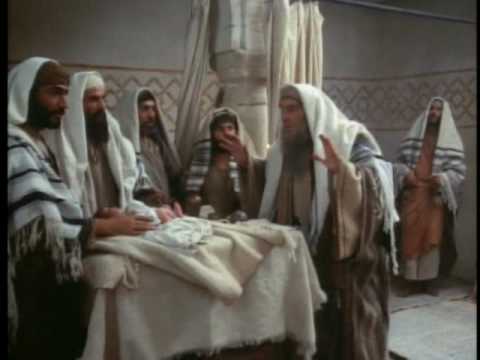
The miniseries “Jesus of Nazareth” (1977) directed by Franco Zeffirelli features the Presentation of Jesus in the Temple scene. The scene showcases traditional customs and the characters’ emotions as Mary and Joseph bring Jesus to the Temple.
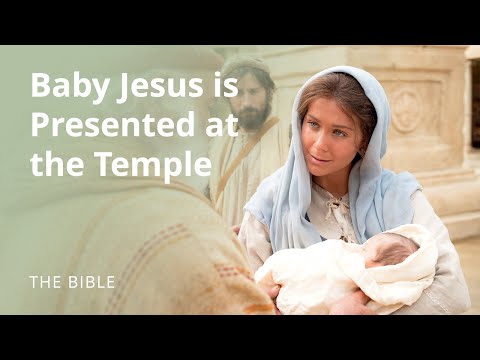
Mary of Nazareth (2012)

Key points to notice in this scene
For starters, we see that Joseph brought two turtledoves for the sacrifice. Turtledoves were the poor family’s offering. Had Joseph and Mary been wealthy, they would have brought a lamb for sacrifice. Jesus, the King of Kings, chose to be born into a poor family to show his great humility. If you are familiar with the Old Testament, you will notice that there was no offering to redeem Jesus from service to Yahweh. From this, we understand that Jesus was now in complete service to God. You could also say that He was not redeemed, because he was the One sent to redeem us all from our sins.
I have always loved the figure of Simeon in the Bible. Though, he is in such a brief section, his appearance packs a punch! Here is a man who has been waiting his entire life for the coming of the Messiah.We too should be awaiting this glorious Second Coming and remember we are in this world, but not of this world. If you notice in the video clip above, Simeon also recognized Mary. Some would view this as taking a creative license. However, according to Tradition, Mary was taken by her parents to the Temple as a young girl. She lived there and served as a Temple virgin until she was betrothed to Joseph. We can find this tradition in the Protoevangelion of James. This feast is celebrated on November 21st and unfortunately is largely unknown in the West. I invite you to take the time about both Mary’s Presentation and Jesus’ Presentation. They reveal small, but key parts of Salvation History that will enrich our understanding of both Jesus and Mary.
SOURCE: Stuart’s Study
Feast of the Holy Family B
“Now that I’ve held Him in my arms” – Michael Card (1983)

RELATED : Singing from the Lectionary (Facebook)
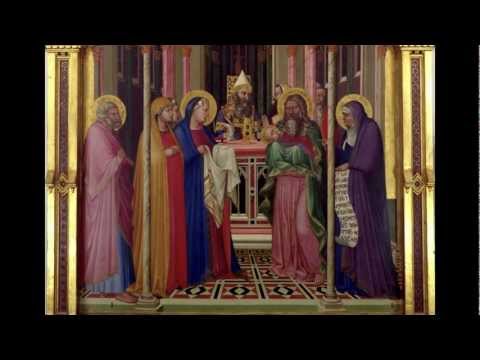
Presentation of Jesus in the Temple by Lorenzetti
(c. 1342)
This video presents a detailed analysis of Leonardo Da Vinci’s depiction of the Annunciation. The scene is set in a closed garden, symbolizing Mary’s virginity. Leonardo uniquely draws the angel’s wings based on his detailed study of bird anatomy. The angel, descending from the left, offers a lily to Mary, signaling her purity. Mary seems surprised yet accepting of her destiny.
However, certain aspects of this work have raised questions. Notably, the addition of color to lengthen the angel’s wings was likely added by someone other than Leonardo, which somewhat compromises his original intention. Also, Mary’s right arm appears longer than her left, an apparent anomaly that might have been deliberate, utilizing a technique called anamorphism.
The landscape and natural elements in the artwork symbolize the divine incarnation in matter. In particular, it’s noted that Leonardo dedicated significant attention to elements like flowers and trees in the background. There’s also a river or lake alongside a city with high towers, and at the center, a large white mountain serves as a source of light representing God’s presence.
Further, this painting illustrates Leonardo’s development of aerial perspective – a technique that accounts for tenuous coloring and blurriness for distant details due to atmospheric dust layers. Overall, Leonardo’s scientific approach and keen observational skills are evident throughout this work of art.
Tribute to Health Care Workers during the Covid-19 Pandemic (2020)