October 12, 2025
October 12, 2025


Homilies
Homilies
Deacon Greg’s blog has garnered some 20 million readers from around the world since its inception in 2007.
28th Sunday of Year C
Gratitude is the Heart of Faith




OUR SUNDAY VISITOR— A writer once said that the two most popular prayers on earth are “Help, help, help!” and “Thank you, thank you, thank you!”
I won’t disagree. A lot of us are very good at praying the first one. But how well, or how often, do we actually pray the second?
This Sunday’s Gospel is a helpful reminder of something we easily forget: the importance of living with an attitude of gratitude, especially gratitude to the Lord. We spend so much of our time on our knees pleading with God to bring us what we need — a cure, a job, a solution, an answer, a sign to help us take a certain path.
But what happens next?
────── ⋆⋅☆⋅⋆ ──────
Deacon Peter McCulloch
28th Sunday of Year C

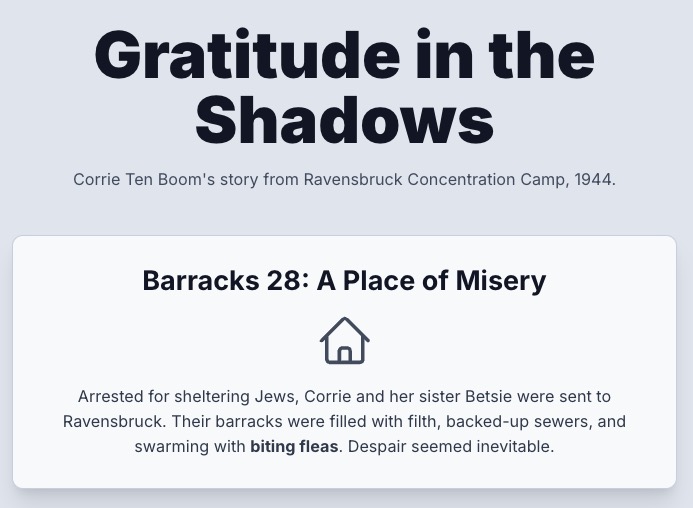
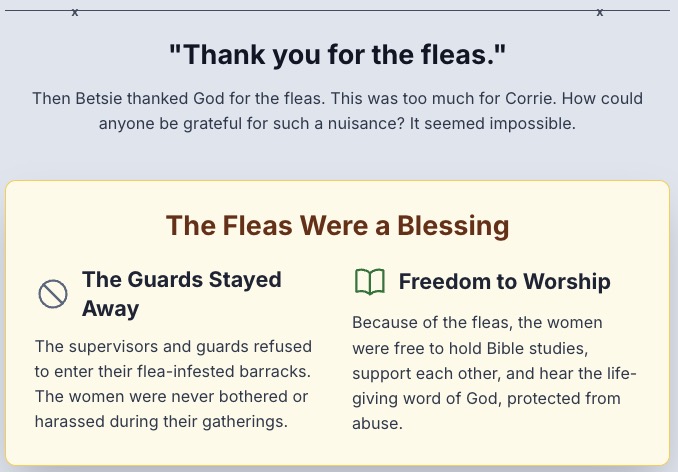
RENEW (04:26) – Mark E. Moore tells the story of Corrie Ten Boom, concentration camp survivor, who discovered the power of thanking God in every circumstance.

Click on infographic to enlarge it
Infographics on this page have been created using AI generative tools (i.e. GOOGLE'S AI Gemini 2.5 Flash LLM, Chart.js and Tailwind CSS). They are free to use for any non-profit ministry. THE WORD THIS WEEK kindly requests that you show your appreciation by sharing a link to the website.

In this Gospel, Jesus is saying that we should all be grateful for our blessings. So, we ask ourselves: are we truly grateful, like the Samaritan? Or do we choose to be like the other nine, taking but giving nothing in return?
Through his letters, St Paul often talks about being thankful. In fact, he does so 46 times (e.g., Col.1:3-8,15; 1Tim.2:1). ‘Give thanks in all circumstances’ (1Thess.5:18), he says…
In her book, The Hiding Place, Corrie Ten Boom explains how she learnt to be grateful, even in the most awful of places. In 1944, in the Netherlands, she and her family were sent to Ravensbruck concentration camp… Arriving at Barracks 28, they were horrified to find the straw mattresses soaked with urine, the sewers backed up and their beds swarming with biting fleas…


Click on infographic to enlarge it
Infographics on this page have been created using AI generative tools (i.e. GOOGLE'S AI Gemini 2.5 Flash LLM, Chart.js and Tailwind CSS). They are free to use for any non-profit ministry. THE WORD THIS WEEK kindly requests that you show your appreciation by sharing a link to the website.

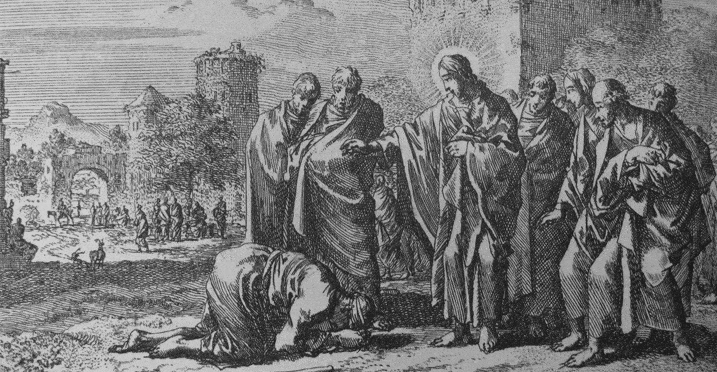
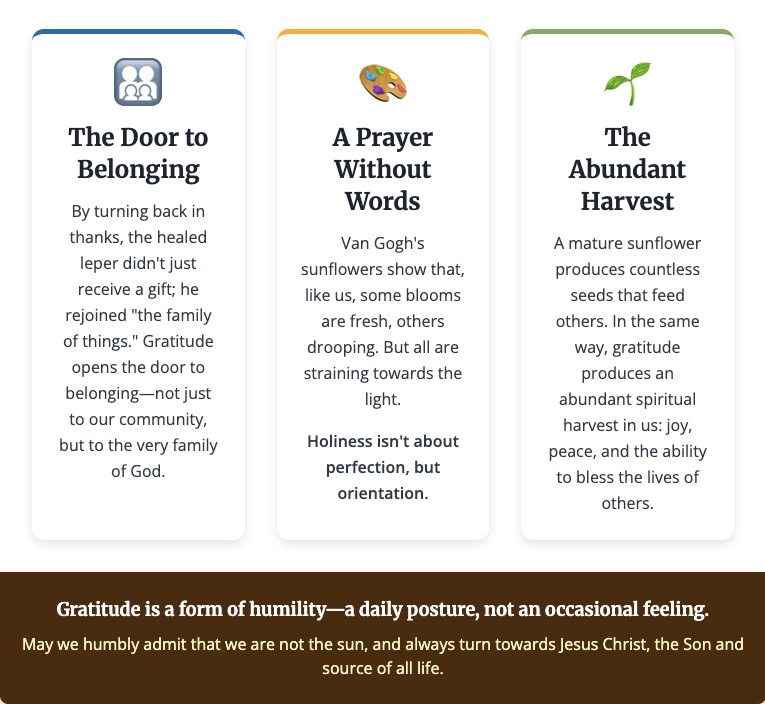
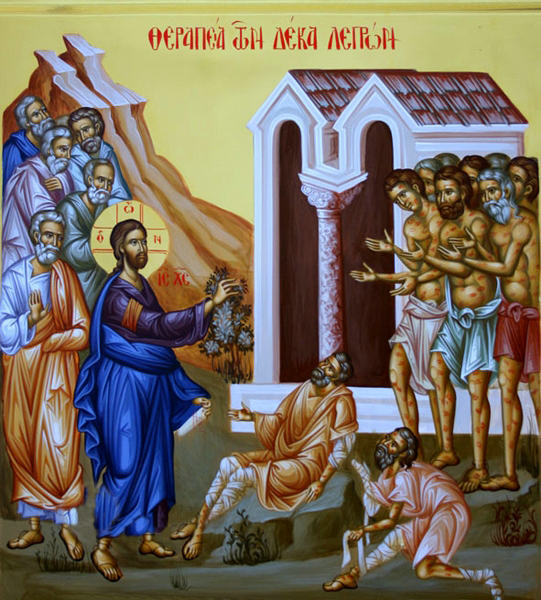
In today’s Gospel, Luke tells the story of ten lepers who ask Jesus for help. He heals all ten, but nine of them simply walk away. They enjoy being healed, but quickly forget the source of their gift.
One man is different, however. Like the sunflower, he turns back towards Jesus, the true Sun of Justice (Mal.4:2) and source of all light and life. And in his gratitude, this man not only receives healing for his body, but also salvation for his soul, for Jesus praises him, saying, ‘Your faith has saved you.’
Perhaps reflecting on the wisdom of this man’s action, the English poet Francis Quarles once wrote of a sunflower turning ‘to her God when he sets, the same look which she turned when he rose.’
────── ⋆⋅☆⋅⋆ ──────

28th Sunday of Year C
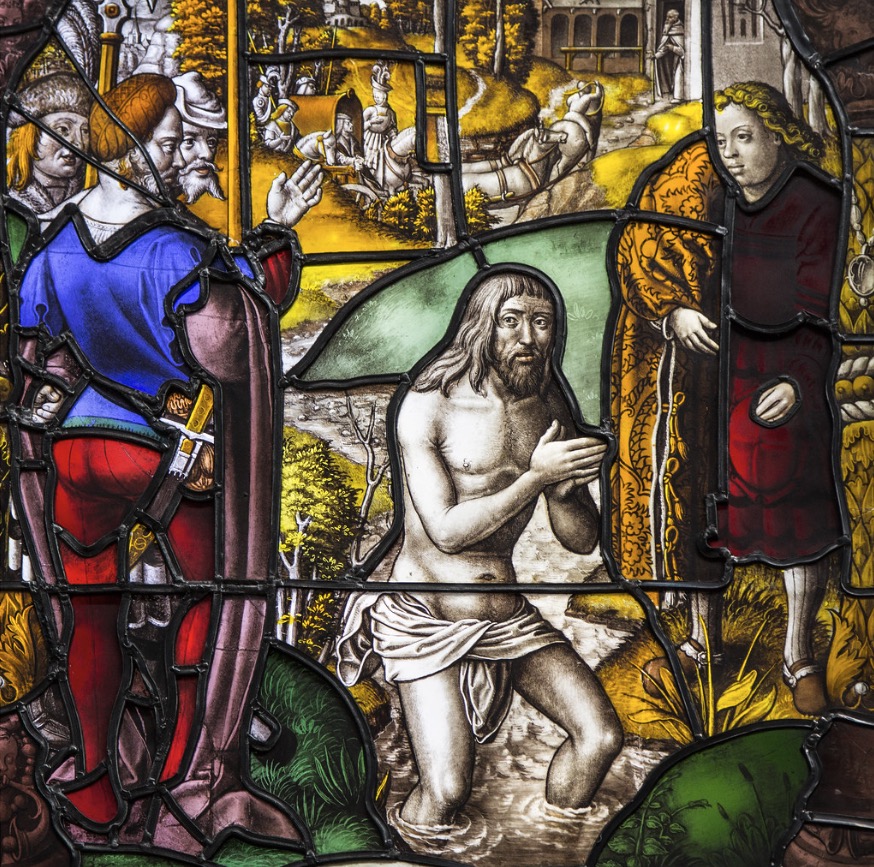
The Healing of Naaman, a stained glass window from the cloisters at Mariawald, a Cistercian abbey, c.1510-30, currently at the Victoria and Albert Museum, London, photographed by Fr Lawrence Lew OP

Click to enlarge

Twenty-eighth Sunday of the Year. Fr Leon Pereira warns against an inauthentic kind of Christianity.
In his homily, Leon Pereira O.P. contrasts authentic faith with an inauthentic “Mary Sue” Christianity. He argues that like a “Mary Sue”—a boringly perfect fictional character—some modern trends seek to create a version of Christianity without flaws, struggle, or sin. This makes everyone an “instant saint” without effort, which is a sterile deformation of the true faith.
Pereira contrasts this with the faith of Naaman and the Samaritan leper, who discovered the living “God in Israel.” They recognized a real, active God who demands struggle and repentance. True faith, he concludes, embraces this challenge, not the destructive ease of a faith twisted to our whims.

Image from an altarpiece depicting Naaman the Syrian by Cornelis Engelbrechtsen
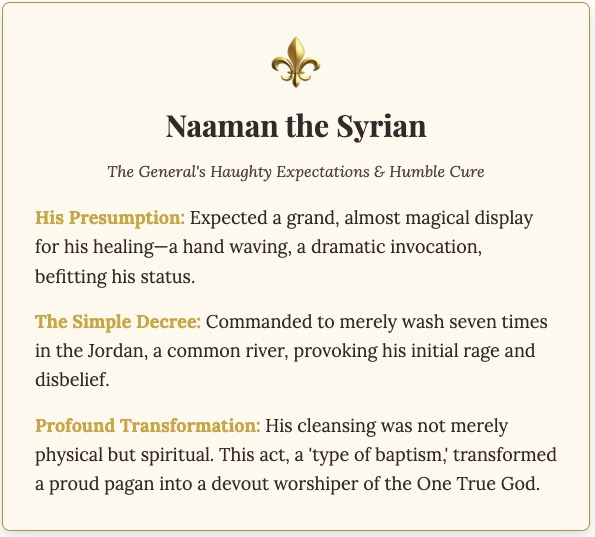

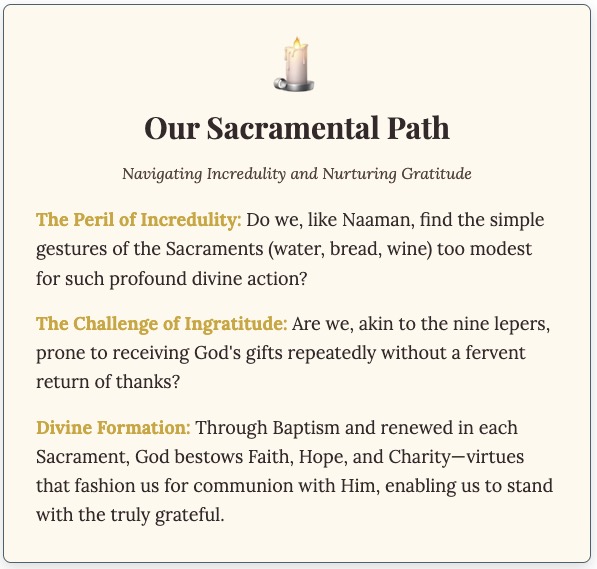
Twenty-eighth Sunday of the Year. Fr Albert Robertson preaches about two grateful foreigners.
The change in Naaman is quite clear when we have a little bit of context. Naaman’s dipping has brought about a change in him, not just a physical change — he has been cured —but a spiritual one. Cleansed, he is now able to enter the house of Elisha and stand before him. His once haughty demeanour is replaced by humility. His paganism replaced by worship of the one true God. No wonder, then, that we see the story of Naaman as a type of baptism, for as St Thomas reminds us, sacramental grace not only removes sin, but works to perfect the soul by conferring upon us the right and obligation to participate in the worship of the One True God (ST, III, 63, 5). Naaman is incredulous about the possibility of healing.
────── ⋆⋅☆⋅⋆ ──────
Fr. Austin Fleming
28th Sunday of Year C

And There Was One


2016 — In his homily, Fr. Austin Fleming re-examines the story of the ten lepers, suggesting the nine who didn’t return were simply obeying Jesus’ command. The focus is on the one Samaritan leper, whose return is significant because Samaritans rejected the Jerusalem temple; he knew the true place for thanks was Jesus himself.
This “attitude of gratitude,” also seen in Naaman, contrasts with our modern “culture of complaint,” which causes us to overlook God’s grace. Fr. Fleming concludes that by coming to the Eucharist, we come to the true temple—Christ’s body—to properly give thanks and cultivate our own gratitude.
────── ⋆⋅☆⋅⋆ ──────
Fr. Jude Siciliano, O.P.

28th Sunday of Year C
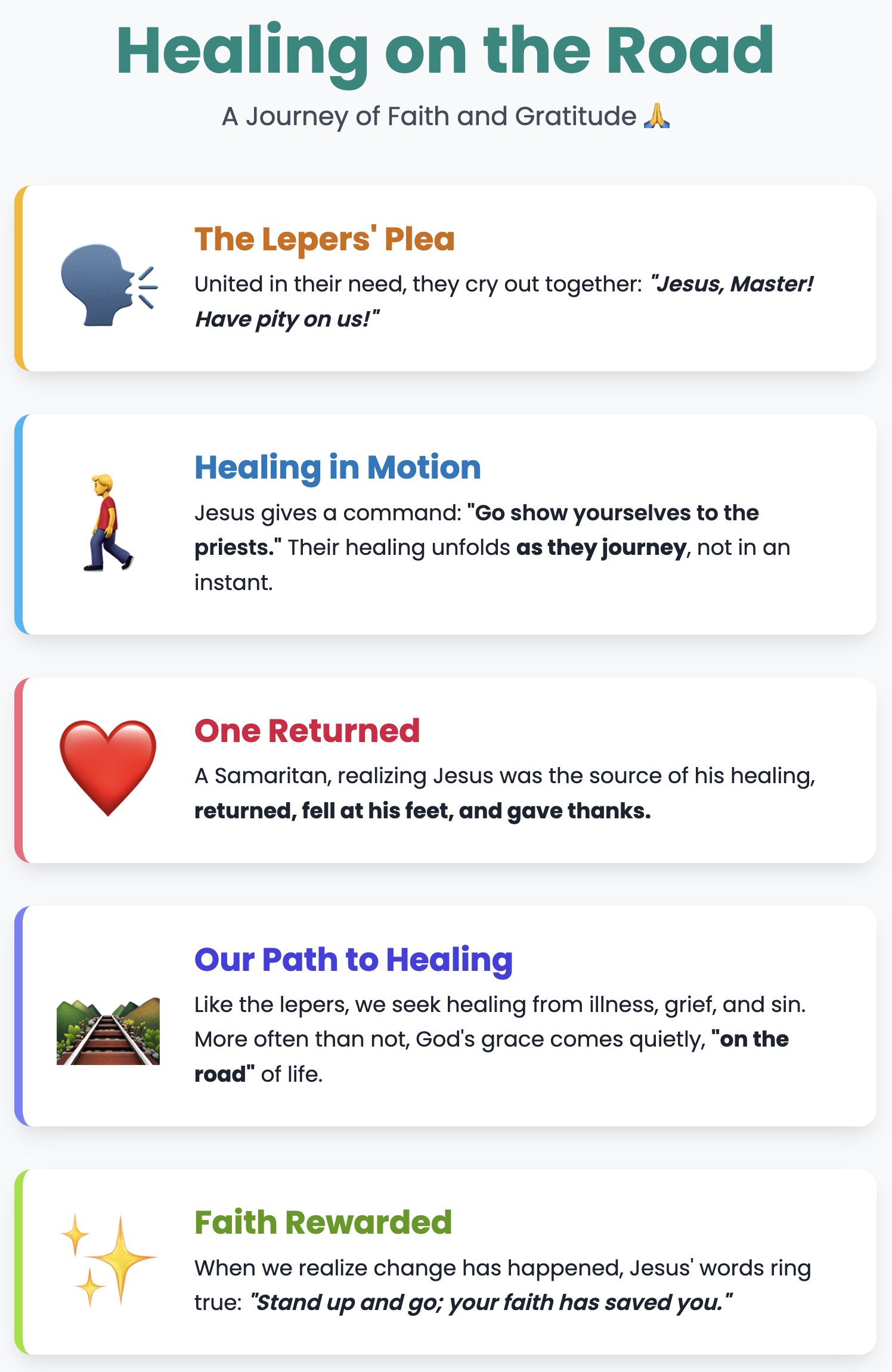
Have Pity on Us!
In the Gospel, the lepers cry out together, united in their need: “Jesus, Master! Have pity on us!” Jesus responds with a command: “Go show yourselves to the priests.” Their healing unfolds as they journey. Most likely, they believed God had healed them, and so they obeyed by heading toward the Temple. But one man—the least expected, a Samaritan—realized what had happened. He recognized Jesus himself as the source of his healing. He returned, fell at Jesus’ feet, and gave thanks.
Many of us, too, seek healing—whether from illness, grief, sin, or the inability to forgive. Sometimes God’s grace is dramatic and unmistakable, but more often it comes quietly, gradually, as we travel through life. Like the lepers, we voice our needs along the way: forgiveness, patience, compassion, the strength to love those we find hardest to love. The healing usually happens, not in an instant, but “on the road.”
Like the Samaritan, we sometimes come to realize that change has taken place—greater strength, patience, generosity, renewal. And we know this has not come from us alone. Jesus’ words ring true: “Stand up and go; your faith has saved you.”
There is still more to come, more healing yet to be done in us. But here and now, at this altar, we pause to give thanks. At the start of every Eucharist we echo the lepers’ plea: “Jesus, Master! Have pity on us!” And here we realize that he has extended mercy to us again—as he does each time we ask.
We are being healed on the road. We travel together as a pilgrim people, and we return here, week after week, to the source of our healing and nourishment: the Eucharist.
────── ⋆⋅☆⋅⋆ ──────
Fr. Charles E. Irvin
28th Sunday of Year C
Click to enlarge
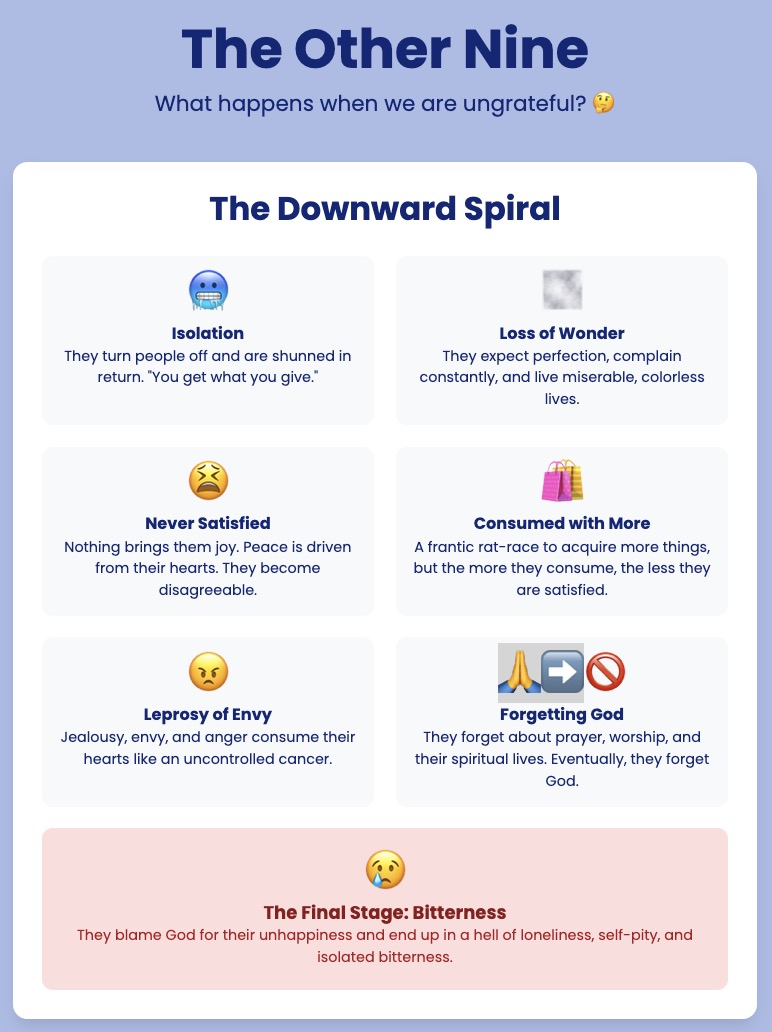
The Other Nine

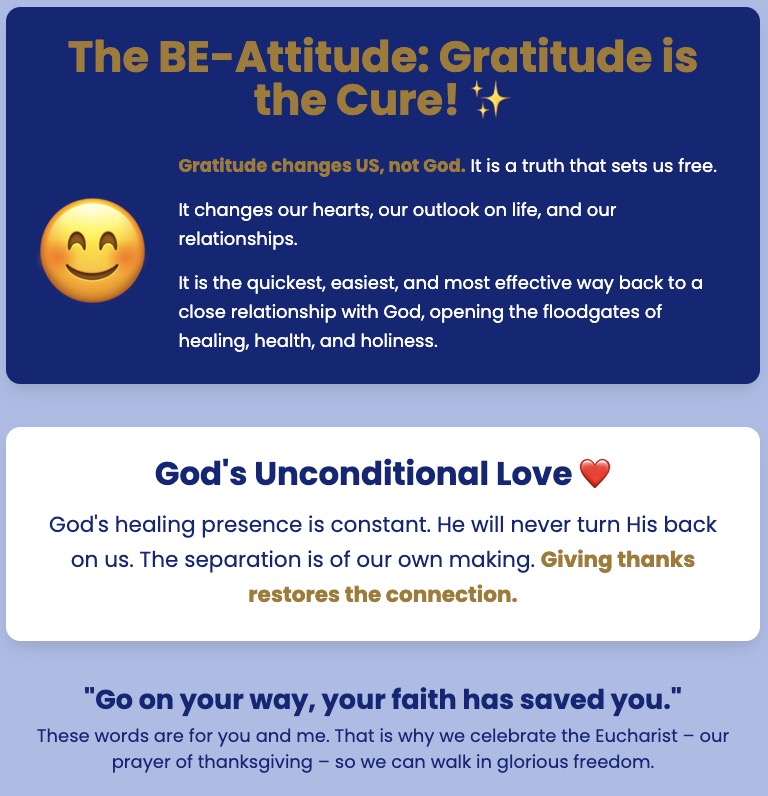
Fr. Irvin’s homily uses the story of the ten lepers, specifically the nine who did not return, to explore the profound and corrosive effects of ingratitude. He posits that an ungrateful spirit leads to a progressive journey into a self-made hell of bitterness and isolation. This downward spiral begins with alienating others and losing one’s sense of wonder, descending into a state of constant complaining and dissatisfaction where nothing brings joy. Life becomes colorless and miserable as miserliness and misery become intertwined.
This progresses to jealousy, an insatiable desire for more possessions, and a cancerous envy that consumes the soul. Ultimately, the ungrateful person forgets their spiritual life, neglects prayer, and eventually forgets God, instead blaming Him for their unhappiness. The final stage is a lonely existence filled with self-pity.
In stark contrast, gratitude is presented as the cure—a transformative “BE-attitude.” It is the key to changing ourselves, not God. Practicing thankfulness heals our hearts, restores our relationship with Him, and opens the floodgates to wholeness, health, and holiness. It is through this act of thanksgiving, embodied in the Eucharist, that we find true freedom and reconnect with God’s constant, unconditional love.
Fr. George Smiga
28th Sunday of Year C

Click to enlarge
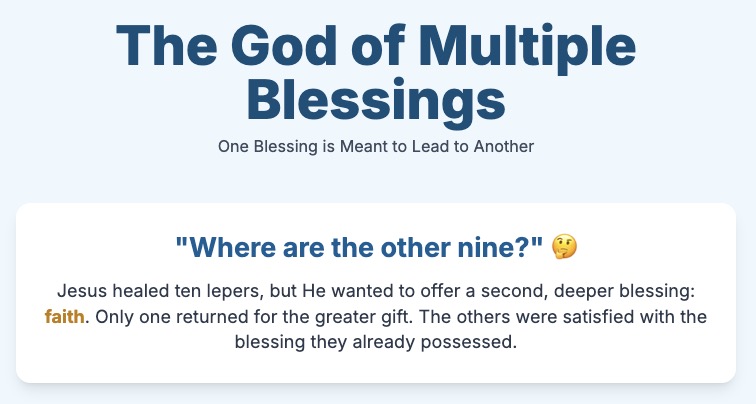
The God of Multiple Blessings

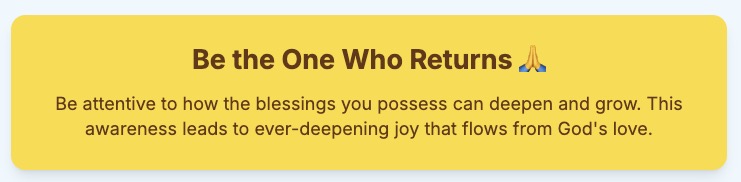
2022 HOMILY – Fr. Smiga reinterprets the story of the ten lepers by focusing on Jesus’s desire to offer multiple blessings. The first blessing was the physical healing from leprosy, but it was meant as a pathway to a second, deeper blessing—faith in him. Jesus’s sadness over the nine who did not return stems from their satisfaction with only the initial gift; they missed the greater opportunity.
The core message is that our God is a God of continuous blessings, intending one grace to lead to another. Therefore, our response must be more than thankfulness; it requires active attentiveness. We are called to look for ways the blessings we already possess—such as a strong marriage, financial security, or a living faith—can deepen and grow. This awareness allows us to experience ever-deepening joy, much like the one leper who returned to receive God’s fuller gift.
28th Sunday of Year C
Click to enlarge

Thank you, Lord

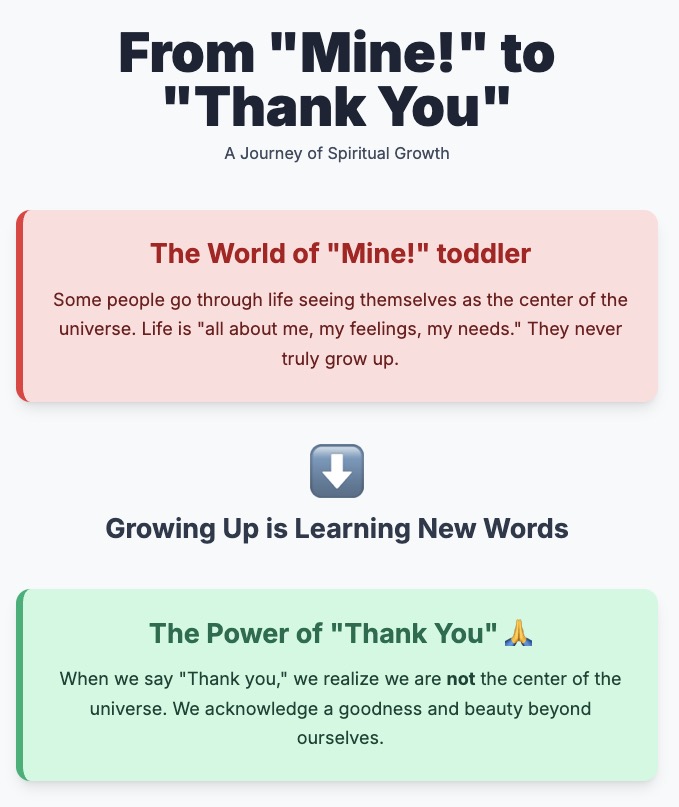
Msgr. Pellegrino’s homily contrasts childish self-centeredness, captured by the word “Mine!”, with spiritual maturity, which is learned through gratitude. Saying “Thank you” is a profound act that admits we are not the center of the universe.
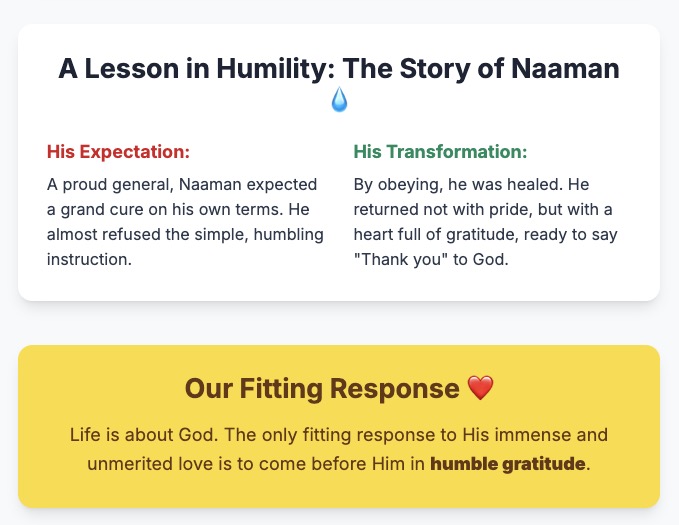
The story of Naaman the Syrian powerfully illustrates this journey. A proud general accustomed to getting his way, Naaman expected a grand cure for his leprosy but was humbled into simply obeying the prophet Elisha’s instructions. His subsequent healing transformed him, and he returned to offer sincere thanks, recognizing God’s power. The homily argues that, like Naaman, our only fitting response to God’s immense and unmerited love is humble gratitude. This thankfulness should permeate our lives, acknowledging His presence through joy and suffering. Worshipping in church becomes our way of standing on holy ground to thank God for His constant love and blessings.
────── ⋆⋅☆⋅⋆ ──────

28th Sunday of Year C

How to Give God
Perfect Thanks
The Gospel for this day makes the point that the Mass is the perfect offering of thanks to the Father in a remarkable and almost hidden way. But for Catholics, it is right there for us to see if we have eyes to see it. The Gospel contains all the essential elements of Holy Mass. It is about giving thanks and reminds us once again that it is the Mass that is the perfect thanksgiving, the perfect “Eucharist.”
────── ⋆⋅☆⋅⋆ ──────
Fr. Michael Chua
28th Sunday of Year C
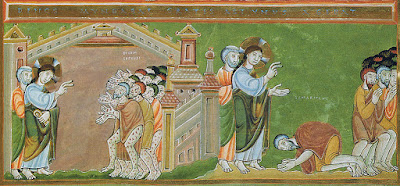
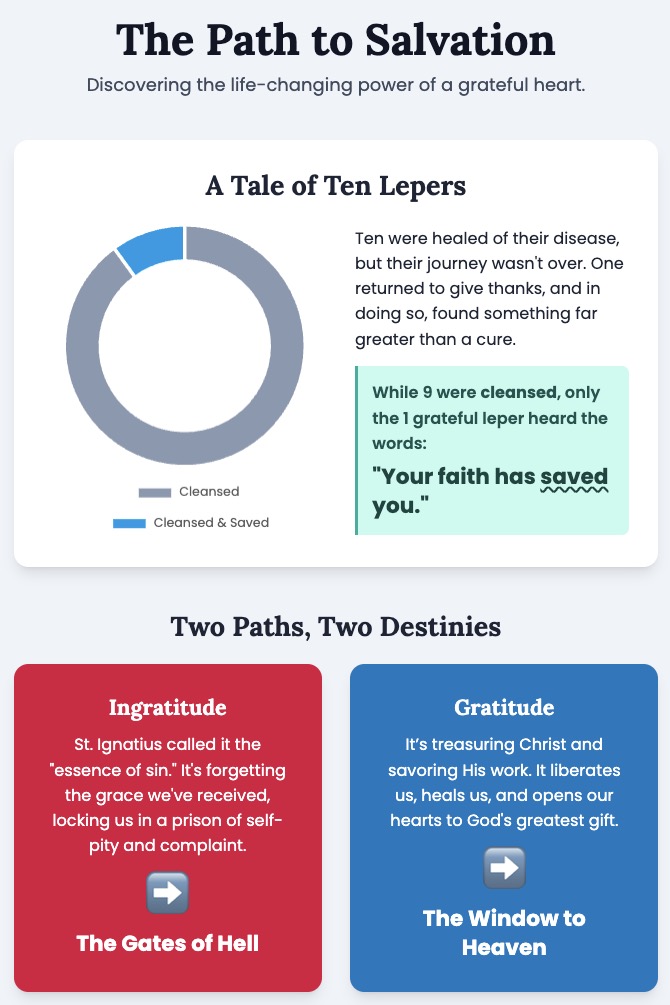


Fr. Chua’s homily reflects on how thanklessness is a common human struggle, affecting everyone. It uses the Gospel story of the ten lepers to illustrate a crucial distinction: while all ten were physically cleansed, only the one grateful Samaritan who returned to thank Jesus received the greater gift of salvation.
This act reveals that gratitude is not mere politeness but the very path to salvation, God’s greatest gift. Ingratitude, conversely, is described as the essence of sin—forgetting the grace we have received.
The homily concludes that the Eucharist, which literally means “thanksgiving,” is the perfect and primary way for Christians to show gratitude. It is Christ’s own perfect thanksgiving to the Father for the gift of salvation, a reality we participate in at every Mass. A lack of appreciation for the Mass stems from a failure to recognize this profound gift.
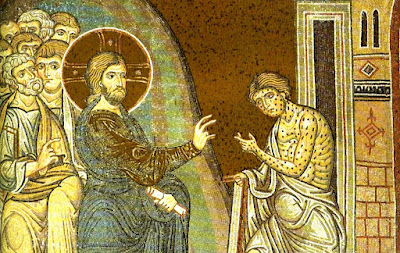
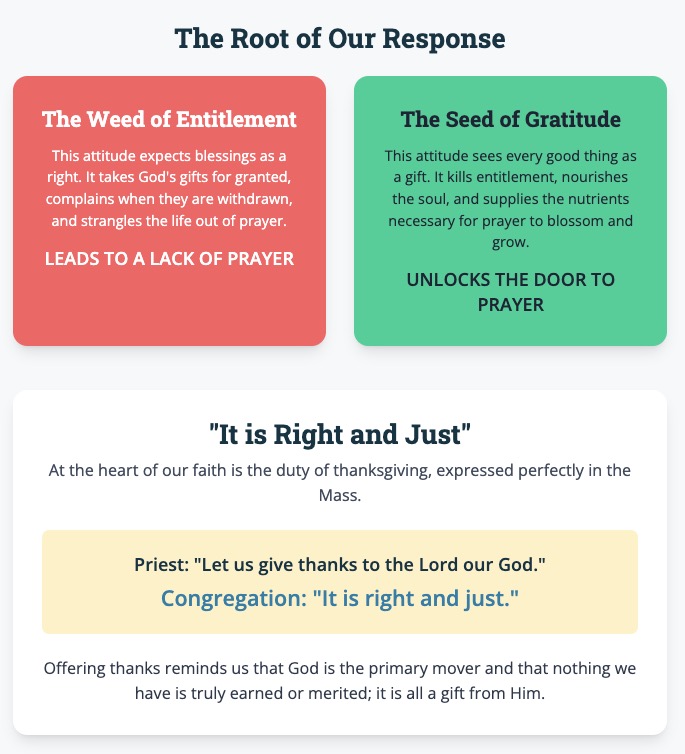

Fr. Chua’s homily highlights the story of ten lepers healed by Jesus, emphasizing that the only one who returned to give thanks was a Samaritan—a despised outcast. This narrative contrasts the Samaritan’s profound gratitude with the other nine’s sense of entitlement. Unable to present himself to a Jewish priest, the Samaritan’s only course of action was to return to the source of his miracle, Jesus.
This act exposes our modern culture of entitlement, which strangles gratitude and prayer. We often take blessings for granted and complain when they cease. The homily posits that true prayer flows from gratitude and desperation, which difficulties can often reveal. Ultimately, the Samaritan’s thankfulness earned him a greater gift than healing: salvation. Jesus’s words, “Your faith has saved you,” reveal that gratitude is the soil in which the gift of saving faith grows and blossoms.


Faith, Gratitude and Salvation
The story of the ten lepers is a wonderful story of the infinite grace and mercy of our Lord and Saviour, one who gives us good gifts, even if we have ungrateful hearts. It is also a story which challenges us to place our trust in God, to follow His commands, and to see the wonderful rewards this brings us. In a few moments we will come to the table of Christ together to celebrate the Eucharist. The word ‘Eucharist’ comes from the Greek word, “eucharistia,” (εὐχαριστία) meaning to give thanks (for the good graces we have received). And so, we give thanks not just because God has healed us, He has liberated us from sin, fear and anxiety. We give thanks because the Sacrifice of the Cross re-enacted at every Eucharist has saved us and continues to make us whole – completing, bringing together and finishing the grand work of salvation which God has begun in us. And I don’t know about you, but the prospect of being made whole, being healed, being liberated and being saved is enough to make me turn around, rush back again to Jesus, and say thank you, Jesus. Thank you so very much.

────── ⋆⋅☆⋅⋆ ──────
Fr. Jude Langeh, CMF

28th Sunday of Year C


Click to enlarge
Gratitude!
The transformative power of faith and gratitude is essential for healing and maintaining a relationship with God, as illustrated by the stories of lepers in biblical times. We must be willing to recognize and acknowledge that we are the recipients of many unearned benefits. The Ungrateful lepers actually cultivated a sense of entitlement. They felt that they deserved the healing they received. Entitlements is virtually the opposite of gratitude as I feel more entitled my gratitude shrinks. In proportion we must learn to be great for my dear brothers and sisters.
More Videos & Homilies
Infographics & Discussion Questions
Bishop Barron | Fr. Kevin Rettig | Msgr. Peter Hahn
Fr. Geoffrey Plant | Priests for Life
The reflection questions and infographics featured in this section have been created with the help of Google Gemini 2.5 AI tools, using Chart.js and Tailwind CSS. THE WORD THIS WEEK is happy to offer these resources to any non-profit ministry for use, and kindly request that you provide credit to the website and the respective contributors whose content is illustrated.