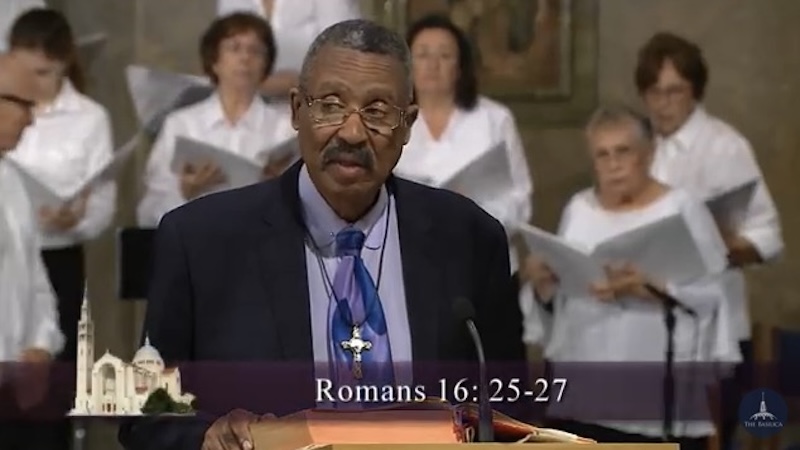
December 24, 2023 – YEAR B

Lectors Tips Guidelines Sunday Mass

Lectors Tips Guidelines Sunday Mass

Lectors Tips Guidelines Sunday Mass

Lectors Tips Guidelines Sunday Mass

Lectors Tips Guidelines Sunday Mass

LECTOR BULLETS

Lisa Bellecci-st.romain

ARCHIVE

FIRST READINGSECOND READING
YouTube player

FIRST READING

This reading starts out with a great story of “Hey, let’s do this!” and God says, “No, I have another plan – I’ve been in charge all along, remember?” So your emotion / “voice” will be instrumental here. But the connection to the gospel is actually toward the end of the reading, so stay strong!

YouTube player

SECOND READING

Your best aid in helping your listeners “hear” this reading will be to emphasize the parallel phrases that start “According to…” Take it slowly.!


LECTOR TIPS & NOTES

First Reading | Second Reading | TBD

Lectors Tips and Guidelines
First ReadingSecond ReadingGeneral Notes

First Reading Tips

When reading 2 Sm 7:1-5, 8b-12, 14a, 16 from the lectionary (NAB) during Mass, here are some specific tips to help enhance the delivery:

Use appropriate tone and dynamics to emphasize David’s intentions:

  • When reading about King David’s desire to build a house for God, convey his initial enthusiasm and dedication.
  • As the focus shifts to God’s response through the prophet Nathan, transition to a tone of reverence and awe.

Emphasize key words and phrases:

  • When David expresses his intentions to build a “house for the Lord” (2 Sm 7:2), emphasize “house” and “Lord” to capture the significance of David’s plan.
  • Emphasize the promises to David: In verse 12, emphasize the words “I will” when God says, “I will raise up your heir after you.” This emphasizes God’s active role in establishing David’s lineage and ensures that the promise is clearly conveyed.

Pause before and after significant verses:

  • Pause after David’s words in verse 5: After David says, “Here I am living in a house of cedar, while the ark of God dwells in a tent!” give a slight pause to allow the congregation to grasp the contrast David is highlighting.
  • Similarly, after verse 12, pause to allow the gravity of God establishing David’s lineage to resonate.
  • Pause after verse 14a: After reading “I will be a father to him, and he shall be a son to me,” pause slightly to let the congregation absorb the intimate relationship being described between God and David’s descendant.

Utilize appropriate gestures:

  • During appropriate moments, consider incorporating subtle gestures to enhance your delivery. For example, when speaking about David wanting to build a “house,” you could gesture with your hands to represent a physical structure.

Second Reading Tips

When reading Rom 16:25-27 from the lectionary during Mass, here are specific tips to enhance the delivery:

Emphasize the theme of faith:

  • When reading “the proclamation of Jesus Christ, according to the revelation of the mystery kept secret for long ages” (Rom 16:25), emphasize “proclamation,” “Jesus Christ,” “revelation,” and “mystery” to emphasize the central message.

Slow down and enunciate for verses 25-27:

  • These verses are a culminating point in Paul’s letter, expressing praise and theological insights. Slow down your pace, enunciate clearly, and allow the congregation to absorb the depth of Paul’s words.
  • Use deliberate pauses after important phrases or ideas, such as between “Now to him who can strengthen you” (Rom 16:25) and “to the only wise God, through Jesus Christ” (Rom 16:27).

Emphasize God’s authority and glory:

  • In verse 27, emphasize the words “wise God” and “glory” to highlight God’s unmatched wisdom and elevate the sense of praise and adoration.

Utilize appropriate gestures:

  • While reading, you can incorporate subtle hand gestures to help emphasize key points or ideas, such as extending your hands upward when mentioning God’s glory or folding your hands in reverence during particularly solemn sections.

General Notes

As a lector, it is an important responsibility to effectively convey the Word of God to the congregation during the Mass. Here are some practical tips:

1. Although tips on what words and phrases to emphasize and when to pause can be helpful, your delivery should ultimately depend on your own prayerful interpretation of the passage. From the series of tips given each week on this page, reader should choose which verses and words they want to emphasize. It’s important to find a balance that helps communicate the message effectively.

2. Familiarize yourself with the text: Read and study the Scripture passage several times before the Mass. Understand the context, the message it conveys, and the emotions it evokes.

3. Practice pronunciation and enunciation: Ensure that you know how to properly pronounce the words and names mentioned in the passage. Practice enunciating clearly and maintaining a steady pace throughout.

4. Use appropriate intonation and emphasis: Experiment with different ways to emphasize certain words or phrases that carry significant meaning. This can help in conveying the depth and impact of the message to the congregation.

5. Maintain a calm and confident demeanor: Approach the ambo with a serene presence and a sense of confidence. Maintain good posture, make eye contact with the congregation, and avoid rushing through the reading.

6. Speak slowly and clearly: Take your time while reading, ensuring that the words are clearly audible to everyone present. However, avoid artificially elongating words or sentences, as it may sound unnatural.

7. Pause when necessary: Pause at appropriate intervals, particularly at natural breaks in the text, such as commas or full stops. Pausing can help listeners absorb the message and reflect on its meaning.

8. Use nonverbal cues: Employ body language and gestures to effectively convey the emotions and ideas expressed in the passage. However, be mindful that gestures do not distract from the message or become exaggerated.

9. Maintain a respectful tone: Isaiah 61:1-2A, 10-11 is a text of hope and joy. Let the tone of your voice reflect the reverence and beauty of the passage. Be mindful of the emotions conveyed in the words and try to transmit them genuinely to the congregation.

10. Breathe and relax: Take a deep breath before beginning the reading to calm any nerves or anxiety. Remember, you are called to facilitate a meaningful encounter with the Word of God, and the Holy Spirit will guide you.

11. Pray before and after your reading: Seek God’s guidance and ask for His grace to effectively convey His message to the congregation. Offer a prayer of thanksgiving after the reading, asking for a blessing on the listeners and yourself.

By following these practical tips, you will be better equipped to deliver a clear, engaging, and spiritually uplifting reading during Mass.


Lector Notes

Ask your presider to tell your listeners (or tell them yourself): Fourth Sunday of Advent, year B, December 24, 2023 Before the first reading: The once nomadic Hebrews used to carry with them the ark of God, what we call the Ark of the Covenant. It was an ornate chest containing the stone tablets inscribed with their covenant with God. When they settled down and grew prosperous, their king proposed to build a permanent shrine for the ark. God responds to the king’s plans. After the psalm, before the second reading: Saint Paul summarizes and concludes his letter to the Romans. He emphasizes that God’s plans were only incompletely revealed until now. Before the gospel acclamation: Saint Luke’s original audience were pagans who had become Christians, and had never been Jews. For them Luke grounds the gospel in the Jewish heritage of Jesus. His introduction foreshadows much of what they already knew about the adult mission of Jesus. Guest writer: The late Hugh M. Kahler, who long helped lectors prepare at Saint Paul’s Episcopal Church, Marquette, Michigan, USA, wrote the “Proclaiming It” paragraphs of today’s Notes. The link, above, to Hugh’s obituary is up to date as of December 2, 2023. First Reading, 2 Sam 7:1-5, 8b-12, 14a, 16 Our Liturgical Setting: Today’s gospel,Luke 1, 26-38, explains the apparent earthly lineage of Jesus: his mother’s fiance was “of the house of David.” That would have helped put one in good standing among the Jews, for David was a revered early king and the original Messiah (literally, “anointed one,” since the inauguration ritual for Judah’s kings was not crowning but anointing). Our first reading includes a prophecy that David would have a long line of royal descendants. The Historical Situation: Moses had led God’s people out of Egypt around the year we now reckon as 1250 B.C.E. Joshua led them on an invasion of Palestine around 1220. Judges ruled them from 1200 to 1025. The last Judge, Samuel, anointed for them their first king, Saul, around 1030. David succeeded Saul in 1010. The “Ark of God” all this time was an ornate chest containing the stone tablets inscribed with the covenant that God struck with Moses on Mount Sinai (thus the chest’s familiar title, “Ark of the Covenant”). (See Exodus, chapter 25 for the origin of the Ark.) It was the people’s single most sacred object. The chest was quite portable, appropriate for nomadic people. When the nomads stopped for a while, they erected a special tent for the Ark. But now they were more settled, so much so that their king has a permanent house. He wants to make a permanent house for the Ark. A Theological Reflection: The great irony here is that God is too great to need a house, and, in a neat turn of phrase, promises a house of another kind for his would-be architect. God asks David “Should you be the one to build me a house? Come now, boy king. You’re too big for your britches. You want to make a house? I will tell you about making a house.” New, in 2020: To hear my oratorical interpretation of just one clause, click the wedge: This should be a required reading at every liturgy for the dedication of a church. Proclaiming It: Here again, the Lord speaks to a man, David, through another man, Nathan the prophet. Nathan reports not a rumor, but the promise of God. God, who had worked great things through Moses and others, promises David a line of kingly succession. But the promise is conditional, upon the good behavior of David’s son and successor, Solomon. Sadly, the line ends there, at least in its original sense. (Ironically, Solomon got to build the house for the Ark, the temple, that his father had wanted to build.) Mark the heart of the text, verse 8, “The LORD of hosts has this to say:…”, with a pause and change in your tone of voice. Be the messenger speaking God’s word to the king. Keep the tempo up as you detail the history of all that God did for David. You’re laying the groundwork so that David must accept the conclusion that God, not David, is in charge of their shared history. New in 2017: Author Greg Warnusz gives his oral interpretation of the reading, in an impromptu youtube video. Second Reading, Romans 16:25-27 Our Liturgical Setting: Several phrases make this passage right for the climax of Advent. It’s not about the birth of the infant Jesus, but about the unveiling of God’s plan for human salvation. Prophets revealed it first, but only to the Jews and only incompletely. Now it is revealed to all the Gentiles as they hear the gospel. For this is God to be glorified. This is joyful, but not sentimental. This is Christocentric, but not “Christmasy.” The editors of the Lectionary must be trying to keep us focused on the big picture, at the time of year when that’s most challenging. This passage bolsters a church that evangelizes itself and the world, and upbraids a church that merely assimilates. The Theological Background: These are the concluding versions of Saint Paul’s very challenging Epistle to the Romans, a letter difficult to summarize. Digests of it are highly problematic, as you may remember from the Lectionary’s survey of it in the summer of liturgical year A. But you can regard this passage as a recapitulation of Romans 9, 10 and 11, a section which itself ends in a doxology similar to today’s verses. Those chapters are about the history of salvation offered first to the Jews, then, because of the Jews’ rejection of Jesus, to the Gentiles. Paul hopes that the Gentiles’ example will win the Jews back, thus giving God a universal people, more, one might say, than the sum of its parts. Proclaiming It: This is a perfect example of why it is so hard to proclaim Paul. Read it carefully; it is all one sentence! Three full verses–one sentence. This is going to take the best of your skills to get it across. Read it several times before you proclaim, to get the sense of it. Observe the commas; they are important stopping points. Don’t try to do this all in one breath, but take short breaths at the commas. Keep the level of your voice even, except at the end, where you should be more emphatic. Gospel Reading, Luke 1, 26-38 The Historical Situation: Saint Luke wrote for an audience quite different from those of Mark and Matthew, different, too, from the Thessalonians and many other recipients of Paul’s letters. Luke’s readers lived a generation or more later than the apostles, after the destruction of Jerusalem by the Romans in 70 C.E., and outside the Holy Land. They had never been Jews. They were cosmopolitan, middle-class and Gentile, living in a skeptical society, yet attracted to a religion with long historic Jewish roots. But that new religion only came to its fulfillment by reaching out to all humankind. To tell that story, to ground his audience in their adopted religious heritage, and to keep them focused on the religion’s mission, Luke needed to tell the story of Jesus anew in this gospel, and needed a second book, the Acts of the Apostles. In the chapters of Luke about the adult Jesus, nothing refers back to the infancy narrative in chapters 1 and 2. However, the early chapters point vigorously to themes that will come later. One who has read the whole gospel can then come back to the infancy narrative and “get it” in a new way. One who proclaims this gospel or preaches on it in the Sunday assembly should let the whole gospel message inform that proclamation. The above introduction to Luke is based on the chapter “Luke” by Scholar Jerome Kodell, O.S.B, in The Collegeville Bible Commentary — New Testament (Collegeville, Minnesota: The Liturgical Press, 1992) Proclaiming It: Use different tones of voice for Mary and the angel, but don’t overdo it. The climax of the reading comes at the end, where Mary expresses her complete surrender to God. She is both scared and proud. Make her sound so.
YouTube player
Lector’s Notes author Greg Warnusz interprets the first reading from the Catholic lectionary for the 4th Sunday of Advent, liturgical year B, from II Samuel, chapter 7. The reading pivots around verse 5 (at 0 minutes, 44 seconds in this rendering), where the Lord reacts incredulously to King David’s plan. I publish this because I’ve never heard a lector get it right. I try to stress the contrast between the king’s arrogant plan and the majestic vision of God for the future of the house of David.
Iframe embed courtesy of LectorPrep.org

HOME | COMMENTARY