Papal Homilies
May 31, 2026

⬅️  ➡️
➡️

NOTABLE QUOTES
Pope Francis
On the Totality of Trinitarian Love (Exodus 34 & John 3)
Pope Francis beautifully connects the ancient self-revelation of God to Moses with the ultimate fulfillment found in Jesus Christ:
“The Liturgy of today, Trinity Sunday, shows us in the first reading a God who reveals himself… as a God of tenderness and compassion… Speaking with God, Moses is assured, that however unfaithful and headstrong the chosen people have shown themselves to be, God remains the God of faithful love, ‘a God merciful and gracious, slow to anger and abounding in steadfast love and faithfulness’.” (Angelus, 2020)
“The Scriptures reveal a ‘God of Love who created the universe and generated a people, became flesh, died and rose for us, and, as the Holy Spirit, transforms everything and brings it to fullness.’ This is the God who is Father, Son and Spirit… God does not want so much to reveal to us that he exists, but rather that he is the ‘God with us,’ that he loves us, is interested in our personal story and cares for each person, from the smallest to the greatest.” (Angelus, 2020)
Pope Benedict XVI
On the Mystery of the Cross and Salvation (John 3:16-18)
In a homily delivered on Trinity Sunday, Pope Benedict XVI reflected on how the global reality of human weakness is met with the gift of the Son:
“In the world there is evil, there is selfishness, there is wickedness, and God could come to judge this world, to destroy evil, to punish those who work in darkness. Instead, he shows his love for the world and for men and women, despite their sin, and sends what is most precious to him: his Only-Begotten Son… Responding to the love that comes from the Father, the Son gave his own life for us: on the cross God’s merciful love reaches its highest expression. And it is on the cross that the Son of God obtains for us participation in eternal life that is communicated to us with the gift of the Holy Spirit.” (Angelus, 2005)
On Trinitarian Communion as the Root of All Reality
In his Post-Synodal Apostolic Exhortation Sacramentum Caritatis, Benedict XVI anchors the relational reality of the Trinity directly to the words spoken to Nicodemus:
“The first element of eucharistic faith is the mystery of God himself, trinitarian love. In Jesus’ dialogue with Nicodemus, we find an illuminating expression in this regard: ‘God so loved the world that he gave his only Son…’ (Jn 3:16)… God is a perfect communion of love between Father, Son and Holy Spirit… The ‘mystery of faith’ is thus a mystery of trinitarian love, a mystery in which we are called by grace to participate. We too should therefore exclaim with Saint Augustine: ‘If you see love, you see the Trinity’.” (Sacramentum Caritatis (The Sacrament of Charity)
St. John Paul II
On the Intersect of Human Longing and Divine Grace (2 Cor 13 & John 3)
Celebrating the Solemnity of the Holy Trinity, St. John Paul II framed the mystery as an active invitation rather than a mathematical problem:
“This feast asks us to grapple with the very identity of God. To ask, not only who God is, and what God is, but how he communicates to us because we can only be in relationship with someone who discloses themselves to the other. And God wants to be in relationship, so he is communicating with us.” (Homily, 2000)
“We praise God… ‘Blessed be God the Father and his only-begotten Son and the Holy Spirit: for he has shown that he loves us.’… It is the meeting-point of two movements: the descending movement of God’s love for humanity and the ascending movement of the human longing for communion with God, the source of joy and peace.” (Angelus, 1999)
Most Holy Trinity (A)

Theme of the Readings
FROM THE ARCHIVES (1999)
The revelation of the Trinitarian mystery stands out in the texts the liturgy offers us. The passage from Exodus reveals the unity of God and the Father’s heart “of tenderness and compassion, slow to anger, rich in kindness and faithfulness.” In supplication of Moses: “Let my Lord come with us,” we can glimpse a first step toward the incarnation and revelation of the Son, “Emanuel,” God with us. This mystery of the incarnation is solemnly revealed in the Gospel: “God loved the world so much that he gave his only Son.” At the end of the Second Letter to the Corinthians, Paul takes up a Trinitarian formula of the early Christian liturgy: “the grace of the Lord Jesus Christ, the love of God and the fellowship of the Holy Spirit be with you all.”

Doctrinal Messages
The mystery of the Trinity is something hidden, concealed in God’s very heart. It is not hidden in the earth nor in space so that with time man would be able to find it. It dwells in God himself. And who can know God’s thoughts? God, hundreds of thousands of years ago, first created the world, then man, but he did not reveal this mystery. He then chose a people for himself, established a Covenant with this people, but without revealing his greatness as God. However, in the divine plan the first steps are already made in Israel’s very life and historical experience. Isn’t the passage of the first reading, where God is described as full of “tenderness and compassion, slow to anger, rich in kindness and faithfulness,” a tentative insight of God is Father? For the time being, it is a seed that will be fruitful at the coming of the fullness of time with Jesus Christ, through his incarnation and his teaching on God.
The mystery of the Trinity is beyond any human mind. The Trinity of God was neither the work of theologians nor mystics, nor even less of a think tank, as we say today. The mystery of the Trinity is not an invention of human genius to humiliate our feeble intelligence. It is not an idea, it is a reality, the most sublime and passionate reality which has always existed and will exist for ever. If God himself did not reveal it through his Son, it would have continued to be a reality, but unknown by man and therefore absolutely alien to his existence. God’s great love is inherent in his decision to reveal his mystery to us (Gospel).
The Trinitarian mystery is unveiled to us above all through God’s action in history. God reveals himself as a Father, moved by love, sending his Son into our sinful world to redeem us and to open the welcoming arms of the Father to us. Jesus Christ reveals himself as Son in his intimate filial prayer, his perfect obedience to his Father’s will, and his redemptive death and resurrection, in order to destroy a sin whose stain only the Son could erase and to bring us the grace of salvation. The Holy Spirit reveals himself to us as a bond of love between the Father and the Son, a gift of communion to human beings, so that they can live in the image of the Trinity, even if in a most imperfect way. This is the revelation Jesus Christ makes to us and which the liturgy takes up in the second reading.
Pastoral Suggestions
The human attitudes to this immense mystery. Before God’s mystery the most immediate attitude is adoration, sincere submission to the Father who so loves us, to the Brother who gave his life for us, to the Spirit who accompanies us and supports us down through history. It is more important to worship and give all honor and glory to our Lord than to reflect or ponder over this mystery. Another attitude is that of thanking God for what is a mystery and continues to be a mystery, even after the revelation. Since it is a mystery, it cannot be manipulated by man nor can he exploit it. Let us thank God for being God and not man, and for being a mystery. Finally, an attitude of humble acceptance of the mystery, avoiding both a rationalist stance which excludes it because it does not understand it (in this case, shouldn’t many other things be excluded from his life?), and the irrationalist stance which, rather than accepting it, succumbs to its weight.
In the image of the Trinity. In the Trinity first comes the love between the divine persons, but there is also an outgoing love for creatures, for humanity. In God we have the model of human life. In the first place, we must love the beings who are closest to us and most intimate: the members of the family, the parish, the ecclesial movement to which we belong, etc. We must also love all our brothers and sisters in faith, believers in God, all people without distinction; our friends and our enemies, those of my parish and those of the neighboring parish. We love everyone, for everyone is made in the image and likeness of God.
SOURCE: YEAR A DICASTERY NOTES (1999)
Message of Pope Francis
AT A GLANCE
- The Unified Trinitarian Plan: The Father, Son, and Holy Spirit operate not in isolation, but through a single, cohesive plan of love aimed entirely at rescuing and re-creating a broken world.
- Mercy Over Judgment: Though humanity’s sin provides a just ground for judgment, God responds with an “immeasurable measure” of love, giving His most precious possession—His only-begotten Son.
- The Priority of Grace: Christian faith is fundamentally receptive. God actively seeks us out and encounters us first, inviting us to be fascinated by His close, humble truth.
- Our Divine Identity: Through Christ and by the power of the Holy Spirit, we are no longer defined by our shortcomings; we are elevated to become children in the Son and God’s own legacy.
QUESTIONS FOR REFLECTION
- In moments of personal failure or distance from God, do you truly believe and feel the sentiment, “God loves me!”, or do you find yourself expecting judgment instead?
- Pope Francis contrasts our “stiff-necked” nature with God’s “tender, merciful, and gracious” character. What areas of your own life are currently resistant to letting God pardon your iniquity?
- Faith is described here as a response to being “encountered first” by God. How can you shift your spiritual focus from seeking God to actively welcoming the ways He is already pursuing you?
- Looking at your own history and circumstances, how can you let yourself be more deeply “fascinated by the beauty of God” amidst the noise of daily life?
ACTIONABLE
TAKEAWAYS
- Practice the Interior Affirmation: Begin and end each day this week by pausing for one minute to internalize a single, foundational truth. Explicitly tell yourself: “God loves me, wholly and unconditionally, right where I am.”
- Intercede for the ‘Stiff-Necked’: Emulate Moses’ courage by identifying someone in your community or family who seems hardened or distant from faith. Bring them specifically before the Lord in prayer, asking for His mercy and inheritance over their life rather than judgment.
- Consciously Choose Trust Over Control: Identify one specific anxiety or historical burden you are carrying. In an act of deliberate faith, hand it over to the Holy Spirit, acknowledging that Christian life means trusting in the God-Love who has already entered your history.
- Seek Mary’s Disposition: Before entering into prayer or Mass, ask the Blessed Virgin Mary to help you cultivate an open, receptive heart so that you can dwell with the Trinity just as she did.
Most Holy Trinity (A)
The Trinity is Love
7 June 2020 – Saint Peter’s Square
Today’s Gospel (cf. Jn 3:16-18), on the Feast of the Most Holy Trinity, demonstrates — with the Apostle John’s succinct language — the mystery of God’s love for the world, his creation. In the brief dialogue with Nicodemus, Jesus presents himself as the One who brings to fulfillment the Father’s plan of salvation for the world. He affirms: “For God so loved the world that He gave his only Son” (v. 16).
The Mystery of Trinitarian Love
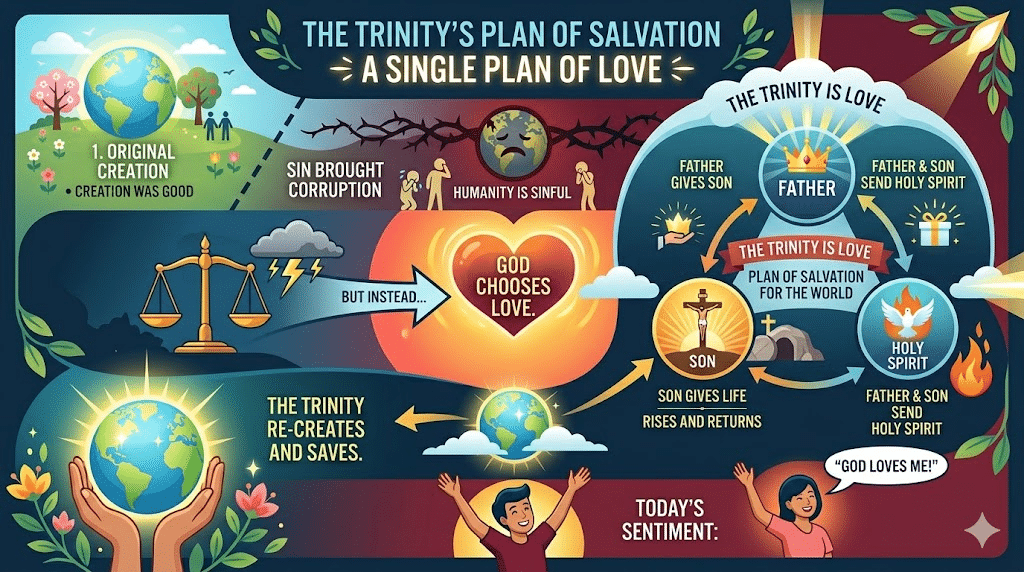
These words are to indicate that the action of the three divine Persons — Father, Son and Holy Spirit — is all a single plan of love that saves humanity and the world; it is a plan of salvation for us. The world God created was good, beautiful, but after sin, the world is marked by evil and corruption. We men and women are sinners, all of us; hence, God could intervene to judge the world, to destroy evil and castigate sinners. Instead, He loves the world, despite its sins; God loves each one of us even when we make mistakes and distance ourselves from him.
God the Father loves the world so much that, in order to save it, He gives what is most precious to Him: his only-begotten Son, who gives his life for humanity, rises again, returns to the Father and together with him sends the Holy Spirit. The Trinity is therefore Love, wholly at the service of the world, which He wishes to save and re-create. And today, thinking of God the Father, Son and Holy Spirit, we think of God’s love! And it would be beautiful if we felt that we were loved: “God loves me!”. This is today’s sentiment.
Scriptural Foundations of God’s Mercy
When Jesus affirms that the Father has given his only-begotten Son, we spontaneously think of Abraham and his offering of his son Isaac, of whom the Book of Genesis speaks (cf. 22:1-14): this is the “immeasurable measure” of God’s love. And let us also think of how God reveals himself to Moses: full of tenderness, merciful, gracious, slow to anger, and abounding in steadfast love and faithfulness (cf. Ex 34:6).
The encounter with this God encouraged Moses, who, as the Book of Exodus tells us, was not afraid to stand between the people and the Lord, saying to Him: although it is a stiff-necked people, pardon our iniquity and our sin, and take us for thy inheritance (cf. 34:9). And this is what God did, by sending his Son. We are children in the Son with the strength of the Holy Spirit! We are God’s legacy!
Welcoming God-Love Through Faith
Dear brothers and sisters, today’s Feast Day invites us to let ourselves once again be fascinated by the beauty of God; beauty, goodness and inexhaustible truth. But also beauty, goodness, and humble and close truth, which became flesh in order to enter our life, our history, my history, the history of each one of us, so that every man and woman may encounter it and have eternal life.
And this is faith: to welcome God-Love; to welcome this God-Love who gives himself in Christ, who moves us in the Holy Spirit; to let ourselves be encountered by him and to trust in him. This is Christian life. To love, to encounter God, to seek God; and He seeks us first; He encounters us first.

Message of Pope Benedict XVI
AT A GLANCE
- The Relational Nature of God: God’s revealed Name—merciful, compassionate, and abounding in love—proves He is not an isolated monad. Instead, the Trinity is a vital, dialogical unity of Father, Son, and Holy Spirit constantly reaching out to communicate life, establish deep bonds, and offer forgiveness.
- The Human Person in the Divine Image: Because we are made in the likeness of a relational, Triune God, human beings cannot find fulfillment in absolute autonomy. We are fundamentally created as children of God, designed to fulfill ourselves through meaningful dialogue, conversation, and relationship with others.
- The Blueprint for Society: This theological understanding serves as the foundation for a universal model of the human family. It establishes that all human beings are brothers and sisters under a common Father, serving as a transversal blueprint for building communities before any juridical or cultural regulations are set.
- The Primacy of God and the Person: Drawing from the Church’s Social Doctrine, a just and free society relies on two central pillars: putting the personal, living God in first place, and placing the relational human person at the center of emotional life, work, and citizenship.
- The Church as a Mystery of Communion: The Church does not build communion from the ground up. It serves as a living sign and sacrament of the eternal dialogue of love that originates in Heaven, working to weave unity into the fractured fabric of human history.
QUESTIONS FOR REFLECTION
- If God is not a self-sufficient monad but an open relationship, how does your own prayer life reflect this? Do you approach Him in isolated duty, or do you step into a vital, communicative bond?
- Moses climbed Mount Sinai to receive instructions for his people’s freedom. What are the “mountains” or quiet spaces in your life where you deliberately step away from daily problems to receive God’s intimate gaze and guidance?
- The text states that man often deceives himself into pursuing absolute autonomy. In what areas of your daily routine or decision-making are you operating under the illusion of self-reliance rather than acknowledging your identity as a child dependent on the Father?
- When you look at the people around you—especially those with different cultural backgrounds or viewpoints—do you recognize them as brothers and sisters who reflect the image of your common Father? How does this perspective challenge your view of modern society?
- As our culture oscillates between the extremes of global mass-connectivity and profound personal individualism, how can you personally help your local parish or small group become a truer, warmer sign of authentic communion rather than just an institution?
ACTIONABLE
TAKEAWAYS
- Realign Your Day Around the Primacy of God: Intentionally put God in first place by dedicating the first ten minutes of your morning entirely to Him. Before checking your phone or jumping into work, sit in His presence, acknowledging His Face and His Name over your day.
- Intentionally Break Your Autonomy: Identify one burden, stressor, or major choice you have been trying to manage completely on your own. Bring it to prayer and explicitly hand it over to the Trinity, choosing to act as a vulnerable child of God rather than a self-sufficient operator.
- Engage in One Authentic ‘Encounter’: Combat the modern drift toward isolation by seeking out a meaningful conversation this week. Put away digital distractions and practice deep, dialogical listening with a family member, colleague, or neighbor, honoring the divine image in their face.
- Bring Communion into Your Circle of Fragility: Look around your immediate community—work, home, or citizenship—and find someone experiencing a moment of fragility or isolation. Offer a concrete gesture of solidarity, whether a shared meal, a phone call, or an act of service, extending the Church’s calling to be an instrument of unity.
Most Holy Trinity (A)
The Trinitarian Blueprint
18 May 2008 | Piazza della Vittoria, Genoa

At the end of a full day spent in your City, we are gathered around the altar to celebrate the Eucharist on the Solemnity of the Most Holy Trinity. From this central square, Piazza della Vittoria, which welcomes us for the communal service of praise and thanksgiving to God with which my Pastoral Visit concludes, I extend my most cordial greeting to the entire Civil and Ecclesial Community of Genoa...
The Revelation of the Triune God as Love
In the First Reading (Ex 34: 4b-6, 8-9) we heard a biblical text that presents to us the revelation of God’s Name. It is God himself, Eternal and Invisible, who proclaims it, passing before Moses in the cloud on Mount Sinai. And his Name is: “The Lord, a God merciful, and compassionate, slow to anger, and abounding in steadfast love and faithfulness”. In the New Testament St John sums up this sentence in a single word: “Love” (cf. I Jn 4: 8, 16). Today’s Gospel also testifies to this: “God so loved the world that he gave his Only Son” (Jn 3: 16).
Consequently this Name clearly expresses that the God of the Bible is not some kind of monad closed in on itself and satisfied with his own self-sufficiency but he is life that wants to communicate itself, openness, relationship. Words like “merciful”, “compassionate”, “rich in grace” all speak to us of a relationship, in particular, of a vital Being who offers himself, who wants to fill every gap, every shortage, who wants to give and to forgive, who desires to establish a solid and lasting bond. Sacred Scripture knows no other God than the God of the Covenant who created the world in order to pour out his love upon all creatures (cf. Roman Missal, Eucharistic Prayer IV) and chose a people with which to make a nuptial pact, to make it become a blessing for all the nations and so to form a great family of the whole of humanity (cf. Gn 12: 1-3; Ex 19: 3-6).
This revelation of God is fully delineated in the New Testament though the word of Christ. Jesus showed us the Face of God, one in Essence and Triune in Persons: God is Love, Father Love – Son Love – Holy Spirit Love. And it is precisely in this God’s Name that the Apostle Paul greets the Community of Corinth: “The grace of the Lord Jesus Christ and the love of God [the Father] and the fellowship of the Holy Sprit be with you all” (II Cor 13: 14).
The Concept of the Human Person
Formed in God’s Imagevercoming Babel
There is contained, therefore, in these Readings, a principal that regards God and in effect today’s Feast invites us to contemplate him, the Lord. It invites us in a certain sense to scale “the mountain” as Moses did. This seems at first sight to take us far from the world and its problems but in fact one discovers that it is precisely by coming to know God more intimately that one receives fundamental instructions for this our life: something like what happened to Moses who, climbing Sinai and remaining in God’s presence, received the law engraved on stone tablets from which the people drew the guidance to continue, to find freedom and to form themselves as a people in liberty and justice. Our history depends on God’s Name and our journey on the light of his Face.
From this reality of God which he himself made known to us by revealing his “Name” to us comes a certain image of man, that is, the exact concept of the person. If God is a dialogical unity, a being in relation, the human creature made in his image and likeness reflects this constitution: thus he is called to fulfil himself in dialogue, in conversation, in encounter.
In particular, Jesus has revealed to us that man is essentially a “son”, a creature who lives in the relationship with God the Father, and in this way in relationship with all his brothers and sisters. Man is not fulfilled in an absolute autonomy, deceiving himself that he is God but, on the contrary, by recognizing himself as a child, an open creature, reaching out to God and to his brethren in whose faces he discovers the image of their common Father. One can easily see that this concept of God and man is at the base of a corresponding model of the human community, and therefore of society. It is a model that comes before any normative, juridical or institutional regulations but I would say even before cultural specifications. It is a model of the human family transversal to all civilizations, which we Christians express confirming that human beings are all children of God and therefore all brothers and sisters. This is a truth that has been behind us from the outset and at the same time is always before us, like a project to strive for in every social construction.
Social Doctrine and Priorities for the Ecclesial Community
The Magisterium of the Church which has developed from this vision of God and of man is a very rich one. It suffices to run through the most important chapters of the Social Doctrine of the Church, to which my venerable Predecessors have made substantial contributions, especially in the past 120 years, making themselves authoritative interpreters and guides of the social movement of Christian inspiration.
Here I would like to mention only a recent Pastoral Note of the Italian Episcopate: “Rigenerati per una speranza viva’: Testimoni del grande ‘si’ di Dio all’uomo” [Regenerated by a living hope: witnesses of God’s great “yes” to man] (29 June 2007). This Note proposes two priorities. First of all, the choice of the “primacy of God”: all the Church’s life and work depend on putting God in first place, not a generic God but rather the Lord with his Name and his Face, the God of the Covenant who brought the people out of slavery in Egypt, who raised Christ from the dead and who wants to lead humanity to freedom in peace and justice. The other choice is to put the person and the unity of his life at the centre, in the various contexts in which he is deployed: emotional life, work and celebration, in his own fragility, tradition and citizenship.
The Triune God and the person in relationship: these are the two references that the Church has the duty to offer to every human generation as a service to build a free and supportive society. The Church certainly does so with her doctrine, but above all through her witness which, with reason, is the third fundamental choice of the Italian Episcopate: personal and community witness in which the spiritual life, pastoral mission and the cultural dimension converge.
The Church as a Sign and
Instrument of Communion
In a society fraught between globalization and individualism, the Church is called to offer a witness of koinonìa, of communion. This reality does not come “from below” but is a mystery which, so to speak, “has its roots in Heaven”, in the Triune God himself. It is he, in himself, who is the eternal dialogue of love which was communicated to us in Jesus Christ and woven into the fabric of humanity and history to lead it to fullness.
And here then is the great synthesis of the Second Vatican Council: the Church, mystery of communion, “in Christ is in the nature of sacrament – a sign and instrument, that is, of communion with God and of unity among all men” (Dogmatic Constitution on the Church, Lumen Gentium, n. 1). Here too, in this great City, as well as in its territory with the variety of the respective human and social problems, the Ecclesial Community, today as yesterday, is first of all the sign, poor but true, of God Love whose Name is impressed in the depths of the being of every person and in every experience of authentic sociability and solidarity…
Message of Pope Saint John Paul II
AT A GLANCE
- The Trinitarian Source of Unity: The Church is not a mere human organization but a community brought into unity directly from the perfect communion of the Father, the Son, and the Holy Spirit.
- The Sacred Architecture of Grace: A cathedral stands as a physical monument to a millennium of continuous grace. Its elevated position visually captures two movements: God’s descending love reaching out to humanity, and humanity’s ascending longing to touch the divine.
- A Universal and Missionary Vision: True communion naturally expands outward. The Church’s rich history of welcoming diverse traditions and sending out missionaries demonstrates that a deep relationship with the Triune God breaks down borders and demands a vast, universal horizon of service.ope.
QUESTIONS FOR REFLECTION
- When you look at the sacred spaces or the historical heritage of your local parish, do you perceive them as “tangible signs of divine love,” or have they merely become part of the background routine of your life?
- The homily calls young people to “think big” and families to “live in full communion.” In what specific areas of your personal life, career, or relationships are you settling for comfortable mediocrity instead of striving for the high standard of Christian perfection?
- Ancona historically served as a peaceful bridge between diverse cultures and eastern traditions. How effectively do you act as a “bridgehead” of peace, harmony, and welcome within your own fractured community, workplace, or social circles?
ACTIONABLE
TAKEAWAYS
- Elevate Your Daily Gaze: Commit to a deliberate, daily habit of “looking upwards” to break the monotony of earthly anxieties. Dedicate the first five minutes of your morning entirely to scripture or silent prayer before engaging with the world.
- Support Visible Works of Solidarity: Translate your faith into communal witness by actively supporting local parish projects that care for the vulnerable, just as the people of Ancona remodeled the Annunziata complex to serve youth and the needy.
- Foster Harmony Over Particularism: Actively resolve a lingering tension or misunderstanding in your family, parish, or workplace this week. Prioritize the common good and shared peace over the desire to protect personal interests or be proven right.
Most Holy Trinity (A)
Glory to the Father,
the Son and the Holy Spirit
30 May 1999 | Millennium of the Cathedral of St. Cyriacus, Ancona
We praise God for the providential coincidence of these two events, different in intent but convergent in meaning, that we are celebrating today: the Solemnity of the Holy Trinity and the 1,000th anniversary of your cathedral. This splendid building, which overlooks the city from the top of a hill, is really a symbol of the People of God in the Ancona region, who have been brought into unity, to use St. Cyprian’s vivid expression, “from the unity of the Father, the Son and the Holy Spirit” (De Orat. Dom., 23: PL 4, 553). Thus as we celebrate the cathedral’s 1,000 years, we are also celebrating the marvels of grace and love that in 10 centuries of history the Holy Trinity has poured out upon generations of Christians in this region who have believed in the Gospel and have striven to live it. With this awareness our liturgical assembly, gathered in this festively decorated stadium, cries out in joy: “Blessed be God the Father and his only-begotten Son and the Holy Spirit: for he has shown that he loves us”.


The Cathedral as a
Tangible Sign of Divine Love
God’s love for each of us is truly great! Great is God’s love for each of you, dear brothers and sisters of Ancona, and your beautiful cathedral dedicated to St Cyriacus is a tangible sign of it.
Viewed from the outside, with its elevated position over the city, it symbolizes well the reassuring presence of the Trinitarian God, who from on high guides and protects the life of human beings. At the same time, the cathedral is a powerful reminder to look upwards, to rise above the routine of daily life and from everything that weighs down earthly existence, to fix our gaze on heaven in a continual pursuit of spiritual values. It is, so to speak, the meeting-point of two movements: the descending movement of God’s love for humanity and the ascending movement of the human longing for communion with God, the source of joy and peace…
An Invitation to Youth:
Striving for Perfection
We have just heard the words of the Apostle Paul: “Brethren, rejoice. Strive for perfection. Encourage one another. Live in harmony and peace, and the God of love and peace will be with you” (2 Cor 13:11). I address these same words to you, brothers and sisters, with heartfelt warmth and affection.
First of all to you, young people! With St Paul I say to you: “Strive for perfection”! Such a demanding invitation presumes that its recipients are capable of enthusiasm. It this not typical of people your age? So I say to you: know how to think big! Have the courage to dare! With God’s help, “strive for perfection”! God has a plan of holiness for each of you.
With you today is the “Young People’s Cross” which has accompanied the Church’s most important youth gatherings since the Holy Year of 1984. The Cross invites you to bear courageous witness to the faith you have inherited from Stephen, Cyriacus and Leopardus, the patrons of your communities. Be ready to carry on the new evangelization and to enter the third millennium with the victorious Cross of Christ.
Ancona’s Cosmopolitan Heritage
and Missionary Zeal
My gaze extends now across your city which, overlooking the Adriatic Sea, has always been, so to speak, a “bridgehead” to the East. Ancona’s history is steeped in apostolic daring and missionary spirit. One need only think of St Stephen Protomartyr, to whom the first cathedral was dedicated, and of Primianus, Greek by birth and the city’s first Bishop. And then there is St Cyriacus, whom we recall in a special way during these millennial celebrations of the cathedral dedicated to him: he came from Jerusalem. Liberius was Armenian and the martyrs of Osimo — Florentius, Sisinius and Diocletius — also came from the East. Your city truly looks out upon a vast horizon!
A transit point for merchants and pilgrims, for centuries Ancona has experienced the peaceful coexistence of Greek and Armenian communities, which built their own places of worship and established relations of mutual respect and cooperation with the Catholic community. Let us thank God that down the centuries the Church in Ancona has acquired a cosmopolitan character and has fostered a burning missionary zeal, eloquent proof of which is the work done in China by Bishop Antonio Maria Saccone and by Bishop Riccardini in the Middle East.
This spiritual heritage has never been interrupted and continues to bear fruit. Proof of this, among others, is the missionary cooperation that the Archdiocese offers the Ecclesial Community of Anatuja, Argentina. I am sure that your Church will be open to new, promising horizons, instilling in all the Christian people of Ancona a renewed apostolic zeal for service to the Gospel. This will be one of the most significant results from the jubilee celebrations of your cathedral.
Building Peace and Unity
in Church and Society
“Live in peace”, St Paul advises. Dear friends, the cathedral is a symbol of the Church’s unity. Here in Ancona too, as in neighbouring Osimo, it has been a place for the whole city to praise God, the site of renewed harmony between the moments of worship and civic life, the reference-point for restoring peace to hearts.
Prompted by memory, you want to live this present moment of history. Just as your ancestors were able to build a splendid church of stone to be a sign and call to communion of life, it is your task to make the meaning of this sacred building visible and credible by living peaceably in the ecclesial and civil community.
Mindful of the past and attentive to the present, but also looking to the future, you Christians of the Archdiocese of Ancona-Osimo know that the spiritual progress of your ecclesial communities and the very promotion of the common good of your civil communities calls for arduous effort and an ever more vital involvement of your parishes and associations in the region. May the road you have traveled thus far and the faith that motivates you give you the courage and enthusiasm to continue.
Trinitarian Blessing and
Entrustment to the Queen of Saints
“The grace of the Lord Jesus Christ and the love of God and the fellowship of the Holy Spirit be with you all” (2 Cor 13:13): these were the Apostle Paul’s closing wishes to the Christians of Corinth. Today the Successor of Peter would like to extend this same Trinitarian wish to your community as you celebrate the millennium of your cathedral.
Christians of Ancona, emulate your ancestors and be a living Church of Gospel service! A hospitable and generous Church, whose persevering witness can give vital expression to God’s love for every human being, especially for the needy and the suffering. I know that this is your commitment. It is demonstrated by, among other things, a project that the Church in Ancona is undertaking in remembrance of the millennial celebrations: the remodeling of the Annunziata complex, which will be used for services of solidarity and for the pastoral care of young people. The Pope praises you for this and encourages you.
May Mary, whom you venerate in your cathedral with the beautiful title of “Queen of All Saints”, watch from the top of the hill over each of you and the people of the sea.
And you, Queen of Saints, Queen of Peace, hear our prayer: make us credible witnesses of your Son Jesus and tireless peacemakers. Amen!