Today’s Mass
Today’s Mass








Carmelites
LECTIO DIVINA
DOWNLOADS
ePub | PDF | Mobi
Spanish, Italian, and English

Augustine Institute Podcast with Tim Gray

Dynamic Catholic
Today’s Gospel with
Matthew Kelly

Daily Reflections
Video courtesy of Chicago Dominicans
“A Word of Hope” is an ongoing daily Catholic video reflection series produced by the Dominican Friars of the Province of St. Albert the Great. It provides practical, contemplative preaching grounded in scripture—designed to offer encouragement, spiritual renewal, and hope for everyday life.
Franciscan Media
- CATHOLIC TV
- BISHOP BARRON
- FR. BRAD DOYLE

SUNDAY | MONDAY | TUESDAY | WEDNESDAY | THURSDAY | FRIDAY | SATURDAY

VIDEO: John Michael Talbot Reflection
- CHRISTIAN ART
- PENITENTIAL ACT
- INTERCESSIONS
Sunday

Give back to Caesar
what belongs to Caesar
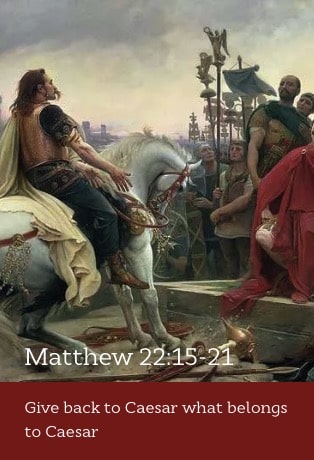
SUMMARY: In Matthew 22:15-21, the Pharisees and Herodians attempt to trap Jesus with a no-win question regarding the Roman census tax. Endorsing the tax would alienate Jews by validating the pagan occupation, while opposing it invited arrest for treason. Jesus brilliantly evades the snare by requesting a denarius. Noting Caesar's image on the coin, he commands, "Give back to Caesar what belongs to Caesar – and to God what belongs to God." Simply possessing the Roman coin exposed the Pharisees' own compromise with their occupiers.
The reflection pairs this encounter with Lionel Royer’s painting of a Gallic chieftain surrendering to Julius Caesar in 52 BC. The artwork captures the confident dominance of the expanding Roman Empire, which also occupied Jewish territories for their strategic value. While Royer's military background informed the masterful scene, he included notable historical anachronisms, such as a Percheron horse and a rectangular Gallic shield.
READ REFLECTION (2023)
Sunday
🥺 Invocations
Lord Jesus, you call us to be faithful citizens of the world, promoting peace and the common good
Lord, have mercy. (Lord, have mercy.)
Christ Jesus, you challenge us to render to God a heart fully devoted to your Gospel:
Christ, have mercy. (Christ, have mercy.)
Lord Jesus, you are seated at the right hand of the Father to intercede for us:
Lord, have mercy. (Lord, have mercy.)
Sunday
🙏 Presider's Introduction
Acknowledging that all we have and all we are belongs to God, we confidently bring our needs and the needs of the world before our Heavenly Father.
General Intercessions
- For the Church: That we may recognize we are made in God’s image and generously render back to Him our whole selves—our time, our talents, and our complete devotion. We pray to the Lord.
- For the World and Civil Leaders: That they may govern with wisdom and justice, acting as faithful stewards of the public trust to promote peace, law and order, and the dignity of all citizens. We pray to the Lord.
- For the Oppressed and Overburdened: That they may experience God’s liberating grace and find support through the compassionate action of their community. We pray to the Lord.
- For our Parish Community: That our work of faith, labor of love, and endurance in hope may serve as a visible witness of Christ’s presence in our neighborhoods and workplaces. We pray to the Lord.
Concluding Prayer
Almighty and eternal God, you hold the universe in your hands and guide the course of history. Hear the prayers of your people, and grant us the grace to live as faithful citizens of this world while keeping our eyes fixed on the world to come. We ask this through Christ our Lord. Amen.

Obligations to God and to Country

Sunday's Commentary
Introduction: The common theme of today’s readings is the nature of our obligations to God and to our country. The readings show us how, with God’s help, we can be ideal citizens of both earth and Heaven.
In the first reading, Isaiah the prophet foretells how, without the great Persian Emperor Cyrus’ intention, his policies would be made part of God’s saving plan for His chosen people.
Today’s Responsorial Psalm (Ps 96) reminds us that when people put God’s Kingdom first, everyone benefits.
In the second reading, Paul praises his converts in Thessalonica for their fidelity to God and to Christ His Son, “our Lord Jesus Christ,” and for their practice, with the help of the Holy Spirit, of the Theological virtues of Faith, Hope, and Charity.
In the Gospel, Jesus escapes from the trap in the question, “Is it lawful to pay the census tax to Caesar or not?” by instructing those who questioned him, “Repay to Caesar what belongs to Caesar and to God what belongs to God.” With this answer, Jesus reminds his questioners that, if they are so concerned and careful about paying taxes to the state, they should be much more concerned and careful about their service to God and their obligations to Him as their Creator and Lord. We fulfill our duties to our country by loyally obeying the just laws of the State and working for the welfare of all citizens. We become good Heavenly citizens by obeying God’s laws.

Sunday's Life Message
The Christian’s Dual Citizenship
1) We need to “give to Caesar what is Caesar’s”: How? It is the duty of Christians, as citizens of the country, to pay for the services and the privileges that government provides, like paved roads, police and fire departments, banks, schools, and other necessities. If we refuse to pay taxes, how will these needs be met? Another way of “giving to Caesar what is Caesar’s” is to participate actively in the running of the government, electing the most suitable candidates and influencing them through frequent contacts.
2 ) We must submit to the civil authorities and respect the just laws of our country in order to live in peace. As loyal citizens, we must also see to it that our elected representatives are faithful in maintaining law and order in the country and in promoting the welfare of all its citizens without violating God’s laws.
3) We need to “give to God what is God’s.” How? Since everything is God’s, we must give ourselves to Him 100%, not just 10% on Sundays. We should be generous in fulfilling our Sunday obligations, and we should find time every day for prayer and worship in the family, for the reading of the Bible and the proper training of our children in Faith and morals. We are invited each year to make a stewardship pledge of our financial offering to the local Church for the coming year. Our contribution to the parish Church should be an expression of our gratitude to God, giving back to God all that He has given us. Active participation in the various ministries of the parish is an offering to God of our time and talents, yet another way of giving to God His due, our whole self.
SOURCE: Fr. Tony's Homilies

SUNDAY | MONDAY | TUESDAY | WEDNESDAY | THURSDAY | FRIDAY | SATURDAY

VIDEO: John Michael Talbot Reflection
- CHRISTIAN ART
- PENITENTIAL ACT
- INTERCESSIONS
Saturday
Saint Ignatius of Antioch, Bishop, Martyr

SUMMARY: oday we honor Saint Ignatius of Antioch, a first-century bishop, Church Father, and martyr instructed by the Apostle John. Governing the historic see where believers were first termed “Christians,” Ignatius authored foundational epistles championing ecclesial unity, warning against heresy, identifying the Eucharist as the “medicine of immortality,” and providing the earliest surviving written reference to the Church as “Catholic.”
Facing execution under Roman persecution, Ignatius passionately welcomed suffering to attain Christ. In Pier Leone Ghezzi’s painting, this supreme sacrifice is captured in Rome's Flavian Amphitheater as lions maul him to death. Kneeling with outstretched arms and eyes fixed heavenward, Ignatius receives the victor's palm from an angel amid descending heavenly clouds. Viewing his impending martyrdom in deeply Eucharistic terms, Ignatius declared himself “the wheat of God,” longing to become the pure bread of Christ through a faithful sacrifice that earthly beasts could never sever.
READ REFLECTION (2026)
Saturday
🥺 Invocations
Lord Jesus, You call us to acknowledge You courageously before the world without shame or fear:
Lord, have mercy. (Lord, have mercy.)
Christ Jesus, You give us the Holy Spirit to teach us what to say and to defend us in the hour of trial:
Christ, have mercy. (Christ, have mercy.)
Lord Jesus, Head of the Church, You nourish us with the Eucharist as the medicine of immortality:
Lord, have mercy. (Lord, have mercy.)
Saturday
🙏 Presider's Introduction
Today we honor Saint Ignatius of Antioch, who offered himself as the pure wheat of Christ amid persecution. Trusting in the Holy Spirit, who defends and guides His people in every trial, let us bring our petitions to God.
General Intercessions
- For the Church: That, through the intercession of Saint Ignatius, the Church may preserve unbroken unity, guard the sacred deposit of faith, and find renewed strength in the Holy Eucharist as the medicine of immortality. We pray to the Lord.
- For the World and Civil Government: That civil authorities may safeguard religious freedom and conscience rights, allowing believers of every land to profess their faith without fear of violence or oppression. We pray to the Lord.
- For the Oppressed and Overburdened: That Christians who face persecution, false accusations, and imprisonment for the sake of the Gospel may be granted courage and the words of divine wisdom given by the Holy Spirit. We pray to the Lord.
- For our Parish Community: That we may unashamedly acknowledge Christ before others, refusing to blaspheme against the Holy Spirit through stubborn impenitence, and living with docility to His divine illumination. We pray to the Lord.
Concluding Prayer
Lord God, heavenly King, You sustained Saint Ignatius in the arena so that he might attain eternal life in Christ. Bestow upon us the Spirit of wisdom and revelation, that in all trials we may courageously bear witness to Your saving truth. Through Christ our Lord. Amen.
Blasphemy Against the Spirit
Saturday's Commentary
The context: The scribes and Pharisees attributed Jesus’ miracles of driving demons out of possessed people to the work of the devil rather than to God. Pride in their knowledge of the Hebrew Scriptures and prejudice against Jesus, the wandering preacher, prompted them to attribute Jesus’ exorcisms to the devil’s power and Jesus’ collaboration with the devil. The first part of today’s Gospel is Jesus’ reply to their false accusation.
Unpardonable sin: The Jews did not have any idea of a Triune God. For them the Spirit of God was God Himself. It was this Divine Spirit Who spoke through Moses and the prophets and Who enabled men and women to understand the Sacred Scriptures. So, Jesus told the unbelieving Jews that they were refusing to believe in the Spirit of God and in the Messianic prophecies given by Him when they attributed Jesus’ miracles to the devil. Hence, theirs was a sin of blasphemy against the Spirit of God. Since they remained unrepentant, thus refusing God’s mercy and forgiveness, their sin against the Holy Spirit of God was unforgivable. In the second part of today’s Gospel, Jesus introduced the Holy Spirit as a Teacher and an Attorney Who would help defend his disciples when they were brought to trial before the Jewish synagogues and Roman authorities because of their Faith in Jesus as God and Savior.

Saturday's Life Message
Eyes Open to Grace
1) Let us have the generosity and good will not to close our eyes to God or to shut our ears to His voice, thus refusing the chances given us by our merciful God to repent of our sins and renew our lives.
2) Let us ask the Holy Spirit to strengthen us in our fight against temptations, and let us pray for the illumination of the Holy Spirit
SOURCE: Fr. Tony's Homilies

SUNDAY | MONDAY | TUESDAY | WEDNESDAY | THURSDAY | FRIDAY | SATURDAY

VIDEO: John Michael Talbot Reflection
- CHRISTIAN ART
- PENITENTIAL ACT
- INTERCESSIONS
Friday
Not one sparrow is forgotten before God
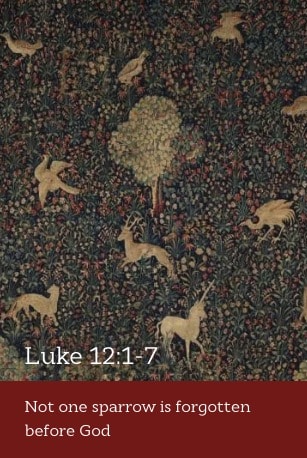
SUMMARY: In Luke 12:1–7, amid surging crowds, Jesus warns His disciples against the corrupting leaven of Pharisaic hypocrisy, cautioning that all secrets will be exposed in the light. He counsels them not to fear earthly persecutors but to revere God alone, reassuring them of His tender, infinite care: not even a single sparrow is forgotten, and every hair on their heads is numbered.
The reflection connects this divine attentiveness to a 16th-century Flemish millefleurs tapestry filled with intricate plants, birds, and symbolic creatures. Although completely self-sufficient and in need of nothing, God lovingly fashions each human life as an indispensable thread in His vast cosmic design. Just as every woven stitch, flora, and animal—from common rabbits to the symbolic unicorn—contributes to the artisan’s grand composition, God orchestrates each soul within His loving providence, ultimately proving our immense value by offering His Son.
READ REFLECTION (2026)
Friday
🥺 Invocations
Lord Jesus, You bring to light what is hidden in darkness and unmask the leaven of hypocrisy:
Lord, have mercy. (Lord, have mercy.)
Christ Jesus, You watch over the smallest sparrow and cherish each of us with infinite love:
Christ, have mercy. (Christ, have mercy.)
Lord Jesus, You have sealed us with the promised Holy Spirit as a pledge of our inheritance:
Lord, have mercy. (Lord, have mercy.)
Friday
🙏 Presider's Introduction
Our heavenly Father knows every detail of our lives, numbering even the hairs on our heads. Casting aside all fear of earthly opposition and living with filial trust, let us offer our prayers to Him.
General Intercessions
- For the Church: That she may remain untainted by the leaven of hypocrisy, preaching the Gospel with utter transparency and holy reverence before God. We pray to the Lord.
- For the World and Civil Government: That leaders may govern with transparency and truth, mindful that secret deeds of injustice and deceit will eventually be brought into the light of judgment. We pray to the Lord.
- For the Oppressed and Overburdened: That victims of religious persecution, violence, and tyranny may be protected in body and soul, fortified by the Holy Spirit to remain steadfast in faith. We pray to the Lord.
- For our Parish Community: That when anxiety or fear tempts us to despair, we may rest securely in the knowledge that God remembers each sparrow and loves each of us with boundless care. We pray to the Lord.
Concluding Prayer
Provident Father, You have sealed us with Your Holy Spirit as an inheritance of eternal glory. Deliver us from the fear of human judgment, and grant that our words and deeds may always be spoken and done in Your light. Through Christ our Lord.. Amen.
Corrupted Dough
Friday's Commentary
The context: Jesus continues his condemnation of the hypocrisy of the Scribes and the Pharisees, comparing it to leaven or yeast. The Jews considered yeast as something evil, corrupting the dough during the process of fermentation. That is why the Law given through Moses prescribes unleavened bread for offering to God. Jesus reminded the common people that the Pharisees were hypocrites who pretended to be holy, and that they corrupted people as the yeast corrupts the dough. The teaching and example of the scribes and the Pharisees influenced the crowd in a disastrous way, especially when the teachers failed to practice what they preached. Jesus also warned these religious leaders that their sins would be brought to light at the Last Judgment (CCC #678).
Hearing in secret and announcing in public: According to the Navarre Bible Commentary, most Palestinian houses had a roof in the form of a terrace. There people would meet to chat and while away their time in the hottest part of the day. Jesus pointed out to his disciples that in these get-togethers, things said in private became matters of public discussion. In the same way, despite the Pharisees' and scribes' efforts to hide their vices and defects under the veil of piety, all they had hidden would become a matter of common knowledge.
A reverential fear of God: Since nothing -- not even the most insignificant thing -- escapes God, no one should fear that any suffering or persecution he experiences in following Christ will remain unrewarded in eternity. But our fear of God should not be servile (based on fear of punishment). It should be a filial fear (the fear of a child who loves, and so does not want to displease, his or her father), a reverent awe nourished by our trust in Divine Providence.

Friday's Life Message
Practicing What We Profess
1) In contrast to the hypocrisy of the Pharisees, the followers of Jesus must display transparency in their Christian lives by practicing what they profess.
2) They should also maintain a reverential fear of God, adjusting their actions in such a way that they may not displease a loving heavenly Father. (Fr. Tony) L/26
SOURCE: Fr. Tony's Homilies

SUNDAY | MONDAY | TUESDAY | WEDNESDAY | THURSDAY | FRIDAY | SATURDAY

VIDEO: John Michael Talbot Reflection
- CHRISTIAN ART
- PENITENTIAL ACT
- INTERCESSIONS
Thursday
Saint Teresa of Ávila, Virgin, Doctor
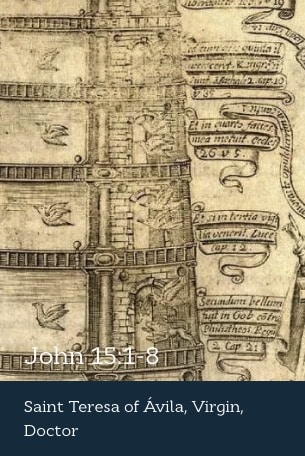
SUMMARY: Born into a century of profound upheaval and renewal, Saint Teresa of Ávila (1515–1582) became a transformative reformer of the Carmelite Order and the first female Doctor of the Church. Renowned for balancing deep contemplative mysticism with practical determination, Teresa authored enduring spiritual classics, most notably The Interior Castle (1577).
In this work, she envisions the human soul as a magnificent crystal castle containing seven mansions. These chambers outline the progressive spiritual journey from initial conversion and prayer through detachment, culminating in the innermost chamber of mystical union with Christ, who dwells at our very center.
An engraving from Fray Juan de Roxas’s 1679 work captures this theology visually. It portrays Teresa guiding the soul—depicted as a dove—through the castle’s ascending tiers past external vices toward the radiant divine Sun, illustrating the inward pilgrimage toward God available to every believer.
READ REFLECTION (2026)
Thursday
🥺 Invocations
Lord Jesus, You chose us before the foundation of the world to be holy and blameless in Your sight:
Lord, have mercy. (Lord, have mercy.)
Christ Jesus, You hold the key of knowledge and invite us into the interior castle of prayer and communion:
Christ, have mercy. (Christ, have mercy.)
Lord Jesus, You pardon our resistance to the prophets and renew our longing for eternal life:
Lord, have mercy. (Lord, have mercy.)
Thursday
🙏 Presider's Introduction
God has chosen us in Christ to be holy and blameless in His sight. Inspired by the contemplative wisdom and reforming zeal of Saint Teresa of Ávila, let us present our prayers to our Heavenly Father.
General Intercessions
- For the Church: That, following the teachings of Saint Teresa of Jesus, all Christians may rediscover the interior castle of their souls through persistent, humble, and unceasing prayer. We pray to the Lord.
- For the World and Civil Government: That societies may welcome the courageous voices of truth and justice rather than persecuting, silencing, or ignoring modern prophets who speak for the marginalized. We pray to the Lord.
- For the Oppressed and Overburdened: That those enduring spiritual dryness, depression, or severe inner darkness may be consoled by the Holy Spirit, who intercedes for us when we do not know how to pray. We pray to the Lord.
- For our Parish Community: That we may not hoard the key of knowledge or hinder others from approaching God, but invite our neighbors warmly into fellowship and divine intimacy. We pray to the Lord.
Concluding Prayer
Father of all grace, who raised up Saint Teresa of Ávila to direct souls toward deep communion with You, graciously hear our petitions. Guide our inward journey of conversion until we reach lasting union with Your Son, Jesus Christ, our Lord. Amen.
Monuments of Hypocrisy
Thursday's Commentary
The context: Today’s passage, taken from chapter 11 of Luke’s Gospel, gives two more accusations which Jesus made against the Pharisees. According to Matthew, Jesus made these accusations on the third day of what we call Holy Week in the Temple precincts of Jerusalem.
1) Jesus criticizes the blatant hypocrisy and false zeal of the scribes and the Pharisees in decorating the old monuments and building new monuments for the past prophets who had been persecuted and murdered by the forefathers of these same Scribes and the Pharisees, while they themselves did not obey the injunctions of these past prophets. Abel’s martyrdom is the first recorded in the Bible (Gn 4:8). [Navarre Bible Commentary: “Zechariah was a prophet who died by being stoned in the temple of Jerusalem around the year 800 B.C. because he accused the people of Israel of being unfaithful to God's law (cf. 2 Chr 24:20-22). The murder of Abel (Gn 4:8) and that of Zechariah were, respectively, the first and last murders reported in these books which the Jews regarded as Sacred Scripture”.] Jesus remarks that the blood-guilt inherited by the ancestors of the scribes and the Pharisees throughout the Old Testament era will spill over when the priests (most of them scribes), and the Pharisees conspired to execute Jesus the Messiah.
2) Since the scribes (religious lawyers), were the official interpreters of the Scriptures, they held the "office of the keys.” Unfortunately, their interpretation of the Scriptures became so distorted and difficult to understand that others were "shut off" from the Scriptures.

Thursday's Life Message
People of Integrity
We need to be men and women of integrity and character without any element of hypocrisy in our Christian life. We should not make a show of holiness and religious fervor when we are not internally holy. Holiness requires humility and giving God credit for any good He does through us.
SOURCE: Fr. Tony's Homilies

SUNDAY | MONDAY | TUESDAY | WEDNESDAY | THURSDAY | FRIDAY | SATURDAY

VIDEO: John Michael Talbot Reflection
- CHRISTIAN ART
- PENITENTIAL ACT
- INTERCESSIONS
Wednesday
You Pharisees who like taking
the seats of honor

SUMMARY: In Luke 11:42–46, Jesus pronounces woes upon the Pharisees and lawyers for their distorted priorities. He rebukes them for meticulously tithing tiny garden herbs while completely neglecting justice and the love of God. Furthermore, He condemns their vanity in craving seats of honor and obsequious public greetings, likening them to unmarked graves that quietly contaminate passersby. When a lawyer objects to the rebuke, Christ directly calls out the legal experts for imposing crushing, unendurable burdens upon ordinary people while refusing to lift a single finger to help.
The reflection pairs this passage with the Oscar statuette—conceived in the late 1920s to celebrate exceptional industry achievements—noting that the hunger for peer praise is an entirely natural human impulse. Yet Christ issues a sharp warning against this pursuit. True righteousness does not chase professional accolades, prestige, or public flattery; our lives must instead be directed toward honoring God and lifting up others.
READ REFLECTION (2020)
Wednesday
🥺 Invocations
Lord Jesus, You call us to prioritize justice, mercy, and genuine love of God above human praise:
Lord, have mercy. (Lord, have mercy.)
Christ Jesus, You forgive us when we yield to the works of the flesh instead of walking by Your Holy Spirit:
Christ, have mercy. (Christ, have mercy.)
Lord Jesus, You come not to lay crushing burdens upon us, but to bear our infirmities and set us free:
Lord, have mercy. (Lord, have mercy.)
Wednesday
🙏 Presider's Introduction
The Lord warns us against rigid legalism that neglects justice and compassion. Guided by the Holy Spirit who produces fruits of patience, gentleness, and love, let us place our supplications before the Lord.
General Intercessions
- For the Church: That pastoral ministers may avoid placing crushing legal burdens on the faithful, serving instead as compassionate guides who lift up the weary and lead them to Christ. We pray to the Lord.
- For the World and Civil Government: That legislators and judges may not pursue self-serving honors or prestige, but dedicate their authority to defending justice and protecting the vulnerable. We pray to the Lord.
- For the Oppressed and Overburdened: That all who are weighed down by heavy social, financial, or emotional burdens may find solidarity, relief, and practical support from caring hands. We pray to the Lord.
- For our Parish Community: That we may crucify our selfish desires, live by the Spirit, and cultivate the fruits of love, joy, peace, kindness, and faithfulness in our daily interactions. We pray to the Lord.
Concluding Prayer
O God, source of true justice and love, keep our feet planted firmly in Your law of mercy. Lead us away from superficial piety so that our lives may bear abundant fruit pleasing to You. Through Christ our Lord. Amen.
The Weight of Legalism
Wednesday's Commentary
The context: In today’s text, taken from Luke’s Gospel, Jesus expresses his moral indignation and sorrow at the hypocrisy of the scribes and the Pharisees who have put obstacles between the common people and God by overburdening them with unnecessary, impractical, and almost limitless interpretations of Mosaic laws.
Three Accusations: In today’s text, Jesus levels three accusations against these religious leaders, naming particular misbehaviors:
1) They have misinterpreted the spirit of the Law, making the Law a heavy burden for the God-fearing common people. Jesus gives the Law of tithing as an example. God intended tithing for His people as an expression of their gratitude to a providing God (Dt 14:22; Lv 27:30). The scribes instructed the people to pay tithes on insignificant things, such as kitchen-garden plants, with great mathematical accuracy, but they themselves neglected justice and love of God in their private lives.
2) The second accusation is that the scribes and the Pharisees are notorious for their status-seeking. They demand that the common people give them special honors because of their expertise in Mosaic Law and faithful religious observance. As a mark of respect, they are to be given front seats in the synagogue and public greeting in the streets.
3) Jesus compares the scribes and Pharisees to the white-washed tombs on the sides of the road leading to Jerusalem. In preparation for the three major Jewish feasts, Passover, Pentecost and Tabernacles, the scribes and Pharisees used to have the tombs whitewashed, so that the pilgrims would not be ritually defiled by unknowingly walking over one. Jesus accuses the Pharisees of moral filth, of hiding injustice and immorality inside themselves and of covering the corruption with pretensions of piety and religious fervor. Thus, they contaminate others with their rotten and dangerous ideas of God’s demands.

Wednesday's Life Message
The Essence of Religion
The essence of religion is to love God, discovering Him in everyone. The basic principles of the Ten Commandments are respect and reverence based on love of God and neighbor. When we learn to reverence God, His holy Name and His holy Day and to respect our parents, elders and all others, their lives, their goods and their good names, we practice true religion without hypocrisy or selfish interests. True love is sacrificial, encouraging us to help lift the burdens of others.
SOURCE: Fr. Tony's Homilies

SUNDAY | MONDAY | TUESDAY | WEDNESDAY | THURSDAY | FRIDAY | SATURDAY

VIDEO: John Michael Talbot Reflection
- CHRISTIAN ART
- PENTITENTIAL ACT
- INTERCESSIONS
Tuesday
You clean the outside
of cup and plate?

SUMMARY: In Luke 11:37–41, a Pharisee is astonished when Jesus sits down to dine without first observing the customary ritual handwashing. Jesus rebukes him, pointing out the hypocrisy of scouring the outside of cups and plates while inner hearts harbor greed, wickedness, and extortion. He commands them to cleanse the inside through genuine charity and almsgiving, which renders all things clean.
As noted in the reflection on Daniel Spoerri’s 1972 assemblage—which permanently displays the soiled remnants of a finished meal on a wall—outward forms quickly fade, leaving only the residue behind. The passage exposes how rigid adherence to external regulations often blinds people to the true state of their souls. Christ demands that holiness transcend mere outward appearances or superficial signs of piety. True purity begins from within, requiring believers to confront interior sin and practice authentic mercy.
READ REFLECTION (2019)
Tuesday
🥺 Invocations
Lord Jesus, You search the recesses of the human heart and desire truth in our inner being:
Lord, have mercy. (Lord, have mercy.)
Christ Jesus, You rebuke our external hypocrisy and call us to a faith that works through active love:
Christ, have mercy. (Christ, have mercy.)
Lord Jesus, You teach us to purify our souls through mercy and sincere almsgiving:
Lord, have mercy. (Lord, have mercy.)
Tuesday
🙏 Presider's Introduction
The Lord looks not upon mere outward appearances but searches the depths of the human heart. Desiring internal purity and genuine love, let us bring our needs before our merciful Creator.
General Intercessions
- For the Church: That she may be purified of all outward pretense and clericalism, shining before the world as a radiant witness of interior holiness and sincere charity. We pray to the Lord.
- For the World and Civil Government: That civil authorities may look beyond political posturing and enact policies that genuinely protect human dignity and serve the common good. We pray to the Lord.
- For the Oppressed and Overburdened: That those suffering from poverty, neglect, and systemic corruption may receive genuine relief through the openhearted generosity and almsgiving of God's people. We pray to the Lord.
- For our Parish Community: That our faith may work through love, motivating us to cleanse our hearts through repentance, sacramental confession, and active works of mercy. We pray to the Lord.
Concluding Prayer
Lord God of holiness, You made both the outside and the inside of our being. Cleanse our hearts of all greed and pride, and strengthen us to offer our lives to You in loving service to our brothers and sisters. Through Christ our Lord. Amen.
Clean Hands, Unclean Hearts
Tuesday's Commentary
The context: In today’s Gospel passage, Jesus accuses the Pharisees of hypocrisy. Jesus was invited by a Pharisee for a dinner at which Jesus violated the ceremonial law by purposely omitting the ritual washing of hands before the meals and between the courses. Pious Jews were expected on each occasion to wash their hands by pouring two ounces of water from finger tips to wrist and in the reverse order, and then to cleanse each palm by rubbing it with the fist of the other hand. Water was stored in big stone jars for this washing ceremony. Omitting the ceremony was considered a sin by Pharisees, and that is why Jesus’ host was astonished.
Jesus teaches the essence of religion: Jesus tells his host that the essence of religion is offering to God a clean heart filled with love, mercy, compassion, and forgiveness. Mere external observance of rituals without a cleansing of the heart is hypocrisy, which God hates. Jesus uses the occasion to accuse the Pharisees of harboring evil thoughts like greed, pride, bitterness, envy, and arrogance in their hearts. Jesus concludes by suggesting that one method of expressing real love of God and neighbor originating from a compassionate heart and making one pure and clean is giving alms to the poor. Almsgiving in the proper sense means realizing the needs of others and letting them share in one's own goods, especially by way of spiritual help, financial and emotional support, consolation, fraternity, and love. St. John of the Cross explains this passage, remarking that “in the evening of life” we will be judged on our love expressed by works of charity.

Tuesday's Life Message
Interior Cleansing
1) In order to have interior cleanliness, let us do some charitable acts which externally express our loving relationship with God and our eagerness to do His will.
2) Since we are offering our hearts and lives on the altar, let us expel everything evil from our hearts by true repentance. Love is what we have to give others – love with understanding, mercy, respect for their freedom, and deep concern for their spiritual and material welfare. Giving this gift requires that we have God’s love in our thoughts, words and actions always.
SOURCE: Fr. Tony's Homilies

SUNDAY | MONDAY | TUESDAY | WEDNESDAY | THURSDAY | FRIDAY | SATURDAY

VIDEO: John Michael Talbot Reflection
- CHRISTIAN ART
- PENITENTIAL ACT
- INTERCESSIONS
Monday
The Queen of the South came to hear the wisdom of Solomon
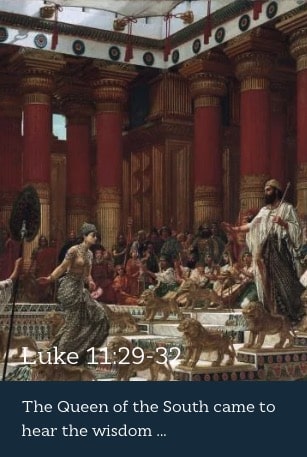
SUMMARY: In Luke 11:29–32, Jesus rebukes the crowds seeking dramatic proof, calling them an evil generation and declaring that only the sign of Jonah will be given. He warns that pagan figures will rise in judgment to condemn them: the Queen of the South journeyed across the earth to hear Solomon’s wisdom, and the Ninevites repented at Jonah’s preaching, yet someone greater than both stands ignored before them.
As reflected in Edward Poynter’s 1890 painting, The Visit of the Queen of Sheba to King Solomon, the Queen brought vast wealth across deserts yet humbly prioritized divine wisdom above gold. Her arduous search directly challenges our tendency to seek sensational signs while overlooking Christ’s presence right in front of us. Today, believers need not traverse continents or offer caravans of riches; at every Mass, we directly encounter the One greater than Solomon in the Holy Eucharist.
READ REFLECTION (2026)
Monday
🥺 Invocations
Lord Jesus, You are the sign of the Father’s mercy, calling every generation to heartfelt repentance:
Lord, have mercy. (Lord, have mercy.)
Christ Jesus, You are the wisdom greater than Solomon, liberating us from the yoke of spiritual slavery:
Christ, have mercy. (Christ, have mercy.)
Lord Jesus, You lift the lowly from the dust and seat them among princes:
Lord, have mercy. (Lord, have mercy.)
Monday
🙏 Presider's Introduction
Christ calls us out of spiritual blindness and sets us free from the slavery of sin. Confident that One greater than Solomon and Jonah is present in our midst, let us lift our petitions to the Father.
General Intercessions
- For the Church: That our bishops, priests, and religious leaders may proclaim the call to repentance with the boldness of Jonah, drawing all people into the freedom of Christ. We pray to the Lord.
- For the World and Civil Government: That leaders of nations, like the Queen of the South, may earnestly seek divine wisdom and govern their people with integrity, humility, and peace. We pray to the Lord.
- For the Oppressed and Overburdened: That those trapped in modern forms of slavery, injustice, or spiritual despair may experience the liberation of the Gospel and know the uplifting mercy of God who raises the poor from the dust. We pray to the Lord.
- For our Parish Community: That we may not demand spectacular signs from heaven, but humbly recognize Christ’s living presence here at the altar and in our neighbor. We pray to the Lord.
Concluding Prayer
Almighty God, whose Son is our true wisdom and redeemer, hear the prayers of Your pilgrim people. Grant us ears to hear Your call to repentance and hearts ready to walk in the freedom of Your grace. Through Christ our Lord. Amen.
The Blindness of Pride
Monday's Commentary
The Context: Since there had been many false prophets and false messiahs in the past, and since their pride and prejudice did not permit them to see the Messiah in a carpenter-from-Nazareth turned wandering-preacher, the Jewish religious leaders demanded that Jesus should show some “Messianic” signs and miracles taken from their list. They would not accept that Jesus’ numerous miraculous healings were the Messianic signs foretold by the prophets.
Jesus’ negative response: Calling them an apostate generation who refused to believe in their own prophets and denied the hand of God in the miracles he worked, Jesus warned these religious leaders that they would be condemned on the Day of Judgment by the people of Nineveh and by the Queen of Sheba from the South. (Sheba, or Saba, was a southern kingdom centred on Yemen or Ethiopia, and possibly including both. The distance from Yemen to Jerusalem is 2084 miles). This is one of the instances in which Jesus held up Gentiles as models of Faith and goodness (other examples: the Canaanite woman in Mt 15, the centurion in Lk 7, the Good Samaritan story in Luke 10; etc.). The pagan Ninevites heard the voice of the Lord God in the prophet Jonah, repented, and were spared. The Queen of Sheba recognized God’s Wisdom in King Solomon, and she traveled to Israel to receive more of it. Nevertheless, Jesus gave the religious leaders challenging him, “the sign of Jonah.” It was the undeniable Messianic sign of his own Resurrection from the tomb on the third day after his death, just as Jonah had spent three days repenting and praying in the belly of the giant fish before being spat out upon the land and finally going to Nineveh to accomplish the mission God had originally given him (Jonah 2:1-10).

Monday's Life Message
God's Living Presence
1) Each Sacrament in the Church is an external sign representing God’s grace.
2) On the altar we re-present Christ’s sacrifice on the cross using liturgical signs and prayers.
3) Everyone living with us or working with us is a sign of God’s living presence in our midst, inviting us to love and honor him or her as God’s child and the living Temple of the Holy Spirit.
4) All world events and all the events in our lives are signs of God’s care and protection for us, His children.
5) The Holy Bible is a sign of God communicating His message to us every day. So, let us learn from these God-given signs instead of looking for signs in weeping Madonnas, bleeding crucifixes and daily messages of visionaries.
SOURCE: Fr. Tony's Homilies