Vocations, Discernment
Vocations, Discernment
August 9, 2026

⬅️  ➡️
➡️
Follow Me…
Discover Your
Purpose
AT A GLANCE
- Presence Over Spectacle: God rarely speaks through overwhelming chaos, dramatic signs, or emotional storms; He communicates in the intimate “sound of sheer silence.”
- Active Availability: Discernment is not passive waiting—it is an active disposition of trust, fidelity in present duties, and courageous readiness to step forward.
- Cultivating Interior Stillness: Hearing God’s call requires intentionally silencing both external noise (technology, busyness) and internal noise (anxiety, comparison, self-doubt).
- Guided Discerning Grace: Spiritual growth is sustained through regular sacramental life (Eucharist, Reconciliation) and wise, objective spiritual guidance.
REFLECTION
QUESTIONS
- What “wind, earthquake, or fire”—dramatic signs or overwhelming emotional highs—have you been waiting for to validate your call?
- How does the constant noise of modern technology and culture distract you from hearing God’s gentle promptings?
- In what ways do internal anxieties, such as performance fears or comparing yourself to other seminarians/discerners, cloud your peace?
- Elijah retreated to a cave out of exhaustion and fear. What “caves” are you currently hiding in, and what is keeping you from stepping out?
- When you experience silence in prayer, do you welcome it, or do you feel an urge to fill it with words, thoughts, or distractions?
- How faithful are you to the small, unglamorous duties of your current daily life?
- How has God’s presence spoken to you in quiet, gentle ways in your past?
- Do you view discernment as a passive waiting period or an active walk of trust with Christ?
- Is there a habit or distraction in your life right now that you know you need to detach from in order to hear God clearly?
- What step of courage is the Lord inviting you to take today to move from self-doubt into availability?
REAL-LIFE
APPLICATION
- Digital Unplug: Set aside a non-negotiable 20 to 30 minutes every day of complete silence before the Blessed Sacrament or in a quiet room. Leave your phone, smartwatch, laptop, and music outside the room.
- The Rule of Engagement: Resist the urge to “perform” or accomplish anything in prayer. Sit in God’s presence, focus on your breathing, and simply say: “Lord, Your servant is listening.”
- Evening Audit: At the end of each day, write down one instance where you noticed a quiet, gentle prompt toward grace, kindness, or peace—and one noise source you successfully tuned out.
19th Sunday of Year A
The ordained priesthood includes both diocesan and religious order priests.
Discerning the Priesthood
in a Noisy World
First Reading: 1 Kings 19:9a, 11-13a
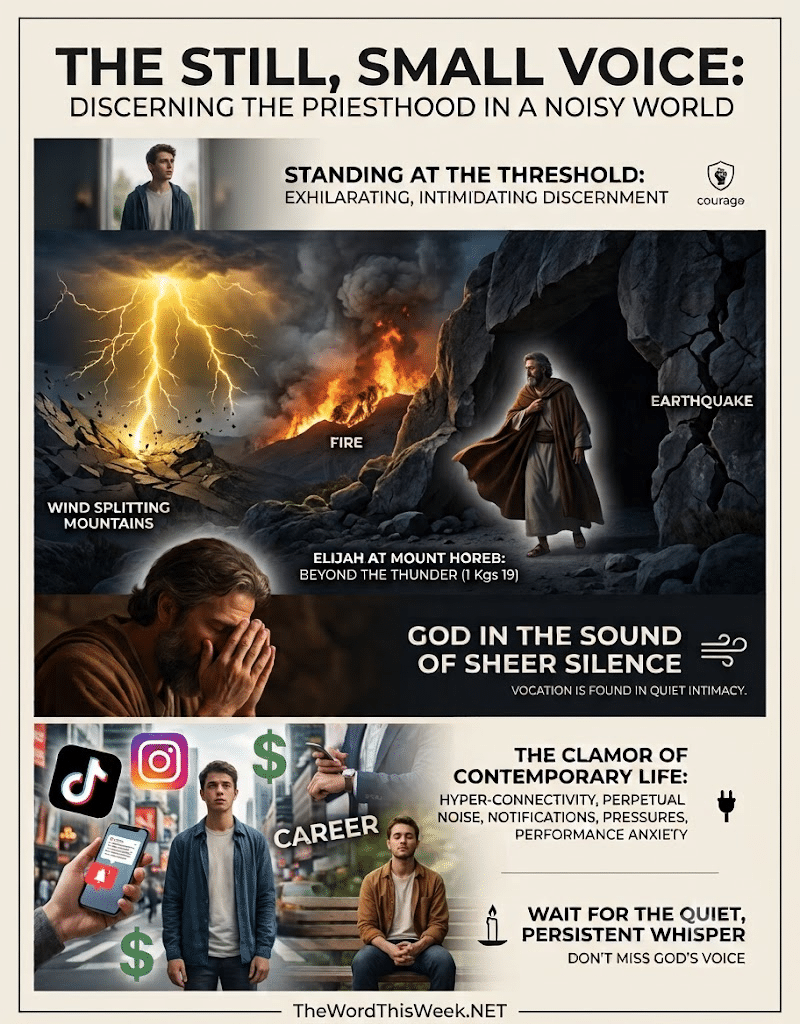
To a young man standing at the threshold of discernment—whether you are taking your very first hesitant steps toward exploring the priesthood, or already walking the halls of a seminary—the path before you can feel both exhilarating and deeply intimidating. In a world defined by relentless activity, constant evaluation, and endless noise, asking the question “Is God calling me to be a priest?” is an act of profound courage.
Click to Enlarge
When seeking clarity about a priestly vocation, we often look for grand signs: a sudden dramatic revelation, a towering certainty, or a powerful wave of emotion. Yet, Scripture offers us a very different vision of how God communicates His subtle, intimate heart to those He calls.
Elijah at Mount Horeb: Beyond the Thunder
In the First Book of Kings (1 Kgs 19:9a, 11-13a), the prophet Elijah stands at a pivotal crossroads. Defeated, exhausted, and fleeing for his life, Elijah retreats to a cave on Mount Horeb. God commands him to go out and stand on the mountain before the Lord:
“Now there was a great wind, so strong that it was splitting mountains and breaking rocks in pieces before the Lord, but the Lord was not in the wind; and after the wind an earthquake, but the Lord was not in the earthquake; and after the earthquake a fire, but the Lord was not in the fire; and after the fire a sound of sheer silence.”
When Elijah heard that gentle whisper—the “sound of sheer silence”—he wrapped his face in his mantle and stepped out to meet his Lord. Elijah expected God to manifest in the dramatic and overwhelming: the gale-force wind, the shattering earthquake, the roaring fire. Instead, God revealed His presence in the faint, quiet breeze. For a young man discerning the priesthood, Elijah’s experience carries a vital lesson: vocation is rarely forged in life’s sensational moments; it is recognized in the quiet intimacy of prayer.
WARNING: When Silence is Abandoned for a Roaring Wave
The Clamor of Contemporary Life
Relating Elijah’s experience to our modern world reveals an immediate challenge. We live in an era dominated by hyper-connectivity and perpetual noise. Social media, notifications, career pressures, and the constant demand for instant productivity act as modern-day winds and earthquakes. They fracture our attention and keep our souls in a state of high alert.
In the seminary or in early discernment, it is easy to let internal noise take over as well. You might find yourself paralyzed by performance anxiety, comparing your spiritual journey to your peers, or waiting for a dramatic, undeniable sign from heaven before committing to the next step. However, the Lord does not usually shout over the din of our cultural or internal anxieties. If you are waiting for an earthquake to confirm your call, you may miss the quiet, persistent whisper already echoing in your heart.
Practical Applications for Your Discernment
How do you cultivate the capacity to hear that “sheer silence” amidst the noise of modern life? Consider three practical habits to ground your discernment:
- Prioritize Unplugged Silence: Set aside non-negotiable time each day for silence—free from phones, music, and digital distraction. Spend twenty to thirty minutes before the Blessed Sacrament or in a quiet room, simply learning to be present to the God who dwells within you.
- Embrace the Small Duties of the Present Moment: Discernment is not a passive waiting game; it is an active walking with God. Focus on fidelity in the immediate tasks before you—your studies, your work, your daily prayer, and your relationships. Sanctifying the present moment builds the spiritual muscle needed to say “yes” to God’s future plan.
- Seek Spiritual Direction and Sacramental Grace: Elijah needed guidance to understand his ministry, and so do you. Regularly meet with a trusted spiritual director, and frequent the Sacraments of Reconciliation and the Eucharist. A priest or mentor can help you distinguish between the chaotic “winds” of emotional highs and lows and the steady, quiet promptings of the Holy Spirit.
Stepping Out of the Cave
When Elijah recognized the gentle breeze, he wrapped his face in his mantle and went out to stand at the entrance of the cave. He moved from hiding in fear to standing in readiness.
The vocation to the priesthood is ultimately a call to step out of self-doubt and into trust. God does not demand that you have every answer today; He simply asks for your availability. Trust that the same quiet voice which called you into this discernment will provide the grace, strength, and joy to sustain you every step of the journey. Wrap yourself in faith, step to the entrance of the cave, and listen—He is already speaking.
Page was created with AI tools and human editorial oversight.
His Hands,
His Feet,
Your Vocation
AT A GLANCE
- Presence Over Resolution: Christ enters our chaotic storms (Matthew 14:22–33) not primarily to remove the waves immediately, but to reveal His holy presence and offer His reassuring peace.
- The Deacon as Diakonia Incarnate: The deacon’s vocation makes visible the reaching hand of Christ—bringing the Lord’s calm into liturgical, pastoral, and marginal spaces.
- The “Non-Anxious” Witness: Anchored in Christ, the minister remains steady during crisis, reminding us that salvation is found in trusting the Lord’s proximity rather than relying on our own strength.
- Sacramental Reassurance: Through the proclamation of the Gospel and the distribution of the Eucharist, Christ continuously pulls his sinking, “little faith” people back into the safety of the Church.
REFLECTION
QUESTIONS
- Identifying the Storm: Where in your life right now do you feel tossed by the waves—and are you looking for Christ within the storm, or only demanding that He stop it?
- Reaching Out in Fear: Like Peter, when you begin to sink under the weight of anxiety or doubt, what keeps you from crying out simply, “Lord, save me!”?
- Being the “Hand”: Who in your family, workplace, or parish is currently sinking in grief or confusion, and how might God be calling you to be the tangible hand of Christ reaching out to them?
REAL-LIFE
APPLICATION
- The “Non-Anxious Presence” Identify one “stormy” situation in your daily life—a heated family disagreement, a tense moment at work, or a parish crisis—where fear or frustration usually takes over.
Commit to entering that space deliberately as a non-anxious presence. Before reacting, take a breath, recall Christ’s words—“Take courage, it is I; do not be afraid”—and choose to offer steady listening, gentle speech, and practical assistance instead of contributing to the panic.
19th Sunday of Year A
Deacons receive the Sacrament of Holy Orders but are ordained unto ministry and service rather than the priesthood. Because permanent deacons are often married and hold secular jobs, treating them as a distinct category makes a lot of practical and theological sense.
The Hand in the Storm
Gospel: Matthew 14:22–33
McCulloch
(Diocese of Broken Bay)
In the dead of night, in the middle of a stormy sea, the disciples are tossed by the waves and terrified. They are exhausted, alone, and at the mercy of the chaos. Into this very chaos Jesus comes, walking on the water. His first words are not a solution, but a presence: “Take courage, it is I; do not be afraid.”
This Gospel is a perfect icon of the deacon’s ministry. He is a man ordained to meet people in the middle of their storms: the storm of illness, the chaos of grief, the waves of loneliness, or the winds of confusion. He may not have the power to still the storm, but his vocation is to be the living, tangible sign of the Lord’s presence within it.
AT MASS
The Proclamation of Courage
At Mass, the deacon is the voice of Christ, speaking this same word of peace over the stormy, anxious hearts of the assembly.
• The Voice in the Storm: When the deacon proclaims this Gospel, he is the voice of Jesus walking on the waves. He relays Christ’s command to take courage, directly to everyone in the assembly who feel tossed by their week’s anxieties.
• The Homily of Seeing: The deacon’s preaching on this text is a call to recognizeChrist where He is, and not just where we want Him to be. He must challenge the parish to identify where the storms might be in our community. And can we see Christ already walking towards us in them?
• The Hand of the Eucharist: Like Peter, we are too often a people of little faith who begin to sink. The deacon, as a minister of the Altar, assists as Christ again stretches out his hand in the form of the Eucharist, pulling us back from our fears and into the boat of the Church.
IN THE PARISH
The Ministry of the Calm Presence
St. Francis of Assisi said that a single ray of light is enough to drive away many shadows. The deacon’s steady, faithful presence in the parish is meant to be such a single ray.
• The Non-Anxious Presence: In the midst of parish storms such as budget shortfalls, pastoral crises, and community disagreements, the deacon is called to be a calm presence. His faith is his anchor, allowing him to be a source of stability and peace when others are crying out in fear.
• A Ray of Light: His ministry in RCIA, in baptismal preparation, or in counselling is a ray of light for those navigating the shadows of doubt or confusion. He is a guide who, with faith, points to Christ as the one, true, steady path through the chaos.
AT THE MARGINS
The Hand that Reaches
Peter cries out, “Lord, save me!” and Jesus immediately stretches out his hand and catches him. This is the very definition of diakonia.
• Going to the Boat: The deacon’s ministry of service is not simply to shout encouragement from the shore. He is the one who gets into the boat with those who are in the storm. He goes tothe hospital, the prison, the home of the grieving.
• The Hand of Christ: His ministry isthe hand of Christ stretched out. The food he gives, the hand he holds, the time he spends listening, the comfort he brings, this isChrist catching the sinking person.
• Whispering “Take Heart”: The deacon’s service does not promise a life without storms. But his faithful presence in the midst of the chaos is the living whisper of the Gospel: “The Lord is near. He is already here. Take heart.”
Faith in Action—
Grace in the
Everyday
AT A GLANCE
- Generational Covenant: Salvation history reveals that God works through lineages, using ancestors and “patriarchs” as essential conduits of His promise, worship, and grace.
- Living Anchors of Faith: Grandparents hold a unique spiritual authority, serving as tangible witnesses to God’s long-term fidelity and grounding the family’s Catholic identity.
- Domestic Liturgy: Family traditions translate abstract doctrines into lived, sensory experiences that anchor children in the Communion of Saints across generations.
- Inherited Identity: Faith is not a isolated project rebuilt by every generation, but a sacred torch received from those who came before and handed on to those who follow.
REFLECTION
QUESTIONS
- How do you actively view your family tree—as just a historical record, or as a living lineage of God’s covenantal love?
- In what ways do your children see the faith modeled by their grandparents differently than how they experience it at home with you?
- What is one story of faith, hardship, or perseverance from your parents or grandparents that your children need to hear?
- How can you better honor and integrate your aging parents or grandparents into the spiritual life of your domestic church?
- Are there any past family wounds or divisions that hinder the generational flow of faith, and how can you pray for healing?
- Which Catholic family traditions from your own childhood have you carried forward into your marriage, and which new ones have you built together?
- How does knowing that your family belongs to a broader lineage of believers change how you view daily parenting challenges?
- When your children look back on their home in twenty years, what specific liturgical or spiritual traditions will they remember most fondly?
- In a culture that values novelty over wisdom, how can your couplehood model deep reverence for the elderly to your children?
- What concrete steps can you take this week to pass on “the worship and the promises” of Christ to the next generation?
REAL-LIFE
APPLICATIONS
Thought-Provoking Ways Couples Can Show Their Love True marital and familial love isn’t just felt internally—it is embodied through intentional action that connects your home to the wider body of Christ.
- “Patriarch” Living History Night: Host or call parents/grandparents to share stories of God’s fidelity in their youth, their marriage, and hard times. Record their voices or write down their wisdom for your children.
- Family Blessing Ritual: Revive the tradition of parental blessings. Trace the Sign of the Cross on your spouse’s and children’s foreheads before bed or leaving the house, invoking God’s blessing over your home.
- “Family Heritage” Prayer Corner: Set up a home prayer space displaying inherited holy items—like a grandparent’s rosary, family Bible, or ancestral wedding photos. Gather there to pray for living relatives and deceased ancestors.
19th Sunday of Year A

The lay state is lived through Holy Matrimony—a sacramental vocation building the domestic church—and the committed single life, which offers a lifetime of unique flexibility to serve God. The single state also includes those patiently waiting and preparing for marriage.
Grandparents, Family Tradition,
and the Legacy of Faith
Second Reading: Romans 9:1-5
To a young Catholic couple striving to build a holy home in today’s complex world, the work of raising a family can often feel like an overwhelming pioneer journey. In the midst of managing busy schedules, navigating cultural pressures, and trying to pass on the Catholic faith, it is easy to focus strictly on the immediate horizon of your own household. Yet, Scripture reminds us that our faith is not an isolated project started from scratch; it is an inheritance passed down through generations—a continuous story of God’s covenantal love.
When reflecting on the profound power of spiritual lineage, St. Paul offers a deeply moving testament in his Letter to the Romans (Rom 9:1-5). Expressing his intense love and sorrow for his own people, the Israelites, Paul writes:
“I have great sorrow and unceasing anguish in my heart… They are Israelites, and to them belong the adoption, the glory, the covenants, the giving of the law, the worship, and the promises; to them belong the patriarchs, and from their race, according to the flesh, is the Christ, who is God over all, blessed forever.”
Patriarchs and the Blessing of Lineage
In this passage, St. Paul highlights a foundational reality of salvation history: God works through generations. He highlights “the patriarchs”—the grandfathers and spiritual ancestors of Israel—as essential carriers of the promise. The covenant was not merely an abstract doctrine; it was a living truth handed down from Abraham, Isaac, and Jacob to their children and grandchildren. The glory, the worship, and the promises reached their ultimate fulfillment in Christ because faithful generations preserved and handed down the torch of faith.
For you as a Catholic couple, this passage carries a vital lesson about the irreplaceable role of grandparents and family traditions. Just as Israel’s patriarchs were the guardians of the covenant, grandparents in a Catholic family serve as the living anchors of faith, wisdom, and continuity.
Grandparents: Your Home’s Living Patriarchs
In a modern culture that often values youth, autonomy, and novelty over history and wisdom, it is easy to view elderly relatives merely as recipients of care rather than active partners in evangelization. Yet, grandparents hold a unique spiritual authority in the lives of your children.
Where parents are often bogged down in the necessary, daily mechanics of discipline, routines, and logistics, grandparents often have the gift of time and perspective. They represent a longer arc of God’s fidelity. When a child hears a grandparent share how God answered a prayer decades ago, or witnesses them humbly praying the Rosary, the faith ceases to be just a set of rules enforced by Mom and Dad. It becomes a historical reality—a lived truth that has sustained their family through generations. Integrating grandparents into your children’s daily lives—whether through regular visits, shared meals, or simple conversations—gives your children a sense of deep spiritual roots. It shows them that they belong to something far greater and older than themselves.
Building Catholic Family Traditions
St. Paul also mentions “the worship, and the promises” handed down through Israel’s heritage. In the context of your domestic church, these promises are made tangible through family traditions. Traditions are the liturgical rhythm of your home. They are the concrete ways you embody the faith so that it saturates your children’s senses and memories. Consider establishing traditions that honor both your ancestral heritage and the Catholic faith:
- Liturgical Celebrations: Mark the liturgical seasons visibly in your home—from lighting Advent wreaths to blessing your home on Epiphany, or celebrating the feast days of your children’s patron saints.
- Family Storytelling: Regularly share stories of the “patriarchs” in your own family tree. Tell your children about how their grandparents or great-grandparents lived out their faith, faced hardships, and trusted in God.
- Ancestral Prayer: Pray together for family members who have gone before you, teaching your children the beauty of the Communion of Saints and the continuity of the Catholic family across generations.
Welcoming the Promise into Your Home
As you look to the future of your family, remember that you are not building on sand; you are building on the foundation of those who came before you. By honoring and involving grandparents, and by intentionally cultivating rich family traditions, you give your children an invaluable gift: an identity rooted in Christ and sustained by a living tradition.
Like the patriarchs of old, may you and the grandparents of your home be faithful stewards of the covenant, ensuring that the light of Christ shines brightly for generations to come.
Page was created with AI tools and human editorial oversight.
Faith in Action—
Grace in the
Everyday
AT A GLANCE
- God Speaks in the Quiet: Spiritual clarity and God’s true presence are found not in dramatic, noisy spectacles, but in silent, interior prayer ($1\text{ Kings } 19:12$).
- Focus Over Applause: Seeking digital relevance, vanity metrics, and worldly validation distracts believers and religious leaders alike from fixing their eyes on Christ.
- The Cost of Disconnection: Drowning in public opinion leads to spiritual erosion, identity crises, and a breakdown of sacred vocations that harms the broader Church community.
- A Call to Unplug: Guarding the soul requires intentional retreat from the noise of the world to cultivate quiet fidelity through the Sacraments and private prayer.
REFLECTION
QUESTIONS
- How often do I mistake high energy, large crowds, or public attention for God’s authentic presence?
- In what ways does my daily screen time or social media use drown out the “tiny whispering sound” of God in my life?
- Where am I currently seeking validation: from public approval and metrics, or from my quiet relationship with Christ?
- When life feels chaotic, do I focus on the wind and waves around me or keep my gaze fixed on Jesus?
- How has an over-reliance on digital engagement or public opinion shifted my personal identity or priorities?
- Am I giving God space in my daily schedule for genuine silence, or am I constantly filling quiet moments with background noise?
- In what areas of my spiritual life am I relying on my own strength rather than crying out, “Lord, save me!”?
- How does the public departure or struggle of religious leaders impact my own faith walk, and how can I respond with prayer instead of judgment?
- What daily boundaries can I set to protect my interior peace from the hyper-polarization and noise of modern culture?
- How can I better support, pray for, and encourage the priests and religious figures in my community to remain grounded in their vocation?
REAL-LIFE
APPLICATIONS
- “Institute a Digital Grand Silence: Establish a strict, non-negotiable boundary—such as logging off all personal devices and social channels during specific hours of the day (e.g., after Compline until after Morning Prayer)—to protect the sacred silence of the morning and evening hours.
- Practice Hidden Ministry: Actively cultivate small, quiet acts of pastoral service that will never be filmed, posted, or praised publicly, reinforcing the truth that a vocation is lived before the face of God, not an audience.
- Anchor the Day in Eucharistic Adoration: Commit to daily, silent prayer before the Blessed Sacrament without digital devices, using this time to bring interior exhaustion and the temptation for worldly validation directly to Christ.
- Accountability in Community Life: Seek out a faithful spiritual director or trusted brother/sister in religious life to openly discuss online pressures, boundary slips, and the subtle spiritual pride that can accompany public visibility or digital praise.
19th Sunday of Year A

ADVATICANUM (11:17) – We’ve all seen influencer priests, monks, and nuns online. It’s a wonderful thing… being able to spread the gospel over such a wide-ranging medium. But is it all rainbows and sunshine? Is there a major risk that comes with entering the online domain? Over the last few years, we’ve seen quite a few “influencer priests” leave their vocations. So I’m trying to find out… is there something about digital content creation that is at odds with sacred vows?
When Silence is Abandoned
For A Roaring Wave
Human nature often confuses crowd size with God’s presence. In an era driven by social media subscriber counts, the Church sees “influencer priests” commanding massive online audiences. Yet behind the vanity of metrics and constant adulation, digital noise can quietly erode a sacred vocation.
Our readings today speak directly to this modern crisis. They offer a timeless roadmap for how to guard our souls against the roar of the world, whether we are on a global stage or simply scrolling through our phones.
The Lord Is Not in the Wind
In our first reading, the prophet Elijah stands on Mount Horeb, weary, isolated, and seeking the Lord. God passes by, accompanied by three dramatic, high-energy phenomena: a crushing wind that rends mountains, a violent earthquake, and a raging fire. To the human eye, these are the ultimate displays of power. They are the biblical equivalent of going viral. But Sacred Scripture tells us that the Lord was not in the wind, not in the earthquake, and not in the fire. Instead, God reveals Himself in a “tiny whispering sound”—a gentle breeze, a shear silence.

We see the tragic cost of choosing the noise over the silence in the recent story of Father Damián María Montes, the Spanish Redemptorist priest who gained viral fame on La Voz. Amassing nearly 750,000 followers on TikTok, Father Damián spent years in the limelight, balancing catechetical videos with secular performance. Yet after three years of inner struggle, he ultimately decided to step away from his priestly ministry, acknowledging how difficult his missionary service had become under the weight of that platform.
The digital continent is built almost entirely on earthquakes and fires. It demands hot takes, constant engagement, curated aesthetics, and relentless public exposure. But a priest or religious sister—and indeed every baptized Catholic—cannot cultivate a genuine interior life in the middle of a continuous thunderstorm. When online religious become swept up in the noise of social media algorithms, brand sponsorships, and secular applause, the quiet, daily voice of God becomes almost impossible to hear. Vocations do not usually collapse in a single day; they wither when the “tiny whispering breeze” of private prayer is drowned out by the roar of the crowd.
Sinking in the Digital Gale
This reality plays out dramatically in today’s Gospel from Matthew. The Apostles are tossed in a boat on the Sea of Galilee in the dark watch of the night. Jesus walks toward them on the water, and Peter makes a bold request: “Lord, if it is you, command me to come to you on the water” (Mt 14:28). At Christ’s invitation, Peter steps out of the boat. As long as his eyes are locked onto Jesus, he walks on top of the chaos. But the moment Peter looks away—when he focuses instead on the strength of the wind and the fury of the waves—fear takes over, and he begins to sink.

The online world is a storm of human opinion, hyper-polarization, and personal pride. Consider the experience of Cristina Scuccia, formerly Sister Cristina, who captivated the world by winning The Voice of Italy. What began as a joyful witness quickly spiraled into international media tours, record deals, and intense public scrutiny. Trapped between the rigid structures of convent life and the overwhelming freedoms and pressures of the secular music industry, she underwent a deep identity crisis. Looking at the storm around her rather than her quiet vows, she felt she could no longer figure out who she was, leading her to eventually lay down her habit and leave religious life.
When a minister of God steps onto that water, the temptation to look away from Christ is immense. Praise and adulation inflate the ego, while online hostility and harassment breed bitterness. In both cases, the gaze shifts from the face of the Savior to the noise of the storm. When we rely on public approval rather than sacramental grace, we begin to drown. Like Peter, the only recourse is to abandon self-reliance and cry out from the depths: “Lord, save me!” (Mt 14:30).
Sorrow for the Scattered Flock
Saint Paul touches on the profound burden of this loss in his letter to the Romans. He speaks of a “great sorrow and constant anguish” in his heart for those of his own kin who have stumbled or drifted away from the fullness of Christ (Rom 9:2).
We feel this same sorrow when we look at figures like Father Alberto Ravignani, a young Italian priest whose digital reach exploded during the COVID-19 lockdowns. Recognized as a prominent digital missionary, his online platform gradually blurred the lines between his priesthood and secular content creation—ranging from fitness routines to brand sponsorships. Eventually, the clash between the demands of the digital culture and his vows led him to leave the priesthood due to struggles with celibacy and church teaching.
When a shepherd or religious leaves their ministry, it is not simply a personal career change; it leaves a mark on the entire Body of Christ. It causes confusion among the faithful, sadness for the Church, and scandal for a world desperately in need of authentic witnesses to the Gospel. Paul reminds us that our true identity is found in Christ, who is “over all, God blessed forever” (Rom 9:5). Vocations of poverty, chastity, and obedience are meant to point directly to the eternal kingdom, not to personal branding, cultural relevance, or worldly freedom.
Returning to the Silence
Brothers and sisters, the modern digital landscape challenges every one of us to examine where we seek validation. We do not need to be internet personalities to fall into the trap of letting the world’s noise dictate our spiritual health. We must all step back from the tempest. We must have the courage to log off, seek solitude, and step into the quiet sanctuary of the confessional and the Blessed Sacrament.
Let us pray fervently today for our priests, bishops, and religious. Pray that they are protected from the traps of pride and worldly fame, and that they find their strength not in the applause of millions, but in the quiet, faithful service of Christ and His Church.
When the storms of culture howl around us, let us fix our eyes firmly on Jesus, step out in faith, and trust the Master who commands the wind and waves.
Page was created with AI tools and human editorial oversight.