
Addiction and Recovery
Addiction and Recovery
Addiction and Recovery

Different
Perspectives
on the Sunday
Readings
IMPORTANT: This page offers a creative synthesis of the biblical text with insights influenced by Catholic theologians and spiritual writers.
For a more comprehensive understanding of the readings, go to
COMMENTARIES
BIBLE STUDIES
Commentary below written in collaboration with OpenAI’s GPT-3.5 model.
Addiction & Recovery
First Reading | Second Reading | Gospel
VERSE BY VERSE COMMENTARY
TOP OF PAGE First Reading | Second Reading | Gospel

FOCUS: Addiction & Recovery
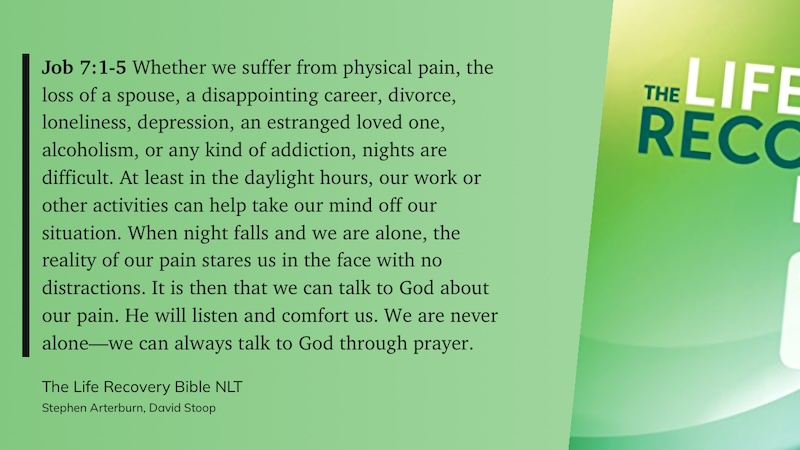
Verse 1: "Is not man's life on earth a drudgery? Are not his days those of a hireling?"
Job, in his despair, expresses the heaviness and hardship of life.
Addiction can turn one's life into a relentless cycle of pain and monotony, mirroring the feeling of a drudgery.
Fulton J. Sheen notes, "Addiction is the deadly enemy of happiness. It convinces its victims that without the drug of addiction, they cannot experience joy."
Verse 2: "He is a slave who longs for the shade, a hireling who waits for his wages."
Addiction often takes hold of individuals, making them feel bound and enslaved to their habits. Like a hireling eagerly awaiting payment, addicted individuals may find themselves longing for their "fix" as their sole source of relief.
Fulton J. Sheen further states, "Addiction is the opposite of freedom. The addict is held captive by his own desires and compulsions, no longer in control of his life."
Verse 3: "So I have been assigned months of misery, and troubled nights have been measured out to me."
Job's description of enduring months of misery and sleepless nights finds parallels in the lives of those struggling with addiction.
Addiction brings a constant sense of inner turmoil, robbing individuals of peace and rest. It becomes an all-consuming force, dictating their thoughts and actions.
Thomas Merton reminds us, "Addiction is not just a physical disease; it is a spiritual malady that can only be healed through a spiritual transformation."
Verse 4: "If in bed I say, 'When shall I arise?' then the night drags on; I am filled with restlessness until the dawn."
Nighttime can be particularly challenging for those battling addiction. A sense of restlessness often accompanies withdrawal symptoms and an overwhelming desire to engage in addictive behaviors. The seemingly endless hours drag on, making it difficult to imagine a future without addiction. Nonetheless, there is hope and light on the horizon for those seeking recovery.
Verse 6: "My days are swifter than a weaver's shuttle; they come to an end without hope."
The brevity and swiftness of days experienced by Job evoke the fleeting nature of life.
This brings to mind the urgency of finding a way out of addiction. Job's expression of hopelessness echoes the despair felt by individuals trapped in the cycle of addiction. However, through faith and perseverance, recovery and healing are possible.
Verse 7: "Remember that my life is like the wind; I shall not see happiness again."
In this verse, Job laments his suffering and doubts if he will experience happiness again.
People struggling with addiction face similar feelings of hopelessness, questioning whether they will ever regain a sense of joy and fulfillment in their lives. However, the teachings of the Catholic Church remind us that healing and redemption are possible for all individuals, regardless of their struggles.
Henri J.M. Nouwen writes, "True healing is the restoration of the person to a personal relationship with God and with others." Through God's grace, the journey of recovery can lead to a renewed relationship with self, others, and ultimately, with God, bringing true happiness and lasting fulfillment.
SOURCE: Content written in collaboration with OpenAI's GPT-3.5 model. If you find an error or would like to add content or edit page, don't hesitate to use contact button below. Excerpts from the Lectionary for Mass for Use in the Dioceses of the United States of America, second typical edition © 2001, 1998, 1997, 1986, 1970 Confraternity of Christian Doctrine, Inc., Washington, DC. Used with permission.
TOP OF PAGE First Reading | Second Reading | Gospel

FOCUS: Addiction & Recovery
Verse 16: "If I preach the gospel, this is no reason for me to boast, for an obligation has been imposed on me, and woe to me if I do not preach it!"
St. Paul emphasizes his deep sense of responsibility to proclaim the Good News.
Just as Paul is compelled to share the gospel, we are called to be advocates for those struggling with addiction, bringing them hope, healing, and the transformative power of God's love.
St. Augustine of Hippo notes, "God has brought us into the world for some definite purpose. We are not here by chance." Our purpose includes supporting those facing addiction and accompanying them on their journey towards recovery.
Verse 17: "And if I do so willingly, I have a recompense, but if unwillingly, then I have been entrusted with a stewardship."
Paul recognizes that willingly fulfilling his calling to preach the gospel brings him a reward.
Similarly, when we willingly embrace the mission of aiding individuals in their recovery from addiction, we not only benefit them but also receive the grace of participating in God's work of restoration and redemption.
Verse 18: "What then is my recompense? That, when I preach, I offer the gospel free of charge so as not to make full use of my right in the gospel."
Paul highlights his selflessness in sharing the gospel without seeking personal gain.
We can apply this attitude to the field of addiction and recovery, ensuring that our efforts are driven by a genuine desire to help others, rather than personal benefit or recognition.
Thomas Merton reflects, "We rise above ourselves and make ourselves more spiritual and more free than we could otherwise ever be by putting our love of others ahead of our love for ourselves." Approaching addiction and recovery with selflessness and generosity enables us to provide genuine assistance and support.
Verse 19: "Although I am free in regard to all, I have made myself a slave to all so as to win over as many as possible."
Paul willingly gives up his freedoms to become a servant to all, with the aim of enabling the salvation and transformation of those he encounters.
In addressing addiction and recovery, we must be willing to humbly serve and come alongside individuals, meeting them where they are and accompanying them through their struggles.
Verse 22: "To the weak I became weak, to win over the weak. I have become all things to all, to save at least some."
Paul adapts his approach to different individuals, recognizing their unique needs and vulnerabilities.
We should follow Paul's example by meeting people in their brokenness, offering understanding and compassion.
St. John Chrysostom advises, "Do not despise addiction; do not hate the addict. It is the disease you are obligated to hate, not the person."
Verse 23: "All this I do for the sake of the gospel, so that I too may have a share in it."
Paul's actions are driven by a desire to participate fully in the work of the Gospel.
Our efforts in addiction and recovery should be motivated by a longing to share in the healing and liberation that the Gospel offers. By supporting and journeying with those grappling with addiction, we contribute to their redemption and restoration, ultimately leading them back to God's loving embrace.
SOURCE: Content written in collaboration with OpenAI's GPT-3.5 model. If you find an error or would like to add content or edit page, don't hesitate to use contact button below. Excerpts from the Lectionary for Mass for Use in the Dioceses of the United States of America, second typical edition © 2001, 1998, 1997, 1986, 1970 Confraternity of Christian Doctrine, Inc., Washington, DC. Used with permission.
TOP OF PAGE First Reading | Second Reading | Gospel

FOCUS: Addiction & Recovery
Verse 29: "On leaving the synagogue Jesus entered the house of Simon and Andrew with James and John."
Jesus leaves the synagogue, representing a place of religious focus, and enters the house of Simon and Andrew.
This scene could be seen as a metaphorical representation of entering the home of addiction and the initial steps of recovery. In addiction, individuals often find themselves trapped in the "house" of their addictive behaviors. Jesus, as the great healer, comes to meet people where they are and offers them a way out.
Verse 30: "Simon's mother-in-law lay sick with a fever. They immediately told him about her."
Simon's mother-in-law represents a person suffering from addiction, an illness that affects not only the individual but also those around them. The disciples recognize the illness and bring it to Jesus, showing their desire for healing.
Similarly, in addiction and recovery, it is crucial that loved ones and support systems acknowledge the problem and seek help for their loved ones. In recovery, we recognize our need for a Higher Power to guide us and restore us to sanity.
Verse 31: "He approached, grasped her hand, and helped her up. Then the fever left her and she waited on them."
In this verse, Jesus physically touches Simon's mother-in-law, raising her up and freeing her from her illness. This act of healing shows Jesus' compassionate touch, bringing restoration and enabling her to serve others.
Likewise, in addiction and recovery, the power of human touch and emotional support is crucial. The touch of God's grace and the support of others play significant roles in the recovery journey.
Verse 32: "When it was evening, after sunset, they brought to him all who were ill or possessed by demons."
This verse highlights the gathering of those who were ill or "possessed by demons" around Jesus.
The evening and sunset symbolize the shadows and darkness within ourselves. The metaphor of possession can symbolize the grip of addiction that takes hold of individuals, making them feel powerless. Just as people came to Jesus seeking healing, individuals in recovery seek support from professionals and the community, often attending group meetings where they find strength in shared experiences.
Verse 33: "The whole town was gathered at the door."
The gathering of the whole town at the door signifies the growing awareness and attraction to Jesus' healing powers.
In addiction and recovery, as individuals begin their journey of healing, they may inspire others to seek help, spreading hope and fostering a sense of community. Sharing our inventory and discussing our past mistakes openly and honestly with a trusted individual, such as a sponsor or a therapist, allows for accountability, growth, and healing.
Verse 34: "He cured many who were sick with various diseases, and he drove out many demons, not permitting them to speak because they knew him."
Jesus' healing ministry included physical and spiritual healing.
In addiction and recovery, the process of healing extends beyond physical well-being. It involves addressing the underlying causes of addiction, such as emotional pain or unresolved trauma, and finding spiritual wholeness.
Henri Nouwen emphasized the interconnection between physical and spiritual healing, stating, "The greatest gift any of us can offer is to receive our wounds in such a way that they become fruitful sources of healing."
Verse 35: "Rising very early before dawn, he left and went off to a deserted place, where he prayed."
This verse demonstrates Jesus' need for solitude and prayer to nourish his connection with God.
In addiction recovery, individuals often find solace in quiet reflection and prayer as they seek guidance, strength, and surrender to a Higher Power.
Thomas Merton beautifully articulated the role of solitude, saying, "In solitude, I can listen to the voice of God and find within myself intimacy with God." This intimacy aids in the recovery journey.
Verse 36: "Simon and those who were with him pursued him."
Simon and the disciples actively sought Jesus, recognizing the importance of his presence in their lives.
This pursuit can reflect the zeal and determination required in addiction recovery. The effort to actively seek support, therapy, and spiritual guidance is vital.
Karl Rahner emphasized the need for active pursuit, stating, "The Christian of the future will be a mystic or will not exist at all."
Verse 37: "On finding him, they said to him, 'Everyone is looking for you.'"
When the disciples find Jesus, they express that everyone is looking for him.
In addiction recovery, individuals may feel overwhelmed by societal expectations and pressures to maintain a certain image. This verse highlights the need for individuals to prioritize their recovery journey above external demands, realizing that their well-being is of utmost importance.
Verse 38: "He told them, 'Let us go on to the nearby villages that I may preach there also. For this purpose, have I come.'"
Jesus emphasizes the importance of spreading his message and healing to other nearby places. This verse reveals that the purpose of Jesus' ministry was to offer healing and hope to as many people as possible.
In addiction and recovery, individuals who have found healing are often compelled to share their experiences to inspire and guide others.
St. Augustine beautifully captures this sentiment when he said, "You are a letter of Christ… known and read by everybody." Our own recovery journeys can become powerful testimonies for others.
Verse 39: "So he went into their synagogues, preaching and driving out demons throughout the whole of Galilee."
This verse portrays Jesus continuing his healing ministry, preaching and driving out demons in various synagogues.
In addiction recovery, individuals can similarly be instruments of healing and transformation, sharing their stories, offering guidance, and supporting those still trapped in the grip of addiction. Just as Jesus' message and healing extended throughout Galilee, our recovery journeys can have an impact that reaches far beyond our personal lives.
SOURCE: Content written in collaboration with OpenAI's GPT-3.5 model. If you find an error or would like to add content or edit page, don't hesitate to use contact button below. Excerpts from the Lectionary for Mass for Use in the Dioceses of the United States of America, second typical edition © 2001, 1998, 1997, 1986, 1970 Confraternity of Christian Doctrine, Inc., Washington, DC. Used with permission.
HOME | COMMENTARY | BIBLE STUDY | CONNECTIONS
