
Bible Study
Bible Study

SOURCE: Cycle B Index
1st Reading: On Trial Before the Sanhedrin
2nd Reading: God’s Love
Gospel: Leadership Through Sacrifice
Bulletin
Study Guide

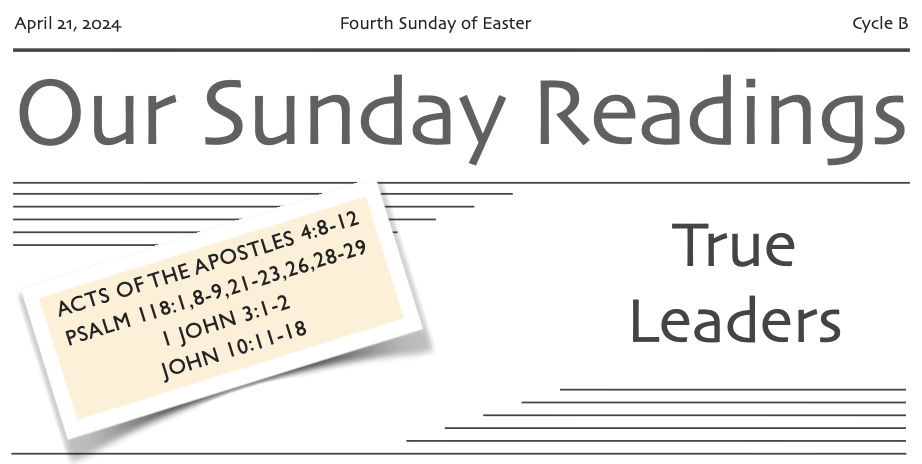
Bulletin
Study Guide
Discussion Questions
4th Sunday of Easter B
Vince Contreras

- In the 1st Reading, how many times is the “name” of Jesus invoked? What power is there in his name?
- In the 2nd Reading, what is the basis of our great dignity in being Christians? Where did this great dignity come from? How and why is this sometimes hard to see in our lives? What, ultimately, is our
destiny in Christ? - Who is Jesus speaking to in today’s Gospel Reading (John 9:40; 10:6-7)? How does the story in chapter 9 flow into Jesus discourse about the Good Shepherd in chapter 10?
- What do the sheep, shepherd, sheepfold and stranger represent? Who are the “thieves and robbers” (Jeremiah 2:8; 10:21; 23:1-4; Ezekiel 34:2ff)? How is Jesus unlike them?
- How do the sheep respond to the shepherd? How does this relate to the Pharisees’ difficulty in accepting Jesus (chapter 9; 10:19-39)?
- Who are the other sheep Jesus must bring also (Ephesians 2:11-22)? What characterizes his flock?
- What final claim does Jesus make (verses 17-18)? Why do his listeners respond as they do? How would you have responded?
- What was the turning point for you in terms of hearing “God’s voice” and responding? How do you discern his voice from all the voices that vie for your attention?
- How does it make you feel to think of God as caring for you as the Good Shepherd?
SOURCE: SundayScriptureStudy.com / used with permission


4th Sunday of Easter B
Anne Osdieck

FIRST READING
1. Peter says that it was Christ who healed the crippled man: Christ “is the stone rejected by you, the builders, which has become the cornerstone.” What gave Peter the courage to speak out like this, when before Jesus died he couldn’t even admit that he knew him? Do we receive that same gift when we speak out for truth or goodness?
SECOND READING
2. What gifts have you received as a child of God? What gifts have you received today from God?
GOSPEL
3. Jesus said, “I know mine and mine know me, just as the Father knows me and I know the Father; and I will lay down my life for the sheep.” Jesus is applying the unconditional love between himself and his Father to the relation between himself and his own. What does this tell you about how well you are known and how much you are loved? And: for whom would you lay down your life?
SOURCE: Sunday Web Site at Saint Louis University
4th Sunday of Easter B
Fr. Clement Thibodeau

- Did your faith formation and religious upbringing give you a sense of intimacy with God? Are you aware that God loves you? What are some of the images that help you grasp that sense of God’s personal love for you? Do you see yourself as a sheep in God’s flock? Or as a child in God’s family? Or as an adult and companion of the Lord Jesus Christ?
- Discuss your appreciation of the Church or the Christian community as flock of Christ, loved and cherished by him. Do you see your parish, your family, your prayer group, as a part
- of the flock of Christ? Does Christ only love you personally or is Christ also cherishing the unit of faith to which you belong? Do you feel loved by God as a Church member or as an individual?
- How do you experience the leadership of Christ in the Church? As one of caring and love? Do you feel that Christ is actually guiding your church in the ways of truth? Do your parish leaders provide nourishment for your spiritual life?
SUGGESTION FOR CHRISTIAN ACTION
Spend some time with your group or your family evaluating the power and presence of the Risen Christ in the life and actions of your group or family. Try to become aware of that power and life in
your midst
SOURCE: Portland Diocese
4th Sunday of Easter B
Fr. Eamon Tobin

- Share with the group or person next to you what spoke to you most in the Gospel. With this first question,
try to refrain from commenting on what others said. Just share what spoke to you and then move on to the
next person. - Who are some modern examples of “rejected cornerstones”—people whose cause or work is not accepted by the general masses? Have you had a personal experience of being rejected for what you believe or for a cause you feel strongly about?
- How might the belief that you are an unconditionally loved child of God impact your prayer and the way you relate to Jesus and others?
- Why is the image of Jesus as the Good Shepherd so popular with people? What other image of Jesus do you like?
- What is the difference between a hireling and a good shepherd when it comes to caring for people? When might we act like a hireling, showing no real concern for those in need of good shepherd care?
- Name 1 thing today’s Gospel says to us that we disciples of Jesus need to heed/ act on.
SOURCE: Ascension Catholic Parish, Melbourne, FL
Bulletin
Study Guide
Ask A Teen Gospel
Questions
ASK A
TEEN
GOSPEL
QUESTIONS
Discussion questions for teens with sample answers based on their interests.
Discussion Questions
John 10:11-18
Discussion Questions:
1. How does the image of Jesus as the Good Shepherd resonate with the struggles teenagers face in navigating complex relationships with peers and authority figures in modern society?
Sample Answer: The image of Jesus as the Good Shepherd can offer comfort to teenagers who feel lost or overwhelmed in their relationships, showing them that there is someone who cares for them deeply and guides them with love and compassion.
2. In what ways can the concept of laying down one’s life for others, as Jesus did, inspire teenagers to practice selflessness and empathy in a world that often prioritizes individual success and achievement?
Sample Answer: The idea of self-sacrifice and putting others’ needs before their own can encourage teenagers to look beyond themselves and consider the well-being of those around them, fostering a sense of community and compassion.
3. How does the notion of Jesus knowing his own and being known by them relate to the desire of teenagers to find acceptance, belonging, and genuine connections in a society driven by superficial relationships and social media?
Sample Answer: The idea of being truly known and valued by Jesus can resonate with teenagers who seek authentic relationships and meaningful connections, reminding them that they are loved unconditionally and accepted for who they are.
4. How can the metaphor of Jesus gathering all into one flock encourage teenagers to embrace diversity, inclusivity, and unity in a world marked by division, prejudice, and discrimination?
Sample Answer: The image of Jesus bringing together all people into one flock can inspire teenagers to celebrate differences, promote equality, and work towards building a more inclusive and harmonious society where everyone is valued and respected.
5. In what ways can the promise of abundant life and eternal love offered by Jesus in these verses provide hope and comfort to teenagers facing uncertainties, pressures, and challenges in their daily lives?
Sample Answer: The assurance of abundant life and everlasting love from Jesus can offer teenagers a sense of hope, purpose, and security amidst the uncertainties and difficulties they encounter, reminding them of the enduring presence of a caring and faithful Shepherd.