
Bible Study
Bible Study
Bible Study
Videos



Fr. Bryan Kujawa

SOURCE: Fr. Bryan Kujawa’s Archives. Switch videos using icon in the upper right corner.



Jeff
Cavins
Jeff Cavins
Ascension Presents
Bulletin
Study Guide

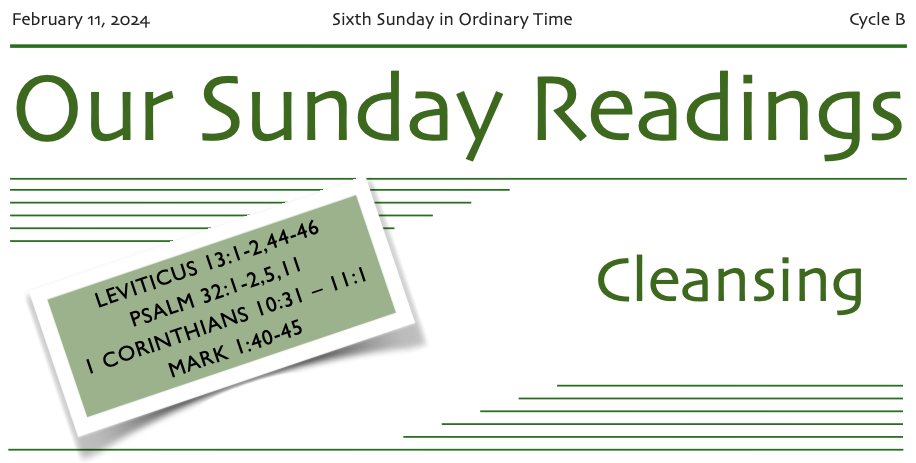

Outlines and Backgrounds

Passage
Outline and
Context
Ancient people believed a face-to-face encounter with God would be overpowering, even deadly. So they welcomed the idea that a prophet, a single human being, could bear the brunt of that encounter for them. They did not always welcome what the prophet had to report from God. (Greg Warnusz)

OUTLINE
I. The Lord speaks to Moses and Aaron regarding skin diseases.
II. If a person has a sore or skin discoloration, they must go to the priest for examination.
III. If the priest determines it is leprosy, the person must live outside the camp and announce their uncleanness
Historical Context

The text of Leviticus 13:1-2 and 44-46 addresses the issue of skin diseases among the Israelites and how they were to be dealt with according to God's law. Skin diseases, or "leprous diseases" as they were referred to in biblical times, were a serious concern for the Israelites due to their highly contagious nature and potential to spread throughout the community.
Cultural Context

The ancient Near Eastern cultural context of this passage is also significant to understanding the severity of skin diseases and their impact on the Israelite society. In ancient times, skin diseases were often associated with divine punishment, and individuals were often ostracized and excluded from the community due to their perceived impurity. Therefore, the laws in Leviticus 13 and 14 were not only meant to address the physical health of the community, but also to maintain a sense of spiritual purity and holiness before God.
It is also important to note that in ancient Israelite society, the role of the priest was highly valued and respected. Therefore, the instructions for the priest to examine the individual with a skin disease and determine their status as clean or unclean carried great weight and authority.
SOURCE: Content written in collaboration with OpenAI's GPT-3.5 model.
Saint Paul continues his teachings about how to be prepared for the imminent return of Jesus in glory. That coming should make people put their priorities in order. (Greg Warnusz)

OUTLINE
I. Whatever believers do, whether eating or drinking, should be done for the glory of God.
II. Christians are encouraged to imitate Paul as he imitates Christ.
III. Paul advises the Corinthians to follow his example in everything they do, as he seeks to follow Christ.
Historical Context
During this time, the city of Corinth was known for its wealth, diversity, and immorality. It was also a significant center for trade, making it a strategic location for spreading the gospel throughout the Roman Empire. However, this cultural and religious diversity also posed challenges for the early church, as believers navigated various cultural and social norms while holding onto their faith in Christ.
Cultural Context
In the cultural context of the first century, it was common for traveling teachers and philosophers to receive financial support from those they taught. Therefore, it was customary for the Jewish teachers and the Greek philosophers to receive payment for their teachings. The fact that Paul did not request financial support from the Corinthian church may have been seen as unusual or even suspicious in their eyes.
SOURCE: Content written in collaboration with OpenAI's GPT-3.5 model.
This gospel recalls a time when people questioned Jesus' authority and right to teach, because of his modest origins. (Greg Warnusz)

OUTLINE
I. Jesus encounters a man with leprosy.
II. The man begs for healing, showing faith.
III. Jesus touches and heals him.
IV. Jesus tells the man to keep quiet, but he spreads the word anyway.
V. As a result, Jesus has to lay low, but people still come to him for healing.
Historical Context
In the context of 1st-century Palestine, leprosy was not just a medical condition but also carried significant cultural and religious implications. Leprosy was considered highly contagious and those afflicted were socially ostracized, forced to live outside of towns and cities.
Cultural Context
The Jewish religious laws mandated strict isolation for lepers to maintain ritual purity. So, when Jesus heals the leper in Mark 1:40-45, it not only showcases his miraculous power but also challenges societal norms, breaks religious barriers, and demonstrates his compassion for the marginalized.
SOURCE: Content written in collaboration with OpenAI's GPT-3.5 model.

6th Sunday of Year B
Jesus Authority for Healing
In this Sunday’s Gospel, we see Jesus authority to heal a man with leprosy, and the impact it has on the community. As Catholics, we believe in the power of Jesus miracles and the importance of faith in our healing. Through this study, we will explore the significance of this event and apply it to our lives.
Prayer: Dear God, help us to have open hearts and minds as we study your Word. May we be transformed by the truth of your love and authority. Amen.
Questions:
- What is the background of this passage?
- Who is the main character in this passage?
- What is the main conflict in this passage?
- How does Jesus respond to the man with leprosy?
- How does the man respond to Jesus healing?
Observation:
- The background of this passage is a time when Jesus was traveling and performing miracles throughout Galilee.
- The main character in this passage is Jesus, the Son of God.
- The main conflict in this passage is the mans leprosy and the cultural and religious beliefs surrounding it.
- Jesus responds with compassion and reaches out to touch the man, even though it was culturally forbidden to touch someone with leprosy.
- The man responds with complete faith and obedience to Jesus authority, immediately spreading the news about his healing.
Interpretation:
- Jesus was not just a teacher or prophet, but He had the power to heal and perform miracles.
- By reaching out and touching the man, Jesus not only healed his physical ailment but also showed that He had authority over cultural and religious norms.
- The mans faith and obedience to Jesus authority led to his complete healing.
- This event revealed Jesus compassion for those who were considered outcasts in society, such as those with leprosy.
- The spreading of the news about the mans healing further increased Jesus popularity and the understanding of His divine authority.
Application:
- Just like the man with leprosy, we may have our own physical, emotional, or spiritual ailments. How do we respond to Jesus authority to heal us?
- Do we have the faith and obedience to reach out to Jesus and ask for His healing in our lives?
- How can we break societal and cultural norms to show compassion and love to those who are considered outcasts in our society?
- In what ways can we spread the news of Jesus healing power to those around us?
- How can we trust in Jesus authority and have faith that He can heal us, both physically and spiritually?
Biblical Truth: Jesus has authority over all aspects of our lives and has the power to heal and transform us. Our faith and obedience play a crucial role in receiving His healing.
Action: Let us take a moment to reflect on any areas in our lives where we need Jesus healing and surrender them to Him in faith. Let us also be open to the promptings of the Holy Spirit to reach out and show compassion to those society considers outcasts.
Conclusion: In this passage from Mark, we see Jesus divine authority, His compassion, and the importance of faith and obedience in receiving His healing. As Catholics, let us trust in His power to heal us and be open to spreading this good news to those around us. Let us continually turn to Jesus in all aspects of our lives, knowing that He has authority over all.
Wikipedia
Key Words

BIBLE
STUDY
Gospel Reading
First Reading
Word
Sunday

Word-Sunday
by Larry Broding
1st Reading: Leprosy
2nd Reading: Freedom Vs. Principle
Gospel: Make Me Whole Again
Questions for
Small Groups
Discussion Questions
Small Group Questions
6th Sunday of Year B
Vince Contreras

GOSPEL
Why is the leper unsure of Jesus’ desire to help (see Leviticus 13)? What is significant about Jesus touching the leper prior to healing him? Was it always necessary for Jesus to touch someone to effect a cure (see Matthew 8:5-13; Mark 3:1-5; John 4:43-54)?
Notice that Jesus’ disciples are not mentioned in this scene? Where do you think they are?
Why would Jesus say “See that you tell no one anything” (see verse 45)?
The leper came to Jesus miserable and humble. Do you think we must admit sin and have a firm purpose of amendment to be forgiven? Why or why not?
Who might the leper in this story represent? What might the disease of leprosy represent?
Who is considered “unclean” in our society? Do you reach out and touch them? How?
Where do you need Jesus’ special touch this week? How can you touch others?
SOURCE: SundayScriptureStudy.com / used with permission
Small Group Questions
6th Sunday of Year B
Anne Osdieck

FIRST READING
1. In those days ritual demanded that if you had the sore of leprosy you had to “tear your clothes, be excluded, made to live apart from those you love, and you were forced to announce your presence by shouting, ‘Unclean.’” Not to this extreme, but are some people treated in a similar way today? Give examples.
SECOND READING
2. Paul says, “Whether you eat or drink, or whatever you do, do everything for the glory of God.” In which of your day’s activities is it easy for you to remember the presence of God? Which are difficult? Can you gradually remember the presence of God in all your actions?
GOSPEL
3. “Moved with pity, he stretched out his hand, touched him, and said to him, ‘I do will it. Be made clean.’” Are you moved with pity in any of the “unclean” situations we are experiencing in our world: Pandemic? Climate crises? Racial injustice? Trafficking? Is there anything you can do to aid Jesus with the cleansing?
SOURCE: Sunday Web Site at Saint Louis University
Small Group Questions
6th Sunday of Year B
Fr. Clement
Thibodeau
Who are the “lepers” of our society today? Who are people we would not want to be seen with? People who speak with a “foreign” accent? Those who walk with leg and arm supports in the supermarket? Those who use an EBT card at the checkout counter? The “other racial” boyfriend your daughter brings home from college?
Tell the story of how liberating you found it to be for yourself when you were able to overcome the prejudices you grew up with in your life. Recount the freedom you found when you accepted people the way God has accepted them. Tell what bondage you found when you harbored prejudices of any kind.
Do you dare to come to Jesus and to expose to him the “unclean” parts of your life that need to be forgiven by him? Do you even acknowledge that you do have some unclean parts of your soul? Do you think he will be down on you and not acknowledge you as part of his family? Have you asked for forgiveness recently?
SOURCE: Portland Diocese
Small Group Questions
6th Sunday of Year B
Fr. Eamon Tobin

I assume all of us have seen the connection between leprosy and Covid-19, which are both very contagious diseases. People are fearful of them. These diseases force people to isolate from the community. For you,
what has been the worst part of this Covid-19
pandemic? What helped you or continues to help you during this distressing time?
Who are the marginalized and ‘untouchables’ in our society? What can help us deal with these brothers and sisters as Jesus would?
Who might be people who may feel unwanted in our parish today? Why? What can be done to overcome this barrier?
Name one thing today’s Gospel says to us that we disciples of Jesus need to heed and act on.