
Click INDEX TAB
in right corner of browser to view page contents.

The Mass Readings Explained

SOURCE: The Mass Readings Explained
The feeding of the 5,000 in John’s gospel is interpreted as a miracle of sharing rather than a miracle of multiplication, with Jesus inspiring generosity and fulfilling a prophecy from the Old Testament.
Hearers of the Word

SOURCE: Hearers of the Word
Jesus’ miraculous feeding of the 5,000 with 5 loaves and 2 fish symbolizes his compassion and ability to meet spiritual needs, leaving the audience questioning his true identity and the deeper spiritual hunger he satisfies.
Ascension Presents

The Bible Timeline®: The Story of Salvation
The Eucharist and the body of Christ emphasize the importance of unity and maintaining peace in relationships to avoid disunity.
The Word Proclaimed

SOURCE: The Word Proclaimed
Jesus fulfills the Passover by feeding the crowd in the desert, multiplying loaves and fish, and claiming to be the prophet, providing bread and wine to navigate through life’s challenges.
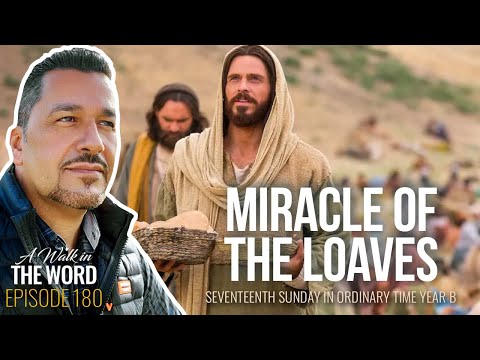
A Walk in the Word
SOURCE: A Walk in the Word
Jesus performs a miracle of multiplying loaves and fishes to feed the multitude, emphasizing his role as a mediator of God’s word and prefiguring the superabundance of the Eucharist.
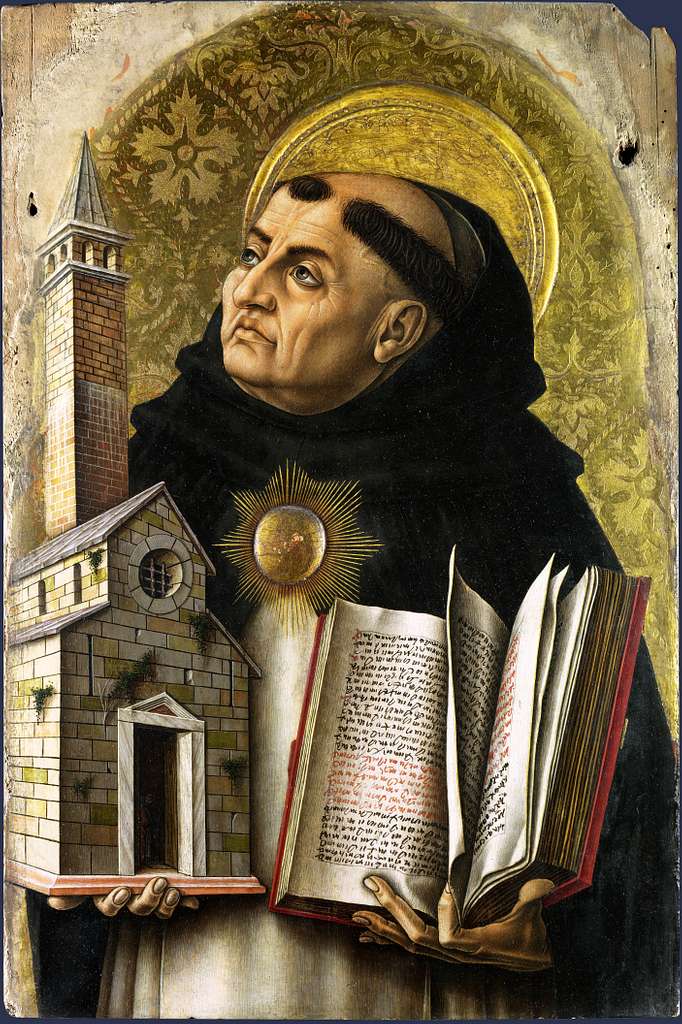
✝️ Catena Aurea
Catena Aurea
Compiled by St. Thomas Aquinas
In his Homily XLII, Chrysostom metaphorically illustrates how violent opposition only fuels rage, while gentleness defuses aggression, and subsequently applies this insight to Christ’s strategic retreat from Jerusalem to the region beyond the Sea of Galilee in order to quell Jewish hostility.
CHRYSOSTOM. (Hom. xlii. 1) As missiles rebound with great force from a hard body, and fly off in all directions, whereas a softer material retains and stops them; so violent men are only excited to greater rage by violence on the side of their opponents, whereas gentleness softens them. Christ quieted the irritation of the Jews by retiring from Jerusalem. He went into Galilee, but not to Cana again, but beyond the sea: After these things Jesus went over the sea of Galilee, which is the sea of Tiberias.
Alcuin discusses the varying names of the sea that Jesus crosses, highlighting its geographical connections and its classification as a ‘sea’ in Hebrew despite being freshwater.
Theophylact emphasizes Jesus’ purpose in travelling to different places – assessing people’s dispositions and piquing their interest in His teachings.
Alcuin adds that Jesus’ physical healing also led to spiritual renewal, showing the comprehensive impact of His miracles.
ALCUIN. This sea hath different names, from the different places with which it is connected; the sea of Galilee, from the province; the sea of Tiberias, from the city of that name. It is called a sea, though it is not salt water, that name being applied to all large pieces of water, in Hebrew. This sea our Lord often passes over, in going to preach to the people bordering on it.
THEOPHYLACT. He goes from place to place to try the dispositions of people, and excite a desire to hear Him: And a great multitude followed Him, because they saw His miracles which He did on them that were diseased.
ALCUIN. viz. His giving sight to the blind, and other like miracles. And it should be understood, that all, whom He healed in body, He renewed likewise in soul.
Chrysostom observes that the people valued Jesus’ miracles over His teachings, indicating a lack of faith, and that solitude enhances wisdom. The Evangelist focuses on Jesus’ discourses rather than detailing His miracles. Jesus went up to the mountain with only His disciples, implying the people’s failure to follow Him. As the Passover feast approached, the absence of many miracles during the year shows the Evangelist’s emphasis on Jesus’ teachings. Jesus’ withdrawal from Jewish feasts aimed to gradually replace the Law due to Jewish wickedness.
Theophylact adds that Jesus had reason to retire and abandon Jewish observances, as truth and revelations rendered types obsolete. The expression ‘a feast of the Jews’ further indicates a separation between Jewish and Christian traditions.
CHRYSOSTOM. (Hom. xlii. 1) Though favoured with such teaching, they were influenced less by it, than by the miracles; a sign of their low state of belief: for Paul says of tongues, that they are for a sign, not to them that believe, but to them that believe not. (1 Cor. 14:22) They were wiser of whom it is said, that they were astonished at His doctrine. (Matt. 7:28) The Evangelist does not say what miracles He wrought, the great object of his book being to give our Lord’s discourses. It follows: And Jesus went up into a mountain, and there sat with His disciples. He went up into the mountain, on account of the miracle which was going to be done. That the disciples alone ascended with Him, implies that the people who stayed behind were in fault for not following. He went up to the mountain too, as a lesson to us to retire from the tumult and confusion of the world, and leave wisdom in solitude. And the passover, a feast of the Jews, was nigh. Observe, in a whole year, the Evangelist has told us of no miracles of Christ, except His healing the impotent man, and the nobleman’s son. His object was to give not a regular history, but only a few of the principal acts of our Lord. But why did not our Lord go up to the feast? He was taking occasion, from the wickedness of the Jews, gradually to abolish the Law.
THEOPHYLACT. The persecutions of the Jews gave Him reason for retiring, and thus setting aside the Law. The truth being now revealed, types were at an end, and He was under no obligation to keep the Jewish feasts. Observe the expression, a feast of the Jews, (Mat. 14:13) not a feast of Christ.
Bede explains that based on the accounts of different Evangelists, there was an interval of one year between John’s beheading and Jesus’ Passion. This conclusion is drawn from Matthew’s mention of Jesus withdrawing after John’s death, followed by John’s account of Jesus feeding the multitude near Passover, and Jesus’ own Passion occurring at Passover the next year. Furthermore, when Jesus lifted up His eyes, Bede suggests it signifies that Jesus usually remained calm and attentive, rather than constantly surveying His surroundings.
BEDE. If we compare the accounts of the different Evangelists, we shall find very clearly, that there was an interval of a year between the beheading of John, and our Lord’s Passion. For, since Matthew says that our Lord, on hearing of the death of John, withdrew into a desert place, where He fed the multitude; and John says that the Passover was nigh, when He fed the multitude; it is evident that John was beheaded shortly before the Passover. And at the same feast, the next year Christ suffered. It follows, When Jesus then lifted up His eyes, and saw a great company come unto Him, He saith unto Philip, Whence shall we buy bread, that these may eat? When Jesus lifted up His eyes, this is to shew us, that Jesus was not generally with His eyes lifted up, looking about Him, but sitting calm and attentive, surrounded by His disciples.
Chrysostom highlights Jesus’ close and familiar interaction with His disciples, which helped Him understand their minds. Jesus questioned Philip to further guide him, as Philip demonstrated a need for more understanding, such as when he asked Jesus to show them the Father. Jesus’ approach aimed to emphasize the magnitude of the miracle by first letting the disciples acknowledge their limitations.
CHRYSOSTOM. (Hom. xlii. 1) Nor did He only sit with His disciples, but conversed with them familiarly, and gained possession of their minds. Then He looked, and saw a crowd advancing. But why did He ask Philip that question? Because He knew that His disciples, and he especially, needed further teaching. For this Philip it was who said afterwards, Shew us the Father, and it sufficeth us. (c. 14:8) And if the miracle had been performed at once, without any introduction, the greatness of it would not have been seen. The disciples were made to confess their own inability, that they might see the miracle more clearly; And this He said to prove him.
Augustine distinguishes between temptations leading to sin, which God never instigates, and trials designed to test one’s faith. In this context, Jesus’ questioning of Philip is described as a trial, but not due to ignorance. The term ‘proved’ signifies a perfect knowledge of Philip’s nature while testing his faith. The Evangelist clarifies this nuanced language by stating that Jesus knew what He would do, ensuring no misunderstanding of Jesus’ intent or awareness.
Alcuin suggests that Jesus’ question aimed to reveal Philip’s lack of understanding to himself, rather than seeking information.
Theophylact agrees that Jesus already knew Philip’s heart and intended to show it to others.
Augustine reconciles the accounts from different Gospels, proposing that Jesus’ question to Philip occurred after He had already told the disciples to feed the multitude, resolving the apparent discrepancy in the narrative sequence.
AUGUSTINE. (de verb. Dom. Serm. 17) One kind of temptation leads to sin, with which God never tempts any one; (James 1:13.) and there is another kind by which faith is tried. (Deut. 13:3.) In this sense it is said that Christ proved His disciple. This is not meant to imply that He did not know what Philip would say; but is an accommodation to men’s way of speaking. For as the expression, Who searcheth the hearts of men, does not mean the searching of ignorance, but of absolute knowledge; so here, when it is said that our Lord proved Philip, we must understand that He knew him perfectly, but that He tried him, in order to confirm his faith. The Evangelist himself guards against the mistake which this imperfect mode of speaking might occasion, by adding, For He Himself knew what He would do.
ALCUIN. He asks him this question, not for His own information, but in order to shew His yet unformed disciple his dulness of mind, which he could not perceive of himself.
THEOPHYLACT. Or to shew others it. He was not ignorant of His disciple’s heart Himself.
AUGUSTINE. (de Con. Evang. l. ii. c. xlvi) But if our Lord, according to John’s account, on seeing the multitude, asked Philip, tempting him, whence they could buy food for them, it is difficult at first to see how it can be true, according to the other account, that the disciples first told our Lord, to send away the multitude; and that our Lord replied, They need not depart; give ye them to eat. (Matt. 25:16) We must understand then it was after saying this, that our Lord saw the multitude, and said to Philip what John had related, which has been omitted by the rest.
Discussing the different accounts in the Gospels, Chrysostom suggests they refer to two separate occasions.
Theophylact analyzes Philip’s response, which reveals his limited understanding of Jesus’ power.
Augustine reconciles the attribution of Philip’s words in John’s Gospel with Mark’s account, where all disciples express a similar concern. Andrew, exhibiting slightly more faith, mentions the availability of five loaves and two fishes but still questions their sufficiency.
Chrysostom highlights the incorrect assumption that the extent of a miracle depends on the quantity of materials available. He emphasizes that miracles do not require materials, as Christ’s power transcends such limitations.
Theophylact asserts that this miracle contradicts Manichean beliefs, since a good God would not multiply inherently evil creations.
CHRYSOSTOM. (Hom. xlii. s. 1) Or they are two different occasions altogether.
THEOPHYLACT. Thus tried by our Lord, Philip was found to be possessed with human notions, as appears from what follows, Philip answered Him, Two hundred pennyworth of bread is not sufficient for them, that every one of them may take a little.
ALCUIN. Wherein he shews his dulness: for, had he perfect ideas of his Creator, he would not be thus doubting His power.
AUGUSTINE. (de Con. Evan. l. ii. c. xlvi) The reply, which is attributed to Philip by John, Mark puts in the mouth of all the disciples, either meaning us to understand that Philip spoke for the rest, or else putting the plural number for the singular, which is often done.
THEOPHYLACT. Andrew is in the same perplexity that Philip is; only he has rather higher notions of our Lord: There is a lad here which hath five burley loares and two small fishes.
CHRYSOSTOM. (Hom. xlii. 2.) Probably He had some reason in his mind for this speech. He would know of Elijah’s miracle, by which a hundred men were fed with twenty loaves. This was a great step; but here he stopped. He did not rise any higher. For his next words are, But what are these among so many? He thought that less could produce less in a miracle, and more more; a great mistake; inasmuch as it was as easy for Christ to feed the multitude from a few fishes as from many. He did not really want any material to work from, but only made use of created things for this purpose in order to shew that no part of the creation was severed from His wisdom.
THEOPHYLACT. This passage confounds the Manicheans, who say that bread and all such things were created by an evil Deity. The Son of the good God, Jesus Christ, multiplied the loaves. Therefore they could not have been naturally evil; a good God would never have multiplied what was evil.
AUGUSTINE. (de Con. Evang. ii. c. xlvi) Andrew’s suggestion about the five loaves and two fishes, is given as coming from the disciples in general, in the other Evangelists, and the plural number is used.
Chrysostom explains that Jesus had the people sit down before the miracle to demonstrate that, with Him, things that are not are as things that are. He also emphasizes the importance of giving thanks to God before meals and highlights Jesus’ prayer in this instance as a lesson for the gathered multitude rather than a necessity.
Hilary reflects on the miraculous nature of the event, stating that it surpasses human comprehension.
Augustine compares the multiplication of loaves to the growth of harvest from a few grains, emphasizing Christ’s divine power.
Chrysostom contrasts the limited power given to prophets with Christ’s absolute power and explains that the twelve baskets of fragments correspond to the twelve apostles, who would become the world’s teachers.
CHRYSOSTOM. (Hom. xlii. 2.) And let those of us, who are given to pleasure, observe the plain and abstemious eating of those great and wonderful menb. He made the men sit down before the loaves appeared, to teach us that with Him, things that are not are as things that are; as Paul says, Who calleth those things that be not, as though they were. (Rom. 4:17.) The passage proceeds then: And Jesus said, Make the men sit down.
ALCUIN. Sit down, i. e. lie down, as the ancient custom was, which they could do, as there was much grass in the place.
THEOPHYLACT. i. e. green grass. It was the time of the Passover, which was kept the first month of the spring. So the men sat down in number about five thousand. The Evangelist only counts the men, following the direction in the law. Moses numbered the people from twenty years old and upwards, making no mention of the women; to signify that the manly and juvenile character is especially honourable in God’s eyes. And Jesus took the loaves; and when He had given thanks, He distributedc to them that were sat down: and likewise of the fishes as much as they would.
CHRYSOSTOM. (Hom. xlii. 2.) But why when He is going to heal the impotent, to raise the dead, to calm the sea, does He not pray, but here does give thanks? To teach us to give thanks to God, whenever we sit down to eat. And He prays more in lesser matters, in order to shew that He does not pray from any motive of need. For had prayer been really necessary to supply His wants, His praying would have been in proportion to the importance of each particular work. But acting, as He does, on His own authority, it is evident, He only prays out of condescension to us. And, as a great multitude was collected, it was an opportunity of impressing on them, that His coming was in accordance with God’s will. Accordingly, when a miracle was private, He did not pray; when numbers were present, He did.
HILARY. (iii. de Trin. c. 18) Five loaves are then set before the multitude, and broken. The broken portions pass through into the hands of those who break, that from which they are broken all the time not at all diminishing. And yet there they are, the bits taken from it, in the hands of the persons breakingd. There is no catching by eye or touch the miraculous operation: that is, which was not, that is seen, which is not understood. It only remains for us to believe that God can do all things.
AUGUSTINE. (Tr. xxiv. s. 1.) He multiplied in His hands the five loaves, just as He produces harvest out of a few grains. There was a power in the hands of Christ; and those five loaves were, as it were, seeds, not indeed committed to the earth, but multiplied by Him who made the earth.
CHRYSOSTOM. (Hom. xlii. 3) Observe the difference between the servant and the lord. The Prophets received grace, as it were, by measure, and according to that measure performed their miracles: whereas Christ, working this by His own absolute power, produces a kind of superabundant result. When they were filled, He said unto His disciples, Gather up the fragments that remain, that nothing be lost. Therefore they gathered them together, and filled twelve baskets with the fragments. This was not done for needless ostentation, but to prevent men from thinking the whole a delusion; which was the reason why He made use of an existing material to work from. But why did He give the fragments to His disciples to carry away, and not to the multitude? Because the disciples were to be the teachers of the world, and therefore it was most important that the truth should be impressed upon them. Wherefore I admire not only the multitude of the loaves which were made, but the definite quantity of the fragments; neither more nor less than twelve baskets full, and corresponding to the number of the twelve Apostles.
Theophylact encourages not to lose faith even in times of poverty.
Bede explains that the people called Jesus a Prophet as they did not yet understand His divinity.
Alcuin clarifies that the people singled out Jesus as the Prophet due to the miracles He performed, and Augustine expands on Christ’s roles as both Prophet and Lord of Prophets.
Chrysostom highlights that the people anticipated a great Prophet’s arrival, recognizing Jesus as such.
Augustine argues that while the miracle of feeding the multitude was remarkable, the continuous divine governance of the world is even more miraculous, although often overlooked.Reply in a thread
THEOPHYLACT. We learn too from this miracle, not to be pusillanimous in the greatest straits of poverty.
BEDE. When the multitude saw the miracle our Lord had done, they marvelled; as they did not know yet that He was God. Then those men, the Evangelist adds, i. e. carnal men, whose understanding was carnal, when they had perceived the miracle that Jesus did, said, This is of a truth that Prophet that should come into the world.
ALCUIN. Their faith being as yet weak, they only call our Lord a Prophet, not knowing that He was God. But the miracle had produced considerable effect upon them, as it made them call our Lord that Prophet, singling Him out from the rest. They call Him a Prophet, because some of the Prophets had worked miracles; and properly, inasmuch as our Lord calls Himself a Prophet; It cannot be that a prophet perish out of Jerusalem. (Luke 13:33)
AUGUSTINE. (Tr. xxiv. s. 7) Christ is a Prophet, and the Lord of Prophets; as He is an Angel, and the Lord of Angels. In that He came to announce something, He was an Angel; in that He foretold the future, He was a Prophet; in that He was the Word made flesh, He was Lord both of Angels and Prophets; for none can be a Prophet without the word of God.
CHRYSOSTOM. Their expression, that should come into the world, shews that they expected the arrival of some great Prophet. And this is why they say, This is of a truth that Prophet: the article being put in the Greek, to shew that He was distinct from other Prophets.
AUGUSTINE. (Tr. xxiv. s. 1, 2) But let us reflect a little here. Forasmuch as the Divine Substance is not visible to the eye, and the miracles of the divine government of the world, and ordering of the whole creation, are overlooked in consequence of their constancy; God has reserved to Himself acts, beside the established course and order of nature, to do at suitable times; in order that those who overlooked the daily course of nature, might be roused to wonder by the sight of what was different from, though not at all greater, than what they were used to. The government of the world is a greater miracle, than the satisfying the hunger of five thousand with five loaves; and yet no one wonders at this: the former excited wonder; not from any real superiority in it, but because it was uncommon. But it would be wrong to gather no more than this from Christ’s miracles: for, the Lord who is on the mounte, and the Word of God which is on high, the same is no humble person to be lightly passed over, but we must look up to Him reverently.
Alcuin interprets the sea as a symbol for the tumultuous world, and Christ’s interaction with it signifies His birth, death, and resurrection.
Bede equates the mountain to heaven, where Jesus ascended.
Alcuin suggests that the distinction between the multitude and the disciples represents the different levels of spiritual maturity in receiving Christ’s teachings. The refreshment before Passover symbolizes spiritual nourishment through God’s word and spiritual transformation.
Augustine connects the five barley loaves to the Old Law, highlighting its limitations and the spiritual nourishment hidden beneath carnal ceremonies.
ALCUIN. Mystically, the sea signifies this tumultuous world. In the fulness of time, when Christ had entered the sea of our mortality by His birth, trodden it by His death, passed over it by His resurrectionf, then followed Him crowds of believers, both from the Jews and Gentiles.
BEDE. Our Lord went up to the mountain, when He ascended to heaven, which is signified by the mountain.
ALCUIN. His leaving the multitude below, and ascending the heights with His disciples, signifies, that lesser precepts are to be given to beginners, higher to the more matured. His refreshing the people shortly before the Passover signifies our refreshment by the bread of the divine word; and the body and blood, i. e. our spiritual passover, by which we pass over from vice to virtue. And the Lord’s eyes are spiritual gifts, which he mercifully bestows on His Elect. He turns His eyes upon them, i. e. has compassionate respect unto them.
AUGUSTINE. (lib. lxxxiii. Quæst. q. 61. in princ.) The five barley loaves signify the old law; either because the law was given to men not as yet spiritual, but carnal, i. e. under the dominion of the five senses, (the multitude itself consisted of five thousand:) or because the Law itself was given by Moses in five books. And the loaves being of barley is also an allusion to the Law, which concealed the soul’s vital nourishment, under carnal ceremonies. For in barley the corn itself is buried under the most tenacious husk. Or, it alludes to the people who were not yet freed from the husk of carnal appetite, which cling to their heart.
Bede asserts that barley, being the food of cattle and slaves, represents the Old Law given to those under the dominion of their carnal nature.
Augustine likens the two fishes to the royal and priestly authority governing the people, both of which prefigure Christ’s roles.
Bede alternatively suggests that the two fishes symbolize the prophetic writings and Psalms. The number five is associated with the five senses, and a thousand represents perfection. The boy with the loaves and fishes might signify the Jewish people who possessed the Law but did not derive spiritual nourishment from it until Christ provided a deeper understanding.
Bede emphasizes that the Law had limited impact until Jesus fulfilled and imbued it with a spiritual significance.
BEDE. (Hom. in Luc. c. vi.) Barley is the food of cattle and slaves: and the old law was given to slaves and cattle, i. e. to carnal men.
AUGUSTINE. (lib. lxxxiv. Quæst. qu. 61) The two fishes again, that gave the pleasant taste to the bread, seem to signify the two authorities by which the people were governed, the Royal, viz. and the Priestly; both of which prefigure our Lord, who sustained both characters.
BEDE. Or, by the two fishes are meant the saying or writings of the Prophets, and the Psalmist. And whereas the number five refers to the five senses, a thousand stands for perfection. But those who strive to obtain the perfect government of their five senses, are called men, in consequence of their superior powers: they have no womanly weaknesses; but by a sober and chaste life, earn the sweet refreshment of heavenly wisdom.
AUGUSTINE. (Tr. xxiv. 5) The boy who had these is perhaps the Jewish people, who, as it were, carried the loaves and fishes after a servile fashion, and did not eat them. That which they carried, while shut up, was only a burden to them; when opened became their food.
BEDE. (Aug. xxiv. 5) And well is it said, But what are these among so many? The Law was of little avail, till He took it into His hand, i. e. fulfilled it, and gave it a spiritual meaning. The Law made nothing perfect. (Heb. 7:19)
Augustine interprets the breaking of the five loaves as the unfolding of the five books of Moses, leading to a multitude of books. Additionally, he suggests that by breaking and opening the Law, Jesus revealed its full meaning. The people’s ignorance of the Law is emphasized, with the metaphor of lying on grass representing their carnal mindset. Those who internalize the teachings are filled with the loaves, while the fragments symbolize the deeper truths reserved for the capable few, such as the Apostles, who are represented by the twelve baskets.
Alcuin further expands on the symbolism of baskets as the Apostles, who despite being looked down upon, are filled with spiritual riches and are tasked with spreading the doctrine of the Trinity across the world. Finally, the multiplication of existing loaves signifies the expansion and explanation of the Old Testament rather than its rejection.
AUGUSTINE. (Tr. xxiv. s. 5) By the act of breaking He multiplied the five loaves. The five books of Moses, when expounded by breaking, i. e. unfolding them, made many books.
AUGUSTINE. (lib. lxxxiii. Quæst. qu. 61) Our Lord by breaking, as it were, what was hard in the Law, and opening what was shut, that time when He opened the Scriptures to the disciples after the resurrection, brought the Law out in its full meaning.
AUGUSTINE. (Tr. xxiv. s. 5) Our Lord’s question proved the ignorance of His disciples, i. e. the people’s ignorance of the Law. They lay on the grass, i. e. were carnally minded, rested in carnal things, for all flesh is grass. (Isa. 40:6) Men are filled with the loaves, when what they hear with the ear, they fulfil in practice.
AUGUSTINE. (Tr. xxiv. s. 6) And what are the fragments, but the parts which the people could not eat? An intimation, that those deeper truths, which the multitude cannot take in, should be entrusted to those who are capable of receiving them, and afterwards teaching them to others; as were the Apostles. For which reason twelve baskets were filled with them.
ALCUIN. Baskets are used for servile work. The baskets here are the Apostles and their followers, who, though despised in this present life, are within filled with the riches of spiritual sacraments. The Apostles too are represented as baskets, because, that through them, the doctrine of the Trinity was to be preached in the four parts of the world. His not making new loaves, but multiplying what there were, means that He did not reject the Old Testament, but only developed and explained it.
CONTEMPORARY APPLICATION
📖 Fr. George Corrigan OFM

The Musings of a Franciscan Friar
🗒️ Commentary Note Cards
COMMENTARIES
🟢 Grace Multiplied: Offering Our Resources
Offering our resources to God transforms us into channels of grace, enabling miraculous recoveries beyond our expectations.
Commentary Note Cards

🟤 The Church’s Faithful Witness Amidst Societal Pressures
Resisting worldly pressures to conform to societal expectations, the Church must remain steadfast in upholding God’s will to faithfully witness and lead people to salvation in Christ, even if it entails enduring rejection and ridicule.
Commentary Note Cards

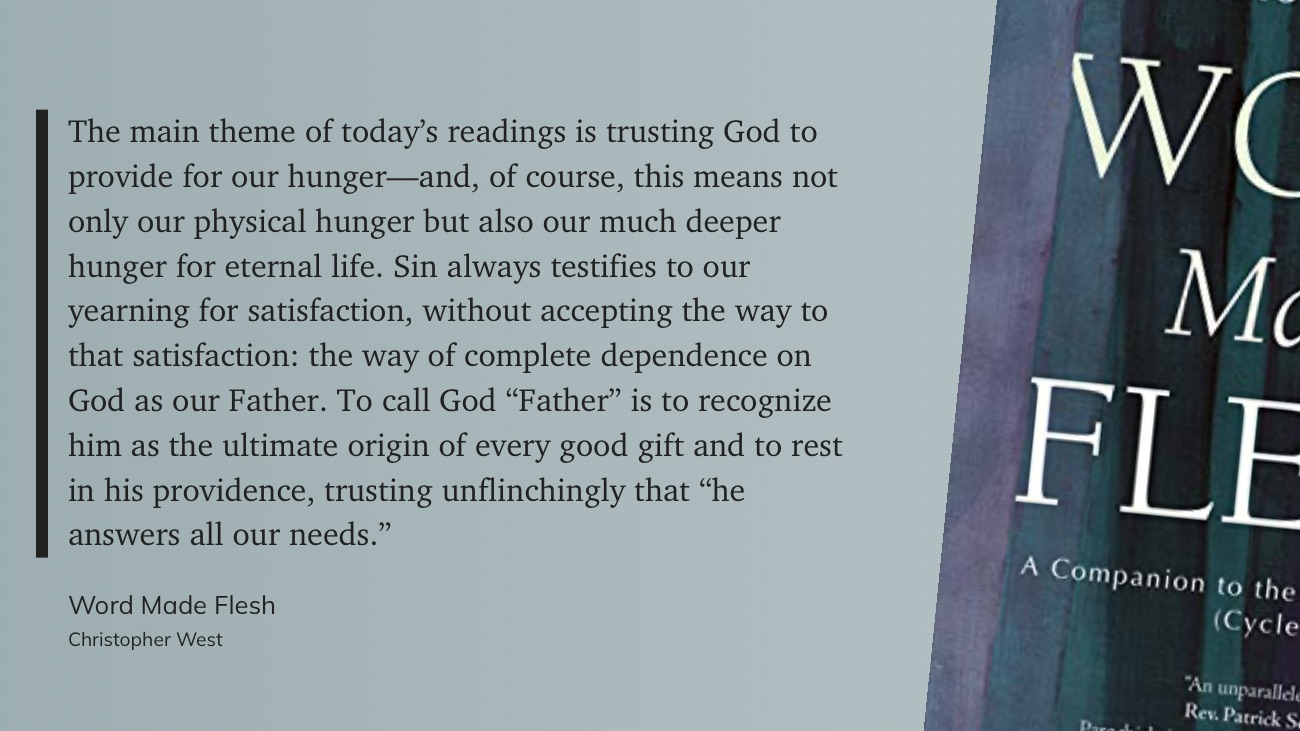
🟣 Nourished by Faith: Complete Dependence for Eternal Satisfaction
Trusting God as our Father to fulfill our physical and spiritual hunger, and relying on Him as the source of all good gifts, is the central theme of today’s readings.
Commentary Note Cards
⛪ Navarre Bible Notes

Commentary Notes
Commentary Notes (PDF)

🌐 Wikipedia Article

Wikipedia
✍️ Sermon Writer Exegesis

RIchard Niell Donovan

Gospel Exegesis
✨ Jesus took the loaves, and having given thanks (eucharisteo), he distributed to the disciples…(v.11)
“Jesus took the loaves, and having given thanks (eucharisteo), he distributed to the disciples, and the disciples to those who were sitting down” (v. 11). Eucharisteo is the Greek word from which we get our word Eucharist.
Jesus most likely prayed traditional prayer of thanksgiving, “Blessed art thou, O Lord our God, King of the universe, who bringest forth bread from the earth” (Carson, 270). It expresses, not a blessing of the food, but thanks to God.
In the Synoptics, the disciples distribute the bread, but in this Gospel, Jesus, acting as the host, does it.
“When they were filled” (v. 12a). The people eat their fill—not just a token amount as some scholars have suggested. Nor is this a lesson in sharing, as others have suggested. This is NOT the story of a young boy who sets an example of generosity that inspires the rest of the crowd to share their food which turns out to be adequate for the occasion. This IS a story—one of many in both Old and New Testaments—about God’s/Jesus’ ability to transform too little into more than enough.
Attempts to explain this story by rationalistic or humanistic interpretations only diminish it—shrinking the miracle to fit our vision instead of expanding our vision to see God’s majesty. We must ask why some interpreters find it possible to believe in the miracle of the resurrection but not the miracle of the loaves and fishes—and if they do not believe in the miracle of the resurrection, how can they be faithful spiritual guides?
RICHARD NIELL DONOVAN was a Disciples of Christ clergyman who published SermonWriter, for a paid subscription, from 1997-2020. After he died, his family has generously provided his resources without subscription.