November 9, 2025
November 9, 2025
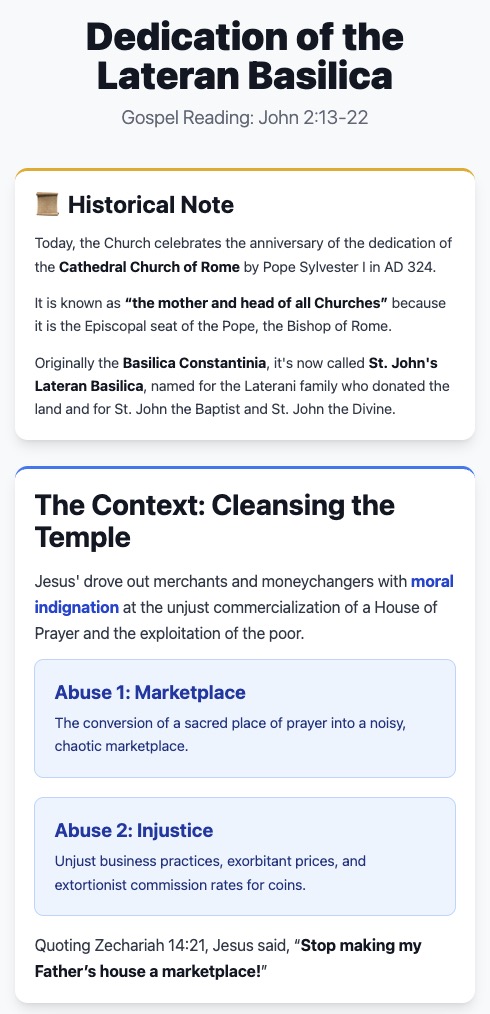
Dedication of the Lateran Basilica


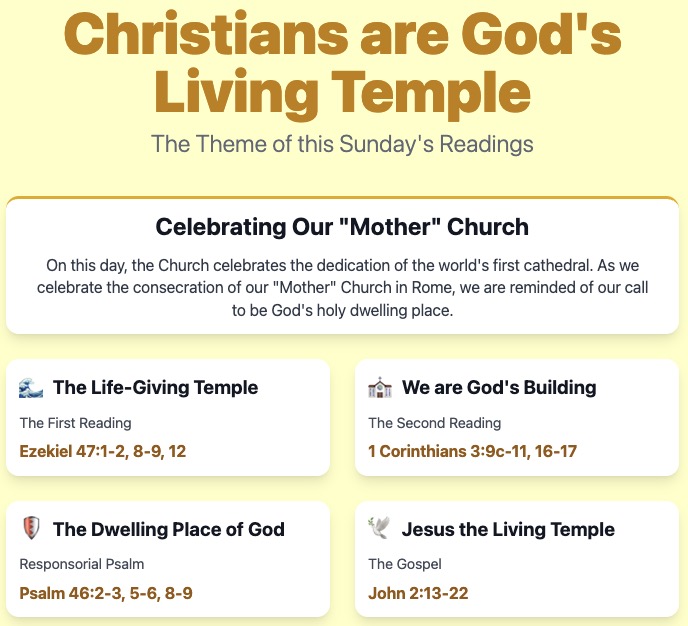
Commentary Intro to Mass Readings for Sunday
CommentaryIntro to Mass Readings for Sunday


Click to enlarge

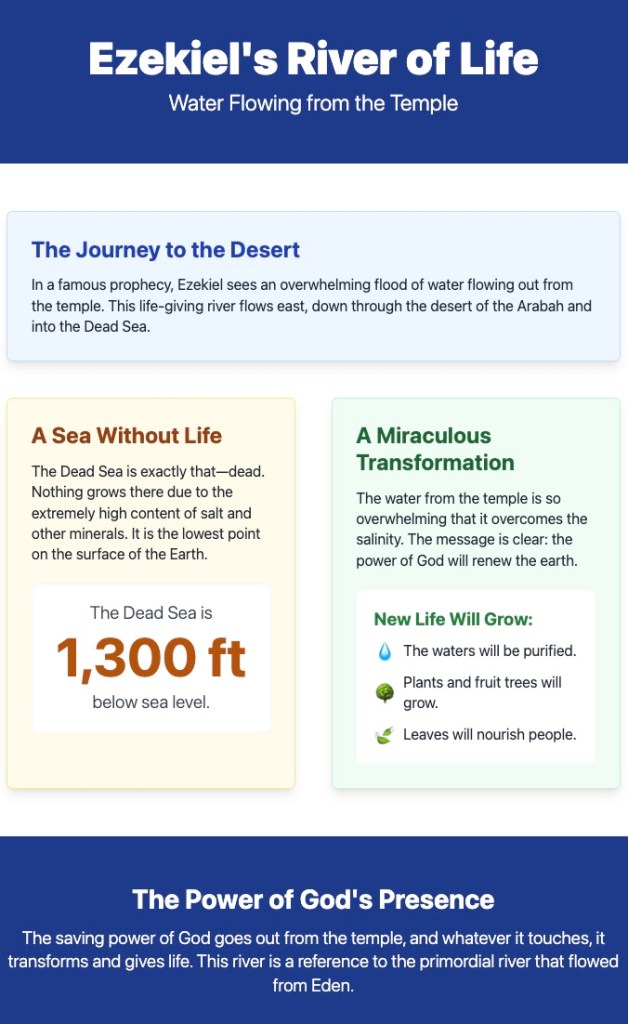
A Life Giving Flood
by Larry Broding

Have you ever felt alone, like you were in the empty desert? How has God given you life in those moments? How has his love been like the torrent of a great river?
Deep Dives
Click on timestamp links to watch different sections of the video.


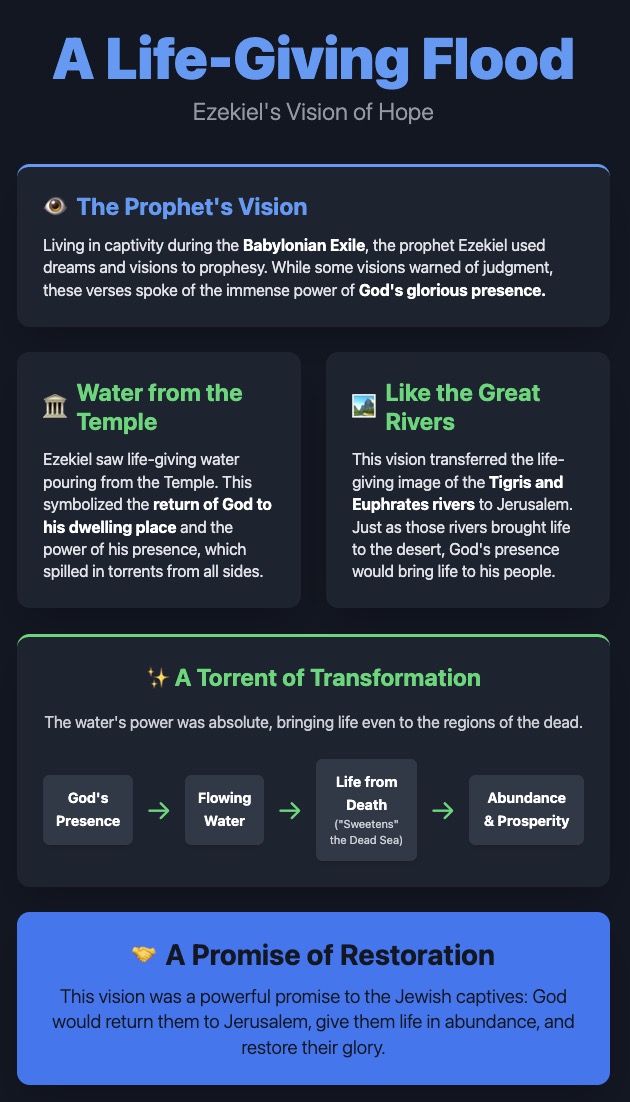
A city or a church, symbolized by the Lateran Basilica, represents a unified community of God’s people where life-giving water flows, bringing love, life, joy, and restoration to all, and serving as a foretaste of the glorious City of Jerusalem.
- 00:00 The prophet Ezekiel describes a vision of the temple in Jerusalem, where water flows from the threshold, symbolizing life and restoration, and exits on the south side after flowing around the outside of the temple.
- 02:13 The prophet describes the city’s river as an oasis that brings life and freshness to the desert, symbolizing God’s blessing and gift.
- 03:22 The Basilica, a model of heaven, represents a city where humans, body and soul, are filled with God’s life, beauty, and joy, and from which life-giving water flows to all.
- 04:46 The prophet describes a symbolic vision of spiritual abundance and joy, where waters bring life and fertility, mirroring the church as a place of unity and love for millions of believers.
- 06:07 A city can be beautiful or dangerous depending on whether it’s filled with love, friendship, and God’s presence, or human vice and corruption.
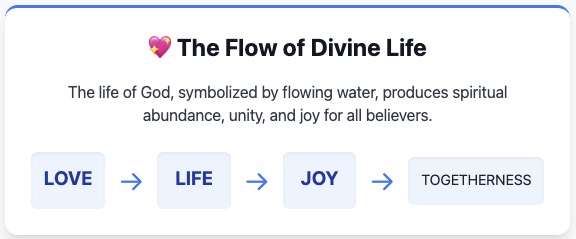
- 07:09 The life of God, symbolized by flowing water, produces love, life, fruit, joy, and togetherness, and dedicating a church, like the Lateran Basilica, represents a foretaste of the glorious City of Jerusalem, where millions of people live in peace and joy.
- 08:27 The dedication of the Lateran Basilica symbolizes the gathering of humanity, represented by the 12 tribes, into a unified, thriving community of God’s people, reflecting the promise of eternal unity and life.
- 09:52 The Lateran Basilica’s dedication commemorates the Church as a living, vibrant entity composed of individual believers fitted together in unity, reflecting the heavenly city.
Click to enlarge
God’s Home
by Larry Broding
Where do you fit into God’s home, his Temple? Remember, you are an important part of the structure!o) gave you the power to persevere?


Deep Dives
Click on timestamp links to watch different sections of the video.


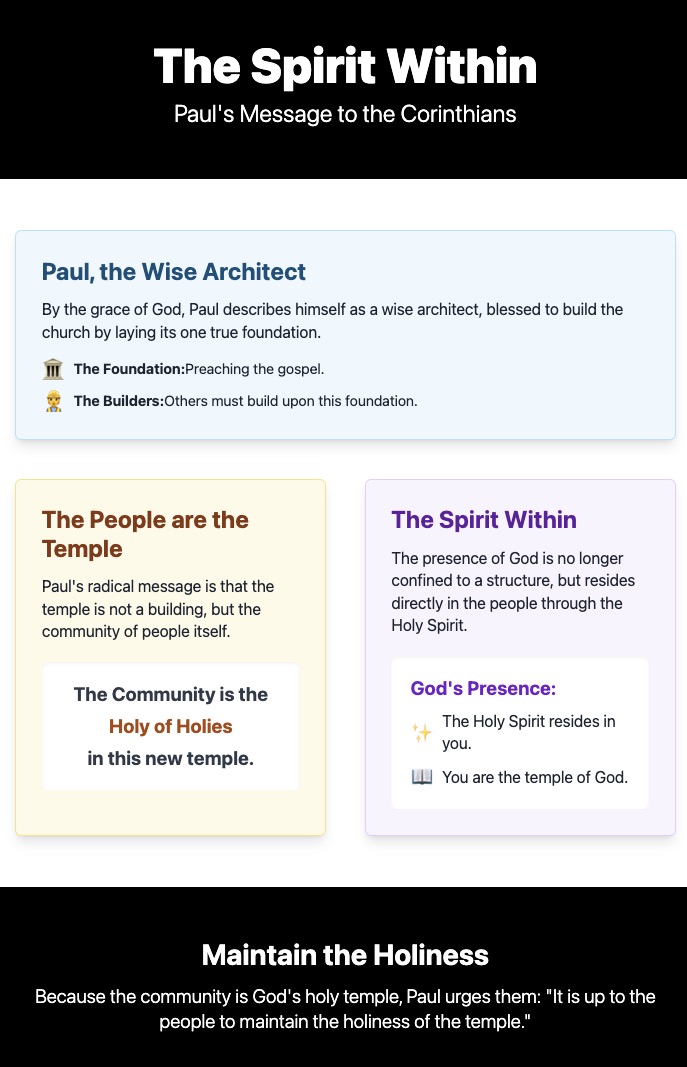
Jesus Christ is the foundation of the Church and the Christian life, and that all teachings, preaching, and behaviors must be built on and centered around Him to ensure spiritual integrity and unity.
- 00:00 The church’s one foundation is Jesus Christ, and all believers are co-workers with God, building on this foundation with care.
- 02:08 The foundation of the Church’s teaching must be Jesus Christ, and any teaching that deviates from or is not founded on Him will not last.
- 03:49 The foundation of the Christian life is Jesus Christ, and preachers must serve to reveal Him in a loving way, allowing people to build their lives on Him alone.
- 05:41 When preaching, one must ensure that their words are founded on Jesus Christ, as the foundation, and not on personal ideas or formulas, to avoid deflecting the love and zeal of the people.
- 07:07 The quality of a person’s work will be revealed on Judgment Day, and if their work is not up to par, they will suffer loss but still be saved, barely escaping like someone fleeing a burning building.
- 08:09 God’s people, as His holy temple, must avoid destructive behaviors like gossip, backbiting, and jealousy that can contaminate the foundation of Christ and lead to spiritual destruction.
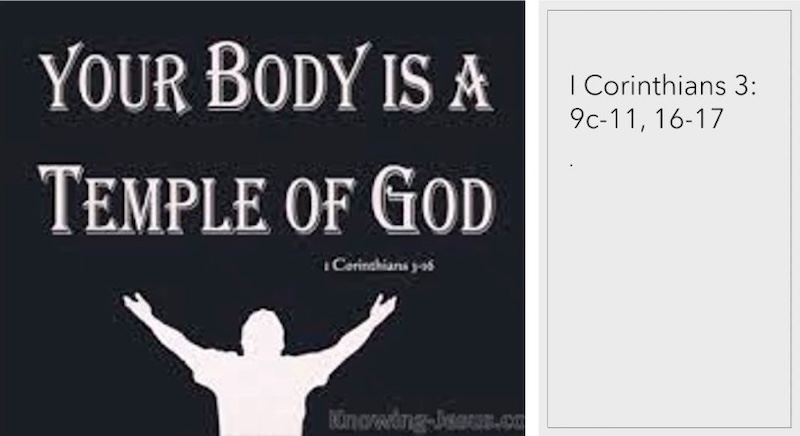
- 09:07 Christians are called to build a unified community, the Church, where God’s spirit dwells.
- You plural are God’s Temple, and God’s spirit dwells in you.
- Christians are called to build a community, the Church, where individuals are free to be creative and innovative, yet unified in love and service, as a temple where God dwells.
- 11:59 We must strive for unity and avoid division, gossip, and jealousy, just like the one temple of the Basilica, to reflect a harmonious community and a foretaste of Heaven.


Click to enlarge
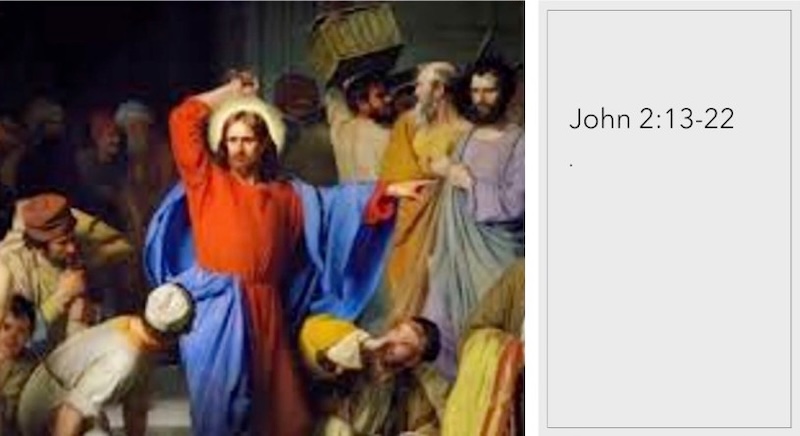
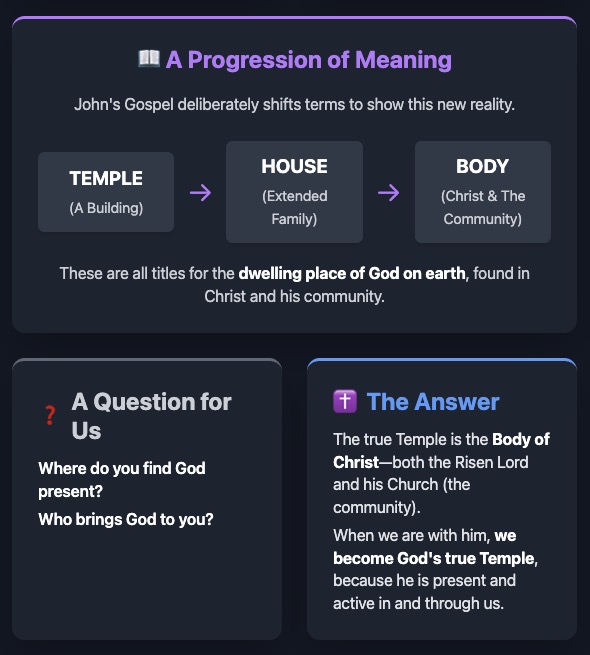
Where do you find God present? Who brings God to you? How is God active in your life? How does God work through you?

The Cleansing of the Temple
- Intro to Gospel
- Business of the Temple
- Signs and Clarity
- Reflection by Gail R. O’Day
- House We are Building
PDF COMMENTARY | INDEX
(John 2:13-22)
Deep Dives
Click on timestamp links to watch different sections of the video.


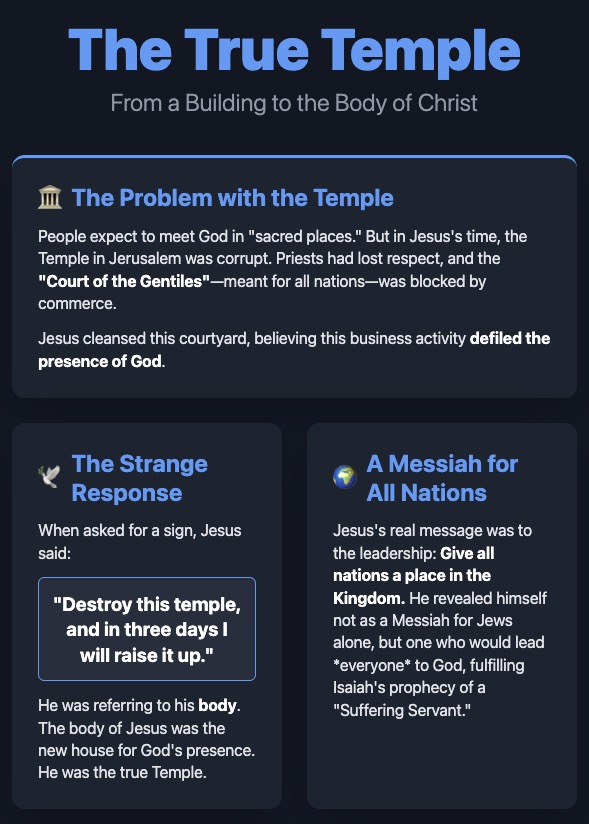
Jesus’ cleansing of the temple, as described in John 2, serves as a powerful reminder of the true purpose of the church, which is to be a house of worship, care, and forgiveness, prioritizing people over material wealth.
- 00:00 The gospel suitable for celebrating the foundation of the Lateran Basilica is John 2, specifically the story of Jesus cleansing the temple, which is one of his first public acts.
- 02:24 Jesus’ actions, including a miracle at Cana and cleansing the temple, marked a shift from the old law to the new law of the Holy Spirit.
- Jesus’ miracle of changing water into wine at Cana of Galilee manifested His glory, signifying the change from the old law to the new law of the Holy Spirit.
- Jesus went to Jerusalem for a Jewish feast, was disturbed by money changers and animal sellers in the temple, and was motivated to lead a life that would bring him happiness and allow him to spread the good news.
- 05:10 A priest reflects on the irony of being tempted to check the collection basket during a service, having previously been scandalized by his former pastor doing the same.
- 06:19 Jesus cleansed the temple by driving out money changers and vendors, saying they were turning his father’s house into a marketplace, not a house of God.
- 07:34 The corrupt system allowed only pre-approved animals to be sold near the temple, while poor farmers were exploited and shut out, fueling Jesus’ anger.
- 08:29 A tugboat captain, who had drifted away from the church, returns to his faith with the help of a young priest who befriends him in a hospital.
- 09:49 Jesus referred to his body as the Temple, and Christians are called to be temples of God, united in worship and care for one another.
- Jesus answered the Jews’ criticism of his actions by saying he would raise up the Temple in 3 days, referring to the Temple of his body, not the physical Temple.
- Jesus referred to his body as the Temple, and Christians are called to be temples of God, united in worship and care for one another, not focused on material wealth and status.
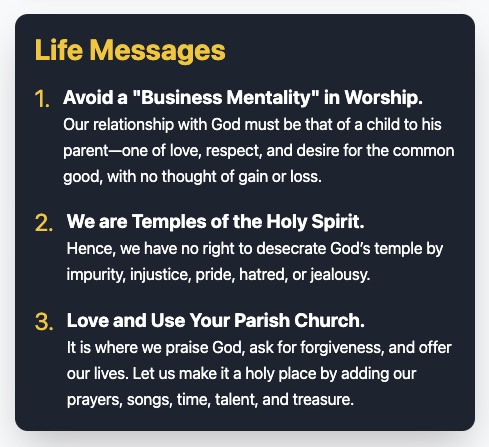
- 12:16 The purpose of a church is to worship God, care for others, especially the poor, and forgive one another, valuing people over material wealth.
- The purpose of a church building is for worshiping God and caring for others, especially the poor, not for showing off wealth.
- The purpose of the church is to worship God, forgive one another, uplift each other, and care for the poor, not for gossip or criticizing, with its true treasure being its people, especially the needy, not material wealth.


Diocese of Phoenix
Dedication of the Lateran Basilica

Christ in Our Neighborhood
Bishop John Dolan
This program aims to foster deeper relationships with Christ through weekly Scripture study and prayer in small faith communities. It was introduced in December 2022

More Discussion Guides
Fr. Thibodeau
Bible Study Notes
Bp. John P. Dolan
Fr. Tobin
Fr. Conley Bertrand
Dedication of the Lateran Basilica
Cycle C (PDFs)
📖 Old Testament (43 pp.)
📖 Epistles (87 pp.)
📖 Gospels (182 pp.)
📖 Daily Gospels (208 pp.)
SOURCE: Come, Lord Jesus
Carmelite Reflections and Prayers
Lectio Divina
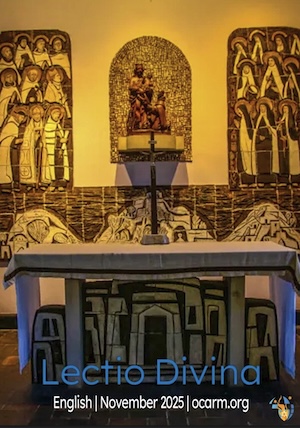
85-page PDF with reflections and prayers for each day of the month
Lectio Divina NOVEMBER 2025 (PDF)
Lectio Divina NOVEMBER 2025 [ePub]
______________
“Lectio divina is an authentic source of Christian spirituality recommended by our Rule. We therefore practise it every day, so that we may develop a deep and genuine love for it, and so that we may grow in the surpassing knowledge of Christ. In this way we shall put into practice the Apostle Paul’s commandment, which is mentioned in our Rule: “The sword of the Spirit, too, which is the word of God, is to dwell abundantly in your mouth and in your hearts; and whatever things you have to do, let them be done in the word of the Lord.” (Carmelite Constitutions (2019), n. 85.)
Source: Carmelites
Jesus’ Cleansing of the Temple
BEDE. Our Lord on coming to Jerusalem, immediately entered the temple to pray; giving us an example that, wheresoever we go, our first visit should be to the house of God to pray. And He found in the temple those that sold oxen, and sheep, and doves, and the changers of money sitting. (Mat. 21)
AUGUSTINE. (Tr. x. c. 4) Such sacrifices were prescribed to the people, in condescension to their carnal minds; to prevent them from turning aside to idols. They sacrificed sheep, and oxen, and doves.
BEDE. Those however, who came from a distance, being unable to bring with them the animals required for sacrifice, brought the money instead. For their convenience the Scribes and Pharisees ordered animals to be sold in the temple, in order that, when the people had bought and offered them afterwards, they might sell them again, and thus make great profits. And changers of money sitting; changers of money sat at the table to supply change to buyers and sellers. But our Lord disapproving of any worldly business in His house, especially one of so questionable a kind, drove out all engaged in it.
Dedication of the Lateran Basilica
BEDE. When our Lord arrived in Jerusalem, the first thing He did was go to the temple. He wasn’t sightseeing; He went to pray. This sets a clear example for us: wherever we travel, our first stop should be the house of God to connect with Him.
When He got there, He found the temple courtyard looking more like a stockyard. The scripture says, “In the temple he found those who were selling oxen and sheep and pigeons, and the money-changers sitting there.” (John 2:14, ESV)
AUGUSTINE. You have to remember why this system existed in the first place. God prescribed these sacrifices for the people way back in the Old Testament. It was a concession to their “carnal minds,” a way to meet them where they were. God gave them a tangible, physical way to worship—sacrificing sheep, oxen, and doves—to keep them focused on Him and prevent them from chasing after false idols.

BEDE. This system, which may have started as a practical solution, had become corrupted. People traveling from far away couldn’t exactly bring their own ox on the journey, so they brought money. For their “convenience,” the religious leaders allowed animals to be sold right there in the temple.
But this convenience turned into a corrupt business. Historians tell us the leaders were likely running a racket—forcing people to buy “pre-approved” animals at outrageous prices. On top of that, you had money-changers sitting at tables, ripping people off with unfair exchange rates just to get the “temple-approved” currency.
Our Lord was disgusted. He couldn’t stand seeing His Father’s house—a place meant for all nations to pray—turned into a shady marketplace. So, He drove them all out.


The Scourge and Divine Power
AUGUSTINE. (Tr. x. c. 5) He who was to be scourged by them, was first of all the scourger; And when He had made a scourge of small cords, He drove them all out of the temple.
THEOPHYLACT. Nor did He cast out only those who bought and sold, but their goods also: The sheep, and the oxen, and poured out the changers’ money, and overthrew the tables, i. e. of the money changers, which were coffers of pence.
ORIGEN. (tom. x. in Joan. c. 16) Should it appear something out of the order of things, that the Son of God should make a scourge of small cords, to drive them out of the temple? We have one answer in which some take refuge, viz. the divine power of Jesus, Who, when He pleased, could extinguish the wrath of His enemies however innumerable, and quiet the tumult of their minds: The Lord bringeth the counsel of the heathen to nought. (Ps. 32, 33:10) This act indeed exhibits no less power, than His more positive miracles; nay rather, more than the miracle by which water was converted into wine: in that there the subject-matter was inanimate, here, the minds of so many thousands of men are overcome.
Dedication of the Lateran Basilica
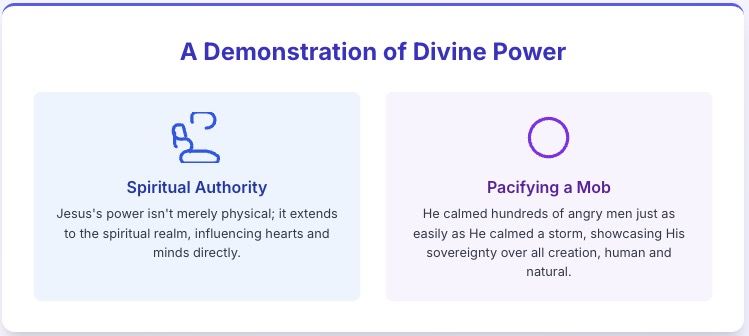
AUGUSTINE. Notice the profound irony here. The very man who would later be scourged by them, beaten and mocked, first appears as the one holding the scourge. Before He suffers their violence, He displays His own righteous, corrective power. “And making a whip of cords, he drove them all out of the temple.” (John 2:15a, ESV)
THEOPHYLACT. And let’s be clear: He didn’t just ask them to leave politely. This was a total eviction. He didn’t just drive out the merchants; He drove out their merchandise, too. The scripture is specific: “…with the sheep and oxen. And he poured out the coins of the money-changers and overturned their tables.” (John 2:15b, ESV). This was a complete and total cleansing.
ORIGEN. Now, you might be thinking, “This sounds a bit out of character. How could one man, the ‘Son of God,’ make a whip and start a riot?” It seems disorderly. But we have to understand what’s really happening. Some explain this by pointing straight to the divine power of Jesus.
When He willed it, He could extinguish the rage of His enemies, no matter how many there were. He could quiet the chaos in their minds. As the Psalm says, “The LORD brings the counsel of the nations to nothing; he frustrates the plans of the peoples.” (Psalm 33:10, ESV).
The Two Natures and “My Father’s House”
BEDE. The Evangelist sets before us both natures of Christ: the human in that His mother accompanied Him to Capernaum; the divine, in that He said, Make not My Father’s house an house of merchandize.
CHRYSOSTOM. (Hom. xxiii. in Joan. c. 2) Lo, He speaks of God as His Father, and they are not angry, for they think He means it in a common sense. But afterwards when He spoke more openly, and shewed that He meant equality, they were enraged. In Matthew’s account too, (c. 21) on driving them out, He says, Ye have made it (My Father’s house) a den of thieves. (21:13.) This was just before His Passion, and therefore He uses severer language. But the former being at the beginning of His miracles, His answer is milder and more indulgent.
AUGUSTINE. (Tr. x. in Joan. c. 4) So that temple was still a figure only, and our Lord cast out of it all who came to it as a market. And what did they sell? Things that were necessary for the sacrifice of that time. What if He had found men drunken? If the house of God ought not to be a house of merchandize, ought it to be a house of drunkenness?
Dedication of the Lateran Basilica
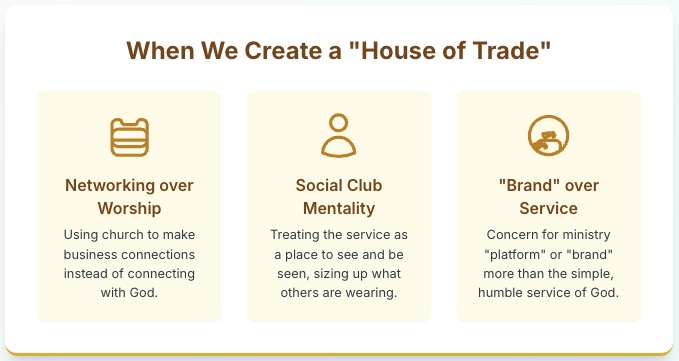
BEDE. The Evangelist, John, brilliantly shows us both natures of Christ right here. He shows us Jesus’s humanity, noting that His mother was with Him and they traveled together to Capernaum. But in the same story, He shows us Jesus’s divinity, quoting Him as He declares, “Do not make my Father’s house a house of trade.” (John 2:16, ESV)
CHRYSOSTOM. Look at that! He calls God His Father, and at this point, the leaders don’t even get angry. They just assume He means it in the general way that everyone is a “child of God.” But later in His ministry, when Jesus speaks more plainly and makes it clear He is claiming equality with the Father, they fly into a rage.
Chrysostom also notes the difference in language between the two temple cleansings. Here at the beginning, He says, “Do not make my Father’s house a house of trade.” It’s a sharp rebuke. But in Matthew’s account, right before His crucifixion, His language is much more severe: “My house shall be called a house of prayer, but you make it a ‘den of robbers.'” (Matthew 21:13, ESV). At the start of His ministry, His words are corrective. At the end, facing His passion, they are a final judgment.
AUGUSTINE. Augustine reminds us that the physical temple was still just a figure—a symbol of the real thing. Our Lord kicked out everyone who was treating it like a marketplace. And what were they selling? Things that were required for the sacrifices of that time!
This makes you think. If the house of God shouldn’t be a house of trade, should it be a house of drunkenness? Of course not. If He was this upset about necessary items being sold corruptly, imagine His anger over things that are purely profane.


Why did Christ Get So Violent?
CHRYSOSTOM. (Hom. xxiii. 2) But why did Christ use such violence? He was about to heal on the Sabbath day, and to do many things which appeared to them transgressions of the Law. That He might not appear therefore to be acting contrary to God, He did this at His own peril; and thus gave them to understand, that He who exposed Himself to such peril to defend the decency of the house, did not despise the Lord of that house. For the same reason, to shew His agreement with God, He said not, the Holy house, but, My Father’s house. It follows, And His disciples remembered what was written; The zeal of thine house hath eaten me up.
BEDE. (in loc.) His disciples seeing this most fervent zeal in Him, remembered that it was from zeal for His Father’s house that our Saviour drove the ungodly from the temple.
ALCUIN. Zeal, taken in a good sense, is a certain fervour of the Spirit, by which the mind, all human fears forgotten, is stirred up to the defence of the truth.
AUGUSTINE. (Tr. x. c. 9) He then is eaten up with zeal for God’s house, who desires to correct all that he sees wrong there; and, if he cannot correct, endures and mourns. In thine house thou busiest thyself to prevent matters going wrong; in the house of God, where salvation is offered, oughtest thou to be indifferent? Hast thou a friend? admonish him gently; a wife? coerce her severely; a maid-servant? even compel her with stripes. Do what thou art able, according to thy station.
Dedication of the Lateran Basilica
CHRYSOSTOM. But why did Christ get so violent? This seems extreme. Chrysostom explains that this was a strategic move. Jesus knew He was about to do things that the leaders would see as breaking the Law—like healing on the Sabbath.
So, to make it clear that He wasn’t acting against God, He first did this act of intense, risky devotion for God. By risking His own safety to defend the honor of the temple, He was showing everyone that He did not despise the Lord of that temple. It was a preemptive strike, proving His loyalty.
This is also why He was specific with His words. He didn’t just say “the Holy house.” He said, “My Father’s house,” driving home His unique relationship with the One they claimed to serve.
It’s at this moment the disciples had a spiritual breakthrough: “His disciples remembered that it was written, ‘Zeal for your house will consume me.'” (John 2:17, ESV)
BEDE. Exactly. When the disciples saw this passionate, burning zeal in Jesus, it clicked. They remembered the prophecy from Psalm 69 and understood: this wasn’t just human anger. This was divine zeal for His Father’s house that drove Him to chase the ungodly from the temple.
ALCUIN. And let’s define that word, “zeal.” Alcuin says that when we talk about zeal in a good sense, it’s a “fervor of the Spirit.” It’s a passion that burns in your mind, makes you forget all your human fears, and stirs you up to defend the truth.
AUGUSTINE. Augustine takes this idea of zeal and brings it right into our living rooms. He says that if you are “eaten up with zeal for God’s house,” it means you actively desire to correct what you see wrong there. And if you don’t have the power to correct it, you at least endure it and mourn it.
He then challenges us: “In your own house, you hustle to keep things from going wrong, don’t you? So why would you be indifferent in the house of God, the very place where salvation is offered?”
He gets intensely practical: “Have a friend? Admonish him gently. A wife? Guide her firmly. A servant? Compel them strongly.” His point is to do whatever you are able to do, according to your role and station in life, to care for the holiness of your own “temple.”


The “Scourge” of Spiritual Darkness
ALCUIN. To take the passage mystically, God enters His Church spiritually every day, and marks each one’s behaviour there. Let us be careful then, when we are in God’s Church, that we indulge not in stories, or jokes, or hatreds, or lusts, lest on a sudden He come and scourge us, and drive us out of His Church.
ORIGEN. (tom. x. in Joan. c. 16) It is possible even for the dweller in Jerusalem to incur guilt, and even the most richly endowed may stray. And unless these repent speedily, they lose the capacity wherewith they were endued. He finds them in the temple, i. e. in sacred places, or in the office of enunciating the Church’s truths, some who make His Father’s house an house of merchandize; … I think too that He meant the above, as a mystical intimation that whatsoever was to be performed with regard to that sacred oblation by the priests, was not to be performed after the manner of material oblations… For our Lord, by driving away the sheep and oxen, and ordering away the doves… He as much as declared that the dispensation was to be broken up and destroyed, and the kingdom translated to the believing from among the Gentiles.
Dedication of the Lateran Basilica

ALCUIN. Now, let’s look at this mystically. Alcuin suggests that God enters His Church spiritually every single day, and He is paying close attention to how every single person behaves there. This should make us careful. When we are in God’s house, we can’t be indulging in idle gossip, dirty jokes, old hatreds, or lustful thoughts. If we do, let’s not be surprised when He comes suddenly with His scourge and drives us out of His Church.


ORIGEN. Origen takes this allegory even deeper. He says it’s entirely possible for someone who lives in “Jerusalem”—an insider, a church leader, someone richly gifted—to be guilty of this sin and stray. And if they don’t repent quickly, they will lose the very gifts and authority they were given.

Origen says Jesus finds these people “in the temple”—that is, in sacred places, in positions of leadership, in the job of teaching the Church’s truths—and He finds them “making His Father’s house a house of trade.” How?
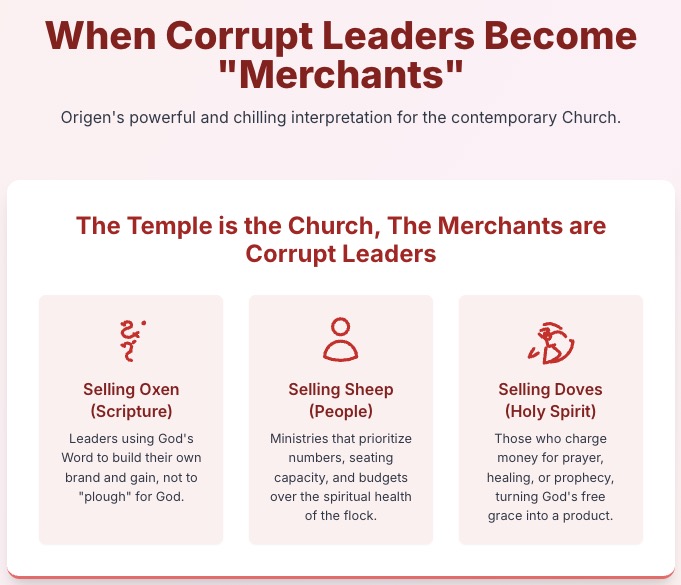
- They “sell the oxen”: The ox, which pulls the plough, is a symbol of the apostles and prophets who “tilled the soil” of our hearts with the Scriptures. Leaders “sell” them when they use the Bible not to feed people, but to gain honor, status, or profit for themselves.
- They “prefer mammon to the sheep”: They value money more than the “sheep,” the actual people of God they are supposed to care for.
- They “abandon the doves”: The dove (a symbol of the Holy Spirit) represents the simple, pure-hearted, and faithful. These leaders abandon the care of these people, all for the sake of “miserable gain.”
So, Origen says, our Savior finds these corrupt leaders in His house, makes His whip, and drives them all out—along with the very “sheep and oxen” they were selling. He scatters their money and “overthrows the tables set up in the minds of the covetous,” forbidding them from selling what should be given freely.
But Origen sees a second, bigger meaning. He thinks Jesus was giving a mystical sign that the entire old system was ending. The time for animal sacrifices and material oblations was over. By driving out the animals, overturning the (literal) money tables, and scourging the people, Jesus was physically demonstrating that this whole dispensation was being “broken up and destroyed,” and the kingdom was now being “translated to the believing from among the Gentiles.”

Mystical Interpretation: The Temple as the Church
ORIGEN. (tom. x. in Joan. c. 20) Both those, i. e. both the Body of Jesus and the temple, seem to me to be a type of the Church, which with lively stones is built up into a spiritual house, into an holy priesthood; according to St. Paul, Ye are the body of Christ, and members in particular. (1 Cor. 12:27) And though the structure of stones seem to be broken up, and all the bones of Christ scattered by adversities and tribulations, yet shall the temple be restored, and raised up again in three days, and stablished in the now heaven and the new earth. For as that sensible body of Christ was crucified and buried, and afterward rose again; so the whole body of Christ’s saints was crucified with Christ, (each glorying in that cross, by which He Himself too was crucified to the world,) and, after being buried with Christ, hath also risen with Him, walking in newness of life. Yet have we not risen yet in the power of the blessed resurrection, which is still going on, and is yet to be completed. Whence it is not said, On the third day I will build it up, but, in three days; for the erection is being in process throughout the whole of the three days.
Dedication of the Lateran Basilica

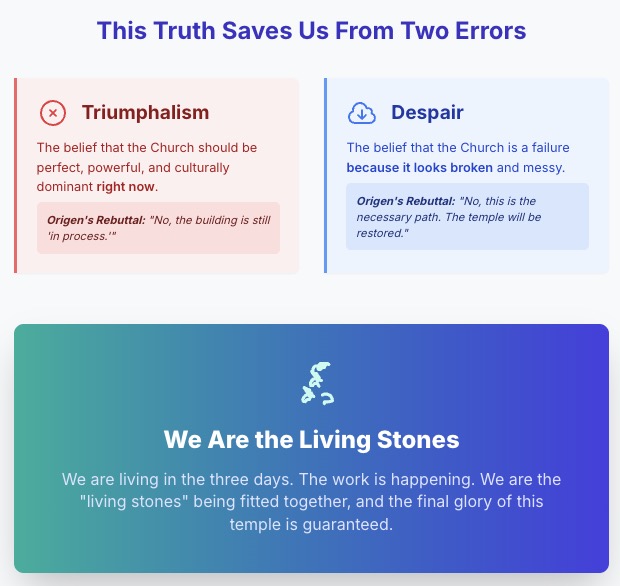
ORIGEN. Origen continues, saying that both the physical temple and the physical Body of Jesus are types—symbols—of the Church.
The Church is what Peter calls a “spiritual house” built with “living stones,” a “holy priesthood.” (1 Peter 2:5, ESV). It’s what Paul calls “the body of Christ, and individually members of it.” (1 Corinthians 12:27, ESV).
Origen says that even when this Church looks like a pile of rubble—even when “the structure of stones seem to be broken up” and “all the bones of Christ scattered by adversities and tribulations”—that temple will be restored. It will be “raised up again in three days” and established in the new heaven and new earth.
He draws a powerful analogy:
- Just as Christ’s physical body was crucified, buried, and rose again…
- …So the whole body of Christ’s saints (the Church) is crucified with Christ. We glory in the cross, as Paul did, being “crucified to the world.”
- We are buried with Christ (think of your baptism).
- And we have already risen with Him to “walk in newness of life.” (Romans 6:4, ESV).
But here’s his crucial insight: we haven’t fully risen yet. The “blessed resurrection” is still going on; it’s not yet complete. That’s why Jesus says He will raise the temple “in three days,” not “on the third day.” The “erection” of the temple—the building of the Church—is happening right now, in this entire age between His resurrection and His return.
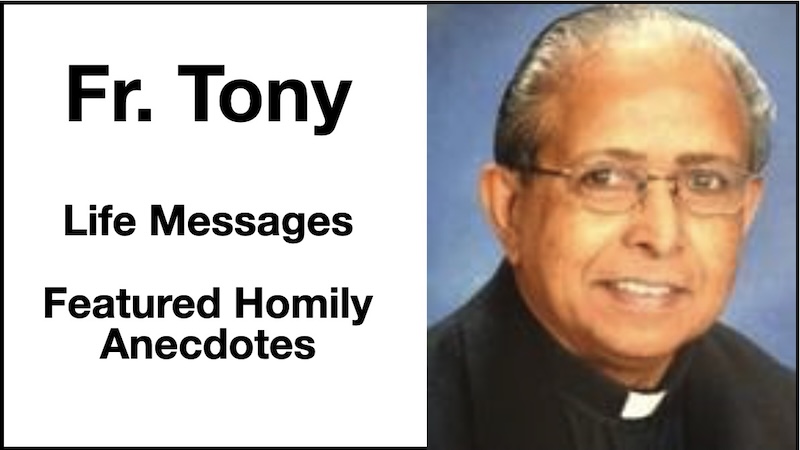
- Ordained in 1967
- Started the “Scriptural Homilies” ministry in 2003 while serving as a chaplain
- Applied scientific methodology to homily ministry+ Reached hundreds of priests and Deacons through word-of-mouth, eventually reaching the Vatican Radio website and four other websites
- Distributed weekly homilies to nearly 3000 priests and Deacons via direct email
- His commentary and reflections were posted on the Vatican News website for several years.
Sunday and Daily Homily Resources
- Eight Minute Homily
- Introduction
- Scripture Summaries
- Exegesis
- Life Messages
- Homily Starter Anecdotes
- Jokes of the Week
Fr. Tony’s
Jokes of the
Week
NOT AVAILABLE
THIS WEEK