Fr. Tony’s 8-Minute Homily

World War II: The Big Three
Huey P. Long
Sunday Mass with Helium Balloons?
—Begin w/ Anecdote
World War II: The Big Three
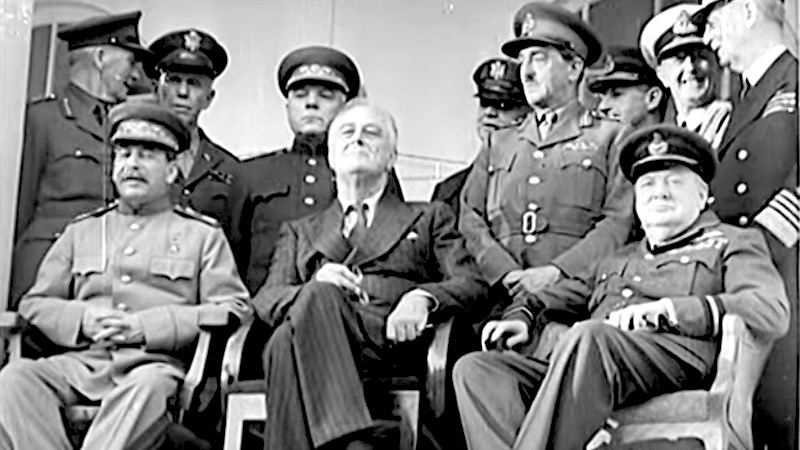
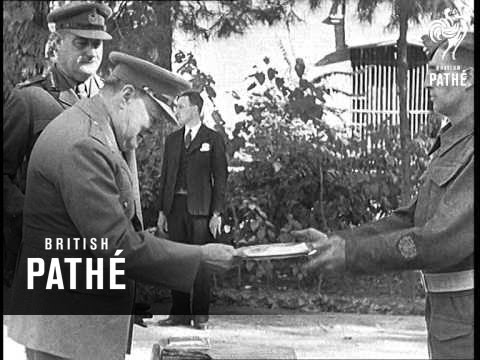
At the end of World War II, the Russian head-of-state Joseph Stalin gave an elaborate banquet to honor the British Prime Minister Winston Churchill. The Russians arrived in their best formal wear — military dress uniforms — but their honored guest did not. Churchill arrived wearing his famous zipper coveralls that he had worn during the German bomb attack in London. He thought it would provide a nostalgic touch the Russians would appreciate. They did not. They were humiliated and insulted that their prominent guest-of-honor had not considered their banquet worthy of his best clothes.
Wearing the right clothing to a formal dinner honors the host and the occasion; neglecting to wear the right clothing is an insult. Weddings were such an important occasion in Palestine in Christ’s days that people were expected to wear the proper clothing to show appreciation and respect for the invitation — clothing, in fact, provided by the host!
SOURCE: Flor McCarthy in New Sunday and Holy Day Liturgies; quoted by Fr. Botelho
In today’s Gospel, Jesus demands, and provides, the wedding garment of righteousness from his followers.
—Begin w/ Anecdote

“We didn’t know you had Catholic Grandparents”
Huey Long was a very colorful Louisiana politician who had hopes of running for the presidency in 1936. He began as an unschooled farm boy and ended up in the governor’s mansion, one of the most popular politicians in the history of the state. Long was born in the central part of Louisiana, and when he first campaigned for governor, he was given some advice about the voters in the New Orleans area.
“South Louisiana is different from the northern part of the state,” he was told. “We have a lot of Catholic voters down here.”
Long nodded knowingly and went out to make his speech.
“When I was a boy, I’d get up at six every Sunday morning, hitch our old horse up to the buggy, and take my Catholic grandparents to Mass. I’d bring them home and then take my Baptist grandparents to Church.”
The speech was a rousing success. Afterward, a New Orleans political boss said, “Huey, you’ve been holding out on us. We didn’t know you had Catholic grandparents.” Huey looked at him slyly and said, “We didn’t even have a horse!”
SOURCE: Joe Claro, The Random House Book of Jokes (New York: Random House, Inc., 1990)
Don’t let anybody mislead you. Around the banquet table of God there won’t be Baptists, or Catholics, or Methodists. There won’t even be a head table reserved for the very saintly. There will only be sinners for whom Christ died. That includes you and me. Everyone is invited.
—Begin w/ Anecdote

Sunday Mass with helium balloons?
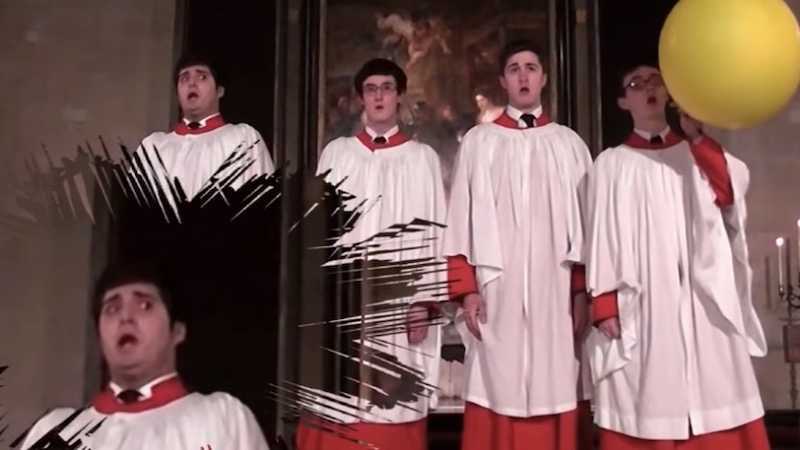
At an Evangelical church conference in Omaha, people were given helium-filled balloons and told to release them at some point in the service when they felt joy in their hearts. All through the service worshippers kept releasing balloons, but at the end of the service it was discovered that most of them still had their balloons unreleased. — If this experiment were repeated in our Church today, how many of us would still have our balloons unreleased at the end of the Mass? Many of us think of God’s House as a place for seriousness, a place to close one’s eyes and pray, but not a place of celebration, a place of joy.
SOURCE: Fr. Essou M.
The parable of the Great Supper in today’s Gospel paints a different picture. The Christian assembly is a gathering of those who are called to the Lord’s party. In the Eucharist, we say of ourselves, “Blessed are those called to the Supper of the Lamb.” The Lord invites us to a supper, a banquet, a feast. Can you imagine a wedding feast in which everyone sits stone-faced, cold and quiet?
Fr. Tony’s
Commentary
28th Sunday of Year A
Fr. Tony started his homily ministry (Scriptural Homilies) in 2003 while he was the chaplain at Sacred Heart residence, applying his scientific methodology to the homily ministry. By word of mouth, it spread to hundreds of priests and Deacons, finally reaching Vatican Radio website. These homilies reach nearly 3000 priests and Deacons by direct email every week.
The clipart is from the archive of Father Richard Lonsdale © 2000. It may be freely reproduced in any non-profit publication.
Heavenly Banquet
Today’s Scripture readings offer us a standing invitation to the everlasting joy of the Heavenly Banquet and a loving warning to stay ready always for this Heavenly banquet by constantly wearing the wedding garment, i.e., remaining in a state of grace by avoiding sins and by doing good.
1st Reading – Is 25:6-10

In the first reading Isaiah describes the Messianic banquet on the Lord’s Mountain. The prophet sees the mountain of the Holy City transformed into a grand banquet hall full of life and good things. He paints the picture of “a feast of rich food and choice wines.” The Responsorial Psalm (Ps 23) describes how, like a totally committed shepherd, God spares nothing in order to provide nourishment for His flock.
2nd Reading – Phil 4:12-14, 19-20

In the second reading, Paul tells Philippians about the high expectations he has for them, reminding them that they need to become fruit-producing Christians by praying and giving thanks to God and by practicing justice, purity, and graciousness in their lives.
Gospel – Mt 22:1-14

In the Gospel’s parable, Jesus describes the eschatological banquet of Heaven. He characterizes the reign of God as a wedding feast, a banquet of “calves and fatted cattle.” When the banquet is rejected by the chosen guests, it is offered to all and sundry. Thus, all the readings suggest that God loves His people and provides for their eternal salvation. Today’s Scripture readings give us the strong warning that if we do not accept God’s love, if we reject His gift, we can have no place with Him. We have to stay prepared for the freely offered Heavenly Banquet by getting (in Baptism), and wearing every day, the freely given wedding garment of grace always. We “wear” the garment by cooperating with God’s grace in prayer, in attending Mass and receiving the Sacraments with devotion, in doing good and avoiding evil, and in responding to His love by lovingly sharing our blessings with others. The parable warns us that membership in a Church alone does not guarantee our eternal salvation.
Fr. Tony’s Life
Messages
28th Sunday of Year A
We need to be grateful to Christ for the invitation to the Heavenly banquet
From the moment of our Baptism, we have been invited to the Heavenly Banquet and provided with the Wedding Garment of Sanctifying Grace. These great privileges and blessings are freely offered to all, and they are given to us who accept His Gift of Faith, by a loving God. These daily Divine invitations to salvation are to be welcomed with a willingness to be daily transformed by God’s grace and according to God’s will. But the same obstacles which prevented the Pharisees from entering the Kingdom –- pride, love of this world, its wealth, its power, and its pleasures –- can impede us, too. Hence, we must be prepared to do violence to our ordinary inclinations and to offer ourselves in love and service to Jesus and to his people. That is how we will make, and keep, our Wedding Garment clean and bright every day. Receiving these gifts of God fully also demands that, instead of remaining marginal members of our parish community, we bear visible witness to our beliefs. Let us have the consoling conviction that, while as Church members we are expected to contribute actively to its life and witnessing, the forgiveness of God and of the community is always available whenever we fail, and betray its ideals in our weak moments. Therefore, let us pray that we may keep our Wedding Garments pure and spotless, and that we may become disciples who really practice the teachings of Jesus, rather than remaining mere Sunday Catholics. Let us pray for a deeper Faith, Hope, and Love, and a better spirit of responsibility to our community.
We need to make our “banquet halls” full and vibrant
What do we do to make sure that the “banquet halls” of our Churches are filled with people on Sunday mornings? Are we concerned enough to do something about it if they are not full or lively? The first part of the parable has some strong connections with our worship services. Does not God invite us there? Aren’t we also called to be the Lord’s messengers who are instructed to go and tell the invitees (the whole world) that everything is ready? Or do we absent ourselves because we have other “pressing” business that we think is more important? Do we remain mired in oppressive attitudes and discriminatory relationships even if our bodies are in Church? Do we ever prefer revenge to forgiveness? Do we see victimization of others and blame the victim? We must all work with God to rid ourselves of such attitudes.
We need to wear our Wedding Garment for the Eucharistic banquet

Catechism of the Catholic Church (CCC #1402-1405,CCC #2837) teaches that the Eucharist is the foretaste of the Messianic Banquet. God Incarnate waits for us in His House of Worship, offering Himself for us on our altars and inviting us to the sumptuous Banquet of His own Body and Blood for the nourishment of our souls in the Holy Eucharist. Hence, we should never approach to receive Jesus in Holy Communion “improperly dressed”—that is, without being in the state of Sanctifying Grace given us in Baptism.
St. Paul says we eat and drink condemnation on ourselves when we approach the Sacrament in mortal sin (1 Cor 11:27-32). Just as the king provides clothes for the guests, so Jesus provides the Sacrament of Penance to cleanse our soul, but if we don’t go to confession and instead come to Communion unworthily, we’re just like the person in the parable who nonchalantly tries to show up for the banquet in his own dirty clothes rather than in the vesture given.
According to St. Gregory, men and women who come to the Wedding Feast with hatred in their hearts do not wear the acceptable garment spoken of in the parable. Men and women whose Faith and love are cold, who attend Church only for social reasons, to show off their clothes and jewelry, or to visit with acquaintances, are not dressed in a Wedding Garment pleasing to the King, Christ Jesus.
Our Wedding Garment is made of our grace-assisted works of justice, charity, and holiness. Let us examine ourselves to see whether we have fully accepted God’s invitation to the Messianic banquet, and let us remember that banqueting implies friendship and intimacy, trust, and reconciliation with Christ Who loves us every day of our lives.
HOME | FAITH SHARING QUESTIONS