God's Promise of Restoration and Joy
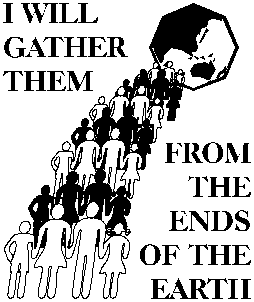
I. Gathering the remnant of Israel (Jer 31:7)
- God's plan to gather His people from distant lands
- The comparison to a shepherd gathering his scattered flock
II. Joy and deliverance for the remnant (Jer 31:8-9)
- The image of a great assembly rejoicing in God's goodness
- Transformation from mourning to joy
- God's care for those in need, such as the blind and the lame
Jesus as the High Priest

I. Qualities of a high priest (Heb 5:1-4)
- Chosen from among humans
- Appointed to represent people in matters related to God
- Offers gifts and sacrifices for sins
- Shows compassion and empathy for those he represents
II. Jesus as the high priest (Heb 5:5-6)
- Christ's appointment by God
- The unique role of Jesus as both the Son of God and a high priest forever
- The eternity and divine authority of Jesus' priesthood
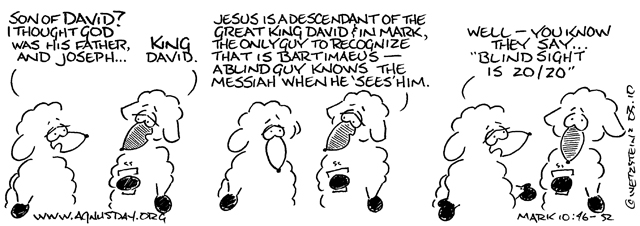
The Healing of Bartimaeus

I. Bartimaeus' cry for help (Mk 10:46-48)
- Bartimaeus, a blind beggar, calling out to Jesus
- His persistence despite others' attempts to silence him
- Bartimaeus' address to Jesus as the "Son of David"
II. Jesus' response (Mk 10:49-50)
- Jesus' command to bring Bartimaeus closer
- The question posed by Jesus, asking what Bartimaeus desires
- Bartimaeus' expression of faith in Jesus' healing power
III. Bartimaeus' healing and transformation (Mk 10:51-52)
- Jesus' act of healing Bartimaeus' blindness
- The immediate impact of the healing on Bartimaeus' life
- Bartimaeus' decision to follow Jesus after his healing
1ST READING | 2ND READING | GOSPEL
Tap the links above to view an OUTLINE for each reading.

Jeremiah 31:7-9

What is the primary focus of Jeremiah 31:7-9?
a. The rise of a new king in Israel
b. The promise of a joyous homecoming for exiled Jews
c. The construction of a new temple in Jerusalem
d. The establishment of a new set of laws for the Israelites
How does Jeremiah encourage his fellow Jews in the passage?
a. By sharing God's promise of a homecoming similar to their ancestors' return from Egyptian slavery
b. By emphasizing the power of the Assyrian and Babylonian captors
c. By highlighting the failures of their ancestors
d. By encouraging them to build alliances with neighboring nations
What does the passage foretell about God's promise to His people?
a. The promise of life in fullness
b. The promise of military victory
c. The promise of wealth and prosperity
d. The promise of a new set of religious leaders
How did the exiled Jews grow spiritually during their captivity?
a. Through practicing traditional rituals
b. Through seeking revenge on their captors
c. Through humility, repentance, and turning to God
d. Through forming alliances with other exiled groups
Who would be included among the returnees to Jerusalem?
a. Only the wealthy and powerful
b. Only the religious leaders
c. Only the healthy and able-bodied
d. The blind, the lame, and the vulnerable, along with the healthy
How does the Gospel connect to Jeremiah's prophecy?
a. Jesus' journey to Jerusalem with the lame and blind fulfills the prophesied journey
b. Jesus establishes a new set of laws that contradicts Jeremiah's prophecy
c. Jesus emphasizes the importance of military might
d. Jesus focuses solely on the spiritual well-being of the religious elite
What does the first reading emphasize in contrast to the Gospel?
a. God's wrath and judgment
b. The actions of religious leaders
c. God's merciful actions in delivering, guiding, and consoling His people
d. The need for self-reliance and independence
ANSWERS
- b. The promise of a joyous homecoming for exiled Jews
- a. By sharing God's promise of a homecoming similar to their ancestors' return from Egyptian slavery
- a. The promise of life in fullness
- c. Through humility, repentance, and turning to God
- d. The blind, the lame, and the vulnerable, along with the healthy
- a. Jesus' journey to Jerusalem with the lame and blind fulfills the prophesied journey
- c. God's merciful actions in delivering, guiding, and consoling His people
Hebrews 5:1-6
What is the main role of Jesus described in Hebrews 5:1?
a. Messiah
b. King
c. High Priest of the new Covenant
d. Prophet
How does the writer of Hebrews aim to comfort those who were ostracized from synagogues?
a. By depicting Jesus as a superior replacement for the priests they depended on
b. By encouraging them to return to Judaism
c. By denying the significance of ancient Jewish traditions
d. By emphasizing the importance of human priests
What distinguishes Jesus from the ancient Jewish priests?
a. His miracles and teachings
b. His appointment by the religious authorities
c. His status as the Son of God
d. His popularity among the people
How does Jesus' role as a High Priest benefit believers?
a. They can approach the throne of grace with confidence and boldness
b. They can expect judgment and condemnation
c. They are guaranteed material wealth and success
d. They are given the authority to judge others
Why is Jesus considered a compassionate and understanding High Priest?
a. He shared in human nature and experienced suffering
b. He was born into a royal family
c. He had a large number of followers
d. He performed many miracles
What is the significance of Jesus being appointed in the order of Melchizedek?
a. It establishes him as a priest only for the Israelites
b. It highlights his need for a human successor
c. It confirms his status as a temporary mediator between God and man
d. It surpasses the Jewish priesthood and appoints him as an eternal mediator
How does the passage encourage believers to view their relationship with God?
a. With fear and uncertainty
b. With gratitude for material blessings
c. With trust in God's goodness and grace
d. With focus on personal achievements
ANSWERS
- c. High Priest of the new Covenant
- a. By depicting Jesus as a superior replacement for the priests they depended on
- c. His status as the Son of God
- a. They can approach the throne of grace with confidence and boldness
- a. He shared in human nature and experienced suffering
- d. It surpasses the Jewish priesthood and appoints him as an eternal mediator
- c. With trust in God's goodness and grace
Mark 10:46-52
What was the significance of Jericho in the context of today's Gospel?
a. It was the birthplace of Jesus
b. It was the first city conquered by the Israelites in Palestine
c. It was the location of the Last Supper
d. It was known for its lack of wealth and beauty
Why were there great numbers of Jewish priests and merchants in Jericho?
a. They were seeking refuge from Roman persecution
b. They were on their way to Jerusalem for the Passover
c. They were gathering to hear Jesus' teachings
d. They were fleeing from the city of Jerusalem
What was the Mosaic Law requirement for Jewish males living within fifteen miles of Jerusalem?
a. To attend weekly religious services
b. To make a pilgrimage to the Jordan River
c. To attend the Passover
d. To offer sacrifices at the temple
What was unique about Bartimaeus compared to other healing stories in the Gospel of Mark?
a. He was not healed by Jesus
b. He was a wealthy merchant
c. He was mentioned by name
d. He was a Jewish priest
What was the meaning of Bartimaeus' name in Aramaic?
a. Son of Timaeus
b. Blind beggar
c. Son of David
d. Man of Faith
What does the title "Son of David" imply about Jesus in the context of Roman occupation?
a. It emphasizes his role as a spiritual leader
b. It highlights his connection to King David
c. It has political and messianic overtones
d. It refers to his miraculous healing abilities
How does the Law of Moses instruct the Israelites to treat the blind?
a. To avoid them
b. To offer them protection
c. To consider them cursed
d. To force them into servitude
What does Psalm 146 say about God's relationship with the blind and the righteous?
a. God ignores their suffering
b. God tests their faith
c. God gives sight to the blind and loves the righteous
d. God expects them to fend for themselves
ANSWERS
- b. It was the first city conquered by the Israelites in Palestine
- b. They were on their way to Jerusalem for the Passover
- c. To attend the Passover
- c. He was mentioned by name
- a. Son of Timaeus
- c. It has political and messianic overtones
- b. To offer them protection
- c. God gives sight to the blind and loves the righteous
1ST READING | 2ND READING | GOSPEL
Tap the links above to view QUESTIONS for each reading.


Enhancing Classroom and Homeschool Discussion through Diverse Perspectives and Creative Insights
Grades 7-12
TOP NEWS STORY
30th Sunday of Year B
CHURCH HISTORY
30th Sunday of Year B