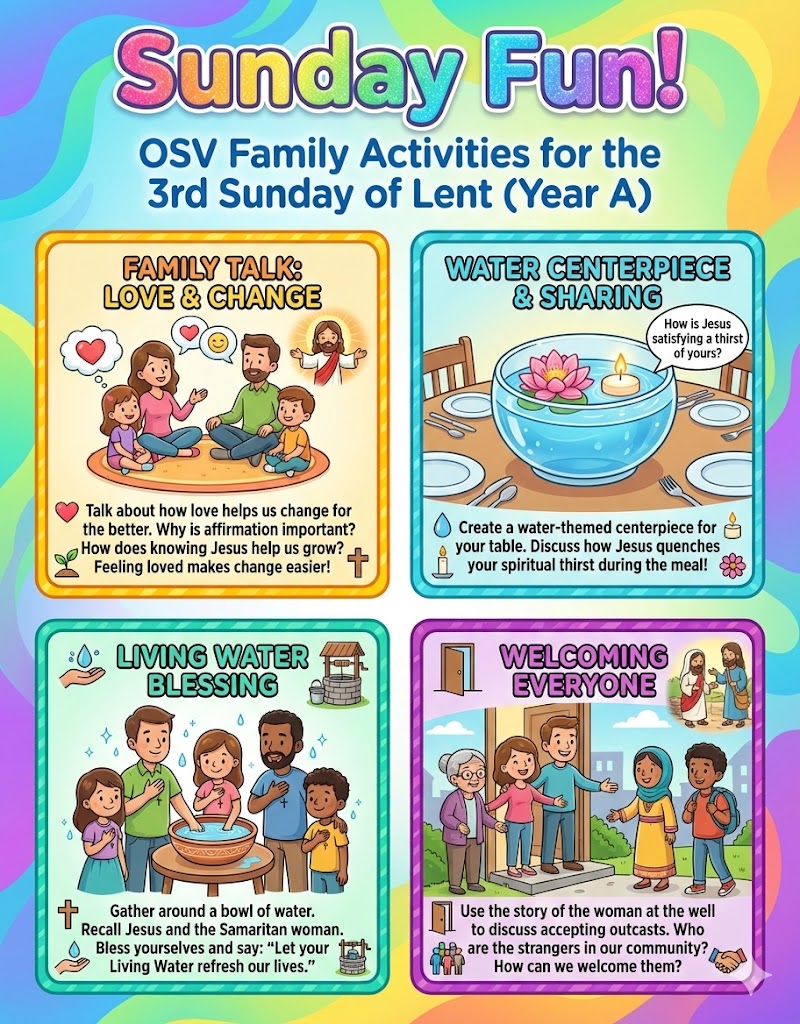
Free catholic clip art, bulletin inserts for web pages, presentations, etc. are included in the tWtw magazine (graphic edition) of THE WORD THIS WEEK website.

tWtw magazine, Clip art, comics, Bulletin Inserts for Sunday

tWtw magazine, Clip art, comics, Bulletin Inserts for Sunday

tWtw magazine, Clip art, comics, Bulletin Inserts for Sunday

tWtw magazine, Clip art, comics, Bulletin Inserts for Sunday

March 8, 2026

March 8, 2026

3rd Sunday of Lent (A)

SUNDAY (PDF) GRAPHIC EDITIONFR. LONSDALE'S CLIPARTSUNDAY COMICS & GRINSBULLETIN INSERTS

Coming Soon!

max(120%);height:0;width:100%

DOWNLOAD PDF

Screenshot

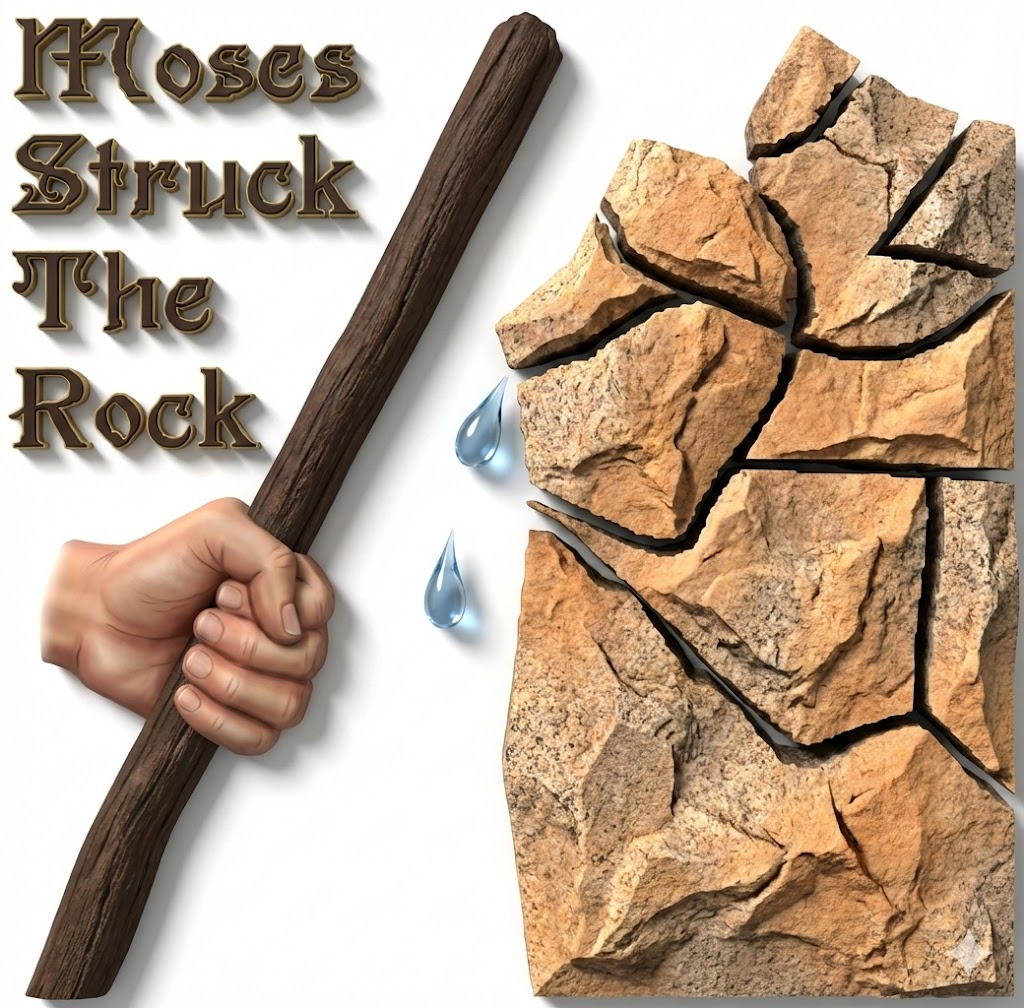
Using provided gif, reimagine it by colorizing it and making it 3-D so image pops out, keep the white background.

Give a detailed art and theology analysis of the image connecting it ############/

Fr. Lonsdale’s Clipart

Exodus 17:3-7

CLICK HERE FOR A MORE DETAILED ANALYSIS

I. Theological Analysis: Connecting to Exodus 17:3-7

The image is a theological commentary on the narrative found in Exodus 17, capturing the themes of divine provision, human desperation, and the nature of God's power.

1. The Context of Crisis (Exodus 17:3)

"But the people thirsted there for water, and the people grumbled against Moses..." (Ex. 17:3, ESV)

The image visually represents the solution to a life-or-death crisis. The extreme dryness of the fractured rock serves as a synecdoche for the entire wilderness experience. The Israelites were in a place where life was impossible without divine intervention. The art emphasizes that this provision did not come from a lush environment, but was forced from the most unyielding substance in the desert landscape.

2. The Agency of Moses and the Staff of God (Exodus 17:5)

"And the Lord said to Moses, 'Pass on before the people... and take in your hand the staff with which you struck the Nile, and go.'" (Ex. 17:5, ESV)

The image highlights the human instrument and the divine tool. The realistic hand emphasizes Moses’ humanity—he is the agent acting in obedience. The staff is crucial; God specifically reminds Moses that this is the same staff used to turn the Nile to blood. Theologically, this connects past deliverance to present need. The staff that brought judgment on Egypt (turning water to blood) now brings life to Israel (turning rock to water). The image captures the moment this instrument of divine authority is deployed.

3. The Violence of Grace: "Striking" the Rock (Exodus 17:6)

"...I will stand before you there on the rock at Horeb, and you shall strike the rock, and water shall come out of it..." (Ex. 17:6, ESV)

The text specifies that Moses must strike (Hebrew: v’hikita) the rock. It is not a gentle tap or a spoken word (contrast with Numbers 20, where Moses is punished for striking the rock twice instead of speaking to it). The art visualizes this necessary violence. The rock is not just leaking; it is shattered, fractured into pieces by the blow. Theologically, this suggests that God’s provision sometimes requires a forceful breaking down of barriers. The impossible obstacle (the solid rock) must be broken for the blessing (water) to flow.

4. Typological Implications (Christian Interpretation) While the image is a direct illustration of Exodus, Christian theology often views this event typologically, as referenced by Paul in 1 Corinthians 10:4: "and all drank the same spiritual drink. For they drank from the spiritual Rock that followed them, and the Rock was Christ."

By emphasizing the striking and the breaking of the rock, the image subtly aligns with a common Christian interpretation: that Christ is the Rock who was "struck" (crucified) so that the "living water" of the Holy Spirit could flow to believers (John 7:37-39). The pristine clarity of the water droplets against the broken stone visually supports the idea of pure, spiritual life emerging from sacrifice.

II. Artistic Analysis: Visualizing the Miraculous

The artistic style is a highly textured, photorealistic 3D rendering set against a stark white background. This isolation forces the viewer to focus entirely on the tangible elements of the miracle, removing environmental distractions.

1. Texture and Materiality: The Contrast of Wet and Dry The most striking artistic element is the masterful handling of texture.

  • The Rock: The stone on the right is rendered as arid sandstone or granite. The surface is dusty, rough, and deeply fissured. The artist has physically fragmented the rock face into distinct shards, visualizing the violence of the impact. This dryness makes the environment palpable.
  • The Water: In stark contrast to the dusty rock, two droplets of water are rendered with jewel-like clarity. They possess perfect surface tension, transparency, and light refraction. This visual contrast—the ultimate wetness emerging from the ultimate dryness—is the central artistic tension of the piece.
  • The Hand and Staff: The hand is rendered with realistic flesh tones, showing tension in the grip. The staff is not a polished rod but a rugged piece of tree branch with rough bark, emphasizing the raw, earthy nature of the tools used.

2. Composition and Dynamics: The Frozen Moment The composition is asymmetrical and dynamic. A strong diagonal line runs from the top left (the text and the top of the staff) down toward the center right (the point of impact on the rock).

  • Action Vector: The staff acts as a vector of force. The viewer’s eye is led down the shaft to the exact point where it connects with the stone.
  • Temporal Capture: The image freezes time microseconds after the impact. The rock has just fractured, and the very first drops of water are released. By showing the start of the flow rather than a gushing river, the artist emphasizes the immediate causality between obedience to God’s command and the miraculous result.

3. Typography as Iconography The text "Moses Struck The Rock" is not merely a caption; it is an integrated design element. The font is an ornate, Old English or Gothic style, often associated with ancient manuscripts or sacred texts. The letters are rendered in a metallic, bronze-like material with beveled edges, giving them weight and permanence, as if carved or forged. This lends an authoritative, historical gravity to the image.
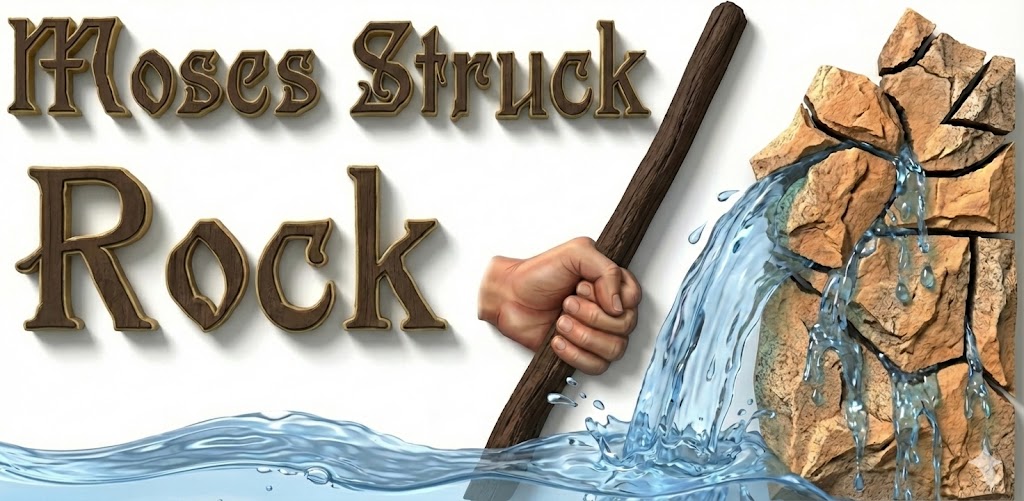
The image is a theological commentary on the narrative found in Exodus 17, capturing the themes of divine provision, human desperation, and the nature of God’s power. The artistic style is a highly textured, photorealistic 3D rendering set against a stark white background. This isolation forces the viewer to focus entirely on the tangible elements of the miracle, removing environmental distractions.

Romans 5:1-2, 5-8

CLICK HERE FOR A MORE DETAILED ANALYSIS

I. Theological Analysis: Connecting to Romans 5:1-2, 5-8

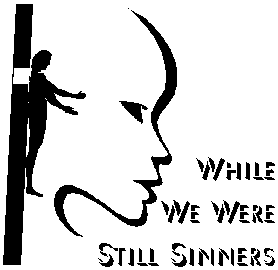
The sculpture is a visual exegesis of Paul’s argument in Romans 5 regarding justification, grace, and the timing of God’s love.

1. The Core Thesis: Unmerited Love (Romans 5:6-8) The central theme of the artwork is explicitly stated in the text at the bottom: "WHILE WE WERE STILL SINNERS". This is a direct quotation of the pivotal clause in Romans 5:8: "But God shows his love for us in that while we were still sinners, Christ died for us."

The artwork visualizes the theological concept that God’s love is proactive rather than reactive. The sheer beauty and warmth of the massive bronze face (representing God) are directed toward the figure that is currently dark, undefined, and shadowy (representing humanity in sin). The visual statement is clear: God did not wait for the figure to become polished bronze before offering His presence; He arrived while the figure was still dark iron. This captures the essence of verses 6-8, noting that Christ died for the "ungodly" and the "weak," not the righteous.

2. Access Through the Cross (Romans 5:1-2) Romans 5:1-2 states: "Therefore, since we have been justified by faith, we have peace with God through our Lord Jesus Christ. Through him we have also obtained access by faith into this grace in which we stand..."

In the sculpture, the wooden beam (the cross) is the mechanism of this "access." The dark figure is standing directly against the wood. Crucially, the light that illuminates the scene and bridges the gap between the sinner and the Divine represents the "grace in which we stand." This light does not come from the sinner, nor does it come solely from the bronze face; it emanates specifically from the cross. This visually articulates that peace with God and access to His glorious presence are mediated exclusively "through our Lord Jesus Christ" and His sacrificial death.

3. The Outpouring of God's Love (Romans 5:5) Romans 5:5 mentions that "God's love has been poured into our hearts through the Holy Spirit who has been given to us."

While the human figure is dark, its posture is receptive—arms open to the light and the Divine presence. The massive bronze face is characterized by flowing, liquid-like lines, particularly at the top and bottom, suggesting movement and pouring rather than static solidity. The warm, reflective quality of the bronze visualizes the "glory of God" (Rom 5:2) and the intense, warm love that is offered to the receptive heart, even before that heart has been transformed from darkness to light.

II. Artistic Analysis: Materiality, Scale, and Light

The image is a photorealistic rendering of a sculptural relief representing a spiritual encounter. The artist utilizes distinct materials, dramatic lighting, and contrasting scales to create a visual hierarchy and narrative.

1. Material and Texture as Metaphor The artwork employs three distinct textural elements to convey meaning.

  • The Wood: On the far left is a vertical beam rendered as aged, rough-hewn wood. Its rugged texture suggests history, suffering, and an earthly reality, serving as a clear visual signifier for the cross of crucifixion.
  • The Shadowy Figure: Adjacent to the wood is a human silhouette representing the "sinner." It is rendered as dark, textured metal, almost like wrought iron or slag. It lacks internal detail or polish, visually suggesting a state of spiritual darkness, unrefined density, or the "weakness" mentioned in Romans 5:6.
  • The Divine Countenance: On the right is a massive, stylized profile face rendered in highly polished, warm bronze or gold. This material suggests value, permanence, glory, and divinity. Its smooth curves contrast sharply with the rough wood and the dark silhouette.

2. Scale and Composition The composition relies heavily on a disparity in scale. The bronze face is vastly larger than the human silhouette. This immediately establishes a theological hierarchy: the immense, overwhelming reality of the divine compared to the smallness and finitude of humanity. The human figure is oriented toward the divine face, arms outstretched in a gesture of longing, reception, or pleading.

3. Lighting and Dimensionality The piece is lit dramatically. A distinct light source emanates from the wooden beam itself—specifically from a glowing square segment positioned at the head level of the human silhouette. This light casts illumination onto the dark figure and catches the edges of the bronze face and the raised text below. The strong shadows cast on the white background give the objects substantial physical weight and depth, emphasizing that these spiritual realities are concrete and real.

4. Typography The text "WHILE WE WERE STILL SINNERS" is rendered in three-dimensional metal capital letters, matching the material of the divine face. By giving the text physical substance, the artist treats the scriptural truth not just as an idea, but as a foundational, tangible reality undergirding the entire scene.

The sculpture is a visual exegesis of Paul’s argument in Romans 5 regarding justification, grace, and the timing of God’s love. The image is a photorealistic rendering of a sculptural relief representing a spiritual encounter. The artist utilizes distinct materials, dramatic lighting, and contrasting scales to create a visual hierarchy and narrative.


John 4:5-42

CLICK HERE FOR A MORE DETAILED ANALYSIS

I. Artistic Analysis: Visualizing the Spiritual

The image is a symbolic, three-dimensional illustration that translates abstract spiritual concepts into concrete visual forms. Its composition is hierarchical, moving from the foundational text at the bottom to a representation of the divine at the top.

1. Key Visual Elements and Symbolism:

  • The Golden Sphere: At the apex of the composition is a large, glowing golden sphere, resembling a sun. Its color and position symbolize divinity, glory, and the eternal. It radiates fine, metallic lines, suggesting light or divine influence spreading outwards.
  • The Open Book: Centered below the sphere is an antique-style open book with aged, cream-colored pages. This traditional symbol for knowledge and scripture serves as the foundation from which the other elements emerge.
  • The Red Heart: Resting in the middle of the open book is a polished, vibrant red heart. This universal symbol of love, the soul, and the seat of emotions is central to the composition, indicating that the message is one of personal, inner transformation.
  • The "Living Water": A dynamic splash of clear, blue water erupts from the heart and the pages of the book. The water is rendered with energy, featuring droplets and upward momentum, splashing around the heart and reaching towards the golden sphere. This visualizes an active, life-giving force.
  • The Typography: The text "The Water I Shall Give Will Become A Spring Of Living Water Welling Up To Eternal Life" is rendered at the bottom in a raised, dark bronze, calligraphic font. The material and style give the words a sense of permanence, weight, and ancient authority.

2. Composition and Movement: The composition creates a clear vertical movement. The eye is led from the foundational truth of the scripture text up to the book, then to the heart where the action begins. The splashing water then carries the viewer's gaze upward to the golden sphere representing the divine and eternal. This upward flow visually narrates a process of transformation and ascension.


II. Theological Analysis: Connecting to John 4:5-42

The image is a direct visual commentary on the core theological truth Jesus reveals in John 4:5-42. The entire narrative centers on the contrast between physical water, which only temporarily quenches thirst, and the spiritual "living water" that Jesus offers.

1. The Source of Life (John 4:10, 14):

"If you knew the gift of God, and who it is that is saying to you, 'Give me a drink,' you would have asked him, and he would have given you living water." (John 4:10, ESV)

The image identifies the source of this "living water." It springs not from a physical well, but from the open book (symbolizing God's Word/Scripture) and is centered in the heart (symbolizing the individual's inner being through faith). The text at the bottom, a direct quote from John 4:14, explicitly names Jesus ("I shall give") as the giver of this water. The golden sphere above represents God the Father, the ultimate source of the "gift of God."

2. Internal Transformation (John 4:14):

"...but the water that I will give him will become in him a spring of water welling up to eternal life." (John 4:14, ESV)

This verse is the central thesis of the artwork.

  • "In him": The placement of the red heart within the book and as the source of the splash visually represents the truth becoming internalized. The spiritual life is not an external rule but an internal reality within the believer's heart.
  • "A spring of water welling up": The dynamic, upward-splashing blue water is a literal visualization of this phrase. It is not a stagnant pool but an active, energetic spring that bursts forth with life and power. This captures the transformative, self-sustaining nature of the Holy Spirit's presence in a believer's life.

3. The Goal: Eternal Life (John 4:14, 36): The water does not just splash aimlessly; it splashes upwards towards the golden sphere. This sphere, with its sun-like glory and position at the top, symbolizes "eternal life" and the divine presence of God. The visual trajectory of the water shows that the life Jesus gives has a divine destination, connecting the believer directly to the eternal. This echoes Jesus' words about gathering fruit "for eternal life" (v. 36) and the ultimate purpose of His gift.

4. Worship in Spirit and Truth (John 4:23-24): While not explicitly depicted, the combination of the book (Truth) and the heart/spirit (Spirit) from which the water flows can be seen as referencing Jesus' teaching that true worshipers will worship the Father "in spirit and truth." The image suggests that true spiritual life springs from a heart that has internalized the truth of God's Word.

In summary, image_18.png is a powerful theological diagram. It uses the symbols of the book, heart, water, and golden sphere to visually narrate the promise of John 4: that Jesus' gift of the Holy Spirit is an internal, dynamic, and eternal source of life that connects the believer to God.

The image is a symbolic, three-dimensional illustration that translates abstract spiritual concepts into concrete visual forms. Its composition is hierarchical, moving from the foundational text at the bottom to a representation of the divine at the top. The image is a direct visual commentary on the core theological truth Jesus reveals in John 4:5-42. The entire narrative centers on the contrast between physical water, which only temporarily quenches thirst, and the spiritual “living water” that Jesus offers.

SOURCES: Clip art on the left is from Father Richard Lonsdale © 2000. AI enhanced colorized reimagined clip art of Father Lonsdale’s original images are on the right. To copy the clipart images, click with your right mouse button and use “save picture (or image) as…” To view a complete list of clipart images and commentaries: Lonsdale Commentaries and Clipart

Sunday Comics and Grins

TEXT VERSION

BAPTIZING COW INTO FISH:

John Smith was the only Protestant to move into a large Catholic neighborhood. On the first Friday of Lent, John was outside grilling a big juicy steak on his grill. Meanwhile, all of his neighbors were eating cold tuna fish for supper. This went on each Friday of Lent. On the last Friday of Lent, the neighborhood men got together and decided that something had to be done about John! He was tempting them to eat meat each Friday of Lent, and they couldn’t take it anymore. They decided to try and convert John to Catholicism. They went over and talked to him and were so happy when he decided to join his neighbors and become a Catholic. After an intensive training in Catholic Catechism they took him to their pastor and got him baptized and announced to him: “You were born a Baptist, you were raised a Baptist, but now you are a Catholic.” The men were most relieved, that their biggest Lenten temptation had been resolved. The next year’s Lenten season rolled around. The first Friday of Lent came, and just at supper time, when the neighborhood was setting down to their tuna fish dinner, came the wafting smell of steak cooking on a grill. The neighborhood men could not believe their noses! WHAT WAS GOING ON? They called each other up and decided to meet over in John’s yard to see if he had forgotten it was the first Friday of Lent. The group arrived just in time to see John standing over his grill with a small pitcher of water. He was sprinkling some water over his steak on the grill, saying, “You were born a cow, you were raised a cow, but now you are a fish.”

SOURCE: Fr. Tony's Homilies

SUNDAY SCHOOL WOES

Screenshot
TEXT VERSION

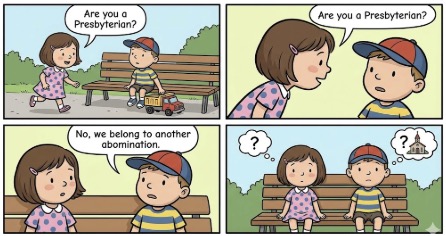
Anthony de Mello tells the story of the little girl who asks a boy, “Are you a Presbyterian?” He answers, “No, we belong to another abomination.”

SOURCE: Fr. Tony's Homilies

MANAGEMENT LESSON

TEXT VERSION

Consider the story of the company CEO who sat for the final exam of his business strategy class.  He spent many hours preparing for it.

“The teacher handed out the exam,” he said. “It was on one piece of paper which surprised me, because I figured it would be longer than that.  Once everyone had their paper, the teacher said, ‘Go ahead and turn it over.’  Both sides were blank.”

The teacher then said, ‘I’ve taught you everything I can about business in the last ten weeks, but the most important message, the most important question is this:  What’s the name of the lady who cleans this building?’

‘It was the only test I ever failed,’ he said, ‘and I got the “B” I deserved.  Her name was Dottie, and I didn’t know Dottie.  I’d seen her, but I’d never taken the time to ask her name. I’ve tried to know every Dottie I’ve worked with ever since.’

SOURCE: Ron Thomas, How a Cleaning Lady Taught Me A Management Lesson I Never Forget

ADAM AND EVE

TEXT VERSION

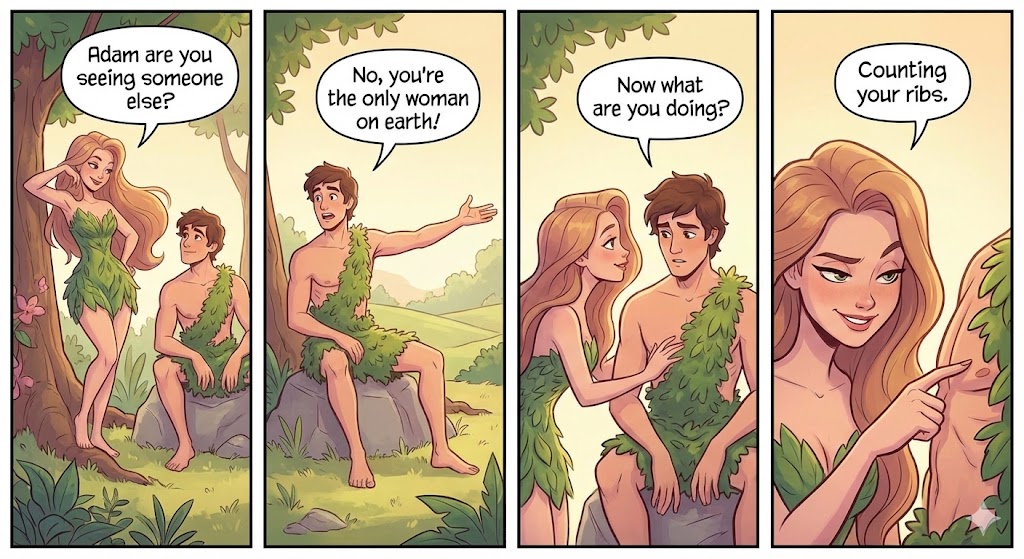
Eve: "Adam are you seeing someone else?"

Adam: "No, you're the only woman on earth!"

Adam: "Now what are you doing?"

Eve: "Counting your ribs."


TEXT VERSION

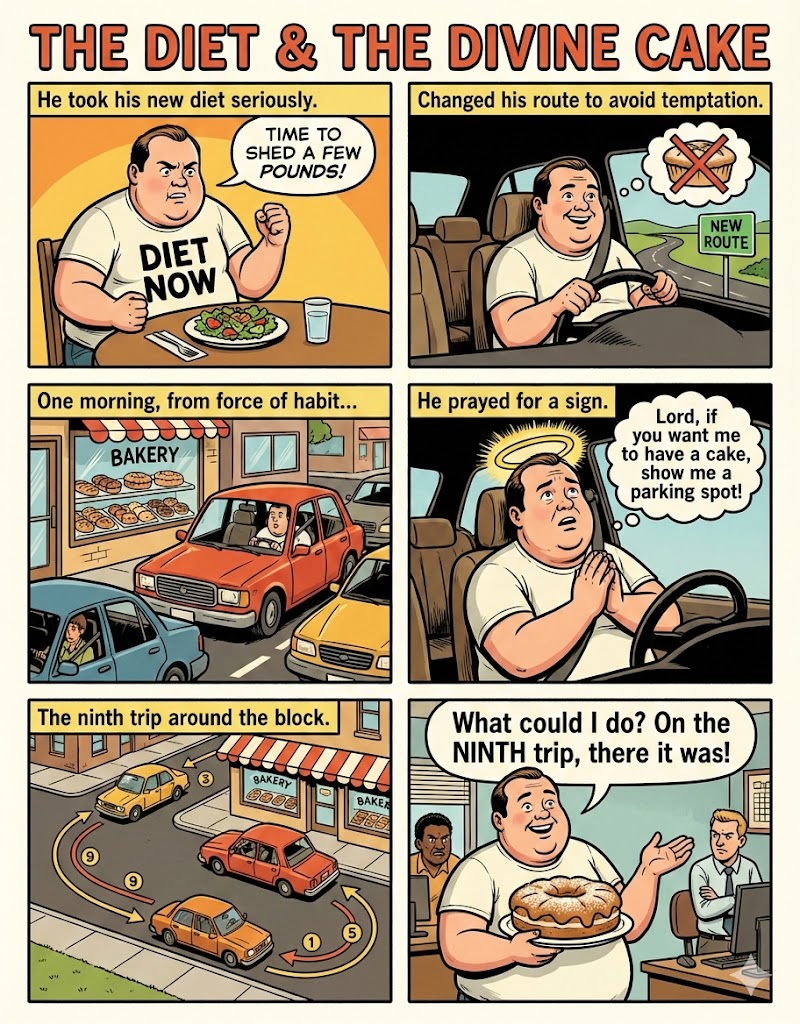
A comical, but illustrative, story shows us how adept we are at rationalizing our actions: A very overweight man decided that it was time to shed a few pounds. He went on a new diet and took it seriously. He even changed his usual driving route to the office in order to avoid his favorite bakery. One morning, however, he arrived at the office carrying a large, sugar-coated coffee cake. His office mates roundly chided him, but he only smiled, shrugged his shoulders and said, “What could I do? This is a very special cake. This morning, from force of habit, I accidentally drove by my favorite bakery. There in the window were trays of the most delicious goodies. I felt that it was no accident that I happened to pass by, so I prayed, ‘Lord, if you really want me to have one of these delicious coffee cakes, let me find a parking place in front of the bakery.’ Sure enough, on the ninth trip around the block, there it was!” — Temptation is strong, but we must be stronger. We should not tempt fate, and we should not rationalize our actions. 


BAPTISM: Catholic, Baptist, Jewish

TEXT VERSION

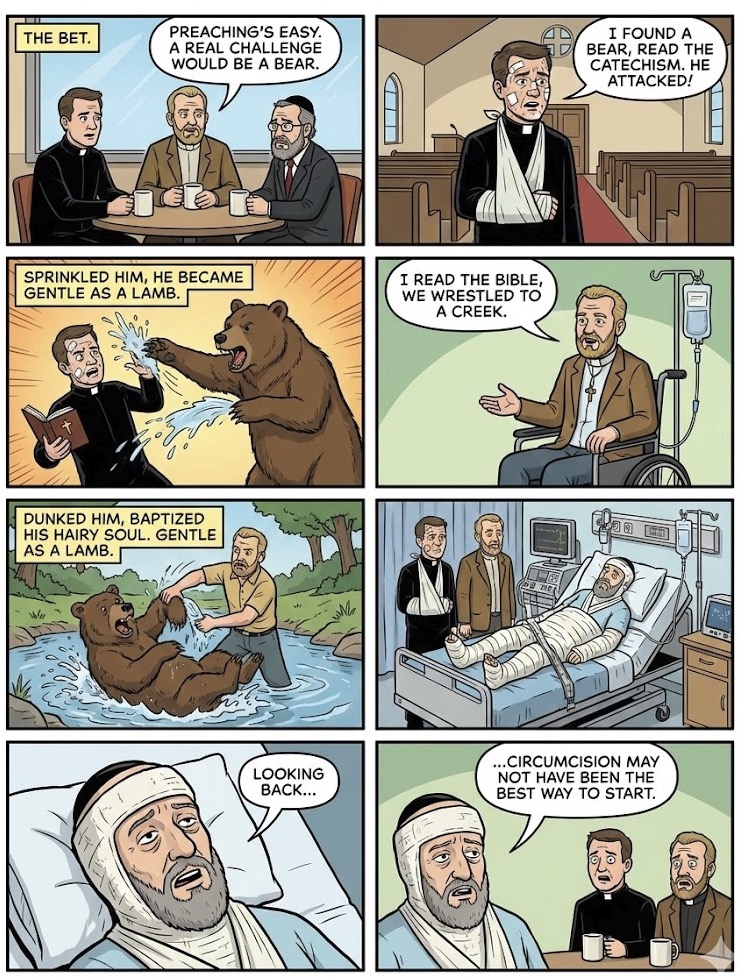
A Catholic Priest, a Baptist Preacher and a Rabbi were sitting around drinking coffee. Someone made the comment that preaching to people isn’t really all that hard, a real challenge would be to preach to a bear. One thing led to another, and they decided that each would find a bear and attempt to convert it to their religion. Seven days later, they all came together to discuss their experiences.

Father Flannery, who had his arm in a sling and had various bandages on his body and limbs, went first. ‘Well,’ he said, ‘I went into the woods to find me a bear. And when I found him, I began to read to him from the Catechism. Well, that bear came after me and began to slap me around. So I quickly grabbed my holy water, sprinkled him and, Holy Mary Mother of God, he became as gentle as a lamb.’

Reverend Billy Bob the Baptist spoke next. He was in a wheelchair and had an IV drip. ‘I went out and found me a bear. And then I began to read to my bear from the Bible! But that bear came after me. We wrestled down one hill, until we came to a creek. So, I quickly dunked him and baptized his hairy soul. And just like you said, he became as gentle as a lamb.

The Priest and the Reverend both looked down at the Rabbi, who was lying in a hospital bed. He was in a body cast and traction with IV’s and monitors running in and out of him. The Rabbi looked up and said: “Looking back on it, circumcision may not have been the best way to start? 

SOURCE: Comic panels were created using AI based on anecdotes/jokes found at Father Tony’s Homilies. Permission is given for them to be freely copied in any publication for non-commercial use.

Free Clip Art

Featured This Week

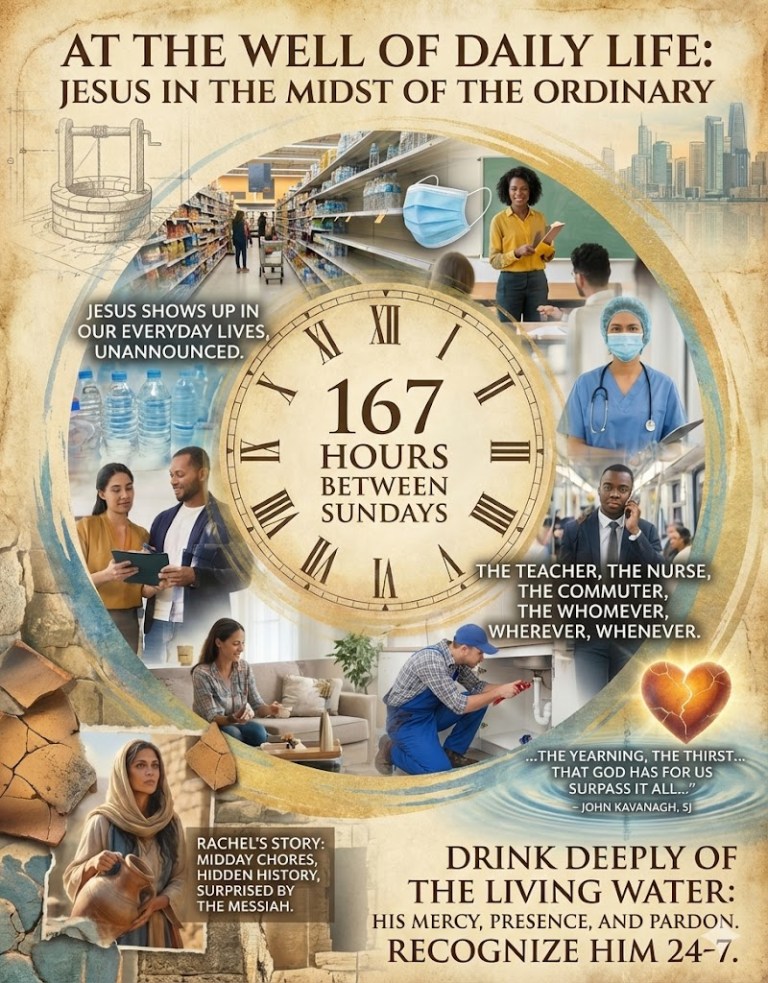
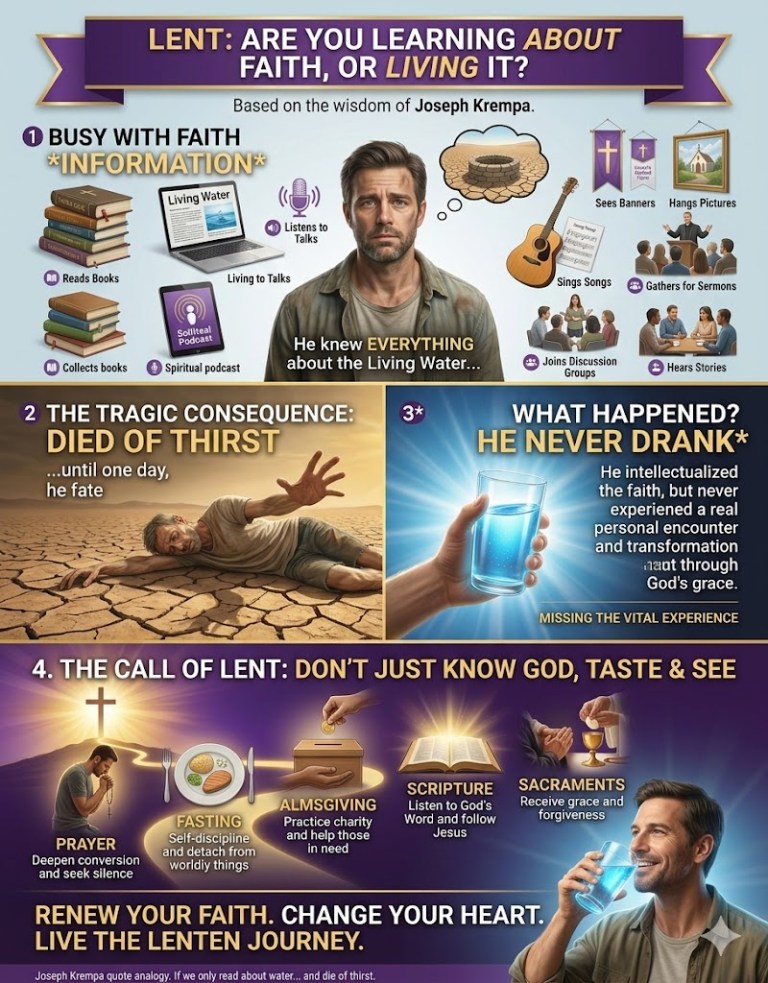
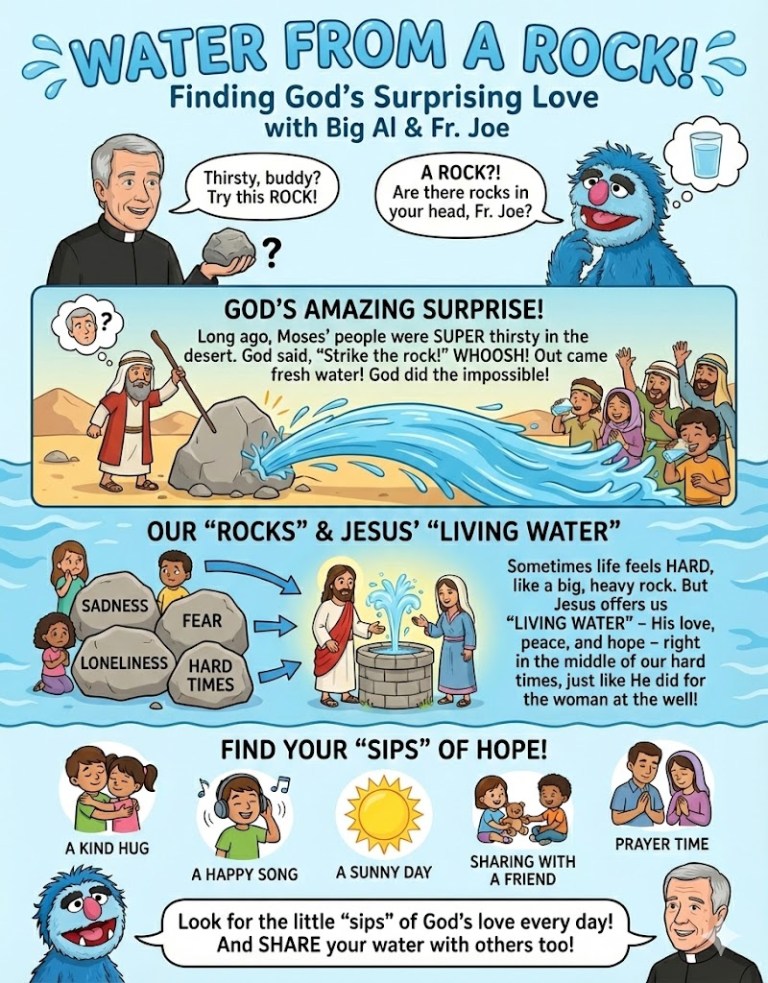
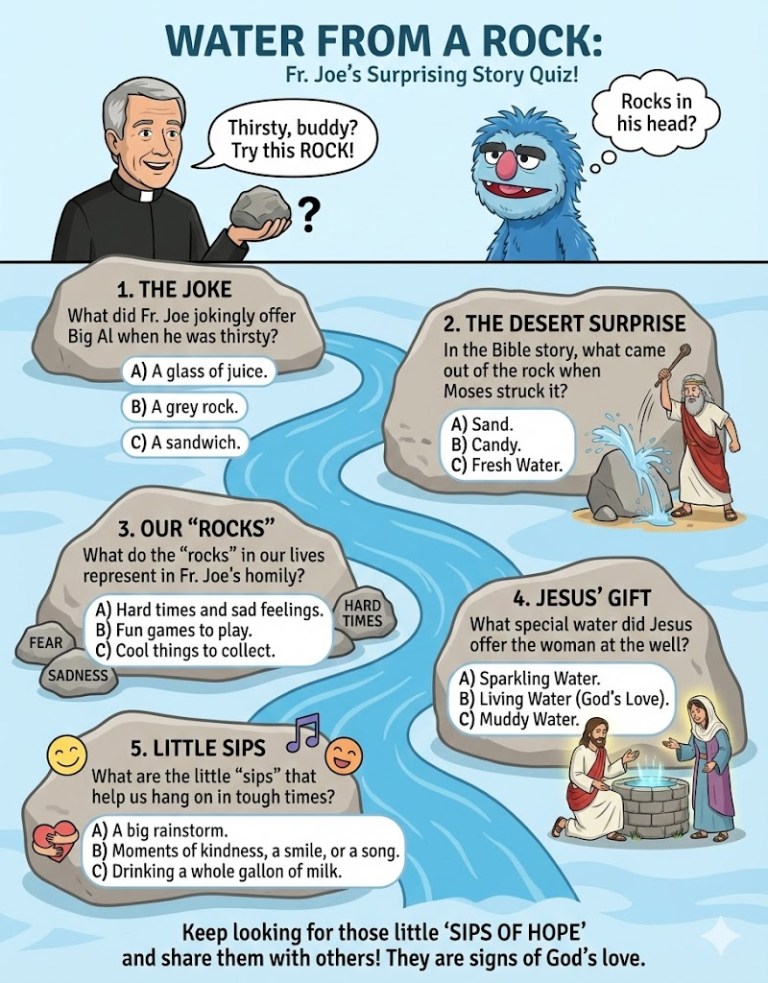
A small sample of the over 100 graphics made available this week related to the Sunday readings. You are free to download or copy/paste them into Sunday bulletins, post them on bulletin boards, use them in the classroom, etc.

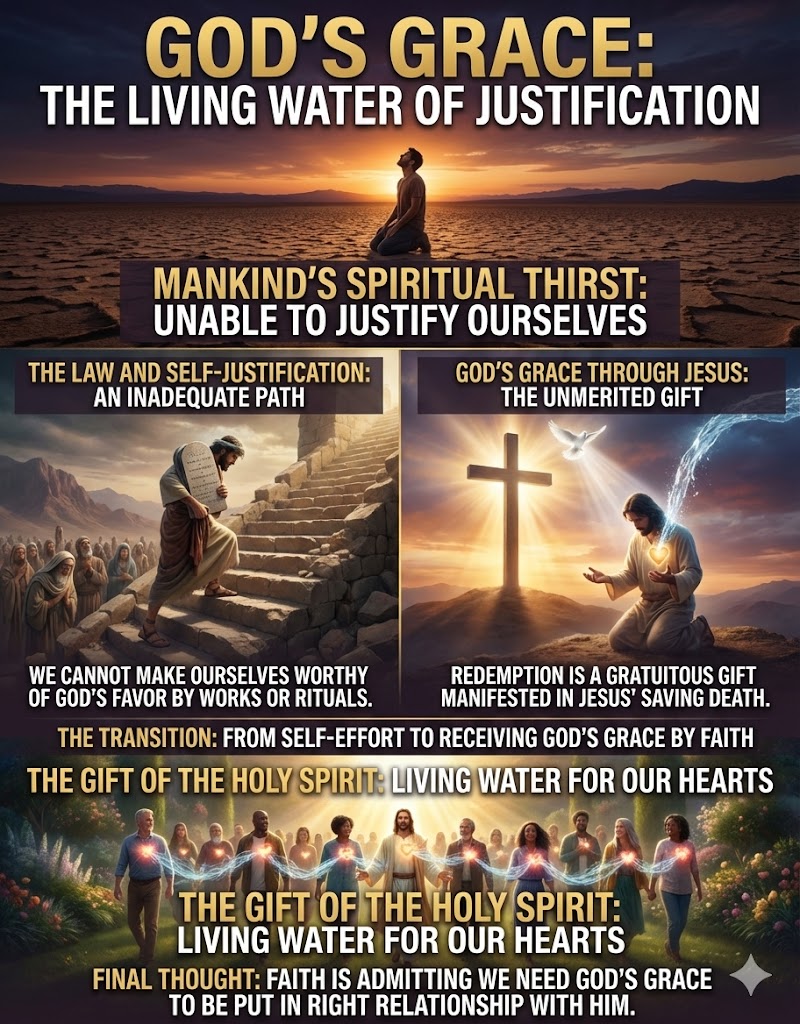
TWTW bulletin inserts on this page were created using Nano Banana and Gemini AI 3.0 Pro. Permission is granted to non-profits to copy, paste them in their publications and websites. Please credit TWTW website.

Free Clip Art