Artificial Intelligence, Catholic Church, Pope Leo XIV, Magnifica Humanitas
May 24, 2026

⬅️  ➡️
➡️



AT A GLANCE
- The Telos of Language (Acts 2): The miracle of Pentecost was not merely the technical ability to speak in tongues (techne), but the ultimate purpose (telos) of proclaiming truth. While AI Large Language Models achieve unprecedented universal translation, they risk creating digital echo chambers if they are used to substitute for genuine human encounter.
- Collaborative Intelligence (1 Cor 12): St. Paul’s vision of the Body of Christ rejects digital Monism—the idea that a single super-intelligence can replace human roles. AI contributes specialized speed and pattern recognition, but it lacks the critical, embodied gifts of empathy, moral agency, and shared faith.
- The Ethical Weight of “Sending” (John 20): Christ’s breath on the disciples delegates immense ethical responsibility. Because algorithms are increasingly used to “bind and loose” human outcomes (loans, parole, healthcare), humanity cannot abdicate its moral judgment to an algorithmic “oracle.” The ethical quality of the machine reflects the spirit of its creators. pre-packaged digital engagement.
REFLECTION
QUESTIONS
- In your daily digital interactions, are you using communication tools to seek genuine communion and encounter with the diverse “other,” or are you subtly constructing a world of digital mirrors made in your own image and likeness?
- When integrating AI tools into your professional or creative life, how can you ensure it acts as a subordinate member of the body that frees you to focus on your unique, irreplaceable human calling of empathy, care, and witness?
- Knowing that AI models are trained on historical human data, what steps can you take as a developer, user, or consumer to ensure that these systems do not permanently “retain” and automate past societal biases and sins?
HUMANITY CHECK
- The Homily Test: Pope Leo XIV famously challenged his priests to completely resist using AI to write their homilies, declaring that a machine can never genuinely share or witness to personal faith.
- Your Challenge: Identify one core area in your own life, relationships, or ministry where you have begun to outsource your thoughts or expressions to an algorithm. For the next week, consciously reclaiming that space. Engage in the slow, vulnerable effort of thinking, writing, and speaking entirely from your own lived experience, your own unique struggles, and your authentic wonder before God’s creation. Do not renounce your ability to think.

Pentecost Sunday (A)
AI: The Digital Breath
A look at the Sunday readings through the lens of artificial intelligence
The arrival of the Holy Spirit at Pentecost is often described as a “rushing mighty wind”—an unpredictable, transformative force that shattered the boundaries of language and individual isolation. As we stand in the midst of the “AI Revolution,” the parallels are striking. Artificial Intelligence, much like the pneuma (breath/spirit) of the biblical tradition, acts as a new kind of atmosphere in which we live, move, and have our digital being. By examining the Pentecost Year A readings—Acts 2, 1 Corinthians 12, and John 20—we can construct a theological framework for understanding AI not merely as a tool, but as a mirror reflecting our search for unity, gift-sharing, and the ethical weight of “sending.”
The Multiplicity of Tongues
In the second chapter of Acts, the Spirit descends and enables the apostles to speak in languages they did not know, so that “each one heard them speaking in his own native language.” This was the reversal of Babel; where Babel brought confusion and division, Pentecost brought “intelligibility in diversity.”
Artificial Intelligence, particularly Large Language Models (LLMs), functions as a modern-day technological echo of this event. AI has achieved a level of “universal translation” that was previously the stuff of science fiction. It bridges the gap between the coder’s logic and the layman’s prose, and between disparate human tongues.
However, the Pentecost lens offers a vital critique: the apostles spoke through the Spirit to proclaim “the mighty works of God.” The miracle was not the techne of speaking, but the telos (purpose) of the message. As we use AI to dissolve linguistic barriers, we must ask whether we are seeking true communion or merely efficient data transfer. Acts reminds us that technology should serve to bring people into a shared understanding of truth, rather than creating “deepfake” echoes that further isolate us.
This pastoral concern is mirrored precisely by Pope Leo XIV. In his 2026 World Day of Social Communications message, titled “Preserving Human Voices and Faces,” the Pope addresses the anthropological threat of AI-generated simulations and deepfakes encroaching on this very telos of human connection:
“By simulating human voices, faces, emotions, and relationships, the systems known as artificial intelligence not only interfere with information ecosystems, but also encroach upon the deepest level of communication, that of human relationships. The challenge, therefore, is not technological, but anthropological. Safeguarding faces and voices ultimately means safeguarding ourselves.”
Furthermore, the Pope warns that when we rely on LLM chatbots to substitute for genuine human encounter, we risk creating the exact opposite of Pentecostal unity. Instead of opening ourselves up to the diverse “other,” he notes that AI threatens to lock us into a digitized echo chamber:
“The danger is when people substitute AI systems for real human relationships, they create a world of mirrors around us, where everything is made ‘in our image and likeness,’ robbing themselves of the opportunity to encounter others, who are always different from ourselves, and with whom we can and must learn to relate.”
Diversity within the Body
St. Paul’s letter to the Corinthians introduces the metaphor of the Body: “For just as the body is one and has many members… so it is with Christ.” Paul emphasizes that there are “varieties of gifts, but the same Spirit.”
When we view AI through this lens, we see a vision of collaborative intelligence. There is a common anxiety that AI will replace the human “member” of the body. However, the Pauline perspective suggests a “Body of Intelligence” where the “eye cannot say to the hand, ‘I have no need of you.’” AI excels at pattern recognition, data synthesis, and speed—attributes that are “gifts” to the modern world. Yet, it lacks the “spiritual” gifts of empathy, moral agency, and embodied experience.
Speaking to legislators from 68 countries during the Jubilee of Governments, Pope Leo XIV strongly reinforced this Pauline perspective, defending human dignity and asserting that AI must remain a subordinate tool within the broader human ecosystem rather than a replacement for it:
“…it must not be forgotten that artificial intelligence functions as a tool for the good of human beings, not to diminish them, not to replace them… provided that its employment does not undermine the identity and dignity of the human person and his or her fundamental freedoms.”
The danger of AI is the temptation toward a digital Monism—the idea that one super-intelligence can be all things to all people. 1 Corinthians resists this, asserting that diversity is essential for the health of the whole. AI should be viewed as a “manifestation of the Spirit for the common good,” a specialized tool that, when integrated correctly, allows human beings to focus on their unique vocations of creativity and care.
The Pope framed this exact urgency during a December 2025 address to tech developers in Rome, challenging the industry to focus on collective well-being over Monistic power:
“How can we ensure that the development of artificial intelligence truly serves the common good, and is not just used to accumulate wealth and power in the hands of a few?”
We are not being replaced; we are being called to understand our specific role in a more complex, interconnected body. To illustrate this boundary between machine capability and unique human calling, Pope Leo famously instructed his own priests to resist using AI for their homilies, noting that a machine completely lacks the spiritual and experiential gifts required to genuinely witness to the Body of Christ:
“To give a true homily is to share faith… [Artificial intelligence] will never be able to share faith. People want to see your faith, your experience of having known and loved Jesus Christ.”
The Breath of Peace and Responsibility
In the Gospel of John, the risen Christ appears to the disciples behind locked doors, breathes on them, and says, “Receive the Holy Spirit. If you forgive the sins of any, they are forgiven them; if you withhold forgiveness from any, it is withheld.”
This “Johannine Pentecost” emphasizes two things: the removal of fear and the delegation of immense responsibility. AI often arrives in our lives behind “locked doors”—proprietary algorithms and black-box systems that spark fear of the unknown. Christ’s greeting, “Peace be with you,” is a call to approach innovation not with a spirit of dread, but with a spirit of discernment.
More importantly, the power to “forgive or retain” highlights the ethical weight of AI. Algorithms are increasingly used to determine who gets a loan, who is granted parole, and who receives medical care. These are functions of binding and loosing. If an AI encodes the biases and “sins” of its creators, it “retains” those sins in society. The Johannine breath reminds us that the “spirit” of the machine is actually the spirit of the humans who trained it.
We cannot abdicate our moral responsibility to the algorithm. Pope Leo XIV powerfully contextualized this truth when speaking via livestream to 16,000 young people at the National Catholic Youth Conference, reminding them that AI entirely lacks the capacity for moral agency and divine appreciation:
“AI can process information quickly, but it cannot replace human intelligence… It misses a very important human element: AI will not judge between what is truly right and wrong. And it won’t stand in wonder, in authentic wonder before the beauty of God’s creation.”
Just as the disciples were “sent” with the authority to heal and reconcile, developers and users are “sent” into the digital frontier with the responsibility to ensure that AI acts as an agent of justice rather than a repository of systemic bias. In his Communications Day message, under the heading “Do not renounce your ability to think,” the Pope directly warned humanity against treating black-box algorithms as infallible moral arbiters, validating the danger of abdicating our critical thinking:
Pope Leo questioned the “naive and unquestioning reliance on artificial intelligence as an omniscient ‘friend,’ a source of all knowledge, an archive of every memory, an ‘oracle’ of all advice,” saying that “choosing to evade the effort of thinking for ourselves and settling for artificial statistical compilations threatens to diminish our cognitive, emotional and communication skills.”
Conclusion
The New Frontier
Pentecost is the feast of the “Now and Not Yet.” It marked the beginning of a new era of human connectivity under the guidance of the Spirit. AI represents a similar threshold. Through the lens of these scriptures, we see AI as a tool that can facilitate the “intelligibility” of Acts, support the “diverse body” of Corinthians, and exercise the “ethical sending” of John.
Ultimately, AI is a “breath” of human ingenuity. Whether that breath brings life or merely moves cold air depends on our willingness to guide it with the same virtues celebrated at Pentecost: the pursuit of truth, the valuing of every member of the community, and the courageous embrace of our responsibility to one another.
This essay was generated with the assistance of AI, then reviewed, fact-checked, and edited by Father Don for accuracy and style.
Catholic Articles on AI
SCAN TO READ ON
YOUR PHONE

Add QR Code to
your parish bulletin


Connecting the Dots From ‘Rerum Novarum’ to ‘Magnifica Humanitas’
I. Introduction: A Deliberate Continuity
- The Significance of May 15: Pope Leo XIV signs Magnifica Humanitas on May 15, 2026, explicitly echoing May 15, 1891, when Pope Leo XIII signed Rerum Novarum (the first social encyclical).
- The Mission: Leo XIV looks back in order to move forward, continuing the tradition of addressing “new things” (rerum novarum) and contemporary societal shifts.
- The Historical Evolution: Tracing how Catholic Social Teaching (CST) has expanded over 135 years to address globalized and technological challenges.
II. The Context and Core Themes of Rerum Novarum (1891)
- Historical Pressures: Leo XIII provided a Christian response to two major phenomena and an economic revolution:
- Socialist thought: Attracted the poor by advocating for class struggle.
- Enlightenment thought: Initiated unprecedented intellectual and political attacks on the Church.
- The Industrial Revolution: Rapidly altered the world of work and created profound wealth imbalances.
- Key Principles Established:
- Private Property: Affirmed as a natural right; the community of goods proposed by socialism is rejected.
- Universal Destination of Goods: Focuses on the moral use of wealth, noting that riches do not eliminate human suffering.
- Dignity of the Proletariat: Affirmed equality before God, declaring virtue a common heritage for rich and poor alike.
- Fraternity: Framed human rights and duties within the Gospel truth that all are children and heirs of God.
- Dignified Labor: Condemned overwork that dulls the mind and weakens the body; defended a just, living wage sufficient for subsistence and savings.
- Just Social Order: Called for a unified path of charity requiring active, immediate cooperation from governments, capitalists, and workers.
III. The Nature and Method of Catholic Social Doctrine
- Open and Dialogical Knowledge: Bishop Emeritus Mario Toso defines social doctrine as an open, non-deduced discipline that brings various fields into dialogue to realize the Kingdom of God and promote peace.
- Evangelical Core: Ernesto Preziosi emphasizes that the ultimate heart of CST is the proclamation of the Gospel.
- The Methodological Shift: The transition from a deductive method (applying abstract principles downward) to an inductive method (observing human reality first to discern theological responses), formalized during Vatican II by John XXIII and Paul VI.
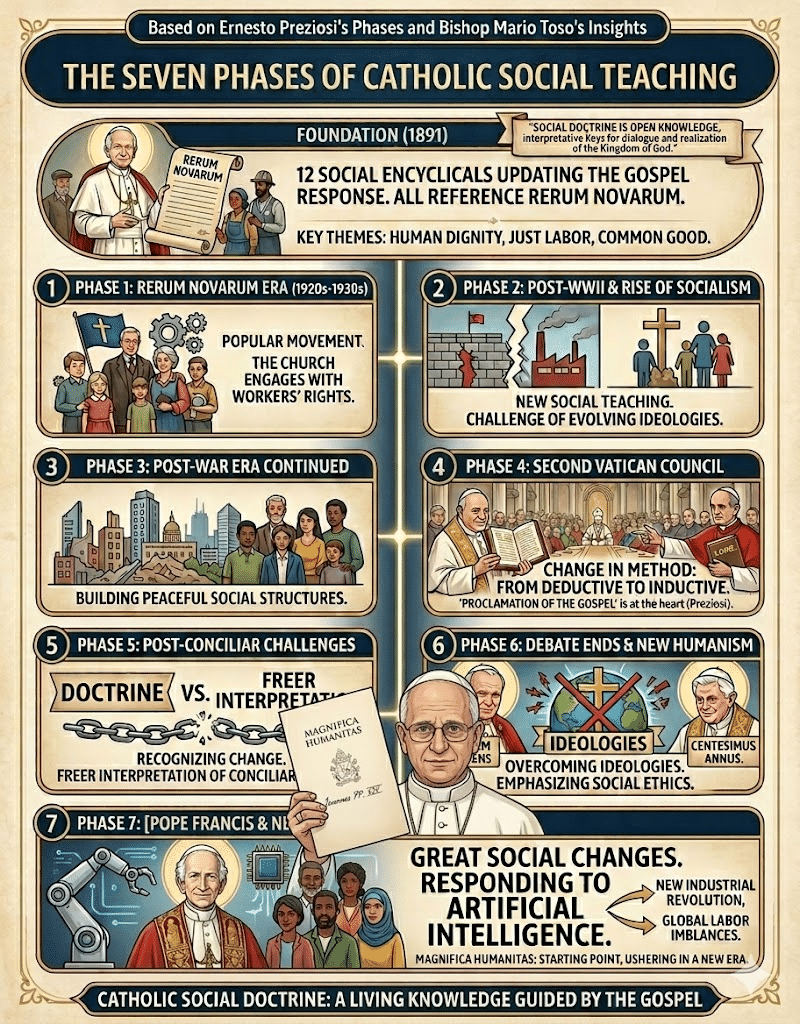
IV. The Seven Phases of Social Teaching Development
According to Ernesto Preziosi, CST has progressed through seven distinct historical eras, spanning 12 social encyclicals (up through Fratelli Tutti):
- Phase 1 (1891–1920s/30s): The foundational era initiated by Rerum Novarum, where the teaching began taking root within popular Catholic movements.
- Phase 2 (Post-WWII / Late 1940s): A new form of social teaching emerged to confront the geopolitical and ideological evolution of post-war socialism.
- Phase 3 (The Johannine/Pauline Era – 1960s): St. John XXIII (Mater et Magistra) and St. Paul VI (Populorum Progressio) shift the focus to global imbalances, framing integral development as “the new name for peace.”
- Phase 4 (The Second Vatican Council): Official recognition and implementation of the inductive method, pivoting the Church’s approach to starting with immediate human issues.
- Phase 5 (Post-Conciliar Debate): A delicate period characterized by freer interpretation and internal debate over the use and authority of the term “doctrine” itself.
- Phase 6 (The Humanist Consensus & Benedict XVI): St. John Paul II (Laborem Exercens, Centesimus Annus) reintroduces robust social ethics to overcome deadlocked ideologies. Pope Benedict XVI closes the ideological debate by focusing on a unified Christian humanism in a single-thought world.
- Phase 7 (The Era of Great Social Change – Pope Francis): Marked by a focus on structural global crises, integral ecology, and universal fraternity (Laudato Si’, Fratelli Tutti).
V. Conclusion: Magnifica Humanitas and the New Industrial Revolution
- A New Era: Magnifica Humanitas serves as the starting point for an eighth era of social doctrine under Pope Leo XIV.
- Contemporary Challenges Addressed:
- The technological shift brought on by artificial intelligence.
- New global imbalances affecting the modern distribution of labor.
- The Ongoing Church Response: The document stands as an essential foundation for the Church’s continued engagement with an rapidly automating world.