1st Sunday of Advent C ✨
COMMENTARY

NEED HELP?
GET ANSWERS
FROM AI

THE WORD THIS WEEK "AI "Catholic Assistant" Chat Bot has been specifically trained for this website
🔵 STEP ONE

CLICK ON THE BLUE ICON at the bottom right corner of screen
🔵 STEP TWO
TYPE YOUR QUESTION that is related to the content on the page
— OR —
COPY AND PASTE any text on the page to generate a more in-depth look of the topic
🔵 STEP THREE
ASK FOLLOW-UP QUESTIONS if necessary
FOR BEST RESULTS:
Refresh chatbot when switching to a different Sunday of year.
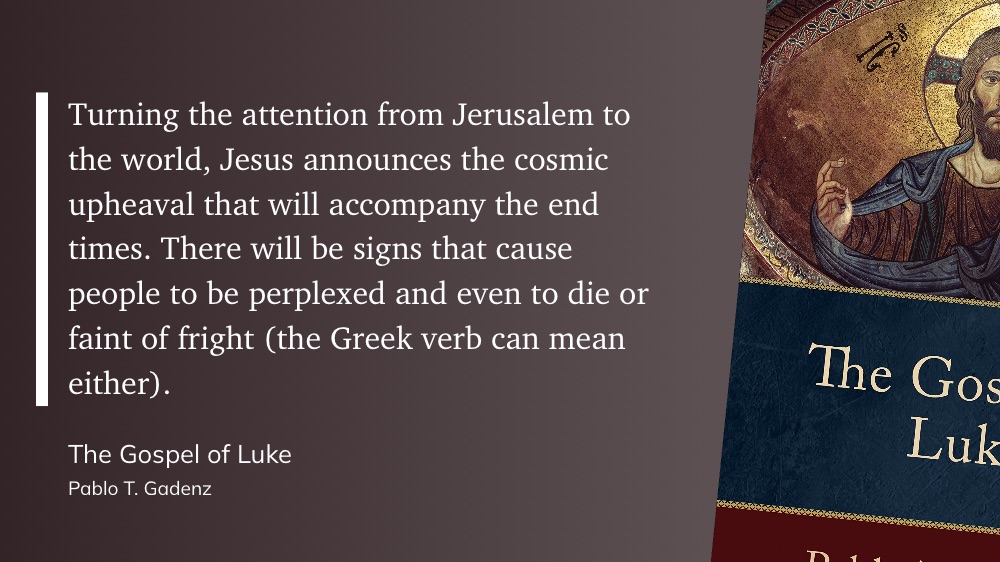
Why is there a darkened sky on the featured image for First Sunday of Advent Year C?
The darkened sky in the imagery for the First Sunday of Advent Year C symbolizes the themes of anticipation and preparation. Advent is a time of waiting for the coming of Christ, both in remembrance of His birth and in anticipation of His return. The darkened sky can represent the darkness of the world awaiting the light of Christ. It serves as a reminder of the hope and renewal that Jesus brings, encouraging believers to prepare their hearts for His coming.
Is this imagery found in any of the readings?
Yes, the imagery of a darkened moon and cosmic signs is found in biblical texts often associated with Advent themes. For example, in the Gospel of Luke (21:25-28), Jesus speaks of signs in the sun, moon, and stars as part of the discourse on His second coming. These cosmic signs symbolize the upheaval and transformation that accompany the arrival of God's kingdom. Such imagery serves to remind believers of the need for vigilance and readiness as they await the fulfillment of God's promises.
What does Barclay in his commentary mean by "Living in the shadow of eternity"
In his commentary, William Barclay's phrase "living in the shadow of eternity" suggests living with an awareness of the eternal significance of our actions and choices. It means recognizing that life on earth is temporary and that our ultimate destiny lies beyond this world. This perspective encourages individuals to prioritize spiritual values, live with purpose, and focus on what truly matters in light of eternity. It calls for a life of faith, hope, and love, aligning daily actions with eternal truths.

ASK YOUR OWN QUESTIONS BY CLICKING ON THE AI CHAT ICON AT THE BOTTOM RIGHT CORNER OF THIS PAGE
- OUTLINES
- CATHOLIC
CATECHISM - CHURCH
FATHERS - PRO-LIFE
INSIGHTS - GREEK
WORDS - COMMENTARY
NOTE CARDS - LECTIONARY
Video SERIES
FIRST
READING
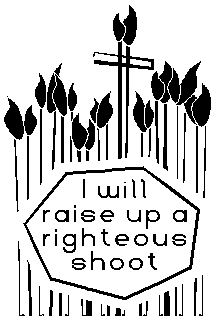
God promises a righteous king from David’s lineage, ensuring Jerusalem’s security and a fulfilling relationship with Judah and Israel. This divine commitment demonstrates God’s unwavering love and faithfulness.
Clipart by Fr. Richard Lonsdale

SECOND
READING
Paul encourages the Thessalonians to love one another and maintain moral purity, striving for holiness as they await the second coming of Jesus. His guidance supports their spiritual growth amidst challenges.
Clipart by Fr. Richard Lonsdale
GOSPEL
Jesus warns of cosmic signs and worldly distress preceding his return. Emphasizing vigilance, prayer, and responsible living, he urges believers to prepare spiritually, avoiding earthly attachments.
Clipart by Fr. Richard Lonsdale
DOCTRINAL
INSIGHTS
Eschatology: This passage deals with the end times and the return of Jesus Christ, which connects to Catholic teachings on the final judgment, heaven, hell, and the resurrection of the dead (CCC 1038-1041, 1042-1050).
The Second Coming of Christ: The text discusses the Son of Man coming in glory, which corresponds to the Catholic belief in Christ’s return at the end of time to judge the living and the dead (CCC 668-672).
Divine Providence: The passage describes God’s ultimate control over creation, connecting to the Catholic understanding of divine providence, which teaches that God sustains and guides all things to their final purpose (CCC 302-305, 314-319).
Vigilance and Prayer: The verses highlight the importance of being prepared for the end times through vigilance and prayer, which aligns with Catholic teachings on the necessity of prayer, spiritual watchfulness, and moral readiness (CCC 1808, 1821, 2559-2565, 2601-2603, 2613-2622).
Salvation and Redemption: The text points to the redemption offered through the coming of the Son of Man, resonating with Catholic beliefs in Jesus Christ as the source of salvation and the ultimate fulfillment of God’s covenant with humanity (CCC 599-600, 652-655, 1021-1022).
Temperance and Moral Life: The warnings against dissipation, drunkenness, and worries of daily life underscore Catholic teachings on the virtues of temperance, moderation, and a well-formed conscience in pursuing a moral life (CCC 1805, 1809, 2290-2291, 2537-2538).

CHURCH FATHERS SCRIPTURE
SEARCH
FIRST READING (2)
SECOND READING (8)
GOSPEL (28)
This tool created by Jeff Pinyan uses the CCEL Early Church Fathers digital edition of the Philip Schaff collection.
A Modern Translation of
Catena Aurea
The Catena Aurea, which means “Golden Chain” in Latin, is a comprehensive biblical commentary comb is a 13th-century biblical commentary compiled by St. Thomas Aquinas. This anthology features insights from over eighty Church Fathers on the four Gospels.
SOURCE: Fr. Don worked with AI generative technology to create this modern translation, outline and study notes, enhancing accessibility and comprehension of the text for contemporary audiences.
Outline
Christ’s Explanation
of End Times
Events
BEDE explains that Christ prophesied about the end times, saying that there will be signs in the sun, moon, and stars, as well as distress on Earth.
Signs in the Heavens
AMBROSE clarifies that the signs mentioned by Christ are described more clearly in the book of Matthew, including the darkening of the sun, the moon not shining, and stars falling from heaven.
EUSEBIUS envisions a new world where Christ will shine like a sunbeam, and His light will outshine the sun, moon, and stars.
CHRYSOSTOM compares the current world to the new world, stating that when Christ appears in glory, the sun, moon, and stars will give up their old appearance for a better light.
The World’s
Transformation
and Distress
EUSEBIUS explains that the transformation of the world will start with the disappearance of water, causing the sea to become silent and leading to severe droughts. This will result in distress among the survivors, as their hearts will be consumed by fear and anticipation of the events unfolding across the entire world.
The Shaking of
the Powers
of Heaven
THEOPHYLACT emphasizes that not only humans but also angels will be affected by the world’s changes, causing the powers of heaven to be shaken.
GREGORY identifies the powers of heaven as angels, dominions, principalities, and powers, stating that they will be visible and judge humans during the end times.
EUSEBIUS explains that when the Son of God comes in glory, the angels will attend Him and the doors of heaven will open, allowing people to witness the things that are above.
CHRYSOSTOM adds that heavenly powers will tremble as they witness countless multitudes being condemned.
BEDE quotes Job, saying that even the pillars of heaven will tremble and be afraid during this time.
EUSEBIUS alternatively interprets the powers of heaven as the forces governing the universe, stating that they will be shaken to reach a better state.
Luke 21:25-28
Christ’s Explanation of End Times Events
BEDE: Christ explains the events that will happen after the time of the Gentiles is over, saying there will be signs in the sun, moon, and stars, and distress on Earth.
Signs in the Heavens
AMBROSE: All these signs are described more clearly in Matthew – the sun will be darkened, the moon won’t shine, and stars will fall from heaven.
EUSEBIUS: When the end of this temporary life comes, as the Apostle says, “The fashion of this world passeth away,” a new world will come where Christ Himself will shine like a sunbeam, and He will be the King of the new world. His light will be so bright that the sun, moon, and stars will be hidden by a much greater light.
CHRYSOSTOM: Just as in our current world the moon and stars are dimmed by the rising sun, when Christ appears in glory, the sun will become dark, the moon won’t shine, and stars will fall from heaven, giving up their old appearance to be dressed in a better light.
The World’s Transformation and Distress
EUSEBIUS: After the light sources go dark, Jesus explains the distress of nations caused by the roaring sea. This seems to imply that the world’s transformation will start with water disappearing. As water vanishes or becomes frozen, the sea will no longer roar, and the waves won’t reach the shore due to severe drought. Other parts of the world will also undergo change, as they won’t have access to the usual water supply. Since Christ’s appearance will stop the evil forces that resist God, His wrath will begin with these droughts, during which no storms or roaring seas will be heard. Following these events, the distress of the survivors will be evident, as their hearts are consumed by fear and anticipation of the events that will unfold across the entire world. Jesus then proceeds to describe these events, saying, “For the powers of heaven shall be shaken.”
The Shaking of the Powers of Heaven
THEOPHYLACT: Alternatively, when the higher world undergoes change, the lower elements will also suffer. This is why it says, “And on the earth distress of nations.” It’s as if He said that the sea will roar fiercely, and its shores will be battered by storms, causing distress to the people and nations on Earth—a widespread misery that will make them waste away from fear and anticipation of the terrible events coming upon the world.
AUGUSTINE: But you might argue that the current punishment proves the end is approaching because it matches the prophecy. After all, it’s clear that every country and place is currently affected or troubled. Yet, if these evils signify that our Lord’s arrival is imminent, what does it mean when the Apostle says, “For when they shall say peace and safety”? Let us consider whether the words of prophecy might instead refer to a future time when the whole world’s tribulations will belong to the Church, which will be troubled by the whole world—not by those causing the trouble. It will be those who say, “Peace and safety.” Right now, the greatest and most extreme evils we see are common to both Christ’s kingdom and the Devil’s. Good and evil people alike suffer them, including widespread participation in immoral feasts. Isn’t this a form of being dried up from fear or, rather, being consumed by lust?
THEOPHYLACT: Not only will humans be affected when the world changes, but even angels will be stunned by the universe’s terrible transformations. This is what is meant by “And the powers of heaven shall be shaken.”
GREGORY: Who are the “powers of heaven” but the angels, dominions, principalities, and powers? When the strict Judge comes, they will be visible to our eyes and will strictly judge us, since our invisible Creator has been patient with us until then.
EUSEBIUS: When the Son of God comes in glory and defeats the sinful empire, the angels will attend Him, and the doors of heaven, which have been closed since the beginning of the world, will open so that we can witness the things that are above.
CHRYSOSTOM: Or the heavenly powers will be shaken, even though they don’t know it. When they see the countless multitudes being condemned, they will tremble.
BEDE: As Job says, “the pillars of heaven tremble and are afraid at his reproof.” If the pillars tremble, what happens to the boards? If the cedar of Paradise is shaken, what becomes of the desert shrub?
EUSEBIUS: Alternatively, the “powers of heaven” are the forces that govern the sensible parts of the universe. They will be shaken so that they can reach a better state. They will be released from their duty of serving God in relation to perishable bodies.
The Church as the Sun, Moon, and Stars
AUGUSTINE likens the Church to the sun, moon, and stars, explaining that it will be concealed during periods of persecution.
AMBROSE further elaborates that the Church’s divine light dims when earthly sins oppose it, comparing it to the moon’s phases or an eclipse. He adds that stars (people who shine in glory) will fall under intense persecution, leading to the gathering of the entire Church.
Interpretation
of Distress and
Coming in the Clouds
AUGUSTINE suggests that “distress of nations” refers to those who will not be blessed, while the phrase “coming in the clouds” signifies Christ’s arrival amidst His Church or in His body.
AMBROSE explains that souls will be consumed by fear and guilt, causing inner fires and spiritual drought. However, heavenly powers will experience increased grace and union with the Divine upon Christ’s arrival.
CHRYSOSTOM and CYRIL OF ALEXANDRIA clarify that Christ’s second coming will be celebrated in divine power, rather than humility.
GREGORY emphasizes that people will witness Christ in power and majesty during His second coming, enabling His saints to endure severe persecution. His grandeur will ensure that His presence is unmistakable.
The Church as the Sun, Moon, and Stars
AUGUSTINE: To avoid ridicule from those who know that these events occurred before Christ’s first coming and that there have been even greater events in the history of nations, we can interpret these words as applying to the Church. The Church is like the sun, moon, and stars, and during intense persecution, it will be hidden from view.
AMBROSE: As many people turn away from religion, clear faith will be obscured by the cloud of unbelief. For me, the Sun of righteousness grows dim or shines brighter depending on my faith. Just as the moon dims during its monthly phases or when it is eclipsed by the Earth, so too does the holy Church lose its divine light when earthly sins oppose it. In times of persecution, worldly love often blocks out the light of the divine Sun. Stars, too, will fall—that is, people who shine in glory will fall when persecution becomes too intense. This will continue until all of the Church is gathered together, because this is how the good are tested and the weak are revealed.
Interpretation of Distress and Coming in the Clouds
AUGUSTINE: In the phrase “distress of nations,” “nations” refers not to those who will be blessed through Abraham’s descendants, but to those on the left.
AMBROSE: Our souls will be consumed by such intense inner fires that, due to our fear of judgment and our guilt from numerous crimes, the comforting dew of the sacred fountain will dry up within us. However, when the Lord arrives to dwell within the entire world, which currently resides in each individual who has embraced Christ wholeheartedly, the heavenly powers will experience increased grace and be moved by a more intimate union with the Divine nature. These heavenly powers, which proclaim God’s glory, will be stirred by an even greater infusion of Christ, allowing them to see Him more clearly.
AUGUSTINE: The phrase “coming in the clouds” can be interpreted in two ways: Christ coming amidst His Church, like a cloud (as He still does today), but with greater power and majesty; or Christ coming in His body, which is seated at the Father’s right hand. He will come not only in His body but also in a cloud, as it was written that “a cloud received him out of their sight.”
CHRYSOSTOM: God always appears in a cloud, as stated in the Psalms: “clouds and darkness are round about him.” Thus, the Son of Man will come in the clouds as God and Lord, not in secrecy but with divine glory.
CYRIL OF ALEXANDRIA: The term “great” should be understood similarly. His first appearance occurred in our weakness and humility, while His second will be celebrated in all His divine power.
GREGORY: People will see Him in power and majesty—the same person they refused to hear when He was in a lowly position. This will make His power even more palpable to His saints, enabling them to withstand such severe persecution. His grandeur will make His presence unmistakable.
Importance of Vigilance and Prayer
THEOPHYLACT: Jesus mentioned the frightening signs of impending calamities, urging sinners to protect themselves through vigilance and prayer.
BASIL: Drawing a comparison between human instincts and animal survival, Christ emphasizes the importance of discernment and wisdom in avoiding sin.
Dangers of Overindulgence and Drunkenness
TITUS BOSTRENSIS: Excessive indulgence can lead to a weakened faith and spiritual ruin.
CLEMENT OF ALEXANDRIA: The deceptive effects of wine and the importance of restraint in eating and drinking.
BASIL: Earthly concerns should be avoided if they do not contribute to spiritual growth.
Preparation for Judgment Day
THEOPHYLACT: The unexpected arrival of Judgment Day, and the importance of being vigilant and dedicated.
EUSEBIUS: Jesus instructed His followers to stay attentive and pray to be worthy of escaping the trials that are to come.
AUGUSTINE: The symbolic interpretation of avoiding earthly worries and indulgence.
Striving for Glory
THEOPHYLACT: Christians must not only flee from evil but also strive to stand before the Son of man and continually behold His face.
BEDE: The neglect of divine guidance despite the trust in human advice.
Luke 21:34-36
Importance of Vigilance and Prayer
THEOPHYLACT: Jesus mentioned the frightening, tangible signs of impending calamities that will befall sinners; the only protection against these is vigilance and prayer, as He said, “And take heed to yourselves, lest at any time…”
BASIL: Every creature has inherent instincts given by God to ensure its survival. Thus, Christ reminds us to use reason and wisdom to avoid sin just as animals avoid deadly food and seek wholesome sustenance. He says, “Take heed to yourselves,” meaning we should discern between what is harmful and what is beneficial. Since we can take heed with our physical eyes or our inner faculties, and physical sight doesn’t lead to virtue, we must rely on our soul’s abilities. “Take heed” means to stay alert, guarding our soul. He says, “yourselves,” as we are mind and spirit, not just physical beings. We are surrounded by material things but must focus on our soul’s well-being. This warning helps both the sick and the well: those who protect the present and prepare for the future, examine their own actions instead of judging others, and control their passions with reason.
Jesus further explains the reason for this heedfulness, “Lest at any time your hearts be overcharged…”
Dangers of Overindulgence and Drunkeness
TITUS BOSTRENSIS: Be cautious not to let your mind become heavy with drowsiness. The worries of this life, indulgence, and drunkenness drive away wisdom, weaken faith, and lead to spiritual ruin.
CLEMENT OF ALEXANDRIA: Drunkenness results from excessive drinking, and crapula refers to the discomfort and nausea associated with it—a Greek term derived from the resulting dizziness. To avoid hunger and thirst, one must eat and drink, but with restraint to prevent overindulgence. The effects of wine are deceptive, and the soul is wisest when sober but becomes lost when intoxicated.
BASIL: Even if carefulness, or concern for earthly matters, doesn’t inherently involve sin, it should be avoided if it doesn’t contribute to religious growth. Jesus explains this, saying, “And so that day come upon you unawares.”
Preparation for Judgment Day
THEOPHYLACT: Judgment Day will come unexpectedly, surprising the unwary like a trap. It will catch those who carelessly linger on the earth’s surface. However, we can avoid it by actively pursuing goodness, refusing to remain idle or complacent. For the vigilant and dedicated, Judgment Day won’t be a snare, but a reason for celebration.
EUSEBIUS: Jesus instructed them to pay attention and avoid falling into indolence. Thus, He says, “Watch ye therefore, and pray always, that ye may be accounted worthy to escape all those things that shall come to pass.”
Striving for Glory
THEOPHYLACT: Through vigilance and prayer, one can avoid temporary afflictions, such as hunger and disease, and the eternal punishment reserved for the guilty.
AUGUSTINE: The flight mentioned in Matthew, which should not occur during winter or on the Sabbath, symbolizes avoiding earthly worries (as dreary as winter) and indulgence (characteristic of the Jews’ worldly Sabbath).
THEOPHYLACT: Christians must not only flee evil but also strive for glory. Jesus adds, “And to stand before the Son of man.” This is the angels’ privilege: to stand before the Son of man, our God, and continually behold His face.
BEDE: If a physician warned us about a lethal herb, we’d heed the advice. Yet, when Christ cautions against drunkenness, overindulgence, and earthly worries, people often neglect His words. They trust a physician’s warning but disregard divine guidance.
PREACHING ON
ABORTION
by Frank Pavone
The beginning of the Season of Advent provides a powerful opportunity to touch upon pro-life themes in the Liturgy.
First of all, the theme of the Second Coming of the Lord – a theme particularly strong in the first part of Advent – calls us as individuals and as a society to repentance in preparation for the Lord’s coming. This repentance includes living with active respect for every human life, and building a society of justice and welcome for the most vulnerable.
Secondly, Advent is about preparation for the birth of the Lord. The joy of his birth, as John Paul II wrote in Evangelium Vitae, is reflected in the joy at the birth of every child. Advent is a perfect time to commend to the prayers of our people all who are carrying a child, and may be tempted by fear or a lack of trust in God’s Providence.
SOURCE: Priests for Life

Cross
References
Jeremiah 33:14-16
– Luke 1:32-33
– Revelation 22:16
– Isaiah 11:1-5
– Micah 5:2
1 Thes 3:12-4:2
– 1 Thes 5:23-24
– Philippians 1:9-11
– 1 Thes 4:9-10
– 2 Thes 2:16-17
Luke 21:25-28, 34-36
– Matthew 24:29-33
– Mark 13:24-27, 32-37
– Revelation 16:15
Greek Word Study
FEATURED
TEXTS
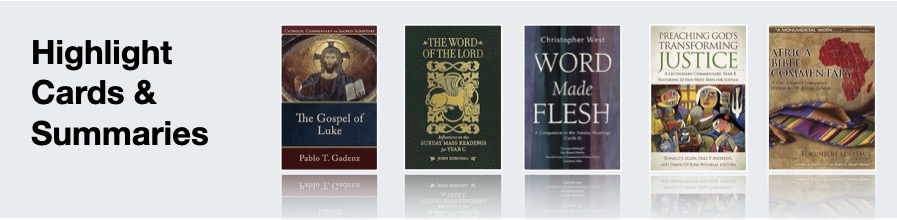
The Catholic Commentary…
Baker
Academic
Gadenz, Pablo T.. The Gospel of Luke The Catholic Commentary on Sacred Scripture. Grand Rapids, MI: Baker Academic, 2008.
The Word of the Lord
Emmaus
Road
Bergsma, John. The Word of the Lord: Reflections on the Sunday Mass Readings for Year B. Steubenville, OH: Emmaus Road Publishing, 2020.

Preaching Justice
John Knox
Press
Allen, Ronald J., Dale P. Andrews, and Dawn Ottoni-Wilhelm, eds. Preaching God’s Transforming Justice: A Lectionary Commentary, Year B. Louisville, KY: Westminster John Knox Press, 2013.

The Word Made Flesh
Theology of the Body Institute
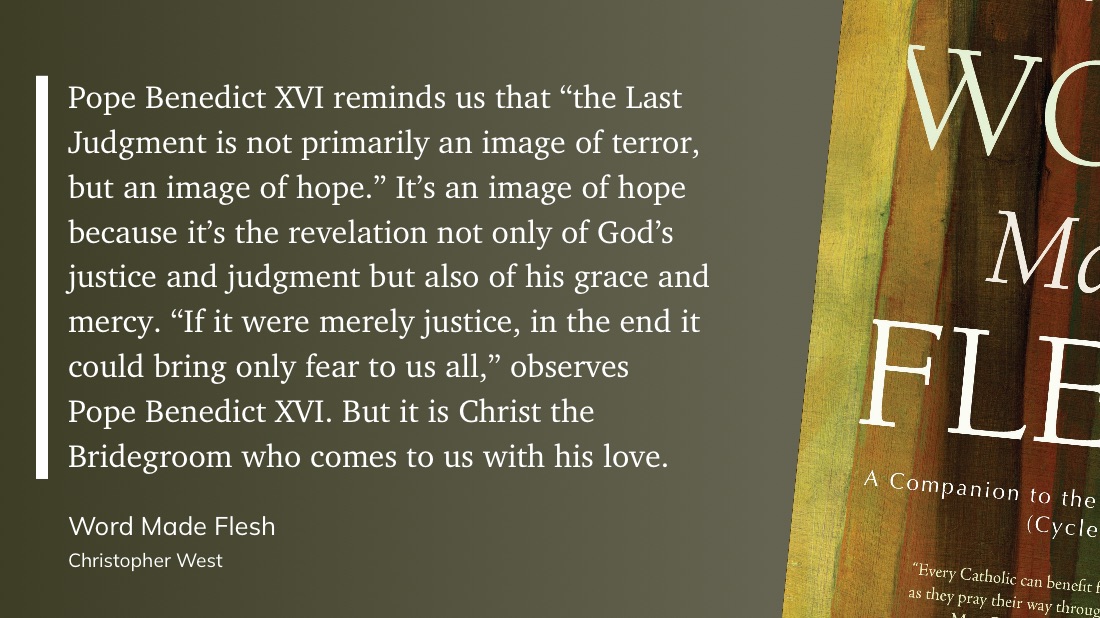
West, Christopher. Word Made Flesh: A Companion to the Sunday Readings (Cycle B). Pennsburg, PA: Theology of the Body Institute Press, 2021.
Barclay’s Commentary
Presbyterian
Publishing
Barclay, William. The Gospel of Luke (The New Daily Study Bible) Presbyterian Publishing Corporation, 1975.

Africa Bible Commentary
Zondervan
Adeyemo, Tokunboh, ed. Africa Bible Commentary. Grand Rapids, MI: Zondervan, 2010.

BEHOLD
This week’s drop
cap acrostic.
A Walk in the Word
Hector
Molina
Behold, the Advent season calls believers to enhance their spiritual readiness through vigilance, prayer, and hopeful anticipation of Christ’s Nativity and His second coming amidst worldly challenges.

Encountering the Word
Jeff
Cavins
Embarking on the Advent journey, individuals embrace preparation and vigilance as they endeavor to enhance their spiritual readiness for Christmas and the Lord’s return, minimizing distractions while enriching their faith.

Hearers of the Word
Kieren J.
O’Mahony
Heeding the call of Advent 2021, the Catholic Church embarks on a transformative journey of discernment and renewal, highlighting the significance of vigilance, a profound and dynamic faith, and active participation in preparing for Christ’s return amidst the complexities of modern times.

The Word on Fire
Bishop
Barron
Observing Advent, the faithful contemplate Christ’s threefold comings—His nativity in Bethlehem, perpetual presence in the Church, and anticipated Parousia—drawing focus on the quintessential virtues of love, community, and selfless service in readiness for His imminent return.

Mass Readings Explained
Brant
Pitre
Living in anticipation of Jesus Christ’s Second Coming necessitates cultivating love, holiness, and chastity, while concurrently yielding to a transformed identity rooted in God’s summons for sanctification.

The Word Proclaimed
Fr. Francis
Martin
Discerning the Gospel’s summons, believers are urged to remain vigilant and prayerful in expectancy of Jesus Christ’s triumphant return, acknowledging the fleeting essence of earthly wealth and the fruition of redemption, even as portents of impending judgment loom.
