Homilies
Homilies
August 9, 2026
⭐⭐⭐ Influencer Priests and Religious


Homily Anecdotes
19th Sunday of Year A

Looking for the perfect homily opener? Each week, TWTW features standout anecdotes from Fr. Tony Kadavil’s longstanding collection, along with a few fresh picks of our own.
Finding Faith in a Noisy World
The following homily anecdotes utilize distinct cultural, historical, and real-world narratives to illustrate finding faith in a noisy world:
Religious Orders

19th Sunday of Year A
Hearing the Quiet Whisper
1 Kings 19:9a, 11-13a
We live in a world consumed by noise. We look for answers in the loudest, most dramatic places—in the crushing winds of political upheaval, the earthquakes of personal crises, and the fires of constant digital distraction. Like the prophet Elijah hiding in his cave on Mount Horeb, we often expect God to reveal Himself in grand, overwhelming spectacles.
Yet, as the writer of Kings reminds us, God was not in the wind, nor the earthquake, nor the fire. He was present only in the tiny whisper—the “still, small voice.”
Saint Augustine understood this profound truth deeply. In his Confessions, he famously prayed: “Late have I loved you, O Beauty ever ancient, ever new… You were within me, but I was outside, and it was there that I searched for you.”
Augustine recognized that our greatest tragedy is not that God is distant, but that we are absent from ourselves. God is intimior intimo meo—closer to us than we are to our own hearts. Yet we spend our lives seeking Him everywhere else. We run outward into busyness, anxiety, and empty noise, leaving our inner house empty.
Elijah had to step out to the mouth of the cave and stand in silent interiority before he could hear the Lord. To encounter God, we too must cultivate the courage of interioritas. We must dare to enter the sanctuary of our own hearts, quiet our restlessness, and face ourselves honestly in prayer.
God does not shout over the clamor of our lives; He waits for us in the quiet depths of our soul. Today, step out of the cave of external distractions. Wrap your face in quiet reverence, enter your heart, and listen to the divine whisper waiting for you within.
19th Sunday of Year A
Finding Our Anchor on the Stormy Sea
Matthew 14:22-33
In today’s Gospel, we find the disciples caught in the middle of a churning sea, battered by heavy waves and tossing in the wind. When Christ calls Peter to step out onto the water, Peter begins with courage. But the moment he shifts his attention to the roaring wind, fear overwhelms him, and he begins to sink. He loses his footing because he loses his stability.
Saint Benedict recognized that our human lives often resemble that wind-tossed boat. We are easily unsettled by outer storms—unforeseen trials, sudden changes, and the restless chaos of a culture that constantly urges us to flee when things get uncomfortable. To counter this spiritual restlessness, Benedict gave his followers the essential vow of Stability.
Stability is not mere stubbornness, nor is it sitting still in comfortable complacency. It is an intentional choice of the heart to remain grounded—to stay rooted in Christ, in our faith, and in our concrete commitments, especially when the waters grow rough.
When Peter panicked, he cried out, “Lord, save me!” Immediately, Jesus reached out His hand and caught him. Jesus did not calm the storm instantly; He first restored Peter’s trust. True Benedictine stability does not mean waiting for the storm to stop before we find peace. It means fixing our eyes firmly on Christ right in the middle of the gale, trusting that His presence is our immovable rock.
Where in your life are the winds blowing hard right now? Resist the temptation to run away or sink into despair. Cry out to the Lord, grab hold of His outstretched hand, and plant your heart in His unwavering love. Grounded in Him, no wave can sweep us away.

19th Sunday of Year A
Entering the Silent Interior

Lectio Divina
ePUB | PDF
1 Kings 19:9a, 11–13a
There is a sacred thread running from a cave on Mount Horeb straight to the heart of Carmelite spirituality. In today’s first reading, the prophet Elijah stands on the mountain, waiting to encounter the Lord. He witnesses a crushing wind, a violent earthquake, and a roaring fire—yet God was in none of them. Only when a gentle, silent whisper blew across the mountain did Elijah recognize the divine presence and wrap his face in his mantle.
Elijah is the spiritual father of Carmel. In the late twelfth century, the first Carmelite hermits gathered in the quiet valleys of Mount Carmel to imitate his prayerful vigil. They learned what Elijah discovered on Horeb: that God’s presence is rarely found in life’s noise, but in the sacred space of silence and solitude.
Saint John of the Cross, one of Carmel’s greatest doctors, wrote that “the Father spoke one Word, which was His Son, and this Word He always speaks in an eternal silence, and in silence must It be heard by the soul.”
Silence is not simply the absence of noise or words. For the Carmelite, interior solitude is a dynamic, living space—a vessel prepared to receive God. When we quiet the external clamor of our daily routines and calm the restless chatter of our anxieties, we open the door of what Saint Teresa of Ávila called the “Interior Castle.” There, in the quietest center of our soul, the divine guest dwells.
Do not fear the quiet. In a world terrified of silence, step into it with trust. Wrap your heart in stillness today, as Elijah wrapped his face in his cloak, and listen closely to the loving whisper of the God who waits for you within.
19th Sunday of Year A
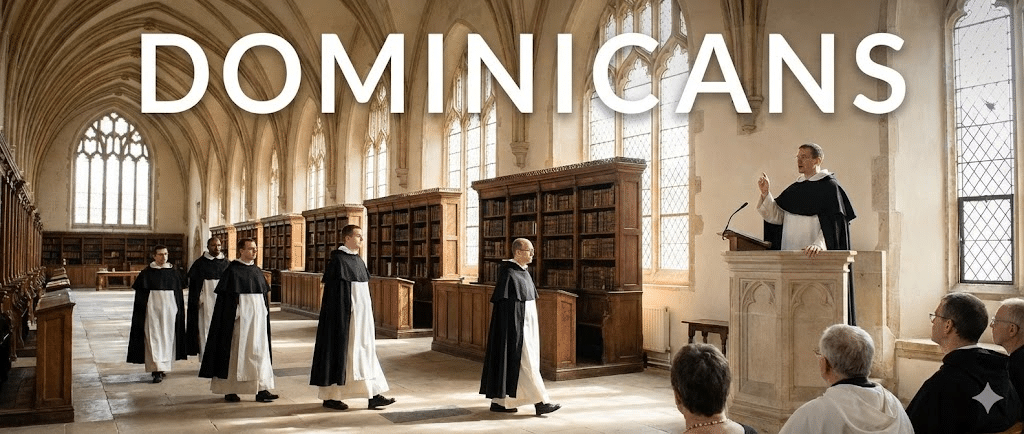
The Weight of Truth, Driven by Love

Romans 9:1–5
In today’s reading from the Epistle to the Romans, the Apostle Paul opens his heart with raw, agonizing honesty. He writes: “I have great sorrow and unceasing anguish in my heart. For I could wish that I myself were accursed and cut off from Christ for the sake of my own people.”
Here, Paul models the core of the Dominican charism: the pursuit of Veritas—Truth—driven by deep, boundless compassion for human souls.
St. Dominic de Guzmán founded the Order of Preachers because he saw a world hungering for the truth of the Gospel, yet wandering in confusion. He famously sold his precious parchment books during a severe famine, declaring: “I will not study on dead skins while living people die of hunger.” For Dominic, and for every Dominican who followed, the pursuit of truth is never a cold, intellectual exercise. True study is an act of love. Truth without compassion becomes harsh dogmatism, but compassion without truth leaves souls adrift.
St. Paul felt the profound weight of Veritas. He understood the glorious truth of God’s covenant, yet his heart broke for those among his own people who had not yet recognized Christ as the fulfillment of that promise. He did not look upon them with judgment or intellectual superiority; he looked upon them with tears, carrying their spiritual hunger as his own.
As followers of Christ, we are called to be seekers and bearers of truth in a world fractured by misinformation, cynicism, and division. But like Paul and St. Dominic, our search for Veritas must always be bathed in empathy. Let us study the scriptures, seek wisdom, and speak the truth—not to win arguments, but to bring healing, illumination, and salvation to every searching heart.
19th Sunday of Year A
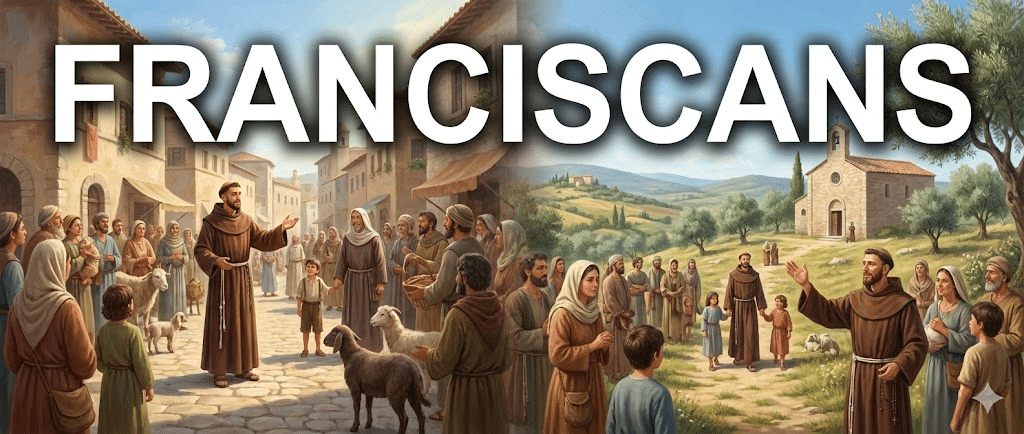
Reaching Out from the Lower Place

Matthew 14:22-33
In today’s Gospel, we see Peter stepping out of the boat into the middle of a storm. He takes a leap of faith to walk toward Jesus on the water. But as soon as he notices the violent wind, fear grips him, and he begins to sink. In his desperation, Peter cries out three simple words: “Lord, save me!”
In that moment of helpless vulnerability, Peter encounters the heart of the Franciscan spirit: Minoritas, or lesser-ness.
St. Francis of Assisi called his brothers the “Friars Minor”—the lesser brothers. He understood that true holiness does not come from our own strength, status, or self-reliance. It begins when we abandon our spiritual pride and acknowledge our own smallness before God. As long as Peter thought he could walk on water through his own boldness, he was vulnerable to the storm. It was only when he recognized his utter helplessness and sank into the lower place that he experienced the saving hand of Christ.
Jesus did not mock Peter’s weakness; immediately, He reached down and caught him.
Francis loved the human, vulnerable Christ who meets us precisely at our points of failure. When we try to play the hero, relying on our own money, power, or self-sufficiency, we easily capsize in life’s rough seas. But when we cultivate the humility of Minoritas, we stop pretending we have it all together. We learn to live like pilgrims—traveling light and trusting entirely in God’s loving providence.
Do not be afraid when the winds howl and your knees wobble. Let go of the illusion that you must save yourself. Embrace your smallness, cry out with open hands, and allow the humble, outstretched hand of Jesus to lift you up.

19th Sunday of Year A
Stepping Out into the Storm
Matthew 14:22–33
In today’s Gospel, the disciples find themselves tossed about on a dark, wind-whipped sea. Suddenly, through the mist, they see Jesus walking on the water. Their immediate reaction isn’t relief, but terror—they cry out, believing He is a ghost.
How often do we do the very same thing? In the middle of life’s chaotic storms, when anxiety, grief, or uncertainty wave over us, God draws near. Yet, blinded by fear, we misinterpret His presence as something threatening or absent entirely.
Saint Ignatius of Loyola taught us that God is actively present in every moment—even in the darkest nights and wildest gales. In his Spiritual Exercises, Ignatius gave us a way to navigate these interior storms through the discernment of spirits. He noted that in times of spiritual “desolation”—when fear, doubt, and agitation threaten to capsize us—the voice of the enemy pulls us into paralysis and despair. But the voice of the Lord brings steady courage, peace, and hope.
Notice how Jesus responds to the disciples’ fear: “Take courage, it is I; do not be afraid.”
When Peter hears this, he tests the movement of his heart and steps out onto the churning water. Yet, the moment Peter focuses on the fierce wind instead of the face of Christ, desolation takes over and he begins to sink.
Ignatian spirituality asks us to practice this same radical attentiveness in our daily lives. Where are you placing your gaze today? Are you staring at the roaring winds of your circumstances, or are you looking for the subtle, loving presence of Christ standing right beside you in the storm?
Do not be afraid to step out of the boat. Pay attention, trust His voice above the gale, and reach for His outstretched hand.
19th Sunday of Year A
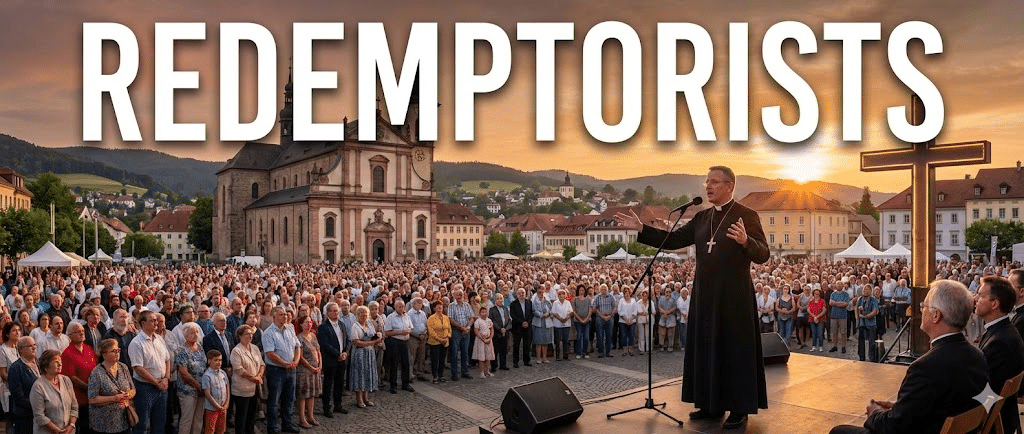
Plentiful Redemption on Stormy Waters
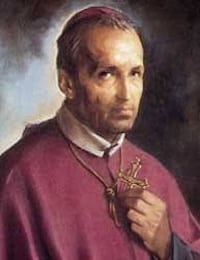
Matthew 14:22–33
In today’s Gospel, the disciples find themselves caught in the dark, tossed around by a fierce tempest on the Sea of Galilee. Peter, fueled by a surge of faith, steps out of the boat to walk toward Jesus. But the moment his eyes drift to the roaring wind and crashing waves, fear seizes him, and he begins to sink into the cold depths. In his desperation, he cries out: “Lord, save me!”
Notice what Jesus does. He does not lecture Peter about his weak faith while he is drowning. He does not leave him to struggle as a moral lesson. Immediately, Jesus reaches out His hand and catches him.
This single, compassionate gesture reveals the absolute heart of the Redemptorist charism: Copiosa Apud Eum Redemptio—with the Lord, there is plentiful, overflowing redemption.
St. Alphonsus Liguori founded our order to proclaim that God’s mercy is never timid or restrictive. Alphonsus spent his life resisting the harsh, guilt-driven theology of his day, which taught that God was a stern judge watching for us to fail. Instead, Alphonsus looked at Christ and saw a Savior whose love is swift, gentle, and abundant.
When we sink under the weight of our sins, anxieties, or life’s overwhelming storms, Christ does not stand at a distance demanding perfection before He steps in. His hand is already extended. Redemption is not something we earn by keeping our feet firmly on the water; it is a gift freely given when we admit we are sinking.
No matter how deep the water feels today, or how fiercely the wind blows around you, do not be afraid to cry out. His mercy is greater than any storm, and His saving hand is always within reach.
Click a tab to view different ways of understanding the readings.
Dicastery Notes / Papal Homilies
19th Sunday of Year A


Featured Homilies
Deacon Peter McCulloch
19th Sunday of Year A
✍️ Camera, Action
EXCERPT: In our first reading, the prophet Elijah is hiding in a cave on Mt Horeb. He’s scared because Jezebel, the wife of King Ahab, wants to kill him. He asks God what he should do, and waits for an answer. Then some strange things happen: there’s a mighty windstorm, an earthquake, and a fire. But God isn’t in any of these things.
Then in the silence Elijah hears a gentle whisper; he realises that it’s God telling him to go to Syria. From this, Elijah learns that the true God is not the God of mayhem or destruction, but the God of love, because love speaks in whispers.
For us today, this means that if you want to talk with Jesus, then make space for silence in your life. (And note that the words ‘silent’ and ‘listen’ share the same letters.)

Bishop Robert Barron
19th Sunday of Year A
▶️ A Tiny Whispering Voice (2026)

Friends, in my evangelical work online, I often encounter people who are skeptical of religion and dismissive of its claims. I usually ask them: How do we explain the intelligibility of the world or our ability to understand it? How about objective values and our ability to recognize them? Our first reading from 1 Kings reflects, I think, a great breakthrough in Western consciousness about how we’re able to identify right and wrong—just as we’re able to identify patterns in the physical world.
The Best and Worst of Religion (2020) – The more we give back to God, the more we get, and then we must give that back again, so as to get even more in return. This is the loop of grace which is spoken of from beginning to end of the Bible. And all of our readings for today touch on it specially.
Walking on Water (2005) – The compassion of Jesus creates the Church. We are the instruments of the Lord’s love for the world. How do we cooperate with him? By giving him even the little that we have and waiting for him to multiply it!
In the News
19th Sunday of Year A
When Silence is Abandoned
for a Roaring Wave
Human nature often confuses crowd size with God’s presence. In an era driven by social media subscriber counts, the Church sees “influencer priests” commanding massive online audiences. Yet behind the vanity of metrics and constant adulation, digital noise can quietly erode a sacred vocation.
Our readings today speak directly to this modern crisis. They offer a timeless roadmap for how to guard our souls against the roar of the world, whether we are on a global stage or simply scrolling through our phones.
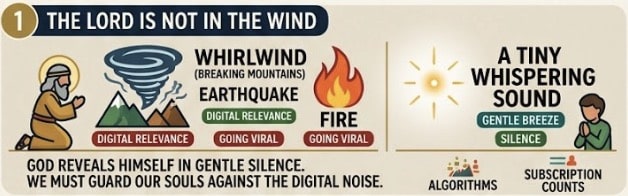
1. The Lord Is Not in the Wind
In our first reading, the prophet Elijah stands on Mount Horeb, weary, isolated, and seeking the Lord. God passes by, accompanied by three dramatic, high-energy phenomena: a crushing wind that rends mountains, a violent earthquake, and a raging fire. To the human eye, these are the ultimate displays of power. They are the biblical equivalent of going viral. But Sacred Scripture tells us that the Lord was not in the wind, not in the earthquake, and not in the fire. Instead, God reveals Himself in a "tiny whispering sound"—a gentle breeze, a shear silence.

We see the tragic cost of choosing the noise over the silence in the recent story of Father Damián María Montes, the Spanish Redemptorist priest who gained viral fame on La Voz. Amassing nearly 750,000 followers on TikTok, Father Damián spent years in the limelight, balancing catechetical videos with secular performance. Yet after three years of inner struggle, he ultimately decided to step away from his priestly ministry, acknowledging how difficult his missionary service had become under the weight of that platform.
The digital continent is built almost entirely on earthquakes and fires. It demands hot takes, constant engagement, curated aesthetics, and relentless public exposure. But a priest or religious sister—and indeed every baptized Catholic—cannot cultivate a genuine interior life in the middle of a continuous thunderstorm. When an online priest becomes swept up in the noise of algorithms, brand sponsorships, and secular applause, the quiet, daily voice of God becomes almost impossible to hear. Vocations do not usually collapse in a single day; they wither when the "tiny whispering breeze" of private prayer is drowned out by the roar of the crowd.
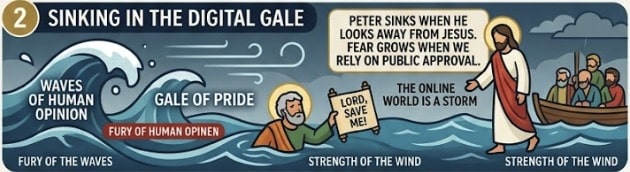
2. Sinking in the Digital Gale
This reality plays out dramatically in today’s Gospel from Matthew. The Apostles are tossed in a boat on the Sea of Galilee in the dark watch of the night. Jesus walks toward them on the water, and Peter makes a bold request: "Lord, if it is you, command me to come to you on the water" (Mt 14:28). At Christ’s invitation, Peter steps out of the boat. As long as his eyes are locked onto Jesus, he walks on top of the chaos. But the moment Peter looks away—when he focuses instead on the strength of the wind and the fury of the waves—fear takes over, and he begins to sink.

The online world is a storm of human opinion, hyper-polarization, and personal pride. Consider the experience of Cristina Scuccia, formerly Sister Cristina, who captivated the world by winning The Voice of Italy. What began as a joyful witness quickly spiraled into international media tours, record deals, and intense public scrutiny. Trapped between the rigid structures of convent life and the overwhelming freedoms and pressures of the secular music industry, she underwent a deep identity crisis. Looking at the storm around her rather than her quiet vows, she felt she could no longer figure out who she was, leading her to eventually lay down her habit and leave religious life.
When a minister of God steps onto that water, the temptation to look away from Christ is immense. Praise and adulation inflate the ego, while online hostility and harassment breed bitterness. In both cases, the gaze shifts from the face of the Savior to the noise of the storm. When we rely on public approval rather than sacramental grace, we begin to drown. Like Peter, the only recourse is to abandon self-reliance and cry out from the depths: "Lord, save me!" (Mt 14:30).

3. Sorrow for the Scattered Flock
Saint Paul touches on the profound burden of this loss in his letter to the Romans. He speaks of a "great sorrow and constant anguish" in his heart for those of his own kin who have stumbled or drifted away from the fullness of Christ (Rom 9:2).
We feel this same sorrow when we look at figures like Father Alberto Ravignani, a young Italian priest whose digital reach exploded during the COVID-19 lockdowns. Recognized as a prominent digital missionary, his online platform gradually blurred the lines between his priesthood and secular content creation—ranging from fitness routines to brand sponsorships. Eventually, the clash between the demands of the digital culture and his vows led him to leave the priesthood due to struggles with celibacy and church teaching.
When a shepherd or religious leaves their ministry, it is not simply a personal career change; it leaves a mark on the entire Body of Christ. It causes confusion among the faithful, sadness for the Church, and scandal for a world desperately in need of authentic witnesses to the Gospel. Paul reminds us that our true identity is found in Christ, who is "over all, God blessed forever" (Rom 9:5). Vocations of poverty, chastity, and obedience are meant to point directly to the eternal kingdom, not to personal branding, cultural relevance, or worldly freedom.

4. Returning to the Silence
Brothers and sisters, the modern digital landscape challenges every one of us to examine where we seek validation. We do not need to be internet personalities to fall into the trap of letting the world’s noise dictate our spiritual health. We must all step back from the tempest. We must have the courage to log off, seek solitude, and step into the quiet sanctuary of the confessional and the Blessed Sacrament.
Let us pray fervently today for our priests, bishops, and religious. Pray that they are protected from the traps of pride and worldly fame, and that they find their strength not in the applause of millions, but in the quiet, faithful service of Christ and His Church.
When the storms of culture howl around us, let us fix our eyes firmly on Jesus, step out in faith, and trust the Master who commands the wind and waves.
EWTN NEWS (Feb. 6, 2026): Why Have Some Priest Social Media Influencers Left the Priesthood?
This essay based on this Sunday's readings and current events was developed collaboratively using artificial intelligence alongside human pastoral curation and theological editing. It is not intended as a finished script, but as a catalyst to spark reflection, provide thematic inspiration, and support preachers in crafting their own authentic homilies for their communities.

The Lord is Not in the Wind
Sinking in the Digital Gale
Sorrow for the Scattered Flock
Returning to the Silence
Fr. Michael Chua
19th Sunday of Year A

✍️ Courage! It is I

EXCERPT: The traditional name we Catholics use to speak of courage is “fortitude.” The Catechism of the Catholic Church (#1808) teaches that “Fortitude is the moral virtue that ensures firmness in difficulties and constancy in the pursuit of the good. It strengthens the resolve to resist temptations and to overcome obstacles in the moral life. The virtue of fortitude enables one to conquer fear, even fear of death, and to face trials and persecutions. It disposes one even to renounce and sacrifice his life in defence of a just cause.”
One of the greatest myths about courage or fortitude is that it means not feeling afraid. If ‘I were brave and courageous, I wouldn’t feel anxious, panicked or worried,’ we might think. But fortitude isn’t the absence of fear. It’s the willingness to be present and respond in spite of fear.
It means we have the capacity to see clearly and act prudently during a crisis. It means we have enough wisdom so that we don’t freak out when things go haywire—or, perhaps even more importantly, so that we don’t shut off in denial and pretend everything is okay.
Dominican Blackfriars
19th Sunday of Year A
✍️ Awesome Wonder
EXCERPT: The event of our first reading, the prophet Elijah’s encounter with God, occurs on the mountain. And whenever we hear of such encounters on the mountain, they leave us with an incredible sense of the otherness of God: as though we catch a tiny glimpse of the greatness and power of God, and of something of the difference between God and his creatures, even those that are chosen by him for some great service. The reaction to such an encounter is a sense of awe and wonder, and a sense of unworthiness. This awe and wonder, and are captured in the response of those who have such an encounter, perhaps most especially in the gesture of covering their faces. Elijah does just that when he encounters God in the sound of the gentle breeze, an encounter that is preceded by great and terrifying signs, where nature seems to be untamed. In the moment of stillness, having brought nature to stillness, God is encountered in his power and in his gentleness.

Fr. Austin Fleming
19th Sunday of Year A
✍️ The Voice of God
EXCERPT: Let me begin with a few questions…
- Whose voice in your life do you turn to most frequently for advice and guidance, for answers to your questions?
- Regardless of where you turn for advice, whose voice in your life actually has the most impact on your thinking, your choices and decisions?
- What voices in your life are in competition for your attention and which of those voices usually wins?…
But let me ask one more question: how about the voice, the word of God?

Monsignor Peter Hahn
19th Sunday of Year A
▶️ Life’s Ups and Downs
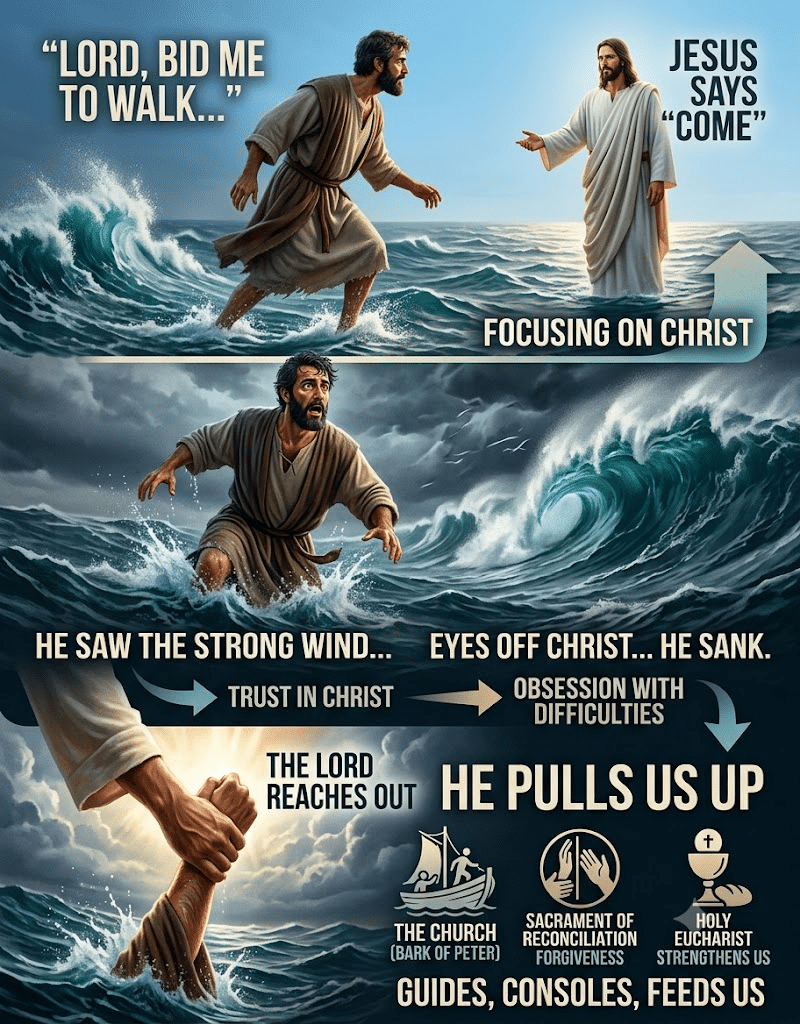
EXCERPT: Peter doesn’t figure out how to do this by himself. He doesn’t somehow calculate how to defy gravity. He simply looks to Christ. He keeps his eyes and his focused on him trusting not thinking of really what he is even really doing.
But then we are told that he saw how strong the wind was. He took his eyes off of Christ. He’s now looking at the situation. He finds himself in and he begins to sink and isn’t that exactly what you and I do almost every day. We have times of great satisfaction and peace hopefully in our lives of prayer and our service and our families. But then we have those great struggles and we take our eyes off of him and we only focus and maybe a better phrase as we become obsessed with whatever difficulty or trial that we are facing and we to begin to sink but the Lord reaches out for us.
As he did for Peter. He pulls us back into the boat that bark of Peter when the images used for the church. He guides us always with the truths that our faith discloses to us. He consoles us and forgives us in the Sacrament of Penance and Reconciliation. He feeds us that he strengthens us with this Blessed Sacrament of his very body and blood in the Holy Eucharist.
Fr. Charles E. Irvin
19th Sunday of Year A
✍️ Where is God?

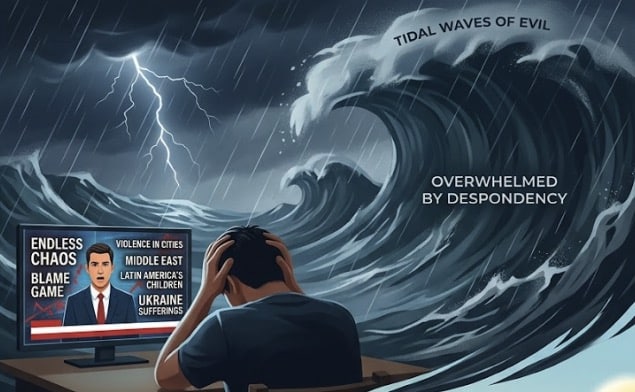
EXCERPT: Watching TV news reports night after night can lead us into despondency to the point where we might lose our faith in the basic goodness in our world that seems to be buried alive in the tidal waves of the evils that are reported. Over and over again we are confronted by the actions and inactions of our government in Washington. Instead of concrete corrections we hear nothing but the blame game going on between our nation’s leaders. Added that that are the endless reports of violence in our cities, the horrors inflicted by terrorists in the Middle East, the sufferings of children from Latin America that are crossing our borders in order to escape the violence they face caused by the drug lords in their home countries, and the sufferings of people in the Ukraine. I could go on and on but won’t. We know we’re drowning in chaos. We know we are carrying heave burdens…
Is your life getting out of control? Is your faith slipping away from you? Are you experiencing more and more powerlessness in the chaos that surrounds you? If so, here’s what you do. Find a place of solitude and silence. Go to your room, shut your door and gather around you as much silence and solitude as you possibly can. Then kneel down by your bedside and in that silence and in that solitude say: “Speak, Lord, for your servant is listening.” If you do that, you’ll be in exactly the same position that Elijah was. Look into the eyes of Jesus, you’ll be in exactly the same position that Peter was.
The real question, you is not “Is God absent from us.” Rather the real question is: “Are we absent from God?”
Fr. Joe Jagodensky, SDS
19th Sunday of Year A
✍️ No Homily Available

Fr. Langeh, CMF
19th Sunday of Year A
▶️ Look Unto Jesus

EXCERPT: When faced with life’s challenges, it is good to follow Jesus’ example. Jesus found time to go up to the hills by Himself to pray. He wanted space where he could be alone and a time when he could be with His Father… The evangelist Matthew only mentions Jesus praying at really critical moments like on a stormy night and in the Garden of Gethsemane just before his death. It is at such moments that Jesus draws strength from God and sheltering in the divine intimacy of the Father’s love. In such busy situations, Jesus did what Elijah had done before…
We can take comfort, knowing that Jesus is praying for us during the storm. We can take courage, knowing that His coming will bring us great peace. However, such comfort and courage will only come to those who are willing to serve Him now. Are you in the “boat” and “rowing” in the service of Jesus Christ, the Son of God?
Life is all about taking and bearing risks. Most people avoid taking risks. Peter had the choice of remaining in the boat’s “comfort zone” or of moving on the rough sea with Jesus. He chose to walk with Jesus. And he began sinking. If you want to walk on water, you must come out of the boat and strive to imitate Christ. So always look unto Jesus instead of thinking of sinking.
Msgr. Charles Pope
19th Sunday of Year A
✍️ Fix Your Focus
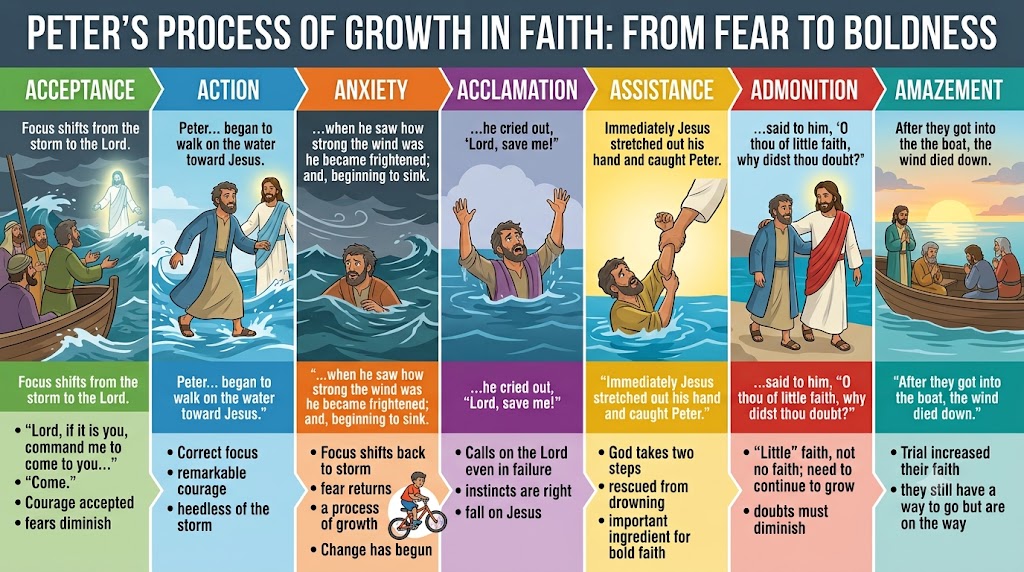
EXCERPT: The Gospel today is about faith and about focus. It teaches that although storms and struggles inevitably arise, we have a choice as to whether we focus on them or on Jesus. The message is clear: “Keep your eyes on the prize. Hold on!”
Let’s look at this Gospel in three stages: Perceived Distance, Produced Distress, and Point of Decision. I have also included a fourth section for more in-depth study: Process of Development….
OUTLINE:
I. Perceived Distance
II. Produced Distress
III. Pointe of Decision
IV. Process of Development
Father Kevin Rettig
19th Sunday of Year A
▶️ When You Fall
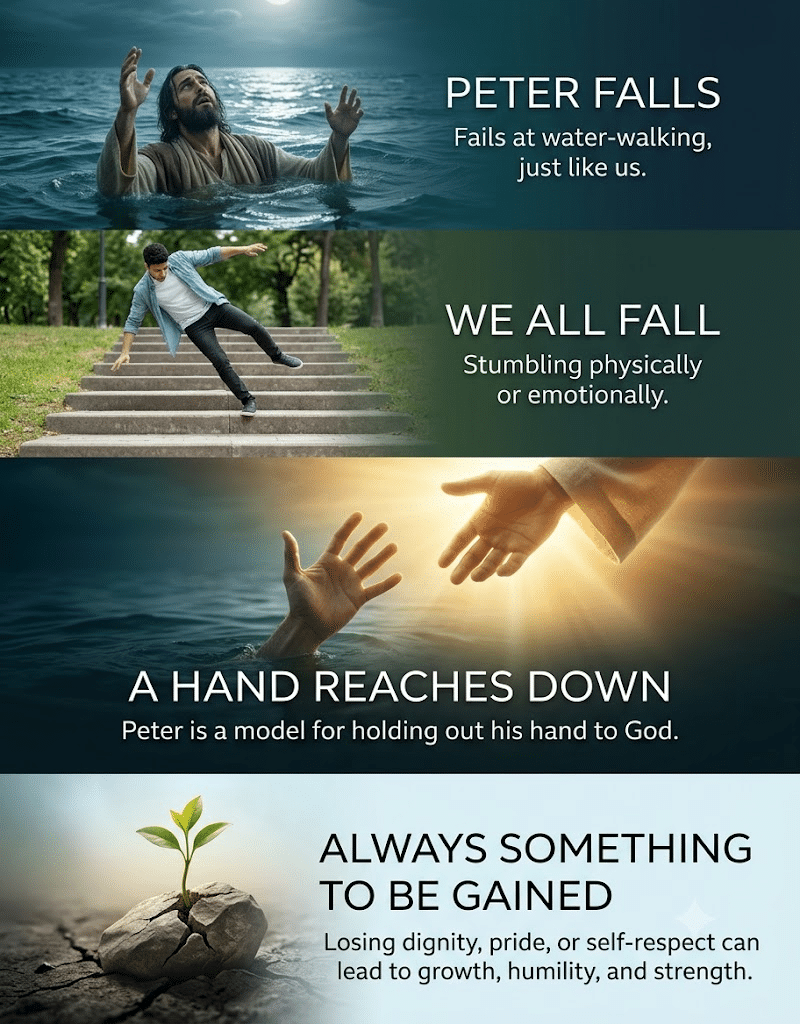
EXCERPT: Peter was trying to walk on the water. He didn’t succeed; he fell, just like most of us would. Walking on water? I fall walking on steps! Peter is a model for all of us, not because he was able to walk on water—he wasn’t, and we have no record of him ever mastering the art of water-walking. He became a saint and a model for us because he fell, and while falling, held out his hand so that God could take him by the hand and lift him up.
When you fall—when you don’t live up to your own expectations—you lose some things. For a moment, you might lose your dignity, you might lose something of your pride, or you might even lose something of your self-respect. You lose something when you fall, even a little, but there is always something to be gained when you fall.
Fr. George Smiga
19th Sunday of Year A
✍️ Why Walk on Water?

Matthew 14: 22- 33
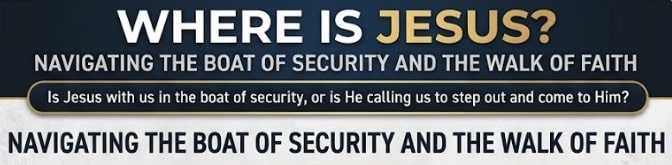
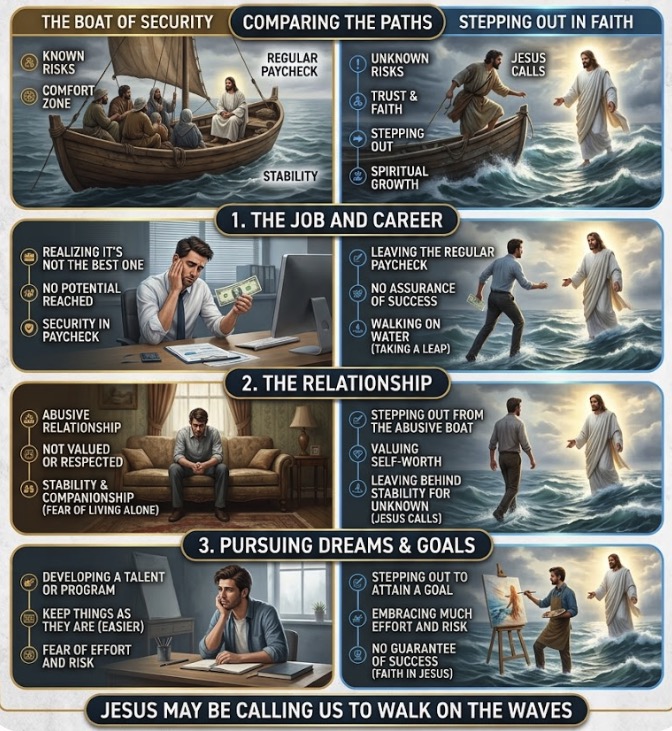
EXCERPT: Where is Jesus? Is Jesus sitting with us in the boat of security in which we sail, or is Jesus calling us to step out of that boat and come to him? We might have realized for some time that the job we are in is not the best one for us and that we will never reach our potential if we stay in it. And yet, there is security in that regular paycheck and we have no assurance that we could find something better. The disciple asks, “Where is Jesus?” Is he with me in the boat in which I sit? Or is he asking me to step out of that boat and walk on the water? We might be in a relationship that is abusive, in which we are not valued or respected. And yet, there is stability and some companionship in the relationship, and we are terrified to think that we might have to live alone. The disciple asks whether Jesus is asking us to stay in the security of that relationship or to leave it behind. We might for years have had a dream to develop some talent that is ours, to organize a program, to attain a goal. But that would require much effort and some risk, and we have no guarantee that we would succeed. It is certainly easier to keep things the way that they are. But Jesus may be calling us to walk on the waves.
Additional Homilies
19th Sunday of Year A

Fr. Vincent Hawkswell | Archive
Stop the Small Talk in Church (2023)

Fr. George Corrigan, OFM
In the Boat, On the Water
Commentary (PDF)
Msgr. Joseph Pellegrino (PDF) | Archive
The Tiny Whispering Sound (2023)
Fr. Tommy Lane | Archive
God is waiting to answer us 2023
Growing through trials like Peter
Amazing Grace that saved a wretch like me!
Trusting in Jesus when problems occur
stories about faith
Fr. Michael Fallon, MSC | Archive
19th Sunday in Ordinary Time (PDF)
