“Death and life” are the two words which may be used to summarize the liturgy which honors the faithfully departed. In the Gospel, Jesus offers himself as the bread of life and says that the Father wants all men to share eternal life. Isaiah places before our eyes the banquet of life, in which God will destroy death forever and will wipe away the tears from every cheek (First reading). And in his letter to the Romans, Saint Paul states that “So it is proof of God’s own love for us, that Christ died for us while we were still sinners.” (Second reading).
Hunger and thirst accompany man in his pilgrimage on earth from the cradle to the grave. Let us not only consider hunger for bread or thirst for water. It must be recognized that from the time he is born, man is hungry for God and thirsty for eternal life. His spiritual nature and his vocation to live in the image of God agitate his entire being and make him constantly long for his Origin and his Destiny.
In Jesus Christ, man satisfies his hunger for God, because he is the bread that has come down from Heaven with which God the Father feeds his children: Bread of the Word made Gospel, Bread of the Eucharist converted into the body and blood of God himself. The Holy Spirit quenches man’s thirst for eternal life, because he is the living water that Christ gives us so that we shall no longer be thirsty. In this life, God satiates our hunger for himself and our thirst for eternal life, but in a limited way; however we are tempted to satisfy our hunger and thirst not in God but in creatures. Only after death will God be our only Bread and our only Water, our true nourishment and drink forever.
The first reading exalts the banquet of life that God has prepared in Zion for all people, a feast which foreshadows the banquet in the heavenly Jerusalem, when Jesus Christ will vanquish all his enemies, and death itself, and will deliver the Kingdom to his Father. In this way, death is presented to us as the invitation to the banquet of life, hosted by God himself. Actually, it is not life that leads to death, but death that leads to life. We normally speak about "life and death," but today’s liturgy urges us to change the order of those terms and prefer "death and life", because it is life that is triumphant in the duel against death; the banquet to which God invites us is not a funereal banquet, but a banquet to celebrate life.
INFOGRAPHIC
Death as Prologue to Book of Life
SHOW/HIDE DICASTERY NOTES
In the years of his existence, man frets in his search. He is an eternal seeker. He seeks to be loved and to love; he seeks knowledge, science, power; he seeks fame; he seeks the truth and life; he seeks God. If he seeks with sincerity and perseverance, he will find what and who he is looking for. He will find God, and he will find life. There is no doubt that man’s life is an eternal search.
But what is death if not the moment at which our search ends and the final encounter with ourselves, with the truth, and with God begins? To have eternal life: isn’t this the greatest and ultimate aspiration of all of man’s quests, even when he undertakes painful and senseless paths, that lead him in the opposite direction from the one that leads to the true object of his search?
Isn’t eternal life also the ultimate and greatest gift that God wishes to personally give to each man? In the Gospel we read, "It is my Father’s will that whoever sees the Son and believes in him will have eternal life, and I will raise that person up on the last day." Death, which condenses in itself our ephemeral existence, may thus well be considered only as a short prologue to the book of life.
INFOGRAPHIC
Light from the Passover of Christ
SHOW/HIDE DICASTERY NOTES
The previous reflections should be seen within the context of the mystery of Christ’s death, whom the Father resurrected from the dead, and who allows us to share in his life. Let us imagine Christ’s death as the great ocean where we find all those who have died throughout history, and his resurrection as the new Paradise prepared by the risen Christ for all those who have been enlightened by his Light.
The life which the liturgy speaks to us about is not only the immortality of the soul (hence the need for its spiritual nature), but rather its sharing in soul and body, in the life of the risen Christ.
The light of the mystery of the Son of God, Jesus Christ, who died and was raised from the dead for us, to wrench us away from death and make us participate in life, enlightens in a completely unique way our earthly life, the end of life with death, and the joyful beginning of an endless life in the company of God and all the saints.
INFOGRAPHIC
Pastoral Suggestions
Christian Vision of Death & Life
SHOW/HIDE NOTES
A certain materialist and horizontal attitude has become dominant, especially in the last two centuries. We say that death is the end of life, but perhaps we are forgetting that it is really the dawn of a new life. When we speak about life we refer to earthly existence, perhaps because "the other life" is not part of our mental schemes, or because we are so well settled in this life that we would rather not think about its fleetingness and its final moment. Life is not only an earthly term; it also belongs to the language of the eternal. We may need to learn this language of the eternal and practice it, for when we cross the threshold to the other side there may be no-one who understands our language, and there certainly will not be any interpreters. A day like today is a valuable time for us to rejuvenate our concepts and our mentality, so that we may open our heart more widely to the realities that await us after death. "The life of those who believe in you, Lord, does not end, it is transformed; and as our earthly home falls apart, we acquire an eternal mansion in Heaven," we pray in the preface to the deceased. And Saint Theresa of the Child Jesus exclaimed, "I am not dying, I am entering life." This is a propitious time for the catechesis on the resurrection of the flesh and on eternal life starting with the pages that the catechism of the Church devotes to such themes (CCC 988-1060).
INFOGRAPHIC
Praying for the Faithfully Deceased
SHOW/HIDE NOTES
In recommending the soul of the dying person to God, the Church speaks to the moribund with gentle assuredness, "Christian soul, in leaving this world, walk forth in the name of God the Father the Almighty, who created you in the name of Jesus Christ, the Son of the living God, who died for you, in the name of the Holy Spirit, who came down upon you. Enter the place of peace and may your home be with God in Zion, the holy city, with the holy Virgin Mary, Mother of God, with saint Joseph and all the angels and saints."
This is what we wish for the dying person, with all of our heart, and this is what we ask God when we pray for him, once he has died. We are bound to our deceased by the bonds of blood and faith, this is why we continue to love them and want what is good for them through our prayers.
The Church, as the mother of all Christians, intercedes on behalf of the deceased each day in every holy mass, "Remember our brothers and sisters who have gone to their rest in the hope of rising again; bring them and all the departed into the light of your presence." (Eucharistic prayer, II). Let us pray for them with a fraternal heart, for they are our brothers and sisters in faith, who have preceded us in the way to eternity. Let us pray for them with sincerity and humility of heart, in order that our intercession on their behalf with God may be heard and in order for them to be able to "always be with the Lord."
INFOGRAPHIC
Non-profit ministries have permission to copy/paste any infographics on this website into bulletins, presentations, or class/home school worksheets. A link and/or shoutout to THE WORD THIS WEEK and respective contributors would be greatly appreciated.
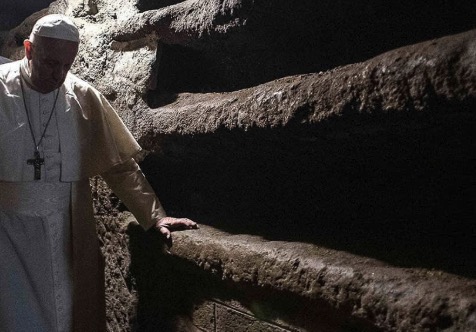
Pope Francis walks through the Catacombs of Priscilla where he celebrated Mass in Rome Nov. 2, 2019, the feast of All Souls. (CNS photo/Vatican Media)
2 November 2019- Catacombs of Priscilla, on the Via Salaria Wisdom 3:1-9 and the Beatitudes
“The celebration of the feast of all the departed in a catacomb — it is the first time in my life that I enter a catacomb, it is a surprise — tells us many things,” begins Pope Francis.
READ EXCERPT FROM POPE FRANCIS' HOMILY
The celebration of the feast of all the departed in a catacomb — it is the first time in my life that I enter a catacomb, it is a surprise — tells us many things. We can think about the lives of those people who had to hide, who had that custom of burying the dead and celebrating the Eucharist in here. It was a bad period in history, but one which has not been overcome. It continues still today. There are many of them. Many catacombs in other countries where people even have to pretend to be having a party or a birthday in order to celebrate the Eucharist as it is forbidden in that place. Today too there are many persecuted Christians, even more than in the first centuries; more. This — the catacombs, the persecution, the Christians — and these Readings make me think of three words; identity, place and hope.
Pope Francis begins by noting the profound setting: his first-ever visit to a catacomb. This setting immediately brings to mind its original purpose: a hiding place for early Christians who were burying their dead and celebrating the Eucharist in secret during a time of intense persecution.
Key Idea: The Pope draws a direct and startling line from this past persecution to the present. He states that even today, “there are many persecuted Christians, even more than in the first centuries.”
The Central Theme: This experience of the catacombs, combined with the day’s readings, brings “three words” to the Pope’s mind which form the structure of his entire homily: Identity, Place, and Hope.
Reflection Questions:
Why does Pope Francis emphasize that persecution is not just a “bad period in history” but “continues still today”?
How does understanding this present-day reality change how you hear the rest of the homily?
This part of the homily answers the question: “What is a Christian?”
READ EXCERPT FROM POPE FRANCIS' HOMILY
The identity of those people who gathered here to celebrate the Eucharist and to praise the Lord is the same as that of our brothers and sisters of today in many, many countries where being Christian is a crime; it is forbidden; they have no rights. The same. The identity is the one that we have heard: theBeatitudes. The identity of the Christian is this: the Beatitudes. There is no other. If you do this, if you live like this, then you are Christian. “No, but look, I belong to that association, to the other ... I am with this movement ...”. Yes, yes all fine things but they are fantasies with respect to this reality. Your identity card is this [he points to the Gospel], and if you do not have this, all the movements to which you may belong and your memberships in others are useless. You either live this way or you are not Christian. Simple. The Lord said this. “Yes but it is not easy, I do not know how to live like this ...”. There is another passage in the Gospel that helps us better understand this and that Gospel passage will also be the “great protocol” by which we will be judged. It is in Matthew 25. With these two Gospel passages, the Beatitudes and the great protocol, by living this, we will show our identity as Christians. Without this, there cannot be an identity. There is the pretence of being Christian, but not the identity.
Main Point: A Christian’s identity is not defined by belonging to an association, a movement, or a group. These, he says, are “fantasies” compared to the core reality.
The “Identity Card”: The Pope holds up the Gospel and states that our “identity card” is found in two key passages:
The Beatitudes (Matthew 5:3-12): “Blessed are the poor in spirit, those who mourn, the meek…” This is the character of a Christian.
The Great Protocol (Matthew 25:31-46): “I was hungry and you gave me food, I was thirsty and you gave me drink, a stranger and you welcomed me…” This is the action of a Christian.
Summary: If you live by the Beatitudes and the “great protocol” of Matthew 25, you are a Christian. Without them, you have the “pretence of being Christian, but not the identity.”
Reflection Questions:
What is one concrete way I can live out one of the Beatitudes this week?
Do I tend to define my Christian identity more by the Beatitudes or by the groups I belong to (my parish, my Bible study, my service organization)?
When I read Matthew 25, do I see a checklist of actions or a description of a way of life?
This part of the homily answers the question: “Where does a Christian belong?”
READ EXCERPT FROM POPE FRANCIS' HOMILY
This is the identity of the Christian. The second word: the place. Those people who came here to hide to be safe, and also to bury their dead; and those people who today celebrate the Eucharist in hiding in the countries where it is forbidden ... I am thinking about that nun in Albania who was in a re-education camp in the Communist era when it was forbidden for priests to administer the Sacraments. And this nun used to baptize them in secret. The people, the Christians knew that this nun administered Baptisms and mothers used to approach her with their babies. However, she did not have a glass, something in which to collect water. She did it with her shoes. She would take water from the river with a shoe and baptize them. The place of Christians is a bit everywhere. We do not have a privileged place in life. Some would like to have it. They are “qualified” Christians. But they run the risk of remaining with just the “qualified” and dropping the “Christian”. What is the place of Christians? The “souls of the righteous are in the hand of God” (Wis 3:1): the place of Christians is in the hand of God where he wants them to be. God’s hands which are wounded, that are the hands of his Son who wanted to take the wounds with him to show them to the Father and intercede for us. The place of the Christian is in the intercession of Jesus before the Father. In God’s hands. And there we are safe come what may, even the cross. Our identity [he points to the Gospel] tells us that we will be blessed if they shall persecute us, if they say something against us; but if we are in God’s hands, wounded by love, we are safe. This is our place. And today we can ask ourselves: Where do I feel safest? In God’s hands or in other things, with other securities that we “rent” but which in the end will fail, that do not have any solidity?
Main Point: Christians do not have a “privileged place” in the world. The Pope warns against becoming “qualified” Christians who seek special status, as they “run the risk of remaining with just the ‘qualified’ and dropping the ‘Christian’.”
The True Place: Our true place is “a bit everywhere,” often in hidden or difficult circumstances, just like the Christians in the catacombs or the nun in Communist Albania he describes.
The Albanian Nun: This powerful story illustrates the point. To baptize babies, she had to fetch water from a river using her shoe. Her “place” was one of risk and creativity in service.
The Safest Place: The ultimate “place” for a Christian is “in the hand of God.”
The Key Image: These are not just any hands; they are the “wounded” hands of Christ, who shows His wounds to the Father and intercedes for us. Being in this “place” means we are safe, even when facing persecution or “the cross.”
Reflection Questions:
Does the story of the Albanian nun challenge my ideas of what is “proper” or “necessary” for worship and sacrament?
Where do I seek my “safest place”? In my job? My finances? My reputation? Or “in God’s hands”?
What does it mean, practically, to live “in God’s hands” when I am facing fear or uncertainty?
This part of the homily answers the question: “What is our future?”
READ EXCERPT FROM POPE FRANCIS' HOMILY
These Christians with this identity card who lived and live in God’s hand are men and women of hope. And this is the third word that comes to mind today; hope. We heard it in the second Reading: that final vision where everything is “re-done”, where everything is recreated, that homeland we will all go to. And in order to enter it, there is no need for strange things, there is no need for attitudes that are somewhat sophisticated. All that is required is to show the identity card: “It is fine, go ahead”. Our hope is in Heaven, our hope is anchored there and holding the rope in our hands, we steady ourselves by looking at the shore of the river that we must reach.
Identity: Beatitudes and Matthew 25; Place, the safest place: in God’s hand, wounded by love. Hope, the future: the anchor there on the other shore, but I am firmly clinging to the rope. This is important, always clinging fast to the rope! Many times, we will only see the rope, not even the anchor, not even the other shore, but cling to the rope and you will reach it safely.
Main Point: Our hope is not just for a better life on earth, but for the “final vision… that homeland we will all go to,” where everything is “re-created.”
The Key Image: Pope Francis uses the powerful analogy of an anchor.
Our hope is “anchored” in heaven, on the “other shore” of the river we must cross.
We are here, on this side, “clinging to the rope.”
He emphasizes that “many times, we will only see the rope, not even the anchor, not even the other shore.”
How to Get There: To enter this homeland, no “sophisticated attitudes” are needed. All that is required is to “show the identity card” — the life lived according to the Beatitudes and Matthew 25.
Summary: Our Identity (Beatitudes) is our passport to our true Place (in God’s hands), which gives us Hope (anchored in heaven) for the future.
Reflection Questions:
What does “clinging to the rope” look like in my daily life, especially when I can’t “see” the anchor or the other shore?
How does this eternal hope change the way I should view my struggles today?
Do I live as if my “identity card” is what truly matters for my final destination?
This Sunday’s Gospel presents Jesus healing 10 lepers, of whom only one, a Samaritan and therefore a foreigner, returned to thank him (cf. Lk 17: 11-19). The Lord said to him: “Rise and go your way; your faith has made you well” (Lk 17: 19).
This Gospel passage invites us to a twofold reflection. It first evokes two levels of healing: one, more superficial, concerns the body. The other deeper level touches the innermost depths of the person, what the Bible calls “the heart”, and from there spreads to the whole of a person’s life. Complete and radical healing is “salvation”. By making a distinction between “health” and “salvation”, even ordinary language helps us to understand that salvation is far more than health: indeed, it is new, full and definitive life.
Furthermore, Jesus here, as in other circumstances, says the words: “Your faith has made you whole”. It is faith that saves human beings, re-establishing them in their profound relationship with God, themselves and others; and faith is expressed in gratitude. Those who, like the healed Samaritan, know how to say “thank you”, show that they do not consider everything as their due but as a gift that comes ultimately from God, even when it arrives through men and women or through nature. Faith thus entails the opening of the person to the Lord’s grace; it means recognizing that everything is a gift, everything is grace. What a treasure is hidden in two small words: “thank you”!