General Intercessions, Prayers of the Faithful for Sunday Mass.
General Intercessions,Prayers of the Faithful for Sunday Mass.
Create preaching tips for a catholic priest giving a homily for the xxxxxxx Sunday in Ordinary Time (Year C) focused on xxxxxxxxxxx Use the New American Bible translation.
Break the tips into four areas: 1 ) General Tips 2) Tips for preaching to an older congregation,for each tip give suggestions 3) Tips for preaching to a younger congregation, for each tip give suggestions 4) Tips for preaching using the Catechism
Preach the Good News, not scolding: The central theme of every homily must be the Good News of Jesus Christ—what God has done, is doing, and wants to do. Moral challenges should flow naturally from this good news, not be presented as a list of "shoulds" and "oughts".
Understand your community: An effective preacher knows the lives, joys, and struggles of the people to whom they are preaching. This allows you to apply the timeless truth of the Gospel to their concrete, contemporary situations.
Embrace the Church's teaching: Ground your homilies in the rich history and doctrine of the Catholic faith. Explain how the Scriptures lead to the Church's teachings and how these doctrines contribute to human happiness.
All Souls Day
The readings for All Souls' Day weave a powerful tapestry of hope, countering the finality of death with the assurance of God's unwavering love and fidelity. The core message is that for the faithful, death is not an end but a passage into the secure and loving hands of God, a truth guaranteed by the sacrifice and promise of Jesus Christ.
Acknowledge the Grief, Preach the Hope
This is a day heavy with memory and loss. Begin by acknowledging the reality of grief in the pews.
Validate the human experience of sadness, but quickly pivot to the profound hope offered in the readings. The homily's goal is not to erase sorrow but to frame it within the promise of eternal life.
CONTINUE READING
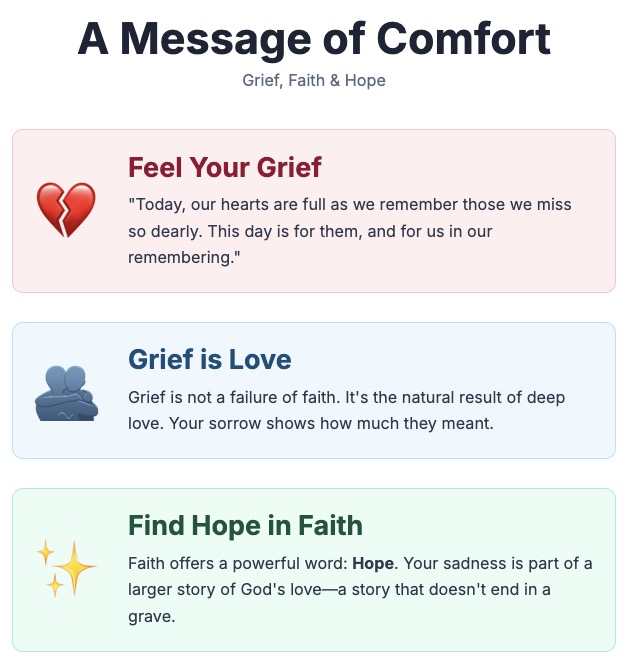
Suggestion: Start by directly acknowledging the pain present in the room. You might say something like, "My friends, today our hearts are full. For some of us, the grief is fresh and sharp. For others, it's a long-held ache for a parent, a spouse, a child, or a friend we miss dearly. This day is for them, and it is for us, in our remembering." This validates everyone's personal experience.
Validate, Don't Dismiss: Emphasize that grief is not a failure of faith; it is the natural consequence of deep love. The sorrow we feel is a testament to the importance of the person we lost.
Pivot to the Promise: After validating their feelings, create a bridge to the readings. For example: "And it is precisely into this very real human experience of loss that our faith speaks its most powerful and defiant word: Hope. The readings today do not ask us to pretend we are not sad. Instead, they invite us to place our sadness into the larger story of God's love—a story that does not end in a grave, but in the eternal embrace of our Father." This reframes the entire liturgy not as an erasure of sorrow, but as its ultimate context.
Use a Central Image
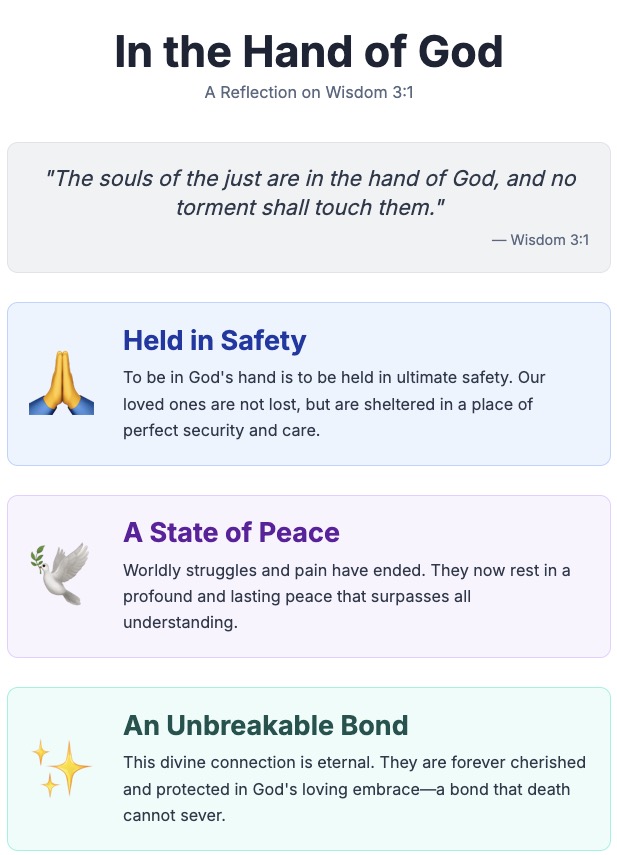
The image from Wisdom 3:1, "The souls of the just are in the hand of God," is a powerful and comforting anchor.
Return to this image throughout the homily. What does it mean to be held in God's hand? It implies safety, love, protection, and a bond that not even death can break.
CONTINUE READING
Start by directly acknowledging the palpable sense of loss in the church. This validates everyone's personal experience and creates an atmosphere of shared, gentle understanding.
Suggested Text: "My friends, today our hearts are full. For some of us, the grief is fresh and sharp, an open wound. For others, it's a long-held ache for a parent, a spouse, a child, or a friend we miss dearly. And for some, it is a quiet, prayerful remembrance of generations past. This day is for them, and it is for us, in our remembering. We gather under the weight of our love, a love that death cannot erase, and we bring it here, to the altar of the Lord."
Why it works: It’s inclusive, gentle, and acknowledges that grief has many forms and timelines. It frames remembrance not as a burden, but as an act of enduring love.
Transition from the feeling of loss to the comfort of the scripture. The "But..." at the start of the verse is a pivot from worldly appearance to spiritual reality.
"The souls of the righteous...": Address the immediate question in people's minds: "Was my loved one righteous?" Gently reassure the congregation that righteousness, in this context, isn't about human perfection. It's about a life lived in faith, a heart that strived for God, a soul that trusted in His mercy. It is the righteousness gifted to us by Christ. Our prayers today are an expression of our loving hope that our deceased are counted among the righteous in the mercy of God.
"...are in the hand of God...": This is the central image. Make it tangible.
A Hand of Safety: It is not a fist, but an open, protective, cupped hand. The image conveys ultimate security. Nothing can snatch them away. They are held, protected, and secure.
A Hand of Love: Think of the tenderness with which you might hold a fragile baby bird or a precious family heirloom. God holds our loved ones with an infinitely greater tenderness and love. He doesn't just hold them; He cherishes them.
A Hand of Identity: In the palm of God's hand, they do not lose who they are. Their soul, the very essence of the person we loved, is preserved and known by God.
"...and no torment shall touch them.": This speaks directly to our deepest fears.
Contrast with Earthly Torment: Many of our loved ones suffered in this life, whether from physical illness, mental anguish, or spiritual struggles. This promise is one of final peace and release from all that pain. The torments of this world have passed away.
The Ultimate Peace: The ultimate torment is separation from God. This scripture promises the opposite: a profound and lasting union with Love itself. This is the peace that surpasses all understanding.
Bridging the Scripture to Our Grief
"The words from the Book of Wisdom are a great comfort, but they don't deny our reality. We miss their laugh. We miss their advice. We miss their physical presence in our lives. Our grief is the testament to their importance. The scripture does not ask us to stop missing them. Instead, it gives us a new way to picture them: not lost in a dark void, but safe and cherished in the loving hand of our eternal Father. Our grief and God's promise can coexist."
Give the congregation concrete actions rooted in our faith.
Pray: Emphasize that our prayers for the dead matter. They are our connection to them through the Communion of Saints. Our prayers are an act of love, helping to complete their journey toward the fullness of God's presence.
Remember: Encourage people to not just mourn the death but to celebrate the life. Tell a story about your loved one today. Look at an old photograph and give thanks for the joy they brought. Cook their favorite meal. We keep their spirit alive by carrying their goodness forward.
Trust: The act of coming to Mass on All Souls' Day is an act of trust. We are entrusting our loved ones, and our grief, into the very hands of God that hold them now.
Tie the homily to the Liturgy of the Eucharist.
"In a few moments, we will approach the altar to receive the Eucharist. In this great mystery, heaven and earth touch. As we receive Christ, we are in the most profound communion possible not only with Him, but with the entire Church—those of us here on earth, and those who are held safely in the hand of God. We are one family, united in a love that is stronger than death."
Connect the Readings
Explain Praying for the Dead
Frame this practice as a profound act of love and communion.
Our prayers are an expression of our unbreakable bond with our loved ones in the Communion of Saints. We are still connected, and our prayers are a tangible sign of that ongoing love, helping them on their final journey home.
CONTINUE READING
Why We Pray for the Dead: An Act of Unending Love
In the Catholic faith, the practice of praying for those who have died is one of the most ancient, cherished, and profound expressions of our belief in a love that death cannot conquer. It is not a morbid preoccupation with the past, but a vibrant and hopeful act of communion, rooted in our understanding of the Church as one family in Christ—a family whose bonds are not broken by physical death.
The Communion of Saints: A Family Beyond Death
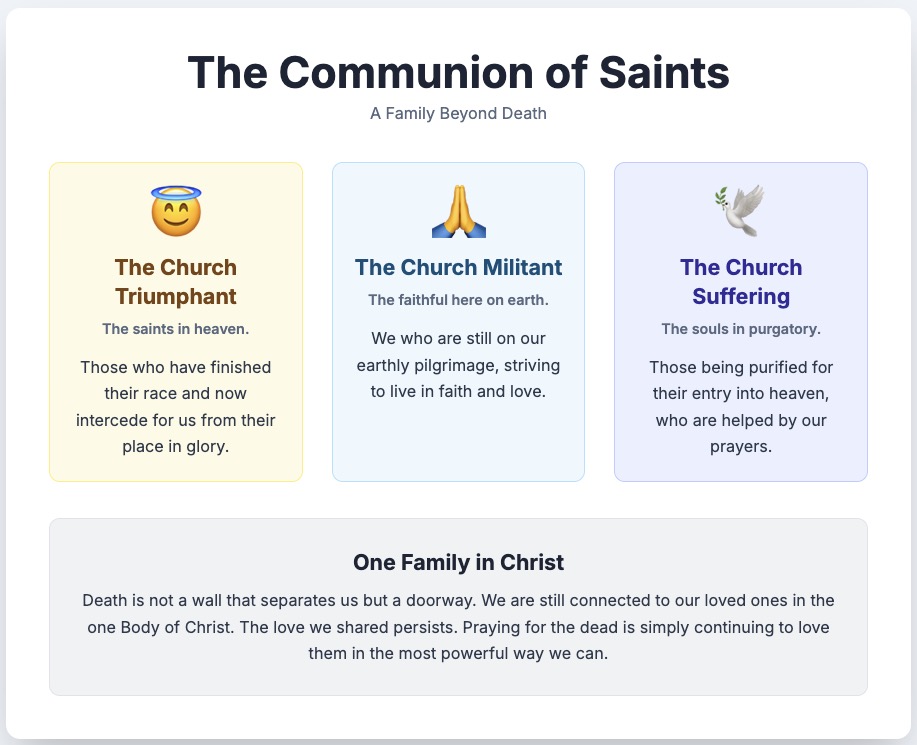
At the heart of this practice is our belief in the Communion of Saints. We profess this every time we say the Apostles' Creed. This doctrine teaches us that the Church is a single body, united in Christ, with three parts that are eternally connected:
The Church Triumphant: The saints in heaven.
The Church Militant: The faithful here on earth.
The Church Suffering (or Penitent): The souls in purgatory being purified for their entry into heaven.
Death, in this view, is not a wall that separates us but a doorway through which our loved ones have passed. We are still connected to them in the one Body of Christ. The love we shared, the bonds we forged—these are spiritual realities that persist. Praying for the dead is simply continuing to love them in the most powerful way we can.
Prayer: A Tangible Sign of Unbreakable Love
Our love for someone doesn't end when they die. We still think of them, miss them, and cherish their memory. Prayer transforms this passive love into an active, powerful force. It is a tangible sign that our relationship continues. When we pray for our deceased family and friends, we are expressing our unbreakable bond and telling them: "We have not forgotten you. We still love you. We are with you on your journey."
This is why the Church encourages us to have Masses said for the dead, to pray the Rosary for them, and to simply offer our own personal prayers. These are not empty gestures; they are real acts of charity and mercy directed toward those we love.
Helping Them on Their Final Journey Home
The Catholic Church teaches that most people who die in God's friendship are not yet perfectly purified to enter the dazzling, holy presence of God in heaven. This final state of purification is what we call Purgatory. It is not a "second chance" or a place of hopeless punishment, but a state of cleansing and healing, where a soul is made ready to experience the fullness of God's love. It is a process born of God's immense mercy.
Our prayers matter in this process. Just as our prayers can help a friend struggling here on earth, they can also help a soul being purified for heaven. Our prayers are a powerful expression of our solidarity with them, assisting them on their final journey home to the Father. It is a beautiful and merciful work we can do for those we still love so dearly, an ultimate act of care for them as they prepare to enter into eternal joy.
In the end, praying for the dead is one of the greatest expressions of Christian hope. It is a confident declaration that Jesus Christ has conquered the grave and that, in Him, our relationships are eternal. It is a testament to a love that is, truly, stronger than death.
Authenticity is Key: Don't try to be someone you're not or use slang you don't know. Youth can spot inauthenticity immediately, so be yourself.
Be You: Let your personality shine through to make your sermon more relatable and impactful.
Meet them in their world: Understand the cultural context of the young people you're speaking to.
Make the Message Stick
Tell Stories: Like Jesus, share stories that illustrate biblical truths and help make personal connections between the message and their lives.
Use Visuals and Interaction: Engage multiple senses by using movie clips, objects, or games to make the message more memorable.
Encourage Participation: Involve the audience through actions like raising hands, shouting answers, or taking polls to foster interaction.
All Souls Day
Young people may be less familiar with the tradition, more fearful or distant from the topic of death, and seeking a message that connects to their lived experience.
Demystify All Souls' Day
Start by explaining what this day is in simple terms. "Today is the day the Church sets aside to remember, love, and pray for everyone we love who has died.
It’s not meant to be scary; it's meant to be hopeful. It's our way of saying that love is stronger than death.
CONTINUE READING
When addressing young people on All Souls' Day, it's essential to create a message that resonates with their experiences and emotions. Here are some suggestions to help you effectively connect with your youthful audience:
Simplify the concept: Start by explaining All Souls' Day in a way that is easy for them to understand. Try saying, "All Souls' Day is a special day when we, as a Church, come together to remember and show our love for all the people we care about who have passed away. It's a day of hope, not fear."
Make it relatable: Help teens connect with the idea by asking them to think of loved ones they've lost—family members, friends, or even pets. Emphasize that love transcends death, and our prayers for them are a way to keep that love alive.
Use familiar imagery: Draw on analogies from popular movies, books, or TV shows to illustrate the concept of purgatory and our role in praying for souls in this state. This can make the topic more approachable and understandable.
Emphasize community: Highlight the importance of communal prayer and the unity of the Church across all its members, both living and deceased. This will help young people appreciate the support that comes from being part of a spiritual family.
Encourage engagement: Invite the youth to actively participate in the Mass, perhaps by reading the names of their departed loved ones during the prayer intentions or lighting candles as a symbolic gesture of remembrance.
Focus on hope: Make sure to emphasize that All Souls' Day is ultimately about hope and God's love. The day serves as a reminder that our ultimate destiny lies in eternal union with God, and our prayers are a means of supporting one another on that journey.
By tailoring your message in this way, you can make All Souls' Day more relatable and engaging for young people, fostering a deeper understanding of this rich Catholic tradition.
Contrast Cultural Fear with Christian Hope
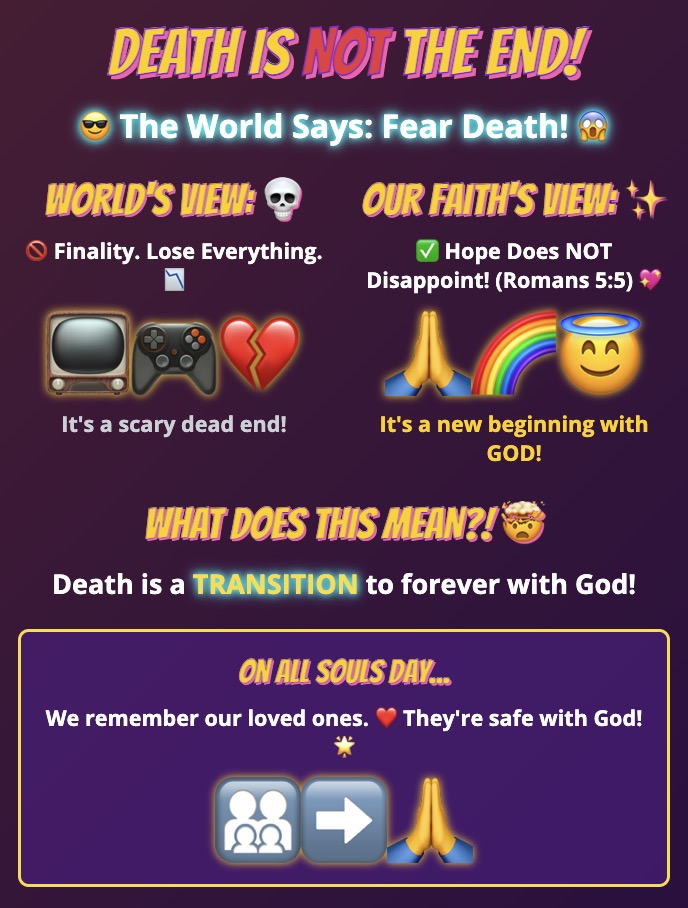
Acknowledge that our culture often portrays death as a terrifying end.
Contrast that with the radical message of Romans 5:5: "hope does not disappoint." Ask a rhetorical question: "In a world that often tells us everything ends, what does it mean to have a hope that is a sure thing?" Present Christianity as the ultimate counter-narrative to despair.
CONTINUE READING
In today's world, death is frequently depicted as a dreadful finality—a specter to be feared and avoided at all costs. This portrayal is prevalent in our movies, TV shows, and other media. It is as though the world shouts that death is the end, and we should despair.
However, the beautiful and radical message of our faith paints a dramatically different picture. As St. Paul so beautifully and succinctly states in Romans 5:5, "hope does not disappoint." This is a hope that transcends the limited understanding of the world.
In a world that so often declares that everything must come to a bitter end, we must ask ourselves a crucial question: What does it truly mean to possess a hope that is a certainty?
This is where our Christian faith shines forth as the ultimate counter-narrative to despair. It is our Christian belief that death is not the end but a transition to a life where we will be in communion with God. We remember with love and honor all those who have gone before us. And this, my dear young friends, is the hope that we celebrate on All Souls Day. This is the hope we carry with us every day, a hope that conquers fear.
So, even as the world may instill dread and despair, let us remember that we are a people of faith, and ours is a hope that does not disappoint. It is our Christian duty and privilege to share this message of hope with others, illuminating the path to eternal life and vanquishing the darkness of despair.
Use a Modern Analogy
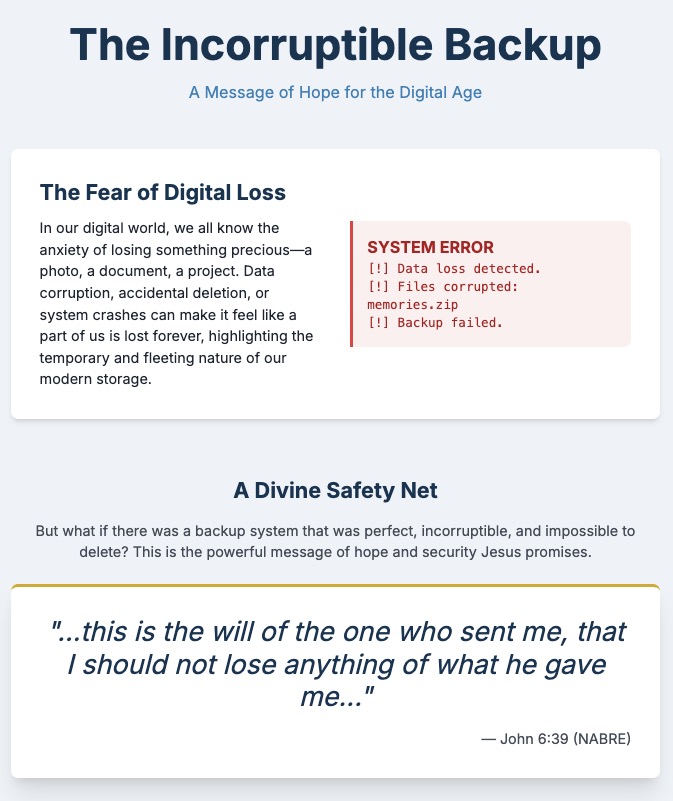
Jesus' promise in John 6:39 that he "should not lose anything" can be compared to a divine safety net or an incorruptible file backup.
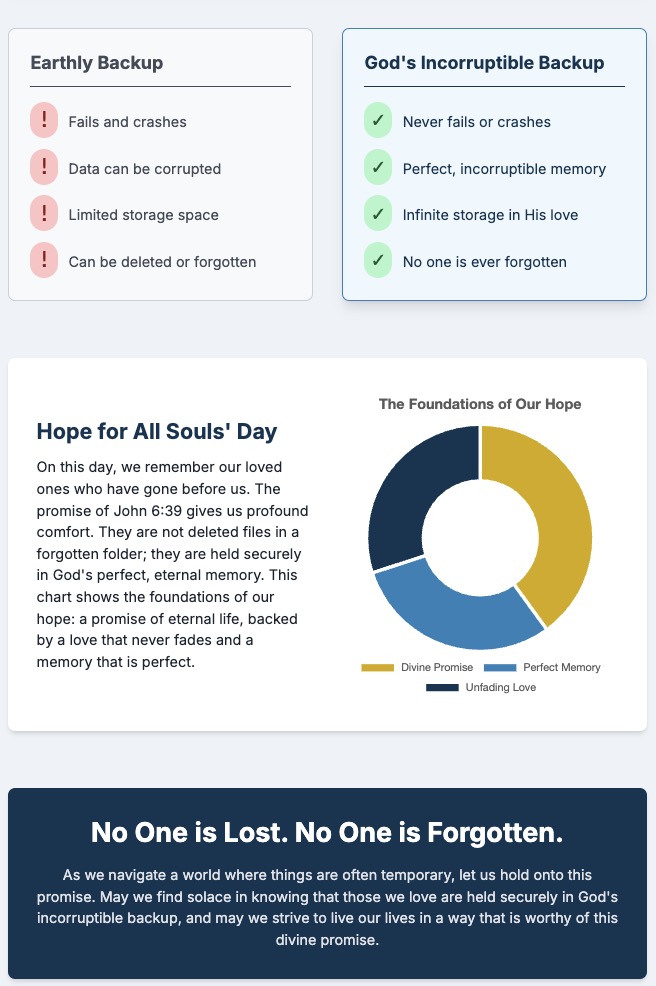
In a world where things are easily lost or deleted, God's memory and love are perfect. No one is forgotten. No one is lost. God's love has us saved and secure.
CONTINUE READING
Today, in this digital age, we're all familiar with the fear of losing valuable data. It could be a cherished photo, an important document, or a creative project we've poured our heart and soul into. No matter how diligent we are, there's always the risk of data corruption, accidental deletion, or a system crash. And when these things happen, it can feel like a part of us is lost forever.
But what if there was a backup system that was perfect, incorruptible, and impossible to delete? What if there was a love so powerful that it kept a record of everything precious to us, never forgetting a single detail? That's exactly the kind of love that Jesus promises in John 6:39 when he says, "I should not lose anything."
Think of it like a divine safety net, an incorruptible backup where everything is stored securely in God's memory. It's a backup that never fails, never crashes, and never runs out of storage space. This is a powerful message of hope and security in a world where things are easily lost or forgotten.
On this All Souls Day, we remember our loved ones who have gone before us. We take comfort in the knowledge that they are not forgotten, that they are safe and secure in God's eternal memory. This is the power of God's love. No one is lost. No one is forgotten. And in this, we find hope and peace.
So as we navigate a world where things are often temporary and fleeting, let us hold onto this promise of God's everlasting love and perfect memory. May we find solace in knowing that those we love are held securely in God's incorruptible backup, and may we strive to live our lives in a way that is worthy of this divine promise.
Make It About Love
Frame the homily around the theme of love. The pain of death is the pain of missing someone we love.
The promise of heaven is the promise that love is eternal. Our prayer for the dead is our love in action. This connects the liturgy to a universal human experience.
CONTINUE READING
HThis guide provides a structured approach to a homily for All Souls' Day, centered on the universal and enduring theme of love.
1. The Starting Point: Acknowledge the Pain of Love Lost
Begin by connecting with the congregation's most immediate feeling: grief. Frame this pain not as a punishment, but as a direct measure of the love they shared with the deceased.
Key Message: "The deep pain we feel today is not a sign of God's absence, but a testament to the profound love we were blessed to share. Grief is the price of love, and it is a pain that unites every one of us in this church today."
Goal: To validate the congregation's feelings and create a shared space of understanding and empathy.
2. The Central Promise: Emphasize Eternal Love
Transition from the pain of temporary separation to the hope of eternal reunion. Heaven is the ultimate promise that the love we cherish does not die with the body.
Key Message: "Our faith does not ask us to believe that love ends; it promises that love is eternal. The people we miss are not lost to us forever. We are separated for a time, but we are promised a joyful reunion in a place where love is not bound by time or space, but is perfected in the presence of God."
Goal: To lift the congregation's perspective from earthly loss to heavenly hope.
3. The Spiritual Connection: Explain Prayer as an Expression of Love
Present prayer not as a mere ritual, but as an active, powerful expression of a love that still connects us to our loved ones.
Key Message: "Our prayers for the dead are a powerful testament to our unending love. They are not just words spoken into the air, but acts of love that cross the boundaries between life and death. Prayer is our sacred line of communication, our way of staying connected, soul to soul, with those we love."
Goal: To empower the congregation by showing them a tangible way to continue their relationship with the deceased.
4. The Liturgical Act: Connect Love to the Service
Help the congregation see the entire All Souls' Day liturgy as a collective expression of their love.
Key Message: "Everything we do here today is an act of love. The scriptures we read tell the story of God's loving promise. The prayers we offer are our love made vocal. The candles we light are symbols of the light of Christ and the warmth of our love, dispelling the darkness of grief."
Goal: To make the liturgy more personal and meaningful for each person present.
5. The Call to Action: Encourage Loving Action on Earth
Remind the congregation that love for the deceased should inspire loving action in the present. Love is not passive; it is active.
Key Message: "How do we honor our beloved dead? By letting our love for them overflow into the world. Comfort someone else who is grieving. Share a happy story or a fond memory of the person you miss. Perform an act of kindness in their name. This is how we keep their spirit, and their love, alive on earth."
Goal: To provide concrete, positive actions that channel grief into goodness.
6. The Concluding Hope: Emphasize the Ultimate Power of Love
End the homily by bringing all the points together under the triumphant banner of love. It is the ultimate force that transcends all boundaries.
Goal: To leave the congregation with a powerful, memorable, and hopeful message that will carry them through their grief.
Key Message: "In the end, everything comes back to love. Love binds us together in life. Love comforts us in our grief. And love gives us unwavering hope for the future. Love is the promise of All Souls' Day, the promise of our faith, and the promise of God Himself. It transcends time and space, life and death."
Preach the familiar gospel: While it's always important to share the gospel, remember that many seniors have heard these messages their entire lives. Repeat familiar, comforting messages like "God will take care of you," "He never leaves us," and "Heaven is our final home".
Emphasize Jesus and the Sacraments: Focus on the person of Jesus, his life, promises, and resurrection, and the sacraments, rather than controversial topics that may divide the audience.
Tell stories. Seniors often respond well to storytelling, which can help them remember and connect with the message.
Connect the past and present: Acknowledge the life they have lived while reminding them that the "God of then is still the God of now."
Address aging realistically: Acknowledge the reality of aging, including loneliness, loss, and physical pain.
All Souls Day
The congregation has likely experienced significant loss and is deeply connected to the Church's traditions surrounding death and remembrance.
Focus on Comfort and Assurance
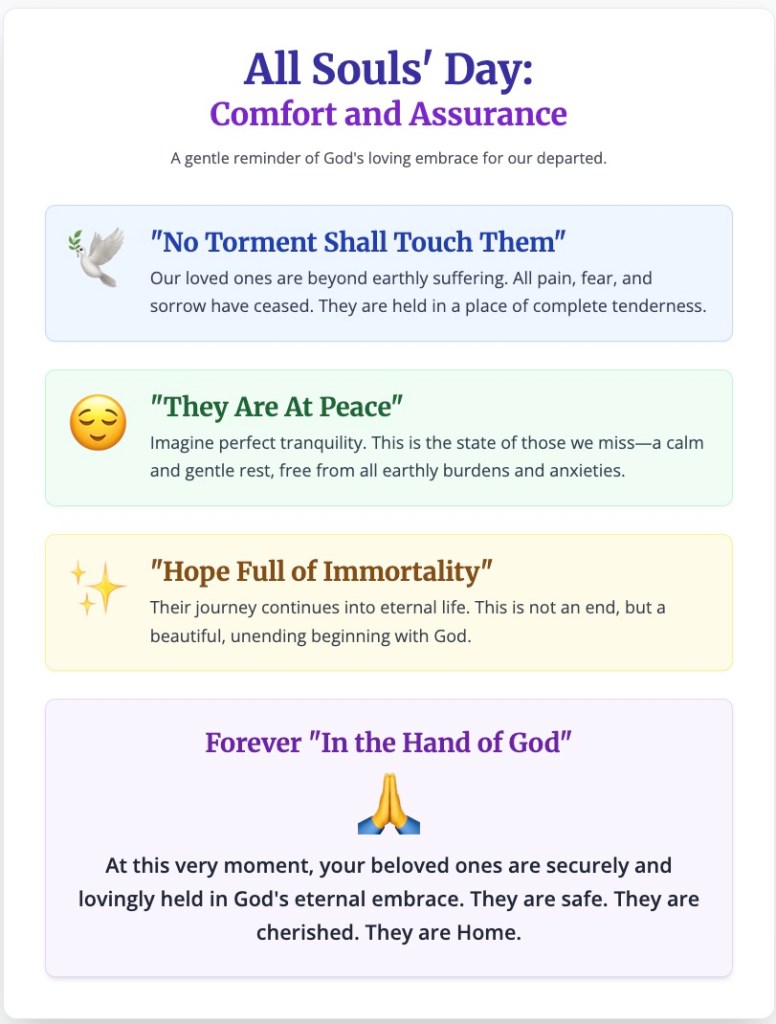
Linger on the phrases from Wisdom: "no torment shall touch them," they are "at peace," and their hope is "full of immortality."
These words are a direct balm for the anxieties that can accompany aging and the loss of peers and spouses. Gently repeat that our loved ones are, at this very moment, "in the hand of God."
CONTINUE READING
Validate a Lifetime of Faith
Connect the congregation's lifelong practice of attending Mass, praying rosaries, and participating in the sacraments to the promise in John 6.
Their fidelity is the very belief Jesus speaks of when he says, "everyone who sees the Son and believes in him may have eternal life." Affirm that their life of faith has real, eternal significance.
CONTINUE READING
Reinforce the Communion of Saints
Speak of the "great cloud of witnesses" (Hebrews 12:1) that now includes their spouses, parents, and friends. Emphasize that we are not separated from them.
The Mass is a moment where that veil between heaven and earth is at its thinnest. Our prayers join their prayers, and one day, we will be reunited in that same communion.
Connect Scripture and Catechism: Use the liturgical readings as a starting point, but then clearly tie them to the established teachings of the Catechism.
Emphasize the Living God: Preaching should aim to help listeners encounter the living God through faith, fostering a sense of personal relationship and community.
Keep it Concise: Aim for brevity to maintain listener attention, as attention spans can wane after 10-12 minutes.
Show, Don't Just Tell: Use illustrations and repetition of key phrases to make the message clearer and more memorable.
Appeal to the Whole Person: Engage the listeners' minds, hearts, and wills to encourage reflection and a response to the Good News.
All Souls Day
Communion of Saints
Catechism Link:CCC 958: "Our prayer for them is capable not only of helping them, but also of making their intercession for us effective."
Use this to show that our relationship with the dead is not a one-way street. As we pray for them, they are perfected in love and become powerful intercessors for us. This makes the Communion of Saints a dynamic, living reality.
CONTINUE READING
Define the Communion of Saints: The Communion of Saints is the spiritual union of all believers, both living and dead. It is a communion in Christ that transcends time and space, and is grounded in the love of God.
The Power of Intercession: As mentioned in the Catechism of the Catholic Church (CCC 958), our prayers for the souls in purgatory not only aid them in their journey towards heaven, but also strengthen their ability to intercede for us. This is a profound testament to the power of prayer and the interconnectedness of all believers in Christ.
A Dynamic Relationship: Our relationship with the dead is not one-way. It is a dynamic exchange of love and intercession that benefits both the living and the dead. As we pray for the souls in purgatory, we help to purify and perfect them in love. In turn, they become powerful intercessors for us, praying for us from their place in heaven.
A Living Reality: This dynamic exchange of love and intercession makes the Communion of Saints a living reality. It reminds us that death does not sever our relationships with our loved ones, but transforms them into a spiritual communion that transcends earthly boundaries.
Personal Connection: Encourage the congregation to think of their loved ones who have passed. Explain that by praying for them, they are not only helping them on their journey to heaven, but also fostering a deeper spiritual connection with them. This can bring comfort and hope to those who are grieving.
A Call to Action: Invite the congregation to actively participate in the Communion of Saints by praying for their loved ones and all souls in purgatory. Remind them that in doing so, they are contributing to the spiritual growth and perfection of the deceased, and are also receiving the gift of their intercession.
Define Christian Hope
Catechism Link:CCC 1817: "Hope is the theological virtue by which we desire the kingdom of heaven and eternal life as our happiness, placing our trust in Christ's promises..."
Connect this directly to Romans 5. The "hope that does not disappoint" is not just wishful thinking; it is a theological virtue, a gift from God. It is a confident expectation based not on our own merits, but on the reliability of Jesus' promises, as heard in the Gospel.
CONTINUE READING
Theological Virtue: Christian hope is more than just optimism or wishful thinking. As described in the Catechism of the Catholic Church (CCC 1817), it is a theological virtue—a gift from God that allows us to desire and strive for the kingdom of heaven and eternal life as our ultimate happiness.
Trust in Christ's Promises: Christian hope is grounded in trust. It is a confident expectation based not on our own merits or abilities, but on the unfailing promises of Christ. This is the "hope that does not disappoint" that St. Paul speaks of in Romans 5. It is a hope that can withstand the trials and tribulations of life because it is rooted in the unwavering reliability of Jesus' promises.
Active and Dynamic: Christian hope is not passive. It is an active and dynamic virtue that calls us to participate in God's plan of salvation. It inspires us to live our lives in accordance with Christ's teachings and to work towards building the kingdom of God on earth.
Personal Connection: Encourage the congregation to reflect on their own hopes and desires. Explain that Christian hope goes beyond earthly goals and ambitions; it is a supernatural virtue that enables us to desire and strive for the ultimate goal of union with God.
A Hope for All: Christian hope is not exclusive. It is a gift available to all who accept it. It is a hope that transcends age, race, culture, and all other earthly divisions. It is a hope that unites us in our common desire for the kingdom of heaven and eternal life.
A Call to Hope: Invite the congregation to embrace Christian hope. Remind them that this is not a naive optimism, but a confident trust in the promises of Christ. Encourage them to live their lives with this hope as their guiding light, and to share this hope with others.
Clarify Purgatory as an Act of Mercy
Catechism Link:CCC 1030: "All who die in God's grace and friendship, but still imperfectly purified, are indeed assured of their eternal salvation; but after death they undergo purification, so as to achieve the holiness necessary to enter the joy of heaven."
Frame Purgatory not as a place of punishment, but as the ultimate expression of God's love—a final cleansing that prepares us to withstand the full glory of His presence. This is why our prayers are so vital; they are an act of mercy, assisting our loved ones in this final purification. This links directly to Wisdom's assurance that the just are in God's hands, even as they are purified.
CONTINUE READING
Understanding Purgatory: Purgatory is often misunderstood as a place of punishment. However, as stated in the Catechism of the Catholic Church (CCC 1030), Purgatory is a state of purification for those who die in God's grace but are still imperfectly purified. It is a final cleansing that prepares us for the fullness of God's glory in heaven.
An Act of Mercy: Far from being punitive, Purgatory is the ultimate expression of God's love and mercy. It is God's way of ensuring that we are fully prepared to enter into His presence and experience the joy of heaven. This understanding of Purgatory links directly to the assurance in the Book of Wisdom that the just are always in God's hands, even as they undergo purification.
The Importance of Prayer: Our prayers for the souls in Purgatory are not a desperate plea, but an act of mercy. They are a way of accompanying our loved ones on their journey towards perfection and holiness. Our prayers provide comfort, strength, and spiritual support to the souls undergoing purification.
A Call to Prayer: Encourage the congregation to pray for their loved ones who have passed, especially those who may be undergoing purification in Purgatory. Remind them that this is not a duty or obligation, but an act of love and mercy. It is a way of participating in God's plan of salvation and sharing in His divine mercy.
Personal Connection: Invite the congregation to reflect on their own need for purification and perfection. Explain that none of us are perfect, and that's okay. We are all on a journey towards holiness, and Purgatory is a part of that journey. It is a reminder of God's love and mercy, and a sign of His desire to see us fully perfected in love.
Anchor Everything in the Resurrection
Catechism Link:CCC 989: "We firmly believe, and hence we hope that, just as Christ is truly risen from the dead and lives for ever, so after death the righteous will live for ever with the risen Christ..."
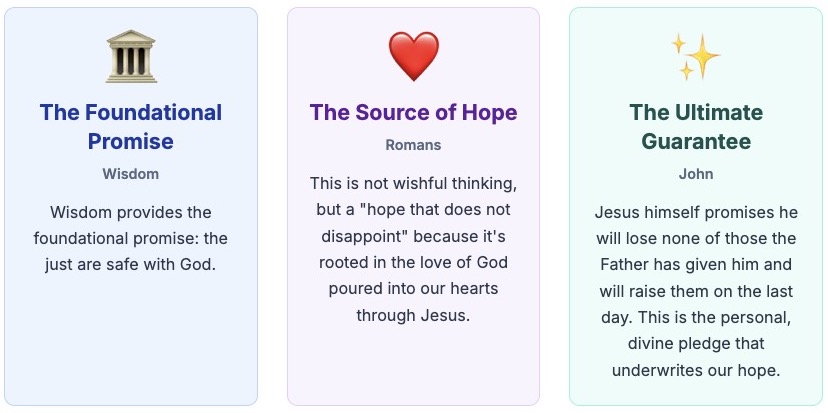
Use this to tie the entire homily together. The promises of Wisdom, the hope of Romans, and the guarantee of John all find their ultimate meaning in the Resurrection of Christ. This is the bedrock of our faith and the reason we can gather on All Souls' Day not in despair, but in triumphant hope.
CONTINUE READING
The Centrality of the Resurrection: The Resurrection of Christ is the cornerstone of our faith. It is the event that gives meaning to all of God's promises, including those found in the Book of Wisdom, the hope expressed in Romans, and the guarantee given in John. Without the Resurrection, our faith would be in vain.
A Triumphant Hope: The Resurrection is not just a historical event; it is a living reality that infuses our faith with triumphant hope. It is the promise that death is not the end, but a transition into eternal life with Christ. This is why we can gather on All Souls Day not in despair, but in hope and expectation.
The Promise of Eternal Life: As stated in the Catechism of the Catholic Church (CCC 989), we believe that just as Christ is truly risen from the dead and lives forever, so too will the righteous live forever with the risen Christ. This is the promise that gives meaning to All Souls Day. It is the promise that those who have gone before us are not lost, but are living eternally with Christ.
A Call to Faith: Encourage the congregation to deepen their faith in the Resurrection. Remind them that this is not just a doctrine to be believed, but a reality to be lived. It is a truth that transforms our lives and gives us hope in the face of death.
Personal Connection: Invite the congregation to reflect on what the Resurrection means for them personally. How does it change their perspective on death? How does it give them hope? How does it inspire them to live their lives differently?
Living the Resurrection: Finally, challenge the congregation to live out the reality of the Resurrection in their daily lives. This means living with hope, spreading the message of eternal life, and working to build the kingdom of God on earth. It means living as people of the Resurrection, who know that death is not the end, but the beginning of a new and glorious life with Christ.