Homilies
Homilies
October 25, 2026
⭐⭐⭐ Beyond Stone Tablets


30th Sunday of Year A

Looking for the perfect homily opener? Each week, TWTW features standout anecdotes from Fr. Tony Kadavil’s longstanding collection, along with a few fresh picks of our own.

Love ‘Till the
Very End
At the height of his fame and health, actor Christopher Reeve became quadriplegic following a riding accident. Contemplating letting go of life, he was renewed by his wife Dana’s unwavering devotion: “I’ll be with you for the long haul, no matter what. You’re still you, and I love you.”
SCRIPTURAL CONNECTIONS
- Conjugal Love as Covenant Fidelity: Loving with the Whole Self
- “Love Your Neighbor as Yourself”: The Nearest Neighbor
- From Covenant Suffering to Communal Mission
Papal Homilies / Catechism
30th Sunday of Year A


Featured Homilies
Deacon Peter McCulloch
30th Sunday of Year A
✍️ The Ten Commandments
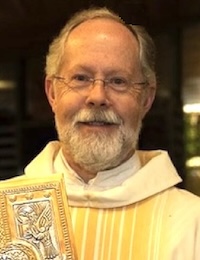
SUMMARY (2023): Scripture contains fourteen imperative statements without numerical labels, resulting in three historical grouping traditions: Talmudic (Jewish), Augustinian (Catholic and Lutheran), and Philonic (Protestant and Eastern Orthodox). St. Augustine combined the commands on false worship and split the prohibitions on coveting, while the Philonic system did the reverse. Deacon Peter notes that division over numbering reflects legalism, mirroring Pharisees who debated the 613 Torah precepts while overlooking their intent. In Matthew 22:34–40, Jesus transcends these disputes by identifying the two greatest commandments: love God wholly and love your neighbor as yourself.

Click to Enlarge
Bishop Robert Barron
30th Sunday of Year A
▶️ God’s Rules for Life
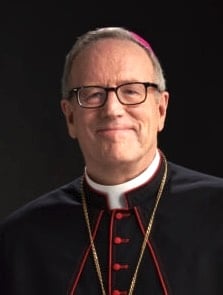
Friends, the Books of Moses teach that the three types of Israelite law—liturgical law, ritual law, and moral law—shape and direct God’s people toward holiness and purity. While the liturgical laws have been carried over and the ritual laws largely set aside, the moral laws remain unchanged, for they represent those great abiding intuitions by which our lives should be structured.
Watch the video, then dive deeper with TWTW study materials below:
- Visuals: 5 companion infographics to follow along with the message
- Transcript: Full sermon text for reading and reference
- Discussion Guide: 25 questions tailored for small groups and classrooms
Bishop James Misko
30th Sunday of Year A
▶️ Love of God and Neighbor

SUMMARY (2026): Real love is hard work, not a sentimental daydream, requiring a deliberate act of will to sustain long-term relationships through natural tensions. It is ironically easier to serve strangers than to love those closest to us, as engaging human hearts demands deep vulnerability rather than following impersonal rules. True repentance stems from love for God and neighbor, and Christian love is ultimately a transformative personal encounter that reorients our entire existence.

In the News
30th Sunday of Year A
Beyond Stone Tablets
In his Word and Art reflection for this Sunday, Bishop John Dolan of the Diocese of Phoenix invites us to contemplate Rembrandt’s masterwork, Moses Smashing the Tablets of the Law. Looking at Moses holding those great stone tablets high overhead, we are reminded of how nearly four thousand years later, humanity is still preoccupied with rules, boundaries, and public displays. We still argue passionately over where the Ten Commandments belong—whether they ought to be posted on courthouse walls, in classrooms, or displayed in the public square.
These can certainly be important cultural conversations, but as Bishop Dolan highlights, this Sunday’s Gospel invites us to look past external signifiers and ask an infinitely deeper question. Jesus doesn’t dismiss the law; rather, He cuts straight to its beating heart. He answers: “You shall love the Lord your God with all your heart, with all your soul, and with all your mind. This is the greatest and first commandment. And a second is like it: You shall love your neighbor as yourself.”
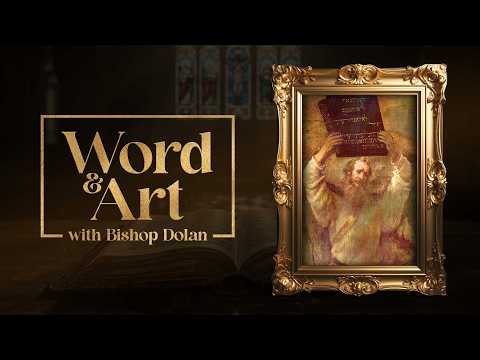
MOSES SMASHING THE TABLETS OF THE LAW: (3:10)
Where Are God’s Laws Posted?
Where, then, should these commandments truly be posted? As Catholics, we have a profound and beautiful ritual answer every time we prepare to hear the Gospel proclaimed at Mass. We trace three small crosses: on our forehead, on our lips, and over our heart. We pray silently: May the Word of Christ be in my mind, on my lips, and in my heart.
It is a powerful gesture, but it also presents us with a searching examination of conscience. Before we worry too much about where God’s laws are posted out there in the culture, we must first ask where Christ’s great commandment of love has been posted within us. Is it active in our thoughts? Is it shaping the words that roll off our tongues? Is it anchored securely in the chambers of our hearts?
Jesus asks us to take this a step further. It is easy in our modern age to broadcast what we believe on a sign, a billboard, or a digital post. But true Christian evangelization asks something much more radical. As Bishop Dolan notes, Jesus does not merely want His law written on stone or typed onto a screen; He asks us to become the posting. He wants our very lives to be the living epistle that others read.
Scripture in Our Modern Headlines
When we look at the world around us today, the desperate need for this living text becomes painfully clear. Consider how the ancient commands of Scripture intersect with our current headlines. In our global community, we witness ongoing refugee crises and fierce political debates over immigration, borders, and the treatment of the vulnerable—echoing the stern warnings of Exodus 22: "You shall not wrong or oppress a foreigner... You shall not mistreat any widow or orphan." God’s law demands that love of neighbor is not a passive sentiment, but a concrete defense of the marginalized.
At the same time, look at our public square. We live in an era of intense political polarization and cultural hostility, where it has become terribly easy to reduce our neighbors—especially those who disagree with us—into ideological opponents or faceless enemies. In response, St. Paul writes to the Thessalonians, praising communities that receive the word in much affliction with joy of the Holy Spirit, becoming models for all believers.
The Cost of Living the Law
To bridge these modern chasms and heal the deep fractures in our communities, we quickly discover that we cannot rely on impersonal rules alone. Following external regulations and checking off the boxes of a legal code is relatively straightforward precisely because it lacks a pulse; rules do not bleed, they do not weep, and they demand no emotional investment.
But loving God and loving our neighbor—our actual, complicated, difficult neighbor who pushes our buttons, disagrees with our politics, or simply exhausts our patience—is infinitely harder because it is profoundly personal. Real love cannot be automated or reduced to a policy debate. It requires the raw vulnerability of looking another human being directly in the eyes, practicing active listening when every instinct tells us to defend ourselves, and choosing to care through a deliberate act of the will long after the initial warmth of sentiment has faded.
Call to Action
This brings us back to the small, familiar crosses we trace upon ourselves just moments before the Gospel is proclaimed. When you press your thumb to your forehead, your lips, and your heart this week, remember that you are engaging in far more than a routine liturgical habit. You are participating in an ancient, embodied prayer: May the Word of Christ be in my mind, on my lips, and in my heart.
Consider what is truly at stake in those three simple gestures. When we mark our foreheads, we ask God to redeem our thoughts, clearing away the clutter of judgment, anxiety, and the relentless noise of our digital feeds. When we mark our lips, we surrender our speech, asking that our words become instruments of healing rather than weapons of political hostility or casual indifference. And when we mark our hearts, we invite the Holy Spirit to expand our capacity for empathy, dismantling the walls we build against our most difficult neighbors.
Jesus makes it clear that faith can never remain a safe intellectual abstraction, a dusty set of rules locked away in a book, or a fleeting slogan broadcasted across the sterile echo chambers of social media. Real love—that demanding, stubborn grace that requires a deliberate, daily act of the will rather than a passing sentiment—calls us out of our comfortable isolation. It drags us past our safe distances and commands us to look directly, unblinkingly into the eyes of the stranger, the exhausted refugee, and even our most bitter political adversary, offering them the very same radical, unearned tenderness that Christ extends to each of us.
When the world looks at us, let it not see a people defined by division or defended by walls. Let it see a community marked by the cross—on our minds, on our lips, and beating in our hearts. Go forth this week, and let Christ's great commandment become flesh in you.
Praise be Jesus Christ, now and forever. Amen.
This essay based on this Sunday's readings and current events was developed collaboratively using artificial intelligence alongside human pastoral curation and theological editing. It is not intended as a finished script, but as a catalyst to spark reflection, provide thematic inspiration, and support preachers in crafting their own authentic homilies for their communities.
Where are God’s Laws Posted?
Scripture in Our Modern Headlines
The Cost of Living the Law
Call to Action
Fr. Mike Schmitz
30th Sunday of Year A

SUNDAYS WITH ASCENSION (2023): Fr. Mike Schmitz is the chaplain for the Newman Center at the University of Minnesota Duluth (UMD) and serves as the Director of Youth and Young Adult Ministry for the Diocese of Duluth.
▶️ Overnight Success (2026)
We are called to love God with all our heart, soul, and mind. But where do we begin? We begin by giving Him something: the first of our time, a small sacrifice, or an intentional act of generosity. These ordinary acts of love over time prepare our hearts for the extraordinary moments when we may be called to give Him everything. Every great act of love begins somewhere: we just have to start.
Fr. Michael Chua
30th Sunday of Year A
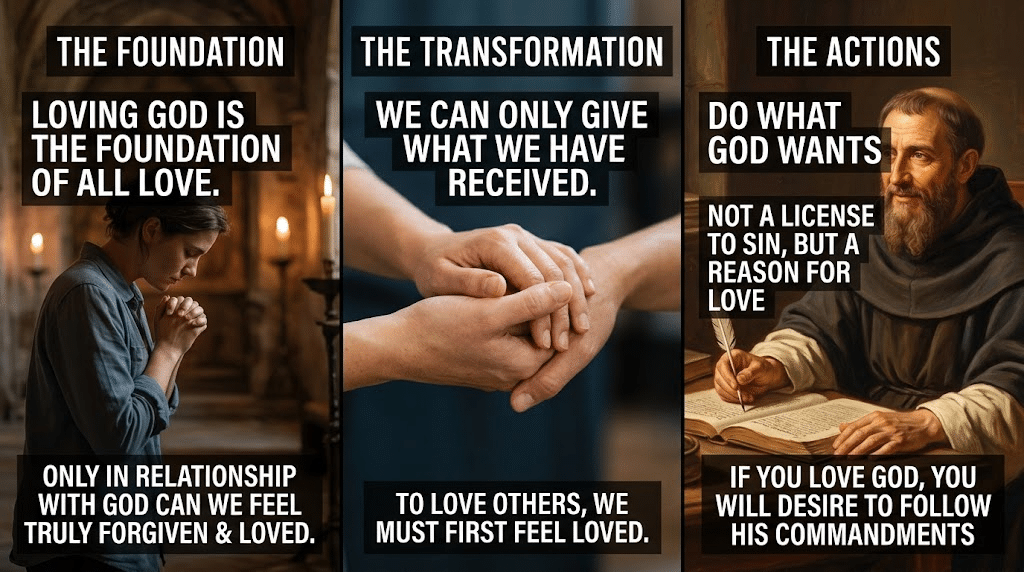
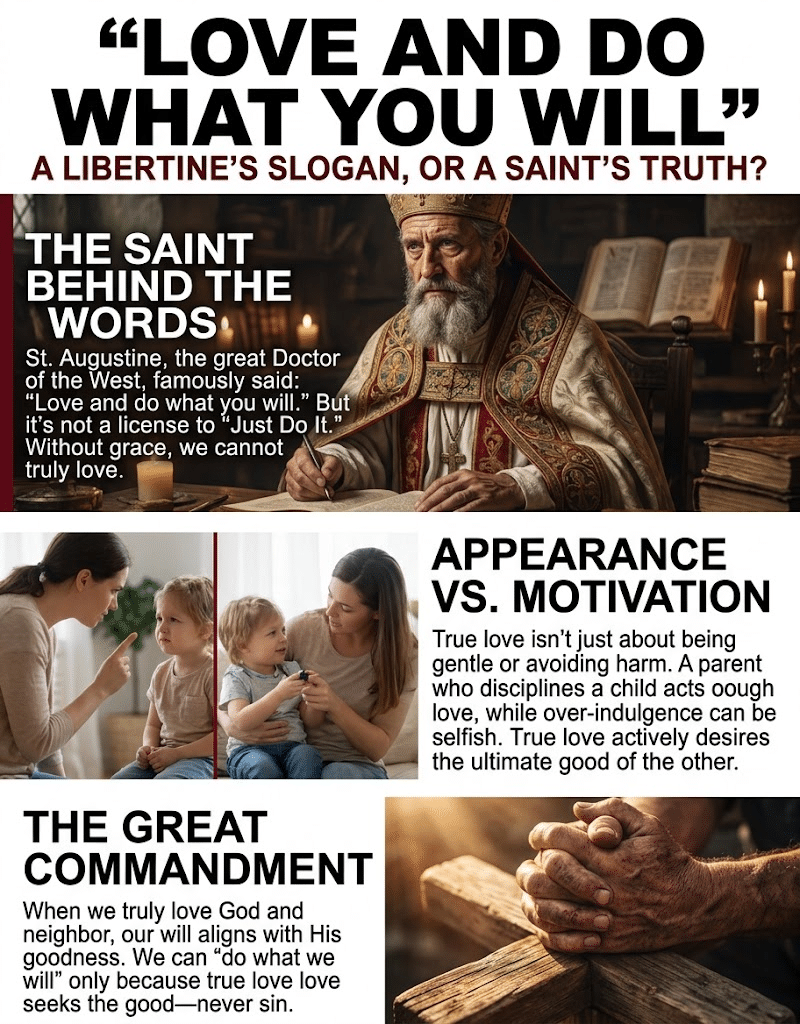
✍️ Love and Do What You Will

Fr. Michael Chua
Homilies (2026)
It would not be Love without the other (2020)
We should be bothered! (2017)
EXCERPT (2023): The slogan, “Love and do what you will” seems more suited on the lips of a libertine than on a saint. We can understand why a libertine would promote this since he is devoid of moral principles except perhaps the most basic moral principle of not doing harm to anyone. In fact, Nike could have even reframed and rebranded the slogan in the form of its famous tagline: “Just Do It.” Most of you may be surprised and shocked to know that these words were indeed spoken by a saint, and not just any ordinary saint. It is none other than the great Doctor of the West, St Augustine, who wrote extensively on original sin and the necessity of grace for one’s justification.
Dominican Blackfriars
30th Sunday of Year A
✍️ Finding Meaning
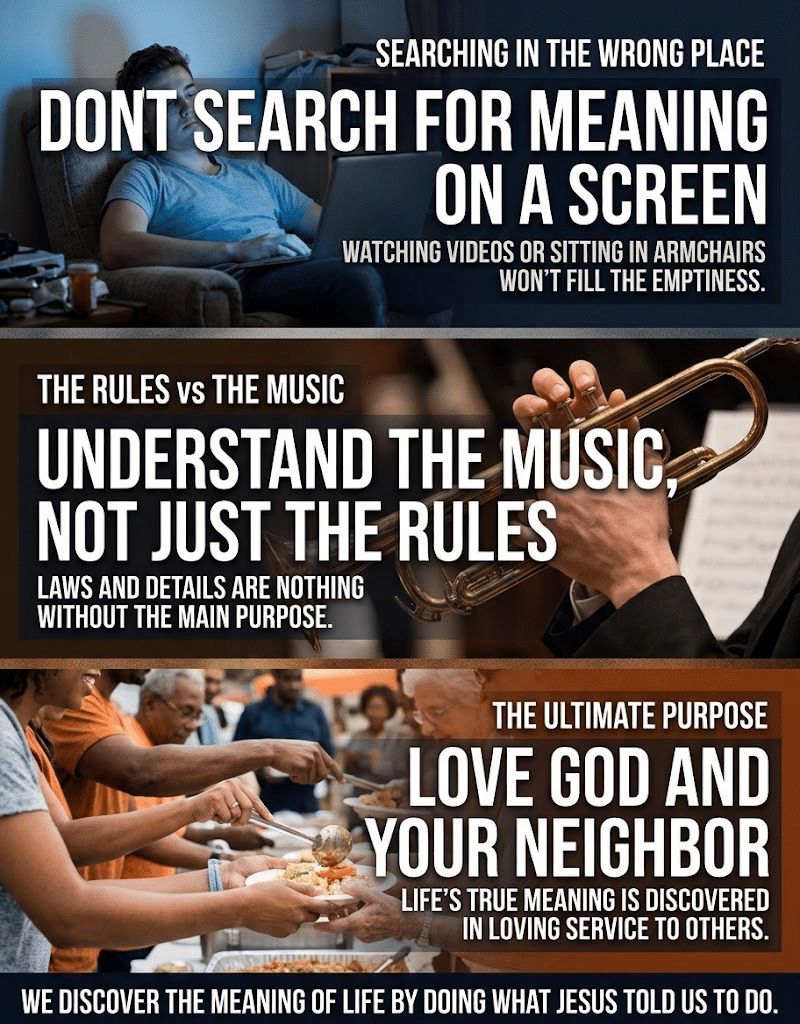
SUMMARY (2020): Fr. Robert Verrill, OP warns that a sense of meaninglessness arises when people waste their lives on trivial distractions, such as sitting passively and consuming ridiculous online videos. Life’s purpose cannot be found through abstract speculation in an armchair or behind a screen. Instead, genuine meaning is discovered through active obedience to Christ’s command to love God and neighbor. By engaging in the Church’s sacramental life and sharing in Christ’s self-giving sacrifice, believers move beyond passive digital consumption into “holy doing”—pouring out their lives in loving service to others, which is the foundational purpose of human existence.
Fr. Austin Fleming
30th Sunday of Year A
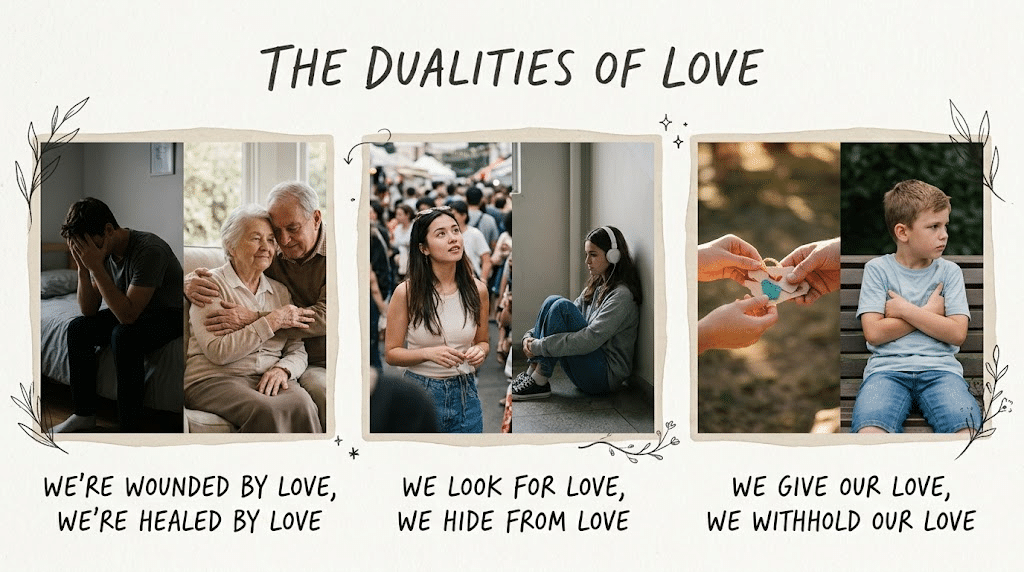
✍️ The Dualities of Love
Fr. Austin Fleming
EXCERPT (2017): Love…
- we’re wounded by love, we’re healed by love,
- we look for love, we hide from love
- we give our love, we withhold our love
- we hunt for love, we run from love,
- we celebrate love and we grieve its loss
- we talk about love, we write about love, we sing about love
- we dream of love, fantasize love, hope for love
- we sell love, buy love, ignore love
- we offer and receive love, we make love
- we need love, we promise and betray love
- we abuse and refuse love, we forget and regret love
- we fear love, we reject love, we welcome love,
- we love love…

Monsignor Peter Hahn
30th Sunday of Year A

▶️ Back to the Basics: God Is Love
Msgr. Peter Hahn
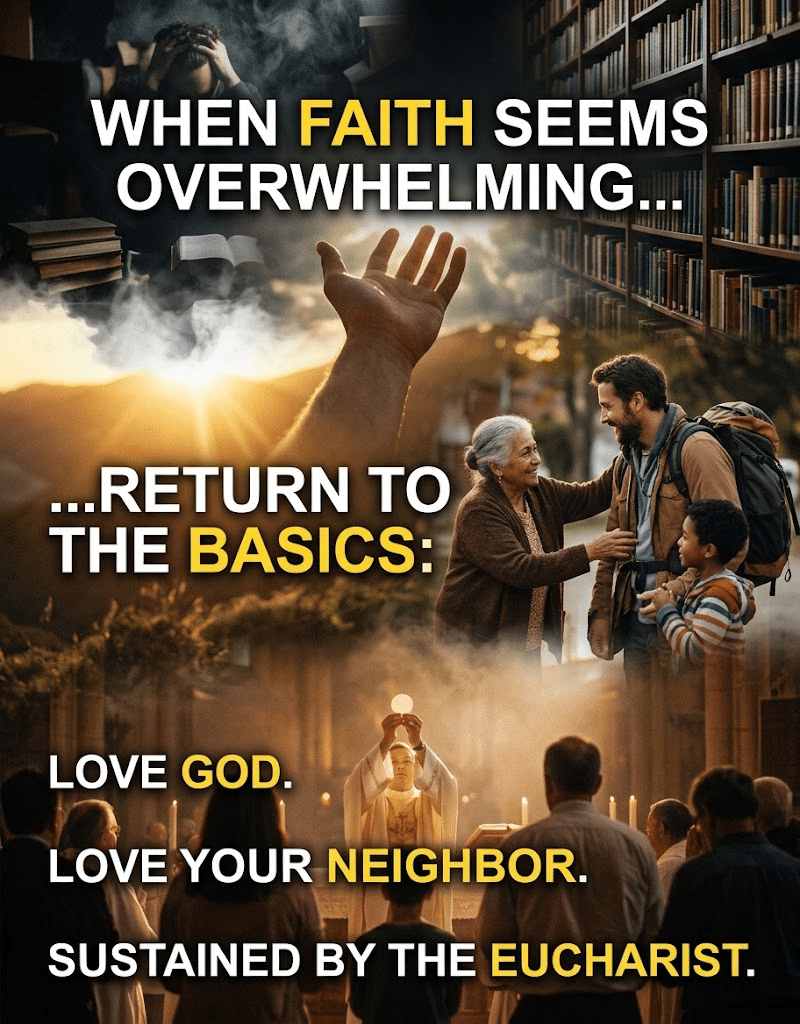
SUMMARY (2017): Msgr. Hahn reflects on how spiritual overwhelm and complexity often distract us from the heart of faith. Responding to the Pharisees’ test in Matthew 22, Jesus cuts through hundreds of legal prescriptions by uniting Deuteronomy and Leviticus into the Greatest Commandment: love God entirely, and love your neighbor as yourself.
This love cannot remain confined to family and friends; Scripture demands active care for the vulnerable and poor, echoing the Final Judgment standard in Matthew 25. Ultimately, the Eucharist forgives, cleanses, and unites us to Christ, supplying the very divine grace needed to live out this radical call to love.
Fr. Charles E. Irvin
30th Sunday of Year A
✍️ Love Is a Decision, Not a Feeling

Fr. Charles E. Irvin
SUMMARY: Fr. Irvin emphasizes that the central biblical rhythm is “God offers, we respond.” While God’s unconditional love is guaranteed, the outcome hinges on human action. Christ’s command to love our neighbor as ourselves is not an emotional recommendation, but an uncompromising mandate.
Feelings are fleeting, unreliable, and cannot be commanded; left unchecked, they lead to self-pity and victimhood. Genuine Christian love is a deliberate choice, decision, and commitment. Pointing to the Last Judgment in Matthew’s Gospel, Fr. Irvin notes that God judges concrete deeds—feeding the hungry, clothing the naked, and sheltering the abandoned—not well-meaning sentiments or polite sympathy.
Rejecting a superficial “gospel of nice feelings,” Jesus acts as an absolute realist, leaving no room for human excuses. Believers are summoned to actively serve everyone, especially the unlovable and marginalized. True love commits to righteous action first; emotions simply follow.
Fr. Tommy Lane
30th Sunday of Year A
✍️ Loving God and Neighbor

Fr. Tommy Lane
SUMMARY (2023): Fr. Lane explains that loving kind people is natural human instinct, which is why Jesus delivers love of God and neighbor as a strict commandment. We do not need a command when life is pleasant; we need it when trials tempt us to abandon God or when neighbors test our patience. Grounding this in the Sermon on the Mount, Fr. Lane shows that genuine love proves itself through adversity.
Loving God requires deliberate practice: engaging the heart through intimate conversational prayer rather than mindless repetition; engaging the soul by worshipping out of devotion rather than fearful obligation; and engaging the mind by cultivating thoughts like a peaceful garden where God can walk, free from modern digital distractions.
Finally, loving difficult or negative neighbors prevents destructive cycles of bitterness. Recognizing that uncharitable people often act out of hidden wounds, believers serve Christ directly by loving the least and most challenging among us.
Fr. Langeh, CMF
30th Sunday of Year A
| HIGHLIGHTS
▶️ Loving God and Loving Our Neighbor
EXCERPT (2020): Love resumes the whole of Christian Scriptures, Revelation and all the Laws of God and the Church that exist. Loving God and loving our neighbour is the heart of our daily lives, the springboard of our actions, the basis of our decisions, the reason for our prayer life, the motivation of our lifestyle and the very reason why we live together on earth. Responding to the question of the Teacher of the Law today: ‘Master, which is the greatest commandment of the Law?’, Jesus stressed the direct relationship between love of God and love of neighbour. He explained that the rest of the laws are based on the two. They are like the hinges on which the entire law hung.
Msgr. Charles Pope
30th Sunday of Year A
✍️ The Gospel, Standing on One Foot
Msgr. Charles Pope
EXCERPT (2023): There was an expression common among the rabbis of Jesus’ time, wherein one rabbi would ask another a question, and request that the answer be given while “standing on one foot.” This is a way of saying, be brief in your answer.
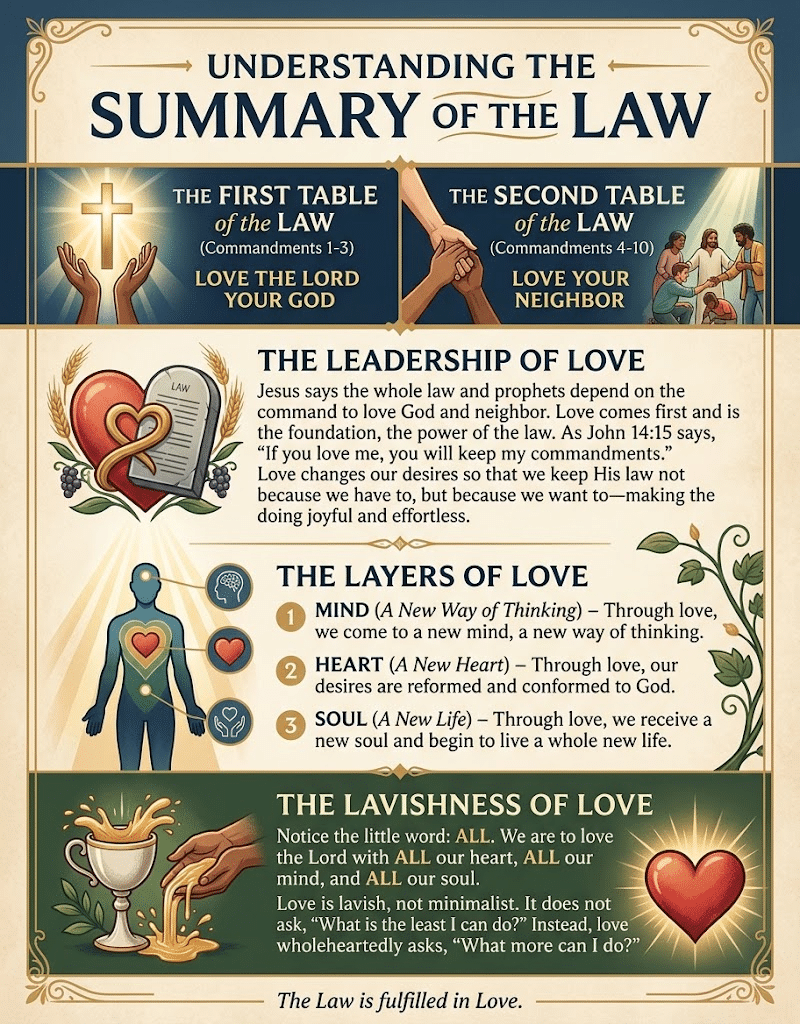
That idea may be behind the question that is raised in today’s Gospel by the scholar of law, who asks, “Teacher, which commandment in the law is the greatest?” …There is value in noting several aspects of [Jesus’ response]:
- The Leadership of Love
- The Layers of Love
- The Lavishness of Love
Father Kevin Rettig
30th Sunday of Year A

▶️ The Law of Love
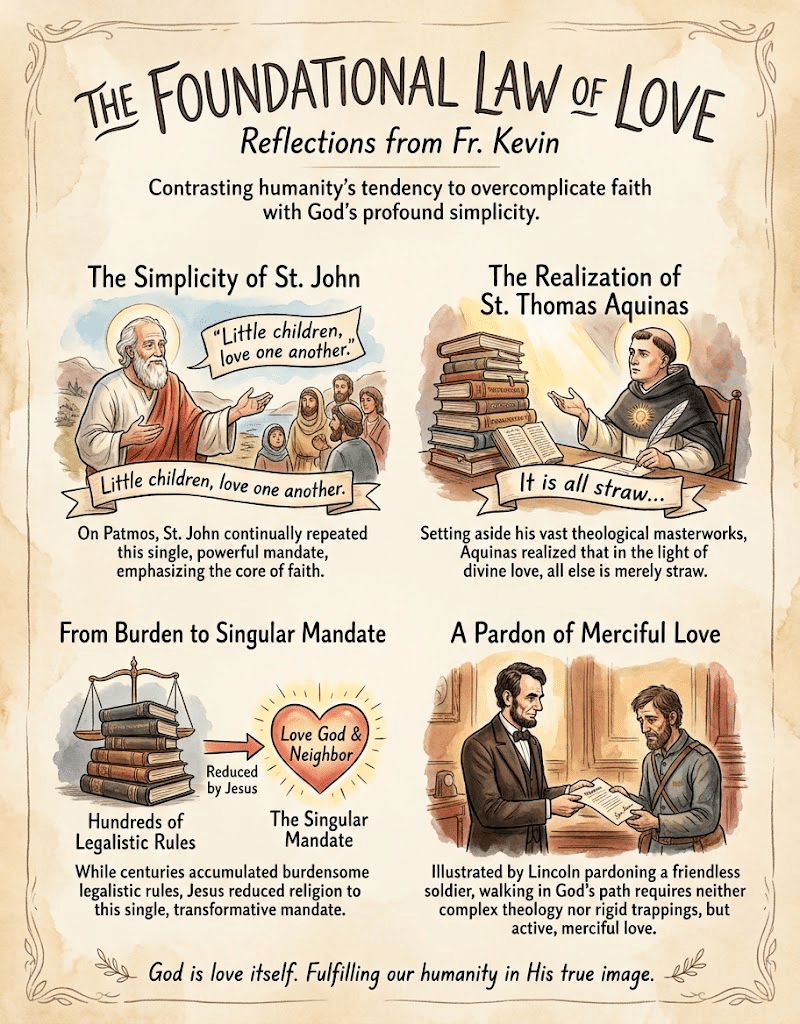
ABSTRACT (2020): Fr. Kevin reflects on Christ’s foundational law of love, contrasting humanity’s tendency to overcomplicate faith with God’s profound simplicity. Drawing upon St. John on Patmos—who continually repeated, “Little children, love one another”—and St. Thomas Aquinas setting aside his theological masterworks as “straw,” he illustrates that God is love itself. While centuries accumulated hundreds of burdensome legalistic rules, Jesus reduced religion to this singular, transformative mandate. Illustrated by Abraham Lincoln pardoning a friendless soldier, walking in God’s path requires neither complex theology nor rigid trappings, but active, merciful love that fulfills our humanity in God’s true image.
Fr. George Smiga
30th Sunday of Year A
✍️ The Greatest Three Commandments

Matthew 22:1-14
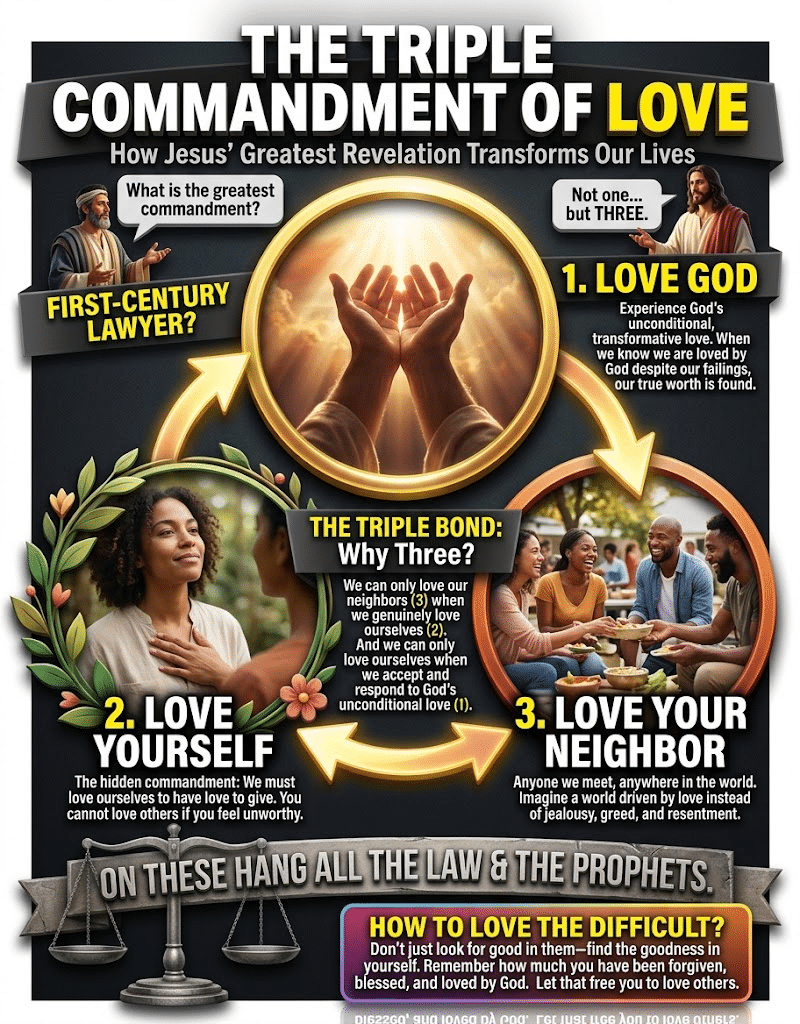
EXCERPT (2008): Jesus pulls a fast one in today’s Gospel. A lawyer comes up to him with a simple question: choose from all the commandments one that is the greatest. Jesus answers the lawyer but instead of choosing one commandment he chooses two. And if we look carefully at his response we can find in one of the commandments a third commandment. Instead of coming up with one commandment that is the greatest, Jesus offers three. First, we are to love God with all of our strength. Second, we are to love our neighbor. But we are to love our neighbor as we love ourselves. So the third commandment is that we love ourselves. If you were to ask Jesus, then, what is the great commandment, he would offer this triple commandment of love: love of God, love of self, love of neighbor. He would suggest that this is God’s greatest revelation of how we should act. It is that upon which everything else hangs—both the law and all the prophets. So since this is so important and central a revelation, we should spend a little time reflecting upon it. We can do so by asking ourselves why does Jesus choose three commandments and what are their relationships to each other?
Religious Orders
30th Sunday of Year A


Featured Priests
SCROLL FOR MORE
The Gravity of Love
Reading: Matthew 22:34–40
Augustinian Theme: Love as the Driving Engine (Caritas)
When the scholar asks Jesus for the greatest commandment, Christ does not cite a complex code of prohibitions. He reveals the single current that sustains existence: “You shall love the Lord your God with all your heart, and your neighbor as yourself.”
Saint Augustine understood this truth down to the marrow of his bones. After wandering through empty pursuits, he realized that every human life is governed by what it treasures. He wrote: “Amor meus pondus meus; illo feror, quocumque feror”—”My love is my weight; by it I am carried wherever I am carried.” Love is not a fleeting emotion; it is the soul’s gravity. What you love determines where you fall, what you build, and who you become.
Too often we compartmentalize our devotion. We imagine love for God as a private interior sanctuary, while love for our neighbor feels like an external obligation. Yet Christ binds them into an inseparable whole. Augustine reminds us that we cannot claim to love the invisible Head while trampling upon His visible body. When you look into the eyes of the person sitting across from you—especially the one who tests your patience or carries silent wounds—you are looking at Christ’s living dwelling place. Your love for them is the true measure of your love for Him.
We cannot manufacture this love by sheer willpower. Our hearts are easily distracted, weighing us down toward self-interest. But grace enters precisely where our strength runs dry. Turn inward today. Yield your tired ambitions to the fire of the Holy Spirit, who pours divine charity into our hearts. Allow that divine gravity to pull your thoughts, words, and daily sacrifices home, until every choice echoes Augustine’s daring counsel: love, and do what you will.

Featured Friars & Monks
SCROLL FOR MORE
The Sacred Stranger at the Gate
Reading: Exodus 22:20–26
Benedictine Theme: Hospitality (Welcoming All as Christ)
In the Book of Exodus, the Lord speaks with urgent tenderness: “You shall not molest or oppress an alien, for you were once aliens yourselves in the land of Egypt. You shall not wrong any widow or orphan.” God does not merely ask His people for legal tolerance; He commands them to remember their own fragility and treat the defenseless with reverence.
Centuries later, Saint Benedict caught this divine heartbeat and wove it into Chapter 53 of his Rule: “All guests who present themselves should be welcomed as Christ, for He will say: ‘I was a stranger and you welcomed me.'” In the monastery, the knock at the door is never an interruption; it is the arrival of the Lord in disguise. Benedict instructed the abbot and brothers to wash the feet of the traveler, break bread with them, and meet vulnerability with radical honor.
Exodus reminds us that the alien, the widow, the orphan, and the neighbor who pledges their only cloak to stay warm through the night are not burdens on our daily rhythm. They are sacred vessels. God warns, “If he cries out to me, I will hear him; for I am compassionate.” In Benedictine wisdom, to shut out the stranger is to bar the door against Christ Himself.
We live in a hurried world that builds walls, guards comfort, and treats the vulnerable as inconvenient. Yet our call is to cultivate an open cloister within our hearts. When the poor, the lonely, or the displaced cross our threshold, we are invited to set aside our self-interest, pour warm water, offer the cloak of our attention, and listen. In welcoming the fragile, our homes become monasteries, our tables become altars, and we meet the living God.


The God Who Girds Us in the Dark
Reading: 1 Thessalonians 1:5c–10
Carmelite Theme: The “Dark Night” and Purification
Writing to the young church at Thessalonica, Saint Paul marvels at a grace that defies worldly logic: “You became imitators of us and of the Lord, receiving the word in great affliction, with the joy from the Holy Spirit.” He describes a people who turned from empty idols to serve the living God, choosing fidelity even when faith meant hardship and exterior stripping.
Centuries later, Saint John of the Cross named this sacred paradox the “dark night of the soul.” Carmel teaches that God often leads those He loves into seasons of obscurity, affliction, and spiritual dryness. When the consolations of life wither and our familiar props are removed, it feels like abandonment. Yet John of the Cross insists the dark night is not divine absence, but the shadow of God’s blinding light. It is an act of supreme mercy—a secret purification where God gently dismantles our subtle idols of self-sufficiency, false security, and emotional reassurance so that we can love Him for who He is, not merely for what He gives us.
The Thessalonians could endure great affliction with joy because their gaze was anchored beyond circumstances. They were not serving a concept; they had fallen in love with a Person. In Carmel, genuine prayer is not an escape from suffering, but an interior union with the Crucified and Risen Lord that remains steadfast even when darkness falls.
When your life feels weighed down by trial or prayer feels dry and barren, do not despair. Welcome the quiet work of the Divine Physician. In the silence of that crucible, Christ is detaching your heart from transient shadows and teaching you to wait upon His Son from heaven with pure, unshakeable trust.

Featured Friars & Websites
SCROLL FOR MORE
The Illuminating Fire of Truth
Reading: Matthew 22:34–40
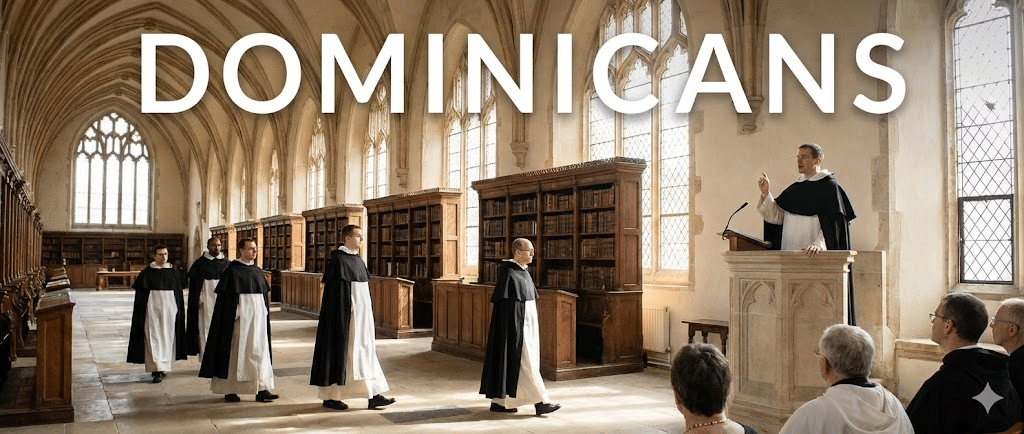
Dominican Theme: Veritas (The Pursuit of Truth) & the Fullness of Love
When the scholar of the law steps forward to test Jesus, he brings a mind honed by debate, asking a question of profound theological precision: “Teacher, which commandment in the law is the greatest?” He seeks the ultimate principle that holds the entire architecture of faith together.
Jesus does not answer with evasive rhetoric. In the spirit of pure Veritas, He pierces directly to the luminous core of divine revelation: “You shall love the Lord your God with all your heart, with all your soul, and with all your mind. This is the greatest and the first commandment. The second is like it: You shall love your neighbor as yourself.”
For the Dominican tradition, truth and love are not rivals; they are inseparable. Saint Thomas Aquinas taught that we cannot love what we do not know, and we cannot truly know God without being set ablaze with love for Him. Christ explicitly commands us to love God with our minds. Faith is never an unthinking sentiment, nor is it a blind adherence to rules. To seek truth with rigorous honesty, to study sacred scripture, and to illuminate human hearts with the clarity of the Gospel is itself an act of deep adoration.
Yet the light of truth demands integrity in action. Christ reveals that authentic knowledge of God bears immediate fruit in charity toward our neighbor. If our theology does not awaken mercy for the living person before us, our intellect has missed the mark.
Let us sit before Christ in contemplation, letting His truth purify our illusions and refine our understanding. Then, hand on those fruits of contemplation to a hungry world—speaking the truth in love and witnessing with our lives to the God who is Love itself.

Featured Websites
SCROLL FOR MORE
The Cloak of the Crucified
Reading: Exodus 22:20–26
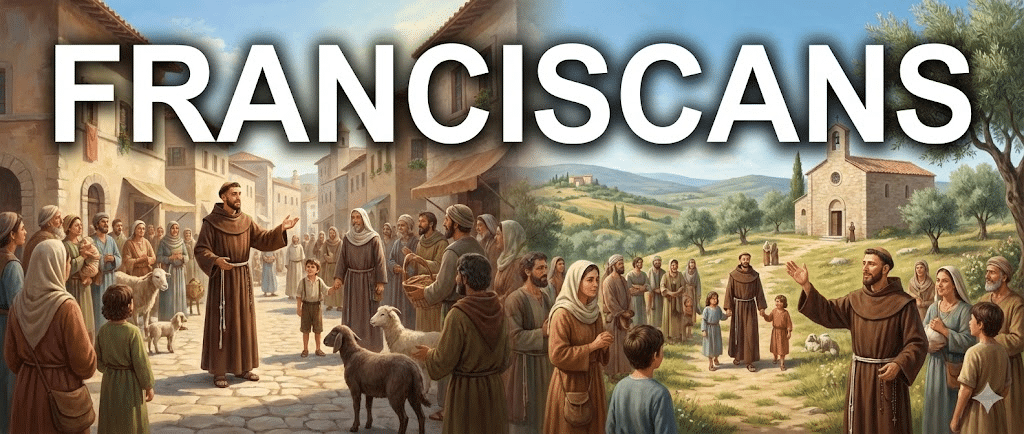
Franciscan Theme: Solidarity with the Marginalized & Minoritas
In the quiet dust of the desert, God speaks with raw and protective tenderness: “You shall not molest or oppress an alien, for you were once aliens yourselves in the land of Egypt. You shall not wrong any widow or orphan. If you take your neighbor’s cloak as a pledge, you shall return it to him before sunset; for that matter is his only covering.”
Saint Francis of Assisi understood this passage not as ancient legal history, but as the living pulse of the Incarnation. Francis’s entire life shifted the day he dismounted his horse and embraced a leper. What had once seemed repulsive became sweetness of soul, because in that disfigured outcast, Francis touched the flesh of the humble, crucified Christ. To follow Jesus as a lesser brother—in minoritas—meant stepping down from the safety of privilege to stand in the dust alongside those who have nothing left.
Exodus reminds us of God’s fierce bias toward the vulnerable. When the impoverished laborer sleeps without a cloak and cries out in the cold night, God declares: “I will hear him; for I am compassionate.” The Lord feels the chill of the shivering poor in His own bones.
In our world, the “cloak” takes many forms: human dignity, a living wage, a fair hearing, or the warmth of being recognized as a brother or sister rather than a problem to be solved. We are summoned to strip away our self-protective indifference, travel light, and look upon the immigrant, the brokenhearted, and the overlooked through the eyes of familial kinship. When we defend the fragile and wrap the suffering in Christlike mercy, we do not merely fulfill an ancient commandment—we welcome our Brother Jesus home.

Featured Websites
SCROLL FOR MORE
Love That Labors
Reading: Matthew 22:34–40
Jesuit Theme: Men and Women for and with Others & The Magis
When the Pharisee tests Jesus on the greatest commandment, Christ refuses to leave faith in the realm of comfortable abstraction. He demands the entirety of our faculties—heart, soul, and mind—and immediately binds divine love to concrete human reality: “The second is like it: You shall love your neighbor as yourself.”
Saint Ignatius of Loyola famously insisted in the Spiritual Exercises that “love ought to show itself in deeds more than in words.” For the Jesuit tradition, loving God with the totality of our intellect and affection is never an interior luxury; it is a commissioning into the world. In the words of Father Pedro Arrupe, we are formed to become “men and women for and with others”—believers who do not simply dispense charity from a safe distance, but who walk alongside the wounded, listen to their sacred stories, and labor to restore their God-given dignity.
This is where the spirit of the Magis challenges our complacency. The Magis is not a demand for frantic perfectionism, but an honest interior inquiry: Where is Christ most in need today? What is the more loving, more courageous choice before me? It asks us to look at the fragmented spaces of our neighborhoods, workplaces, and families not as obstacles, but as the very ground where grace is already laboring.
To love our neighbor as ourselves means entering into their vulnerability, offering our presence as true cura personalis—revering the whole person before us. As we step out of the church doors and into the noise of the world, let us bring our prayer into motion. Discern where Christ is calling you to stand, choose the path of greater love, and go forth to set the world on fire with His justice and mercy.
Featured Websites
SCROLL FOR MORE
The Cry That Pierces the Heavens
Reading: Exodus 22:20–26
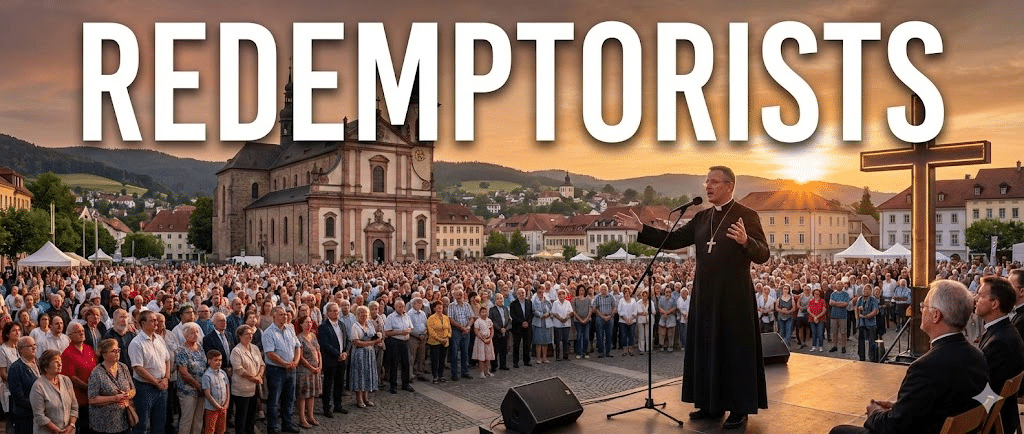
Redemptorist Theme: Mission to the Poor and Abandoned
In the Book of Exodus, God speaks directly to the conscience of His people with words of fierce tenderness: “If you take your neighbor’s cloak as a pledge, you shall return it to him before sunset; for that matter is his only covering… If he cries out to me, I will hear him; for I am compassionate.”
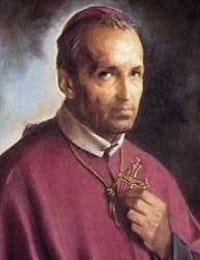
This passage captures the beating heart of the God whom Saint Alphonsus Liguori encountered in the rugged hills outside Naples. When Alphonsus walked among the impoverished goatherds and forgotten day laborers, he realized that the world had stripped them of everything—not merely their daily bread, but their very sense of belonging. Yet in their poverty, Alphonsus recognized those dearest to Christ. He founded the Redemptorists on a single, joyful conviction: Copiosa Apud Eum Redemptio—with the Lord, there is plentiful, overflowing redemption, and no one is too small, too wounded, or too abandoned to be embraced by His mercy.
Exodus reveals that God’s ear is tuned with extraordinary sensitivity to the cries of the defenseless. When the poor person shivers in the cold, lacking even a basic garment for warmth, God does not remain an aloof observer. He takes their suffering personally. To take a poor man’s cloak and leave him shivering is to ignore the cry of the Redeemer Himself.
We are called to carry that same warmth into the wounded corners of our world. Holiness is not found in rigid, legalistic perfection, but in gentle compassion and practical accompaniment. Look around you for those who feel spiritually or physically naked—the forgotten, the lonely, and those crushed by guilt or hardship. Return their cloak. Offer them the shelter of your mercy, speak to them as Christ’s own, and assure them that God’s compassionate ear never turns away.
Bilingual Homily
30th Sunday of Year A
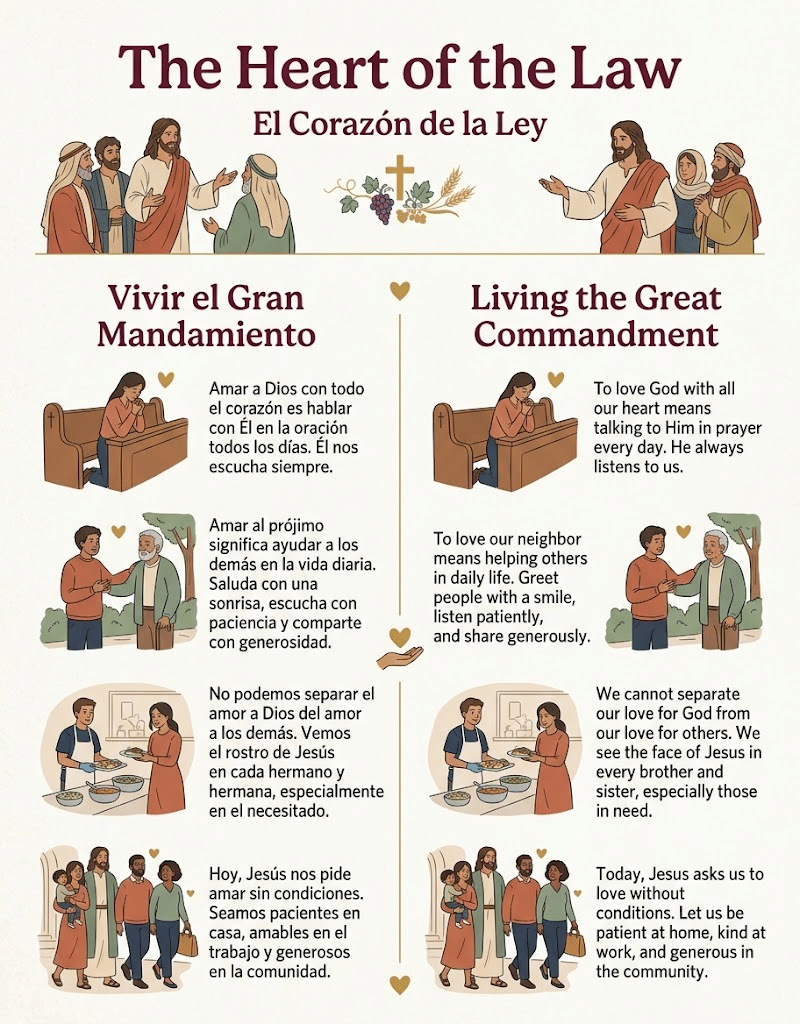
A brief homily for those who are learning Spanish or English. The grammar is kept uncomplicated and uses present-tense vocabulary to ensure it is easy to deliver. The homily focuses on the practical, everyday meaning of Sunday’s Gospel.
Additional Homilies
30th Sunday of Year A


Those who don’t have a large family can still help those who do
Father Vincent Hawkswell | Archdiocese of Vancouver
Fr. George Corrigan, OFM
In the flow of Matthew’s Gospel
Something new
What’s love got to do with it?
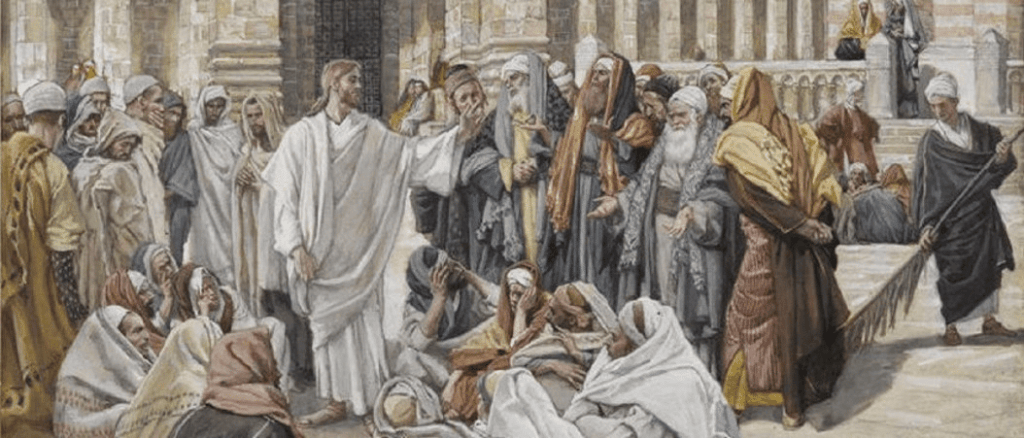
Jesus Being Tested
Jesus’ Choice
Love Means…. What?
In Whose Image..
Msgr. Joseph Pellegrino (PDF) | Archive
On Becoming a Christian (2026)
What Must We Do? (2023)
It’s the Law (2017)
The Heart of the Law (2014)
Everyday Saints (2011)
The Law and the Prophets (2008)
Fr. Michael Fallon, MSC | Archive
 Highlight text or double-click a paragraph anywhere on the site to ADD TO NOTES. You can also click ASK AI to copy your selection to the clipboard with a command prompt, ready for you to paste manually into the chat above.