16th Sunday of Year B

July 21, 2024 Welcome

Sunday Homilies

Sunday Homilies

BIBLE STUDY
CATECHISM
CHILDREN
COMMENTARY
LECTORS
HOLY SEE
HOMILIES

MUSIC
NEWS

Come away by yourselves to a deserted place and rest a while.
Mark 6:31

His heart was moved with pity for them, for they were like sheep without a shepherd
Mark 6:34

Prayers of the
Faithful

Website is now
mobile friendly.

OCP Music
Liturgy Podcast
is back!

Featured Videos: Scroll List Horizontally

SOLT-1, Golka-2, LIFE-3, Tagle-4, CWP-5, MyCatholicLife-6, JMT-7, Dominicans-8
SOLTBP. GOLKAPRO-LIFECARD. TAGLECATHOLIC WOMEN PREACHMY CATHOLIC LIFEJOHN MICHAEL TALBOTKNOW BEFORE YOU GO
YouTube player

SOURCE: Society of Our Lady of the Most Holy Trinity

Jesus, the good shepherd, calls for visible shepherds to care for us, particularly through their teaching and preaching.

SUMMARY OF VIDEO w/ Timestamps
  • 00:00 🐑 Jesus, the good shepherd, looks out at us with pity, seeking to give us rest, guidance, and healing, fulfilling the promise of raising up Shepherds after his own heart.
  • 00:48 👨‍👦‍👦 The Lord calls men to be visible shepherds to care for us, particularly through their voice, teaching about the Lord.
  • 01:14 👂 Listen closely to the care and concern of the Good Shepherd in the preaching of his appointed shepherds and express gratitude to them after Mass.
DISCUSSION QUESTIONS
  1. What does the Gospel passage reveal about Jesus's nature as the Good Shepherd?

Answer: The passage shows that Jesus, as the Good Shepherd, has a compassionate heart and is moved by the plight of the people, seeking to provide them with guidance and care.

  1. How do we experience the care of the Good Shepherd in our lives?

Answer: We experience this care through the tenderness and guidance provided by Jesus, who seeks to give us refreshment, healing, and direction in times of need.

  1. What role do visible shepherds, such as priests, play in guiding the people of God?

Answer: Visible shepherds are called to represent Christ and care for his flock, teaching and preaching the Gospel to provide guidance and support for the people.

  1. How can we recognize the care and concern of Jesus through the voice of these visible shepherds?

Answer: By listening closely to the Gospel readings and the preaching of these shepherds, we can hear the message of Jesus's love and concern for us, even if we don't always experience dramatic revelations or "huge fireworks."

  1. What is the encouragement given in response to the Gospel reading?

Answer: Father Brady encourages us to express gratitude to the shepherds of our souls, such as our local priests, and share with them how the Word of God has touched our lives. By doing so, we can foster a deeper appreciation for the guidance and care provided by these visible shepherds.

YouTube player

SOURCE: Diocese of Colorado Springs

Jesus, as the Good Shepherd, brings order and renewal to the scattered and lost, showing compassion and establishing his authority over evil in the desert.

SUMMARY OF VIDEO w/ Timestamps
  • 00:00 📖 Jesus takes his disciples to a deserted place to rest, showing compassion for the people as they are like sheep without a shepherd.
  • 00:54 🌵 God lures us into the desert to form a covenant and be one with us, even though it may feel like a place of fear.
  • 01:27 🙏 Trust in God when life feels unstable and ask for renewal of Covenant.
  • 01:43 📖 Jesus goes to the desert to confront Satan and establish his authority over evil before beginning his public ministry.
  • 02:09 📖 Jesus brings order to the scattered sheep, as mentioned in the Prophet Jeremiah's reading.
  • 02:23 🐑 Jesus is the Good Shepherd who lays down his life for his sheep, knows us personally, and keeps us together to renew our covenant with God.
DISCUSSION QUESTIONS
  1. In the Gospel reading, why does Jesus invite his apostles to come away to a deserted place?

Answer: Jesus recognizes the need for rest and rejuvenation after the apostles have been working hard preaching, demonstrating the importance of finding balance between ministry and personal spiritual growth.

  1. How does the motif of the desert connect with the spiritual journey of Jesus and the apostles?

Answer: The desert serves as a place where God makes covenants, prophets experience transformation, and Jesus confronts Satan. It represents a space of vulnerability, uncertainty, and spiritual growth, where individuals can deepen their connection with God and confront personal challenges.

  1. What is the role of a shepherd, and how does Jesus embody this role in relation to his followers?

Answer: The role of a shepherd is to keep the flock together and safe. Jesus, as the Good Shepherd, knows his followers personally and is willing to lay down his life for them, guiding and protecting them on their spiritual journey to ensure their unity and salvation.

  1. How does the Gospel reading encourage us to approach times of instability or uncertainty in our lives?

Answer: We are encouraged to look to Jesus, the Good Shepherd, during challenging times and trust in his guidance. By inviting him to bring order to areas of our lives that feel out of control, we can grow in faith and deepen our relationship with God.

  1. What is the significance of maintaining unity within the Catholic Church, as mentioned in the reflection?

Answer: As Catholics, we are called to be one Holy, Catholic, and Apostolic Church. Staying united under Jesus's shepherding helps us resist division and strengthens our connection with the God who created us, ultimately leading to a renewed covenant and deeper spiritual growth.

YouTube player

SOURCE: Priests for Life

The first reading and Gospel echo the theme of God as our Shepherd. In the Second Reading we see exactly how Christ shepherds us…

SUMMARY OF VIDEO w/ Timestamps

The first reading and the Gospel passage echo the theme of God as our Shepherd. It is in the Second Reading that we see exactly how Christ shepherds us – through the reconciliation achieved in his blood. He shepherds us not simply by teaching us, but by destroying the very power of death.

The Church’s pro-life efforts are to be seen and presented in this context, that is, as an aspect of the reconciliation of the world with God in Christ. The “enmity” of which St. Paul speaks has many dimensions, and in its widest spiritual sense includes the enmity that all sin places between us and God, and between us and one another.

The exaltation of individual “choice” above our responsibilities to the lives of others, especially our children, creates a destructive enmity. The peace that Christ gives is not something to be received only in an internal, spiritual way, but is a reality that transforms relationships, cultures, and nations. That peace demands respect for life and a rejection of the enmity that constitutes the culture of death.o overcome the destructive enmity and disrespect for life that the culture of death promotes, thus contributing to the transformation of relationships, cultures, and nations in accordance with Christ's peace.

DISCUSSION QUESTIONS

What is the primary theme connecting the first reading and the Gospel passage?

Answer: The theme of God as our Shepherd is central to both the first reading and the Gospel passage, highlighting God's guidance and care for His people.

  1. How does the Second Reading explain the way in which Christ shepherds us?

Answer: The Second Reading emphasizes that Christ shepherds us through the reconciliation achieved by His blood, ultimately destroying the power of death and overcoming the destructive forces of sin.

  1. What role do pro-life efforts play within the context of reconciling the world with God?

Answer: Pro-life efforts serve as an essential aspect of reconciliation by rejecting the enmity created by prioritizing individual "choice" over responsibilities to others, particularly our children. They work to restore respect for life and dismantle the culture of death.

  1. How does the peace that Christ offers relate to the transformation of relationships, cultures, and nations?

Answer: The peace that Christ gives is not limited to internal spirituality but extends to transforming external relationships, cultures, and nations. This peace calls for a rejection of the enmity present in the culture of death and promotes the respect for life.

  1. What is the overall message of Frank Pavone's reflection regarding the Church's pro-life efforts?

Answer: The reflection emphasizes the importance of understanding pro-life efforts as a part of God's shepherding work through Christ, working to reconcile the world and overcome the destructive enmity that the culture of death generates by fostering respect for life and promoting transformative peace.

YouTube player

SOURCE: JesCom TV

The heart of a true missionary is rooted in compassion and care for people, following the example of Jesus and God’s tender love.

SUMMARY OF VIDEO w/ Timestamps
  • 00:00 🌟 Missionaries need rest and retreat, following Jesus' example of caring for people, and the Lord promises to appoint Shepherds for his flock, while a righteous king will bring salvation and security to Judah and Israel.
  • 03:12 🌟 God guides and comforts us, bringing peace and reconciliation through Christ's sacrifice.
  • 08:32 🌍 Mission is about more than tasks, it's about having a tender heart and caring for people, as God's tender heart moves him to raise good shepherds and St. Paul continues his consoling message to the Ephesians.
  • 12:38 🌟 Jesus' mission of tenderness breaks down walls and shows that God's love can make the impossible possible, emphasizing that true mission comes from the tenderness of the heart.
  • 16:16 🌍 God promises to raise new Shepherds and shows his tender heart in missionary activity, with the tenderness of Jesus's heart and mission being the key to achieving peace and unity.
  • 19:05 🌟 Tenderness is crucial in mission, as Jesus demonstrates by showing care for his disciples and flock, breaking down barriers and entering hearts.
  • 22:47 🌱 The family's pastoral role is vital in transmitting faith and values through simple acts, while pastoral activities involve recognizing and building a bigger family in the Parish Community.
  • 26:09 🌟 Reflect on Pope Francis' words about bonding communion and fraternity, and strive to bring tenderness and compassion into our pragmatic world and pastoral activities.
DISCUSSION QUESTIONS
YouTube player

SOURCE: Catholic Women Preach

Jesus emphasizes the importance of rest and spiritual renewal in caring for others.

SUMMARY OF VIDEO w/ Timestamps
  • 00:00 🙏 Jesus emphasizes the importance of rest and spiritual renewal in the Gospel of Mark and Psalm 23.
  • 02:02 📖 Jesus and his disciples tried to find a solitary place, but people recognized them and arrived ahead of them.
  • 02:20 📖 Jesus had compassion on a large crowd and began teaching them.
  • 02:35 🙏 Take time for rest and spiritual renewal to care for others, as Jesus recognized the need for his disciples to withdraw and rest.
  • 03:36 🙏 Jesus shows compassion by taking care of the crowd and allowing his disciples to rest, demonstrating that he takes care of our concerns and gives us space to renew ourselves in his love.
  • 04:35 🌿 Resting in God's love means letting go of the past and finding peace in his presence, as described in Psalm 23.
  • 05:47 🙏 Find rest and renewal in God's peace, allowing ourselves to be compassionate shepherds and caregivers.
DISCUSSION QUESTIONS
  1. What can we learn from the Gospel passage about rest and self-care?

Answer: Rest and self-care are essential for rejuvenation and effective service to others.

  1. How does Jesus show compassion in the Gospel passage?

Answer: He provides rest for his disciples and attends to the needs of the crowd.

  1. What does "resting in the pastures of our own recycled water" mean?

Answer: Relying solely on our understanding without seeking fresh perspectives or guidance from God.

  1. How can we apply Psalm 23 to our daily lives?

Answer: Trust in God's provision, take time for rest, and find comfort in his presence during challenges.

  1. What does the Virgin of Guadalupe and child Jesus resting among cacti symbolize?

Answer: It represents the importance of rest, spiritual renewal, and experiencing Christ's care and compassion.

YouTube player

SOURCE: My Catholic Life Daily Reflections

Spending time alone with Jesus can help refocus and escape from unnecessary burdens and distractions.

SUMMARY OF VIDEO w/ Timestamps
  • 00:00 🙏 Spend time alone with Jesus, accept his invitation to rest and hear his words directly to you.
  • 00:46 🙏 Take time for silence and solitude to refocus and rest from burdens that weigh us down unnecessarily.
  • 01:53 🙏 Exhaustion from doing God's will deepens our faith, brings joy, and lightens our burdens, so coming away alone with Jesus helps us refocus and escape from unnecessary burdens and distractions.
  • 02:57 🙏 Reflect on finding time for silence to rest in the arms of Jesus and commit to seeking solitude and peace in God's presence.
DISCUSSION QUESTIONS
  1. Why is accepting Jesus's invitation to rest in silence and solitude important?

Answer: It provides healing, refocusing, and spiritual rejuvenation by escaping busyness and connecting with God's voice.

  1. How does being exhausted by God's will impact our faith?

Answer: It deepens faith and brings joy through serving God with purpose and fulfillment.

  1. What are practical ways to find time alone with Jesus?

Answer: Set aside daily quiet time, find peaceful spaces, or attend Eucharistic Adoration.

  1. How can resting in Jesus's presence help us refocus?

Answer: It allows us to discern unnecessary burdens and refocus on God's will.

  1. How can we commit to seeking solitude and God's voice?

Answer: By prayerfully prioritizing quiet contemplation and actively seeking moments of stillness.

YouTube player

SOURCE: John Michael Talbot

Taking time for prayer is essential for maintaining a strong spiritual life and effectively ministering to others.

SUMMARY OF VIDEO w/ Timestamps
  • 00:00 📖 Jesus tells the Apostles to take a break from ministry to avoid burnout and reconnect with their spiritual core.
  • 01:01 🙏 Our world needs compassion and ministering, which comes from a strong spiritual life based on prayer and meditation.
  • 01:48 📖 Jesus took time to pray and minister to the needs of others, showing us that we should do the same.
DISCUSSION QUESTIONS
  1. Why is it important for us to take time away from constant work or ministry, as Jesus suggested to his apostles?

Answer: Taking time away from constant work or ministry helps prevent burnout and allows us to reconnect with our spiritual core. By stepping back and focusing on our relationship with Jesus and the Holy Spirit, we can replenish our spiritual energy and gain the strength to continue serving others effectively.

  1. How does spending time in prayer, meditation, and contemplation help us better minister to others?

Answer: By cultivating a strong prayer life, we create a foundation of spiritual strength that enables us to share our experiences and guidance with others. This personal encounter with Jesus and a strong prayer life allows us to authentically call others to deepen their own relationship with God.

  1. What are some signs that we might be "flailing away" in our spiritual lives, as mentioned in the reflection?

Answer: Signs that we may be struggling spiritually can include feeling overwhelmed, burned out, or disconnected from our faith. When we find it challenging to minister to others effectively or maintain a sense of compassion, it may be an indication that we need to step back and rejuvenate our spiritual lives.

  1. How does the analogy of "sheep without a shepherd" apply to our modern world and the current state of the Church?

Answer: In today's world, people often feel lost or disconnected, searching for guidance and spiritual nourishment. The Church, especially in challenging times, can sometimes struggle to provide the support and direction that people need. By focusing on our spiritual growth and deepening our relationship with Jesus, we can better minister to others and help guide them in their faith journey.

  1. What is the main takeaway from this reflection, and how can we apply it to our daily lives?

Answer: The main takeaway is the importance of balancing our ministry and service to others with personal spiritual growth and self-care. By dedicating time to prayer, meditation, and contemplation, we can strengthen our connection to Jesus and become more effective in our ministry. Applying this principle involves setting aside time for spiritual retreat and renewal and maintaining a consistent prayer life to support our efforts in serving others.

YouTube player

SOURCE: Dominican Friars of the Province of St. Albert the Great, USA

Spiritual leaders, such as the Pope and pastors, are meant to guide and protect their flock, but there is a danger in idolizing political beliefs over faith in God.

SUMMARY OF VIDEO w/ Timestamps
  • 00:00 🐑 The main theme of the readings is about good and bad Shepherds, emphasizing the importance of pastoral leaders who unite and protect the church.
  • 01:44 🐑 Pope Francis excommunicated Cardinal Vigano for criticizing the papacy and church leadership, comparing them to bad shepherds who do not guide their flock.
  • 02:40 🐑 Bishops are Shepherds, but comparing us to sheep is not flattering because sheep are not smart and don't listen to their Shepherds.
  • 03:28 🐑 We resist being shepherded into truth and unity, especially during election season, but we must distinguish between political leaders and spiritual Shepherds.
  • 04:36 🐑 Leaders, especially the president, are meant to be shepherds who bring people together and protect them, but there is a problem when we confuse the political with the spiritual.
  • 05:22 🗳️ People are idolizing political beliefs and parties over their faith in Jesus and God, which is criticized by a pastor and historian.
  • 06:35 🐑 God's kingdom, power, and glory surpass any nation, political influence, or human status, and the United States is not the chosen people of God.
  • 07:43 🐑 Put faith first in evaluating political movements and reflect on the demands of the gospel before engaging in the political environment.

Archive of Videos

DISCUSSION QUESTIONS

1: What is the main theme of the readings for the 16th Sunday in Ordinary Time?

Answer: The main theme of the readings is about sheep and shepherds, focusing on the relationship between church leaders (shepherds) and the community (sheep).

2: What is the role of a good shepherd according to the first reading?

Answer: The role of a good shepherd is to unite the sheep, keep them together, prevent them from straying, and protect them from danger, especially from predators or outside forces.

3: How does the analogy between shepherds and church leaders apply today?

Answer: The analogy applies today as bishops carry a crosier (a symbol of a shepherd) and receive a pallium made of lamb's wool, indicating their role as shepherds. However, it is important to distinguish between spiritual shepherds (with a capital S) like Jesus and our pastoral leaders, and political shepherds (with a small s) when searching for leadership in the context of an election season.

4: What is one disturbing aspect of the analogy between sheep and shepherds in the context of the church?

Answer: Comparing church members to sheep can be unflattering because sheep are often seen as not being smart and not always paying attention to their shepherds. However, the analogy is still relevant as people sometimes resist being shepherded into truth and unity within the church.

5: What issue arises when people confuse the political with the spiritual?

Answer: Confusing political beliefs with faith can lead to idolizing candidates and political movements, substituting or comparing them to Jesus and God, and prioritizing political allegiance over faith in God.

6: According to Tim Alberta, what are the three aspects of God's Kingdom that no nation can compare to?

Answer: God's Kingdom has its own power, glory, and kingdom, which no amount of political, cultural, or social influence can replace.

7: How should we approach the election year and our political environment as Christians?

Answer: As Christians, we should put faith first and evaluate political movements in light of the Gospel. We must reflect on the demands of the Gospel and consider the qualities, spirit, and leadership we should expect from our elected politicians, while keeping in mind that our political leaders are not divinely anointed shepherds.

BIBLE STUDY - 16th Sunday of Year B
BIBLE STUDY
CATECHISM - 16th Sunday of Year B
CATECHISM
COMMENTARY - 16th Sunday of Year B
COMMENTARY
HOMILIES - 16th Sunday of Year B
HOMILIES
LECTORS - 16th Sunday of Year B
LECTORS
PAPAL HOMILIES - 16th Sunday of Year B
PAPAL HOMILIES
MUSIC – 16th Sunday of Year B
MUSIC
CHILDREN - 16th Sunday of Year B
CHILDREN

TWTW PODCASTS

Fr. Don and Tonya’s Sunday Podcast

TRANSCRIPTS

SUNDAY CONNECTION

Movies, Television,
Art, Books, Music,
History, Culture

Sunday Graphic
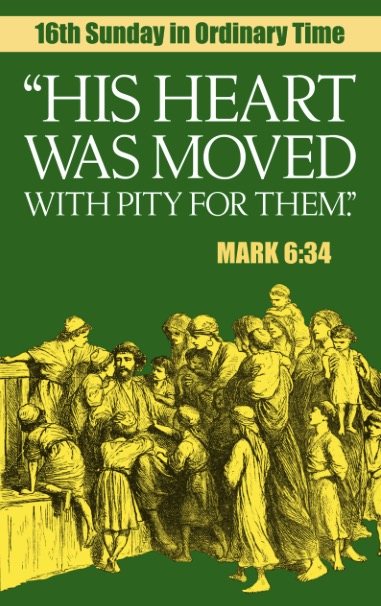
Fr. Richard Hoerning

Permission to use is granted for nonprofit ministries

Click on banner at right
to show/hide essay.

BOOKS

Solitude and Spiritual Rejuvenation: Connecting Mk 6:30-34 and Thoreau’s “Walden”

YouTube player
THE NEW YORK TIMES (1:54) – Vsit Walden Pond, where Henry David Thoreau once lived, in 360 video. Listen to excerpts from his book “Walden.”
WALDEN by Henry David Thoreau

Seeking Balance in a Busy World: Lessons from Mark's Gospel and the Life of Henry David Thoreau

In Mark 6:30-34, Jesus invites his apostles to "come away by yourselves to a deserted place and rest a while," acknowledging the importance of solitude and rejuvenation amidst the toils of daily life. This biblical passage shares a strong connection with the life and philosophy of Henry David Thoreau, as detailed in his influential book, "Walden."

In "Walden," Thoreau documents his two-year retreat to a cabin near Walden Pond, where he sought to escape the pressures of modern society and engage in introspection. This deliberate act of self-isolation mirrors Jesus' invitation to his apostles, demonstrating the universal need for individuals to disconnect from the outside world and reconnect with themselves.

Thoreau believed that by simplifying one's life and minimizing distractions, an individual could achieve greater spiritual fulfillment and personal growth. He emphasizes the importance of self-reflection and mindfulness, much like Jesus' recognition of the apostles' need for rest and rejuvenation. Both instances highlight the value of solitude and introspection for nourishing the human spirit.

Furthermore, Thoreau's connection with nature in "Walden" echoes the essence of Mk 6:30-34, as Jesus and his apostles retreat to a natural setting to find peace and respite. Both narratives underscore the therapeutic and restorative power of nature, serving as a reminder for individuals to seek balance in their lives and prioritize self-care.

In conclusion, Mk 6:30-34 and Thoreau's "Walden" converge on the importance of solitude, introspection, and the healing power of nature. Both narratives serve as powerful reminders for individuals to carve out moments of quiet contemplation amidst the hustle and bustle of daily life, to foster personal growth and spiritual rejuvenation.

Click on banner to show/hide text

AROUND THE WORLD

The Word Exposed
The Phillipines

Lectio Divina
Carmelites

The Word Exposed
The Phillipines

Lectio Divina
Carmelites

Cardinal Goh
Singapore

THE WORD THIS WEEK brings you engaging videos and other content that are tailored to enhance your understanding of the Sunday readings. The creators of these resources are independent and not affiliated with this website. 

sunday homilies

HOME | CATECHISM THEMES | COMMENTARY