Papal Homilies, Pope Francis, Pope Benedict, Pope John Paul II, Pope Leo
October 18, 2026
⭐⭐⭐ Pope Leo XIV



Holy See
- The Bible
- Catechism of the Catholic Church
- Codes of Canon Law
- Ecumenical Councils
- Official Acts of the Holy See
- Social Doctrine of the Church
- Abuse of Minors, the Church’s Response
- Press Office
- Vatican News – Radio Vaticana
- L’Osservatore Romano
- Vatican Websites
- Vatican City State
- Basilicas and Papal Chapels – Virtual Tours
- Liturgical Celebrations
- Tickets for Papal Audiences and Celebrations
29th Sunday of Year A

God is the Lord of the Empires and of History
FROM THE ARCHIVES (1999)
Cyrus reigns over the immense Persian empire (First Reading), but God reigns over Cyrus and providentially makes him his mediator in his plans regarding history. Give to God what belongs to God, the Gospel teaches us, and to the kings and emperors what belongs to them. To God, the plan and purpose of history; to them, the action and onward evolution of history. There is no doubt about the fact that it is the power of God and of his Spirit that is mysteriously present in the vicissitudes that make up the fabric of history (Second Reading).
Doctrinal Messages
There are no two histories, one profane and the other one sacred, but there is only one history: the history of God.
He has started it, he has continued it over time and he will end it whenever he has decided. Humans are words, but only God writes history with such words. In daily events, in the vicissitudes between peoples and nations, in political or social changes, there are essential human agents, but there is especially a greater, divine plan, though we are not capable of perceiving it. To actually see it, we need to know about God, we need the wisdom that probes the depths of God himself. To see it, it is also necessary to have an attitude of prayer and hope, in order for people to cooperate and joyfully lend themselves to fulfilling the divine plan. Sometimes it may seem that history escapes his control, but it is not so. God allows this to happen in his inscrutable plan, to show us that we are heading down the wrong path, to show us the way to build history according to God. In actual fact, God is not at our mercy, nor are we like puppets in God’s hands. This is a great mystery!
Histories and History
The general concept of history encompasses many objects: political, religious, economic, social, national, continental, universal history… Each and every one of them are pieces with which God, helped by us, builds the only history: the history of salvation, which is intertwined with the other histories and seeks to breathe spiritual life into them, without identifying with any of them. Yes, because God wants all to be saved. This is why the power of God and the presence of the Spirit in us and in our actions and plans, transform the small histories into the history above any other form of history: the history that leads to eternity, above and beyond history. We make history, God accomplishes it. We live history, God gives history its meaning, a meaning hidden in a sealed book… “Pay Caesar what belongs to Caesar, and God what belongs to God.”
Pastoral Suggestions
Divine providence
Human history does not evolve haphazardly, without direction or aim. The end of history and its destiny are in the hands of God. “Look at the birds in the sky. They do not sow or reap or gather into barns; yet your heavenly Father feeds them. Are you not worth much more than they are?” (Mt 6:26). We must be convinced of this providential action of God’s in the great history of humanity and in the small history of each human being; surely, the individual is not a puppet, but he is not the lord of history; he is simply its manager, and must behave accordingly. We must also have a sense of providence in everything. Like Job, we must say, “Yahweh gave, Yahweh has taken back. Blessed be the name of Yahweh! In all this misfortune Job committed no sin, and he did not reproach God” (Job 1,21-22). Let us never forget that everything that happens is for the good, for God can find what is good even in the things that are bad, and for those that love God all things contribute to their good.
Sense of responsibility before the history of salvation
No one is neutral in God’s plan, no-one is exempt from playing a role in history. One either builds or destroys. It is impossible not to take a position before the great watershed of history. Let us recall that, at the final hour, we will be accountable for the work we have carried out, both in our personal history and in the history of the community in which we have lived.
The objection,”Since God guides everything towards what is good, the evil that I do will have no consequence,” is a petty objection
Evil will never cease to be evil before ourselves and before God, as much as God, in his goodness and might, is able to get the good out of the bad. God guides history, but he does not make up for our wretchedness or human smallness. The sense of providence does not diminish, but rather enhances our responsibility before God. As far as this issue is concerned, it is necessary to form the conscience of Christians to uprightness and fidelity. An upright conscience to know well the will of God; a faithful conscience to act according to his will.
SOURCE: YEAR A DICASTERY NOTES (1999)
P. Antonio Izqeuirdo, L.C., Copyright © Dicastery for the Clergy, The header image is an AI-generated visual concept illustrating the central themes, scripture quotes, and visual motifs from this week’s Mass readings.

29th Sunday of Year A
Taxes Must Be Paid
18 October 2020 | Saint Peter’s Square
The Insidious Trap of the Adversaries
This Sunday’s Gospel reading (cf. Mt 22:15–21) shows us Jesus confronting the hypocrisy of his adversaries. They begin with flattery, offering many compliments, but quickly follow with an insidious question designed to place him in difficulty and discredit him before the people:
“Is it lawful to pay taxes to Caesar, or not?” (v. 17)
At that time in Palestine, the domination of the Roman Empire was poorly tolerated, understandably so, as the Romans were foreign invaders. The opposition was also deeply religious: for the people, imperial worship—reinforced by the Emperor’s image stamped on the coinage—was seen as an affront to the God of Israel.
Jesus’ Masterful Response
Jesus’ interlocutors are convinced that their question allows no alternative: it must be answered with either a simple “yes” or “no.” They wait eagerly, confident that they have backed him into a corner and trapped him.
Aware of their malice, Jesus sidesteps the pitfall. He asks them to show him the coin used for the tribute. Taking it in his hands, he asks whose image and inscription it carries. When they reply that it is Caesar’s, Jesus delivers his defining answer:
“Render therefore to Caesar the things that are Caesar’s, and to God the things that are God’s” (v. 21).
The Two Images: Earthly Authority vs. Divine Origin
With this reply, Jesus rises completely above the controversy.
On the one hand, he acknowledges that the civic tribute to Caesar must be paid, just as citizens today must pay taxes, because the coin bears Caesar’s image.
Above all, however, he reminds his listeners that every human being carries another likeness within the heart and the soul: the image of God (imago Dei). Because humanity bears the divine image, it is to God, and to God alone, that every person owes their existence and their life.
The Dual Role of the Believer
In this maxim, Jesus provides more than a criterion for distinguishing between the political sphere and the religious sphere; he sets forth clear guidelines for the mission of believers in every age, including our own.
- Civic Duty: Paying taxes and observing the just laws of the state are fundamental obligations of citizenship.
- Divine Primacy: Believers must concurrently affirm God’s absolute primacy in human life and history, honoring God’s sovereign claim over everything that belongs to him.
The Christian Mission in Society
From this truth flows the vital mission of the Church and of all Christians: to speak of God and bear witness to him before the men and women of our time.
Through Baptism, every believer is called to be a living presence in society, animating the world with the Gospel and the lifeblood of the Holy Spirit. This requires committing oneself with both humility and courage to help build a civilization of love rooted in justice and authentic fraternity.

October 18, 2020
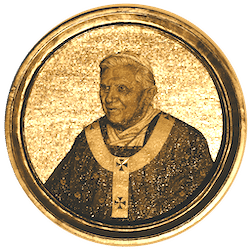
29th Sunday of Year A
Tribute to Caesar
16 October 2011 | Holy Mass for the New Evangelization
Introduction
Let us now come to the biblical Readings in which the Lord speaks to us today.
The Theology of History
The first reading, taken from the Book of Isaiah, tells us that God is one, there is no other; there are no gods other than the Lord. Even the powerful Cyrus, Emperor of the Persians, was part of a larger plan that God alone knew and carried forward. This Reading gives us the theological meaning of history: the epochal upheavals and the succession of great powers are under the supreme sovereignty of God; no earthly power can stand in his stead.
The theology of history is an essential aspect of the New Evangelization because the people of our time, after the inauspicious season of the totalitarian empires in the 20th century, need to rediscover an overall view of the world and of time—a truly free, peaceful outlook, that perspective which the Second Vatican Council communicated in its documents and which my predecessors, the Servant of God Paul VI and Blessed John Paul II, illustrated through their Magisterium.
Proclamation, Communion, and the Holy Spirit
The Second Reading is the beginning of the First Letter to the Thessalonians. This is already deeply evocative because it is the oldest surviving letter of the greatest evangelizer of all time, the Apostle Paul.
He tells us, first of all, that one does not evangelize alone: he too had collaborators—Silvanus and Timothy (cf. 1 Thes 1:1) and many others. He immediately adds something of great importance: proclamation must always be preceded, accompanied, and followed by prayer. Indeed, he writes: “We give thanks to God always for you all, constantly mentioning you in our prayers” (v. 2). The Apostle then acknowledges that he did not choose the members of the community, but that God “has chosen you” (v. 4). Every Gospel missionary must always bear in mind this truth: it is the Lord who touches hearts with his word and with his Spirit, calling people to faith and to communion in the Church.
Lastly, Paul leaves us a valuable teaching drawn from his own experience. He writes: “our gospel came to you not only in word, but also in power and in the Holy Spirit and with full conviction” (v. 5). Evangelization, to be effective, needs the power of the Spirit, who animates the proclamation and imbues those who convey it with the “full conviction” of which the Apostle speaks. This term “conviction” or “full conviction” in the original Greek is plerophoria (πληροφορία): a word expressing not merely a subjective, psychological certainty, but rather the fullness, fidelity, and completeness of the proclamation of Christ. It is a proclamation that, to be complete and faithful, must be accompanied by signs and gestures, just like the preaching of Jesus. Word, Spirit, and certainty—understood in this way—are inseparable and work together to ensure that the Gospel message spreads effectively.
Walking the Way of Truth
Let us now reflect on the Gospel passage. It is the account of the tribute paid to Caesar, containing Jesus’ famous reply: “Render therefore to Caesar the things that are Caesar’s, and to God the things that are God’s” (Mt 22:21).
Before reaching that point, there is an opening exchange that directly applies to those tasked with evangelizing. Those speaking with Jesus—disciples of the Pharisees and the Herodians—compliment him, saying, “We know that you are true, and teach the way of God truthfully, and care for no man” (v. 16). It is this very statement, despite being prompted by hypocrisy, that commands our attention. The disciples of the Pharisees and Herodians do not believe what they are saying; they offer it as a captatio benevolentiae to gain an audience, while their hearts remain far from the truth, seeking only to trap and accuse him.
For us, however, those words are precious: Jesus is truly authentic, teaches the way of God according to the truth, and stands in awe of no one. He himself is that “way of God” which we are called to follow, echoing his words in John’s Gospel: “I am the way, the truth, and the life” (Jn 14:6).
In this regard, St. Augustine’s commentary is illuminating:
“It was necessary for Jesus to say ‘I am the way, the truth, and the life’, when knowing the way by which he went they had to learn where he was going. The way led to truth, it led to life… And where are we going, but to him, and by what way do we go, but by him?” (In Evangelium Johannis tractatus 69, 2).
New evangelizers are called to walk first along this Way that is Christ, leading others to discover the life-giving beauty of the Gospel. On this Way, one never journeys alone, but in fellowship—an experience of communion and fraternity offered to everyone we meet, sharing with them our encounter with Christ and his Church. Thus, witness united with proclamation can open the hearts of truth-seekers, leading them to the true meaning of their lives.
The Image of God and the Sovereignty of the Lord
Consider also the central question regarding the tribute to Caesar. Jesus replies with remarkable political realism grounded in the theocentrism of the prophetic tradition.
The tribute to Caesar must be paid because his likeness is stamped upon the coin; yet the human being—every person—bears within another image: the image of God. Therefore, it is to God alone that every person owes their very existence. The Fathers of the Church, drawing from Jesus’ reference to the imperial image on the coin, interpreted this passage in light of the fundamental truth of the human person created in the image of God (imago Dei), as revealed in the first chapter of Genesis.
An ancient author wrote:
“The image of God is not impressed on gold, but on the human race. Caesar’s coin is gold, God’s coin is humanity… Therefore give your riches to Caesar but keep for God the unique innocence of your conscience, where God is contemplated… Caesar, in fact, asked that his image be on every coin, but God chose man, whom he created to reflect his glory” (Opus Imperfectum in Matthaeum, Homily 42).
St. Augustine frequently returned to this theme in his preaching:
“If Caesar reclaims his own image impressed on the coin, will not God demand from man the divine image sculpted within him?” (Enarrationes in Psalmos, Ps 94:2).
And again:
“As the tribute money is rendered to him [Caesar], so should the soul be rendered to God, illumined and stamped with the light of his countenance” (ibid., Ps 4:8).
This teaching of Jesus is rich in theological anthropology and cannot be reduced merely to a political formula. The Church does not limit herself to pointing out the legitimate distinction between the authority of Caesar and that of God, or between the political and religious spheres. The essential mission of the Church, like that of Christ, is to speak of God, to proclaim his sovereignty, and to remind all people—especially Christians who have lost sight of their identity—of the absolute claim of God over that which belongs entirely to him: our life.

29th Sunday of Year A
World Mission Sunday
20 October 2002 | CAPPELLA PAPALE FOR THE BEATIFICATION OF 6 SERVANTS OF GOD
The Great Commission
“Go therefore and make disciples of all nations, baptizing them in the name of the Father and of the Son and of the Holy Spirit” (Mt 28:19).
The Risen Lord took his leave of the Apostles in this way before returning to the Father: “Go.” His final command is an invitation to mission that stands at once as a promise, a testament, and a duty. Christ entrusts his message of salvation to his disciples, commissioning them to spread it and bear witness to it to the ends of the earth.
This is the enduring meaning of World Mission Sunday. By a providential coincidence, on this very day we raise to the altars new Blesseds who fulfilled in an extraordinary manner the command to proclaim and live the Gospel:
- Blessed Daudi Okelo
- Blessed Jildo Irwa
- Blessed Andrea Giacinto Longhin
- Blessed Marcantonio Durando
- Blessed Mary of the Passion (Hélène Marie Philippine de Chappotin)
- Blessed Liduina Meneguzzi
Their beatification on World Mission Sunday reminds us that the primary service we offer to the mission of the Church is the sincere and constant pursuit of holiness. We cannot genuinely bear witness to the Gospel if we do not first live it faithfully.
Martyrs of the Faith
My thoughts turn first to the two young catechists from Uganda, Daudi Okelo and Jildo Irwa. These courageous witnesses were mere youths when, with simplicity and profound faith, they shed their blood for Christ and his Church.
Animated by youthful enthusiasm to teach the faith to their countrymen, they journeyed in 1918 to northern Uganda. There, at the very dawn of evangelization in the region, they chose death over abandoning their station or forsaking their ministry as catechists. Truly, their life and martyrdom reveal that they were “beloved by God and chosen by him” (cf. 1 Thes 1:4).
Raised today to the glory of the altars, Daudi and Jildo are presented to the universal Church as models of holiness and intercessors for catechists worldwide—especially where catechists endure hardship, social marginalization, and physical danger for the faith. May their witness inspire many across Uganda, throughout Africa, and across the globe to answer generously the call to serve as catechists, bringing Christ to others and fortifying newly formed Christian communities.
The Shepherd of Essential Things
“I have called you by name” (Is 45:4).
The words of the prophet Isaiah, describing the divine call of God’s chosen servant, capture the vocation of Andrea Giacinto Longhin. A humble Capuchin Friar Minor, he served for thirty-two years as Bishop of the Diocese of Treviso during the turbulent opening decades of the twentieth century. True to the Franciscan and Capuchin tradition, he was a poor, humble, and generous pastor, tirelessly available to his flock.
Widely known as the “Bishop of essential things,” he guided his diocese through seasons of deep national tragedy and suffering. He stood out as a loving father to his priests and a vigilant shepherd who remained close to his people in times of acute peril. In this ministry, he anticipated the vision of the Second Vatican Council, which affirmed that evangelization remains “one of the principal duties of bishops” (Christus Dominus, n. 12; cf. Redemptoris Missio, n. 63).
Zeal Rooted in the Cross
“Remembering… your work of faith and labour of love and steadfastness of hope” (1 Thes 1:2–3).
These words of the Apostle Paul sketch the spiritual portrait of Father Marcantonio Durando, a priest of the Congregation of the Mission (Vincentians) and a devoted son of Piedmont. He lived with an ardent faith and apostolic zeal, rejecting every form of compromise and interior tepidity.
Formed in the school of St. Vincent de Paul, he recognized in the sacred humanity of Christ the most accessible, disarming, and profound revelation of God’s love for humanity. Through his life and preaching, he points us to the mystery of the Cross as the summit where the unsearchable depth of divine charity is fully revealed.
Adoration and Apostolic Mission
“We know, brethren beloved of God, that you were chosen by him” (1 Thes 1:4).
Blessed Mary of the Passion allowed herself to be seized entirely by God, who alone satisfied the thirst for truth that consumed her soul. As the Foundress of the Franciscan Missionaries of Mary, she burned with a desire to channel the torrents of divine love into every corner of the earth.
At the very center of her missionary commitment, she placed personal prayer and the Holy Eucharist, recognizing that adoration and mission form a single, unified work. Nourished by Sacred Scripture and the Church Fathers, she seamlessly harmonized the contemplative and apostolic vocations. With bold intuition and selfless readiness, she gave herself entirely to the Church’s universal mission.
Dear Sisters, look to your Foundress: live the foundational intuitions of your charism with renewed fidelity and in deep communion with the Church, so that ever more souls may encounter Jesus Christ, who leads us into the heart of the mystery of God’s love.

Matthew 22:15-21
Search Engine created by Jeff Pinyan
29th Sunday of Year A
Isaiah 45:1, 4-6
Search Engine created by Jeff Pinyan
29th Sunday of Year A
Thessalonians 1:1-5b
Search Engine created by Jeff Pinyan
29th Sunday of Year A
 Highlight text or double-click a paragraph anywhere on the site to ADD TO NOTES. You can also click ASK AI to copy your selection to the clipboard with a command prompt, ready for you to paste manually into the chat above.