Catholic Digest, Homily Themes
Catholic Digest, Homily Themes
July 19, 2026
⭐⭐⭐ Wet Cement (Holy TV Ads)

⬅️  ➡️
➡️



Theology, Apologetics & Evangelization
These channels focus on explaining and defending the Catholic faith, often engaging with modern culture and other viewpoints.
- Bishop Robert Barron (Word on Fire): One of the most influential voices in the Church, offering cultural commentary, movie reviews, and deep theological deep-dives.
- Ascension Presents: A powerhouse channel featuring popular figures like Fr. Mike Schmitz (known for the “Bible in a Year” and “Catechism in a Year” podcasts) and Fr. Josh Johnson, offering accessible videos on faith and life.
- Catholic Answers: The premier channel for Catholic apologetics, featuring live Q&A shows where apologists answer tough questions from callers.
- Pints with Aquinas (Matt Fradd): Long-form interviews and discussions on theology, philosophy, and culture, often over a drink.
- The Counsel of Trent (Trent Horn): Trent Horn, a Catholic Answers apologist, provides rebuttals to atheist and Protestant arguments, as well as commentary on current events.
- Jimmy Akin: A senior apologist at Catholic Answers known for his fairness and deep knowledge, covering everything from bizarre questions to deep theology.
- Breaking In The Habit (Fr. Casey Cole, OFM): A young Franciscan friar who offers fresh, accessible reflections on faith, vocations, and everyday life.
- Thomistic Institute: Excellent, high-quality animated videos and lectures explaining the philosophy and theology of St. Thomas Aquinas.

JULY-AUGUST 2026
PDF (84 pages)
America Magazine: Published by the Jesuits, this leading national review is highly regarded for its thoughtful, nuanced commentary on religion, politics, and contemporary culture.

Commonweal: An independent, lay-edited journal of opinion that provides rigorous intellectual perspectives on faith, society, the arts, and public policy.

JULY-AUGUST 2026
PDF (48 pages)
Liguorian is an award-winning Catholic magazine published since 1913 by the Redemptorists to provide spiritual guidance, pastoral messages, and inspiring stories, helping readers navigate modern life through faith. It acts as a trusted resource for Catholic spirituality, offering insights on faith, social justice, and daily Christian living.

U.S. Catholic: This publication focuses on everyday faith, social justice, and practical insights for living out Catholic teachings in modern, daily life.
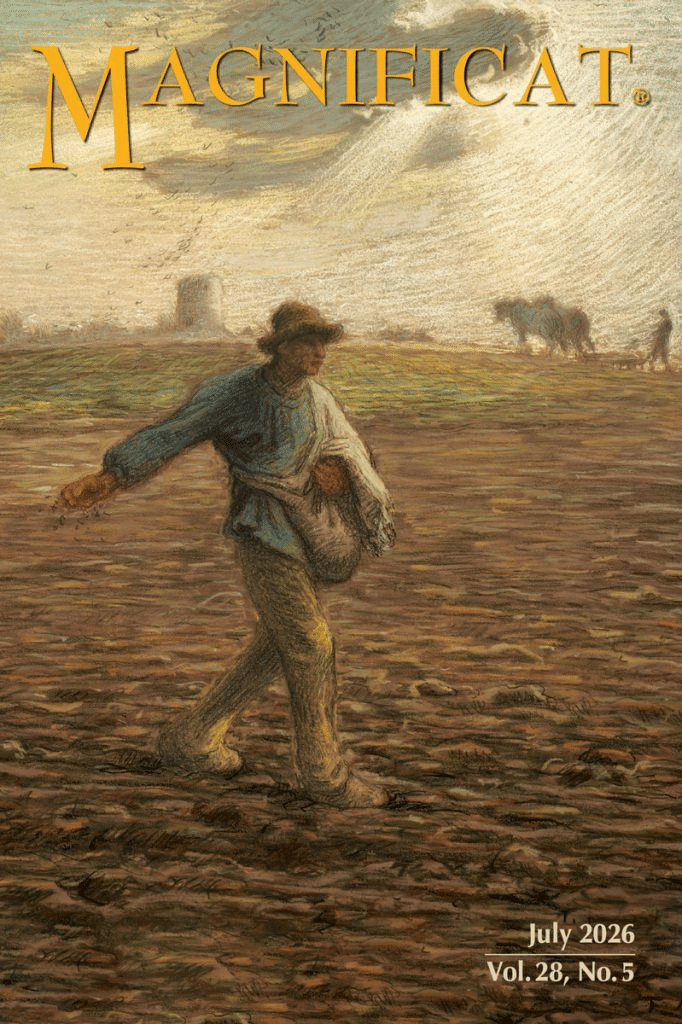
Magnificat: A beautifully designed monthly publication intended for daily use. It includes the texts of the daily Mass, morning and evening prayers, and spiritual reflections. Exploring its Spanish edition, Magnificat en Español, can also be an excellent way to weave language practice into a daily spiritual routine.
Catholic.com
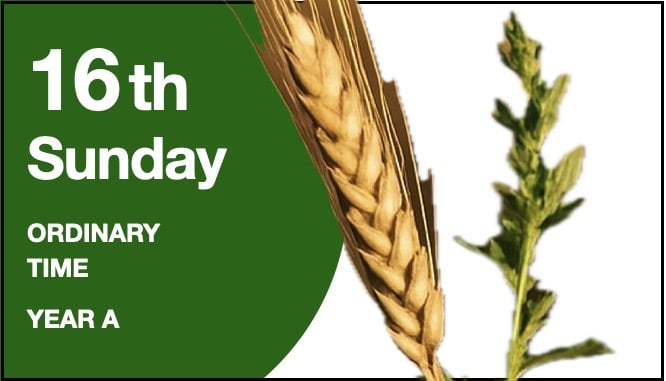
16th Sunday of Year A
SUNDAY BLOG POSTS | CATHOLIC PRESS
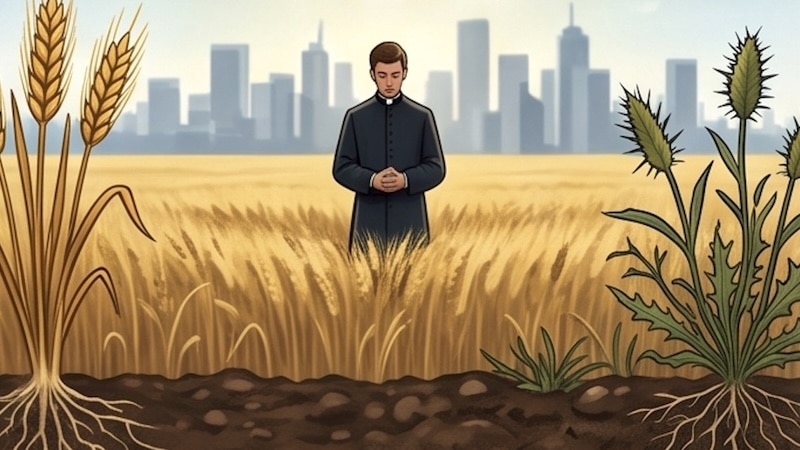
Courtesy of Angelus (Los Angeles Archdiocese)
16th Sunday of Year A
The Field of Discerning Hearts
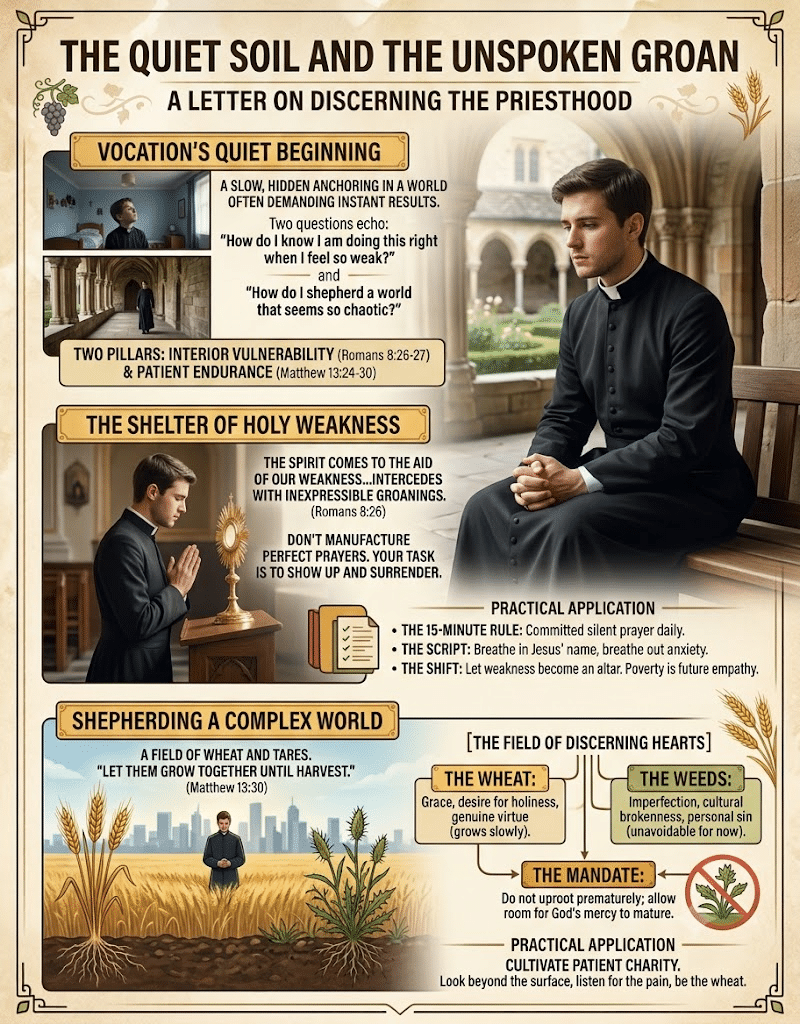
SUMMARY: Discernment requires interior vulnerability and patient endurance. Rooted in Romans 8:26-27, Saint Paul reminds us that our personal weakness is not a failure, but the very place where the Holy Spirit intercedes through silent prayer. Furthermore, Christ’s parable of the wheat and the tares (Matthew 13:24-30) teaches us to navigate contemporary cultural chaos with patient charity. Rather than forcing premature judgment, a future priest must rely on God’s grace to mature the harvest.
Discernment is rarely a lightning bolt. More often, it is a slow, hidden anchoring in a world that demands instant, visible results. In the quiet of your heart, you are likely asking two questions that have echoed through centuries of priestly vocations: How do I know I am doing this right when I feel so weak? and How do I shepherd a world that seems so chaotic?
Two profound texts from the Church’s liturgy offer the blueprint for your journey: Paul’s letter to the Romans and Christ’s parable of the wheat and the tares. Together, they form the twin pillars of priestly discernment: interior vulnerability before God and patient endurance in the world.
The Shelter of Holy Weakness
Let us begin exactly where you feel most inadequate. Discernment can feel like a grueling performance review where you are your own harshest critic. You might think a vocation requires flawless clarity, a robust prayer life, and ironclad theological certainty.
Saint Paul shatters this illusion with astonishing tenderness:
“The Spirit comes to the aid of our weakness; for we do not know how to pray as we ought, but the Spirit himself intercedes with inexpressible groanings.” (Romans 8:26)
If you do not know how to pray as you ought right now, thank God. You are precisely where a future priest needs to be. The priesthood is not a career for the self-sufficient; it is a ministry of qualified beggars leading others to the Bread of Life.
When you kneel before the Blessed Sacrament and find only dryness, distraction, or a heavy silence, you are not failing. You are experiencing the “inexpressible groanings” of the Holy Spirit within you.
The Practical Application: Stop trying to manufacture perfect prayers. Your primary task right now is simply to show up and surrender.
- The Shift: Let your weakness become an altar. A priest who has never struggled to pray cannot comfort a parishioner who feels abandoned by God. Your current poverty is your future empathy.
- The 15-Minute Rule: Commit to fifteen minutes of silent, unstructured prayer every day.
- The Script: If no words come, simply breathe in the name of Jesus and breathe out your anxiety.

Shepherding a Complex World
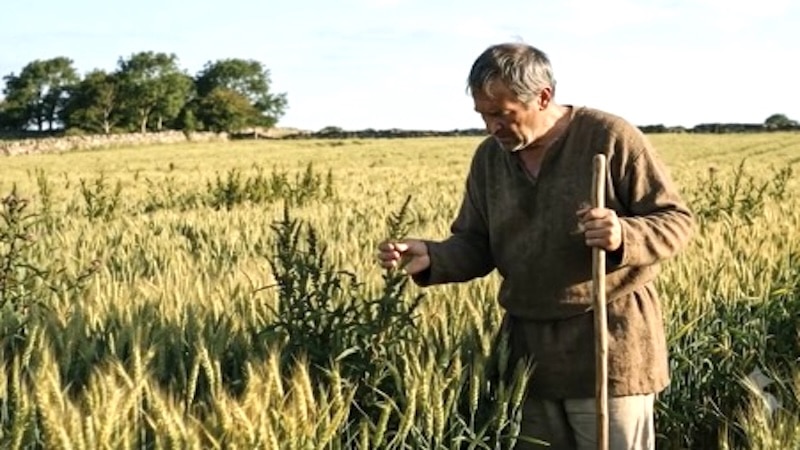
If Romans addresses your interior life, Matthew’s Gospel addresses the landscape you are being called to serve. Christ describes a field where a master sowed good seed, but an enemy came at night and sowed weeds—tares—among the wheat (Matthew 13:24-30). When the servants frantically ask to pull up the weeds, the master gives a counterintuitive command: “Let them grow together until harvest.”
Our contemporary culture is that very field. You are discerning a vocation in a time of profound polarization, systemic distrust, and moral confusion. The temptation for a young man discerning the priesthood today is often to become an ideological gardener—to walk into the world, or the parish, with a spiritual machete, eager to rip out everything that looks like a weed.
But Christ calls his priests to a patient, messy endurance.
The wheat and the tares grow in the world, they grow in the parish, and—most painfully—they grow within your own heart. You will see brokenness in the seminary, faults in your formators, and deep fractures in the culture. If you demand a flawless field before you say “yes” to Christ, you will never step forward.
The Practical Application: Cultivate the virtue of patient charity.
- Be the Wheat: Focus your energy on growing deep roots of virtue rather than obsessing over the weeds around you. The world is changed by the quiet abundance of holiness, not by the loud denunciation of darkness.
- Look Beyond the Surface: When you encounter someone whose lifestyle or beliefs completely contradict the Gospel, resist the urge to immediately argue or condemn.
- Listen for the Pain: Ask yourself, What is the hidden groan in this person’s life?
Trust the Searcher of Hearts
Take heart, brother. The One who searches hearts knows the mind of the Spirit. He knows your desires, your fears, and your hidden goodness.
You do not have to figure out the rest of your life by tomorrow morning. You only have to give God the next right step. Let the Spirit groan within you, let the wheat mature around you, and trust that the Master of the Harvest knows exactly what He is doing with your life. Turn your gaze to Him; He has already looked upon you with love.
Essay and animation created with AI tools and human editorial oversight.
Download PDF (High Resolution)
Non-profits have permission to use in their ministry.
16th Sunday of Year A
The Patient Tending
Gospel: Matthew 13:24–43
Theme: Let them grow together until harvest time.
McCulloch
(Diocese of Broken Bay)
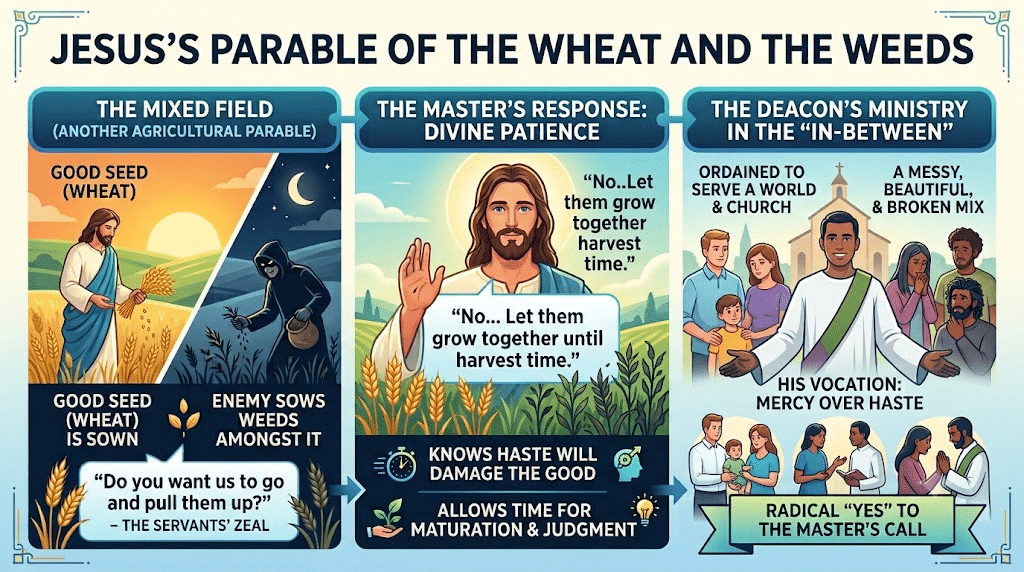
Jesus gives us another agricultural parable, but this one is not about the soil; it’s about the conflict in the field. The Kingdom is a place where good seed (the wheat) is sown, but an enemy also sows weeds. The servants, in their zeal, want to fix the problem immediately. “Do you want us to go and pull them up?” they ask.
The Master’s reply is the very definition of divine patience: “No… Let them grow together until harvest time.” The Master, in his wisdom, knows that in our haste to root out the bad, we will inevitably damage the good.
The deacon’s ministry is lived almost entirely in this in-between of the mixed field. He is ordained to serve a world, and a Church, that is a messy, beautiful, and broken mix of wheat and weeds. His vocation is a radical yes to the Master’s call for mercy more than haste.
AT MASS
The Proclamation of Patience
At Mass, the deacon is the herald of God’s patience and timing.
• Proclaiming the “No”: When the deacon proclaims this Gospel, he gives voice to the Master’s “No”. This is a divine “no” to the parish’s (and our own) impatient and judgmental weed-pulling instincts.
• The Homily of Mercy: The deacon’s preaching on this text is a call for parish self-examination. Where are we trying to be the harvesters? Where are we judging, excluding, or writing people off as weeds? The deacon must challenge the community to serve as a field hospital that tends to all, rather than a courtroom that judges all.
• Praying for the Field: In the Universal Prayer, the deacon prays for the whole field. He prays for the wheat (who are the faithful and the strong) and for the weeds (the struggling, the sinner, the one on the margins), trusting that God’s grace, like the mustard seed, is at work in all of them.
IN THE PARISH
The Ministry of Guardian of Virtues
St. Gregory the Great said that patience is the root and guardian of all virtues. This patience is the deacon’s primary pastoral tool.
• The Non-Judgmental Minister: The deacon, in his parish life, must be the one who refuses to “pull weeds.” He is the one who must stay with the difficult parishioner, the struggling family in marriage preparation, the teen who is full of doubt. He is called to tend, and not to judge.
• Trusting God’s Timing: The deacon’s work in RCIA, in counselling, or in pastoral care is an act of profound trust in God’s timing. He cannot force conversion. He can only tend the field with love, believing that grace is at work even when hidden.
• Seeing the Wheat in the Weed: The deacon’s mercy is rooted in the knowledge that he is not the judge. His patient service is a bet on grace, a belief that the weeds of today (the addict, the angry parishioner) may one day be the wheat of the harvest.
AT THE MARGINS
The Ministry of Presence
The field is the world, and the deacon’s diakonia sends him to the weediest parts of it: the prison, the shelter, the hospital ward for addiction.
• Tending without Pulling: The deacon goes to the margins not with a weed-puller, but with water: the living water of Christ’s mercy. His job is not to condemn or to fix anything immediately, but to be present and to serve the person in front of him.
• The Field of the Human Heart: The deacon knows that the wheat and weeds grow together not just in the world, but in every human heart, including his own. This knowledge makes him humble and merciful, not zealous for judgment.
• God is Still Growing Something Good Here: This is the deacon’s fundamental message. His steady and calm service in the midst of brokenness is a living homily. His presence quietly and powerfully says to the person everyone else has given up on, “The Master has not given up on you. I will not give up on you. God is still growing something good here.”
16th Sunday of Year A

The Trinity Dome
by Bishop John P. Dolan
Diocese of Phoenix
Basilica of the National Shrine of
the Immaculate Conception, Washington D.C.
On this 14th Sunday in Ordinary Time, and as our nation celebrates its 250th anniversary this weekend, the readings invite us to reflect not only on where we have come from but on who we are called to become. “As a mother comforts her child, so will I comfort you.” Isaiah envisions Jerusalem as a mother who gathers, nourishes, and consoles her children. It is an image of belonging, hope, and peace.
With those words in mind, let us look upward—literally upward—to the Trinity Dome in the Basilica of the National Shrine of the Immaculate Conception, the largest Catholic Church in North America. Completed in 2017, the dome contains millions of pieces of mosaic tile. Over 24 tons of mosaic tiles were packed into wooden crates and shipped by air and boat from Italy to Washington, D.C., to be installed.
A Heavenly Perspective
At its center is Christ in glory, united with the Blessed Trinity and the Blessed Virgin Mary. Under her title of the Immaculate Conception, the apostles, the saints, and holy men and women who helped shape the Church in our land called America are there as well. What strikes me about this work is its perspective. The dome draws our eyes upward in a city known for monuments to presidents, lawmakers, and national heroes. This great Catholic mosaic quietly proclaims that history ultimately belongs to God.
Our True Identity in Christ
As we celebrate 250 years of the United States, we rightly give thanks for the blessings of our nation: freedom, opportunity, sacrifice, and the faith of generations who built communities, schools, hospitals, and churches. Yet, the Trinity Dome reminds us that our deepest identity is not found in politics or geography. It is found in Christ.
That is the balance Isaiah offers as well. He speaks of a people who rejoice in their homeland, but only because God is present among them. The source of their peace is not their achievements; the source of their peace is the Lord.
The True Measure of a Nation
I am especially moved by the presence of Mary in this mosaic. Under her title as the Immaculate Conception, she is the patroness of the United States. Just as Isaiah describes a mother comforting her children, Catholics have long turned to Mary as a sign of God’s tenderness and care.
The message of this artwork is simple, but profound. Nations rise and fall. Generations come and go, but Christ remains the Lord of history. The saints remind us that the true measure of a nation is not merely its power or prosperity, but the holiness, justice, and charity of its people.
May the Lord continue to bless our nation. May Mary, the Immaculate Conception, watch over her children. And may our eyes always remain fixed on Christ, who leads us to the homeland that will never pass away.

NATIONAL SHRINE (1:20): Mosaic Artist Designs Face of the Blessed Mother
16th Sunday of Year A

The Nutty Professor (1996)
Scripture Focus: Matthew:13:28b-29 – His slaves said to him, ‘Do you want us to go and pull them up?’ He replied, ‘No, if you pull up the weeds you might uproot the wheat along with them.
The 1996 comedy The Nutty Professor serves as a modern psychological parable of the wheat and the tares operating within a single soul. Desperate to instantly eradicate his vulnerabilities—his obesity and low self-esteem—the brilliant but insecure Professor Sherman Klump creates a genetic serum. This human shortcut unleashes Buddy Love, an aggressive alter-ego who embodies arrogance and vice. Sherman’s chaotic struggle for bodily control demonstrates the danger of trying to violently uproot personal flaws through artificial means. Ultimately, the film illustrates that true transformation requires patient self-acceptance, illustrating the messy reality of grace and imperfection growing together.

Content Warning: Before diving into this theological connection, a vital warning is necessary for modern audiences: The Nutty Professor is an edgy, late-90s comedy. Some viewers may find specific scenes, coarse language, and derogatory comments made by Buddy Love—Sherman’s uninhibited alter ego—highly offensive. Buddy’s dialogue frequently relies on cruel insults, toxic misogyny, and aggressive fat-shaming. Yet, from a theological perspective, the deeply offensive nature of Buddy’s character is precisely the point. He represents the unmitigated, ugly growth of the “tares.”

The Boardwalk Confrontation: Sherman Klump, now trapped in a chaotic internal struggle for dominance against his own alter-ego, Buddy Love, stands on a public stage at a science convention. As the chemical serum wears off, the two personas violently battle for physical control of the same body. In a desperate, public moment of truth, Sherman uses his own scientific equipment to willingly strip Buddy away, breaking through the illusion of a “quick fix” and tearfully accepting his true, flawed self in front of the woman he loves and his peers.
Theological Connection: In the film, Professor Sherman Klump represents the “wheat”—a man of deep kindness, brilliant intellect, and genuine virtue. Desperate to escape the painful “weeds” of his life (societal cruelty, low self-esteem, and obesity), he uses a genetic serum to create Buddy Love. Buddy is the ultimate manifestation of the tares: arrogant, hedonistic, and malicious.
Sherman’s mistake is exactly what the Master warns against in the parable: he tries to use a human shortcut to violently rip out what he perceives as his flaws. By trying to instantly destroy his vulnerabilities, he accidentally unleashes an aggressive, unchecked evil (Buddy) that threatens to completely choke out his true goodness. The film’s resolution beautifully illustrates the mandate of the parable: true transformation cannot be forced through human shortcuts or premature uprooting. Sherman must patiently endure his own complex reality, learning that true holiness and integration require accepting a messy field until the final harvest of self-acceptance.
The Serum and the Soil: Human Shortcuts and Spiritual Harvests in The Nutty Professor
The Parable of the Wheat and the Weeds (Matthew 13:24-30) offers a profound framework for understanding the messy reality of human life. While traditionally applied to the coexistence of good and evil within the world or the Church, this scriptural truth manifests with surprising clarity in secular culture. A compelling, albeit unconventional, example of this is the 1996 comedy The Nutty Professor. Stripped of its slapstick humor, the film serves as a modern psychological and spiritual exploration of the parable, demonstrating what happens when an individual attempts to violently untangle the good seed from the soil of their own broken humanity.
The Interior Field: Wheat, Weeds, and Chemical Serums
In the film, Professor Sherman Klump is the embodiment of the “good seed.” He is a brilliant scientist possessing deep kindness, genuine empathy, and a desire to help humanity. However, Sherman’s life is also plagued by “weeds”—intense insecurity, societal cruelty, and a struggle with obesity. Desperate for a quick fix to his pain, Sherman rejects the patient road of self-acceptance and instead creates a gene-altering serum. His goal is simple: use human ingenuity to instantly rip out his flaws and cultivate a perfect life.
This chemical intervention births Buddy Love. Initially, Buddy appears to be the answer to Sherman’s prayers—confident, charismatic, and unburdened by Sherman’s physical limitations. But just as the servants in Matthew’s Gospel discover that the weeds look identical to the wheat in their early stages, Buddy’s true nature quickly reveals itself. He is a toxic weed, driven by unchecked ego, hedonism, and cruelty.
The Danger of Premature Uprooting
Sherman’s mistake mirrors the panicked reaction of the servants who ask the Master, “Do you want us to go and pull them up?” (Matthew13:28). Sherman tries to use a human shortcut to force perfection. By attempting to aggressively eradicate his perceived imperfections, he accidentally unleashes an internal monster that threatens to completely choke out his inherent goodness. The more Sherman feeds Buddy to escape his vulnerabilities, the more his true, virtuous self begins to vanish.
The climax of the film serves as a powerful spiritual resolution. Realizing that Buddy is destroying his soul, Sherman wages a chaotic, physical battle to reclaim his body. He publicly confesses his deception and embraces his true, flawed self.
The theological takeaway is clear: we cannot bypass the messy reality of our own spiritual fields. True holiness and integration cannot be engineered through quick fixes, forced perfectionism, or the violent denial of our weaknesses. We must have the patience of the Master, trusting that God’s grace operates within the messy landscape of our lives, gradually maturing the wheat until the final harvest.
16th Sunday of Year A

Wet Cement (2014)
The Foundation for a Better Life
Scripture Focus: Matthew:13:28b-29 – His slaves said to him, ‘Do you want us to go and pull them up?’ He replied, ‘No, if you pull up the weeds you might uproot the wheat along with them.
The Scene: “The Patient Vigil”
A construction worker spends hours painstakingly smoothing out a fresh patch of sidewalk. Just as he finishes, a young boy innocently wanders right through the middle of it, leaving deep footprints in the wet concrete. The worker’s initial reaction is visible frustration—his hard work has been compromised by an intrusive element, much like the servants discovering the tares in the master’s field.
Instead of reacting with immediate wrath, punishing the child, or aggressively trying to undo the damage right then, the man pauses, lets go of his anger, and gently scoops up the boy. The commercial ends with the tagline: “Patience. Pass it on.”
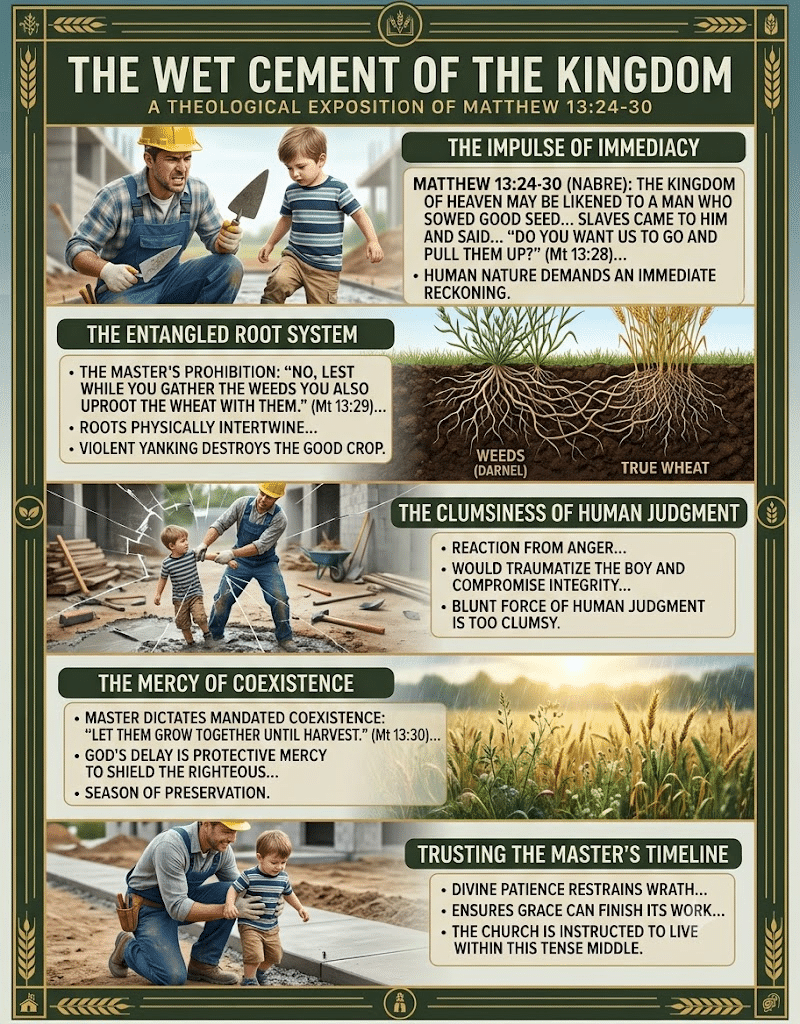
The Wet Cement of the Kingdom: A Theological Exposition of Matthew 13:24-30
In Matthew 13:24-30, Jesus describes a field deliberately sabotaged by an enemy who sows weeds alongside valuable seed. When the damage becomes visible, the servants immediately cry out with an impulse that has defined human history: “Do you want us to go and pull them up?” This reactive, punitive urge directly mirrors the construction worker’s initial surge of visceral frustration when a young boy steps into his freshly smoothed sidewalk. Human nature loathes disruption. When our hard work, our moral order, or our sacred spaces are compromised by intrusive elements, our default setting demands an immediate reckoning. We want to purge the field and patch the concrete right now.
The Entangled Root System
However, the master issues a radical, counter-cultural prohibition: “No, if you pull up the weeds you might uproot the wheat along with them.” This command exposes the dangerous myopia of human judgment and forms the theological heartbeat of the passage. In the agricultural reality of first-century Palestine, the roots of the tares (Lolium temulentum, or darnel) would physically intertwine with the roots of the true wheat underneath the soil. To violently yank out the weed was to inevitably destroy the good crop alongside it.
The Clumsiness of Human Judgment
This is precisely where the commercial’s wisdom deepens into an exposition of divine grace. Had the worker reacted out of raw, unchecked anger—grabbing the child roughly or frantically slapping fresh mortar over the footprints—he would have traumatized the boy and further compromised the structural integrity of the sidewalk. The blunt force of human judgment is simply too clumsy to execute flawless justice in an entangled ecosystem. We cannot tear down the wicked without tearing apart the vulnerable.
The Mercy of Coexistence
Therefore, the master dictates a period of mandated coexistence: “Let both grow together until the harvest.” This directive reveals that God’s delay in executing final judgment is never born out of passivity, impotence, or indifference to evil. Rather, it is an act of supreme, protective mercy designed to shield the righteous. The space between the planting and the harvest is a season of preservation. It allows the wheat to develop deep, resilient roots capable of weathering the storm, while demonstrating that the preservation of the innocent is always more precious to God than the immediate destruction of the hostile.
Trusting the Master’s Timeline
By overcoming his initial anger and gently lifting the child out of the mess, the worker mirrors the heart of the Master. Divine patience deliberately restrains the immediate execution of wrath to ensure that grace can finish its work. The wet cement will eventually dry, the season will conclude, and the final sorting will inevitably come. But until that day, the Church is instructed to live within this tense, messy middle—forgoing the temptation of premature judgment, and trusting that the ultimate separation belongs strictly to the hands of the Lord.