Fr. Tony’s Homily, Homily Starters
Fr. Tony’s Homily, Homily Starters
July 19, 2026



RELATED
PAGES





Wet Cement (2014)
16th Sunday of Year A

A construction worker spends hours painstakingly smoothing out a fresh patch of sidewalk. Just as he finishes, a young boy innocently wanders right through the middle of it, leaving deep footprints in the wet concrete. The worker’s initial reaction is visible frustration—his hard work has been compromised by an intrusive element, much like the servants discovering the tares in the master’s field.
Instead of reacting with immediate wrath, punishing the child, or aggressively trying to undo the damage right then, the man pauses, lets go of his anger, and gently scoops up the boy. The commercial ends with the tagline: “Patience. Pass it on.”
The Connection: This wet cement commercial provides a surprisingly profound modern icon for the theology of divine power and mercy laid out in Wisdom 12:13, 16–19. In the book of Wisdom, we are given a radical critique of how human beings view power versus how God exercises it. The text argues that true sovereignty is not proven by instant destruction, but by immense restraint.
In the commercial, the worker has absolute dominion over the sidewalk. It is his creation, his hard work, and he has the immediate physical authority to reprimand the child. In human terms, we often think strong people must react instantly to defend their boundaries or their “glory.” But Wisdom flips this: God’s absolute sovereignty is precisely why He doesn’t need to strike down every intruder. Like the worker who pauses, God is so secure in His power that He has nothing to prove by a display of immediate wrath. His strength is the very source of His ability to be gentle.
The deep footprints in the fresh concrete represent a violation of order—a visual disruption, much like the “tares” or human sin disrupting creation. The worker is completely justified in his frustration; the damage is real. Wisdom notes that God shows His absolute power to those who defy Him, yet chooses to govern with “great forbearance” (clementia). The worker embodies this dynamic perfectly: he has the power to act (“whenever you choose”), yet he intentionally binds his own hands. He chooses not to use his leverage to crush the child, translating raw power into mildness.
The commercial ends with a public lesson: “Patience. Pass it on.” Bystanders who watch the worker scoop up the boy gently are transformed by the act. This is the ultimate theological link. Wisdom explicitly states that God acts with patience not out of indifference to the damage, but as a pedagogy—a way of teaching us how to treat one another. By withholding the immediate punishment the “ruined cement” warrants, the worker opens up a space for grace, giving the child safety and the onlookers a model of righteousness. Divine patience gives humanity the “fresh concrete” of a second chance.
Scotts Weed B Gon
16th Sunday of Year A

Looking for a powerful way to begin your homily? Use the anecdotes below, and feature one of the infographics above in your parish bulletin. It’s an excellent visual reminder to help your congregation carry the message of The Word This Week home with them. Non-profits have permission to reproduce them freely.
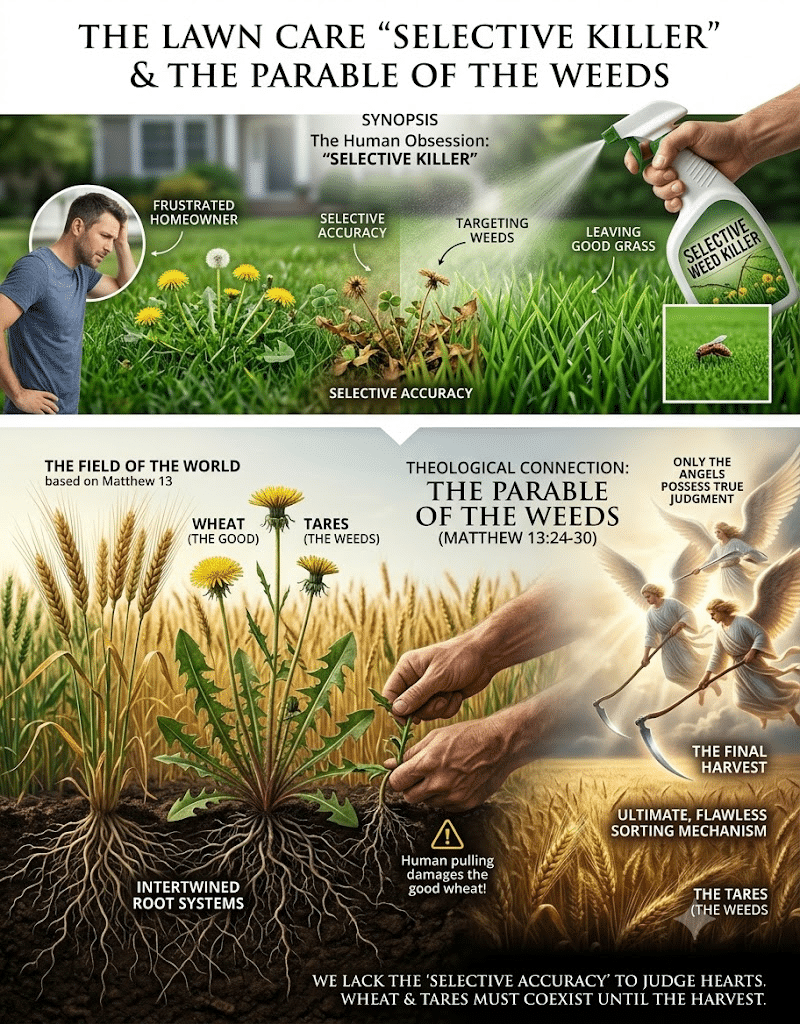
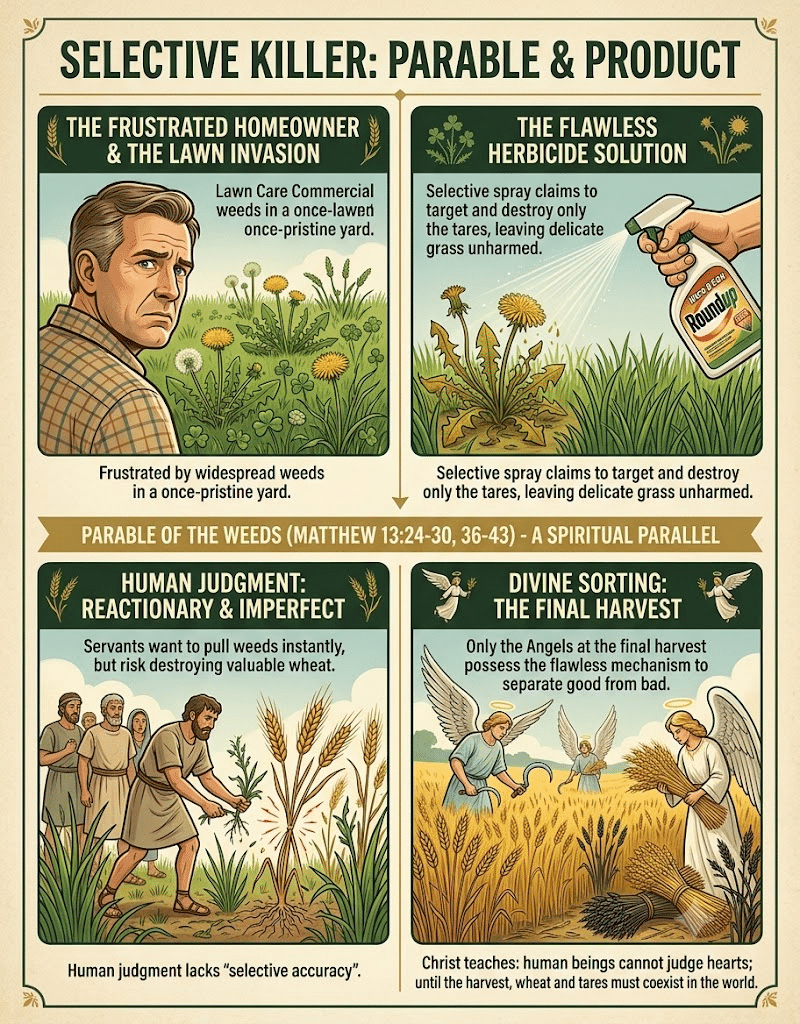
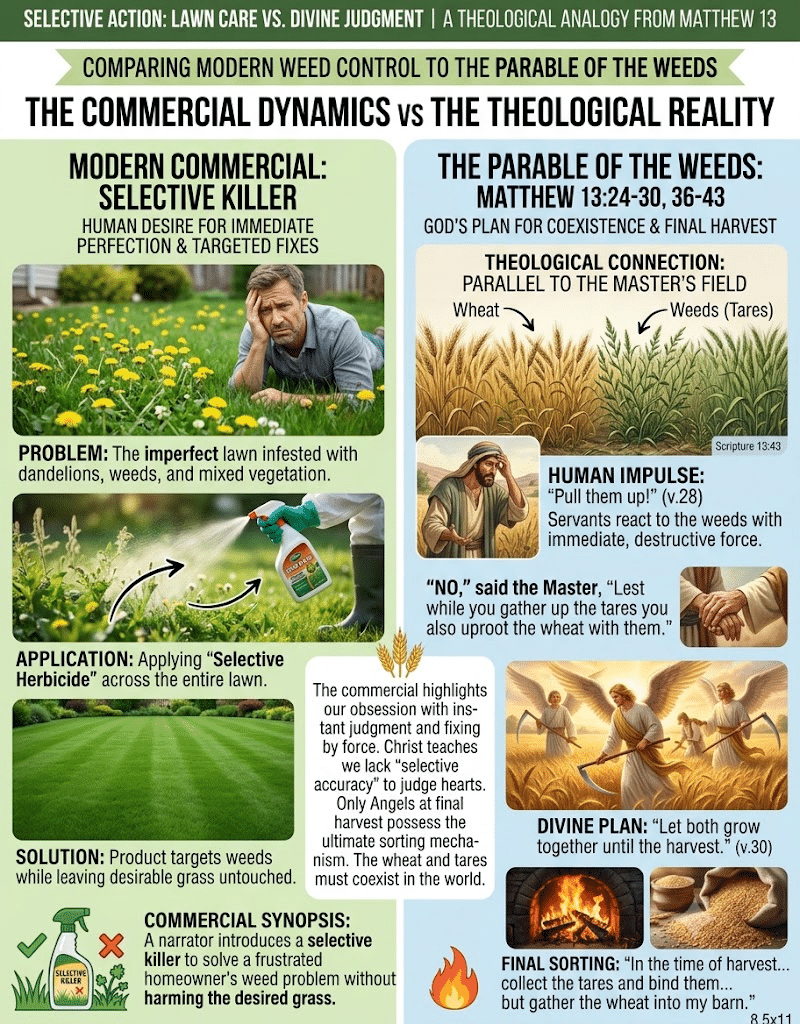
A typical lawn care commercial features a frustrated homeowner looking out over a once-pristine yard that is now heavily infested with dandelions, crabgrass, or clover. The narrator steps in with a solution: a selective herbicide. The visual demonstrates how the product is sprayed over the entire lawn, but it magically target-kills only the weeds while leaving the delicate, good grass completely unharmed and green. The commercial ends with a perfect, uniform lawn.
The Connection: This directly mirrors the dilemma faced by the master’s servants in the Parable of the Weeds. When the servants notice the weeds (tares), their immediate reaction is reactionary and destructive: “Do you want us to go and pull them up?” (v. 28). The master says no, because human pulling is clumsy; trying to rip out the bad will inadvertently uproot the good wheat due to their intertwined root systems. The commercial highlights our human obsession with instant, premature judgment and fixing the world by force. However, Christ teaches that human beings do not possess the “selective accuracy” to judge hearts. Only the Angels at the final harvest possess the ultimate, flawless sorting mechanism. Until then, the wheat and the tares must coexist in the same field (the world).
Dr. Jekyll & Mr. Hyde
16th Sunday of Year A


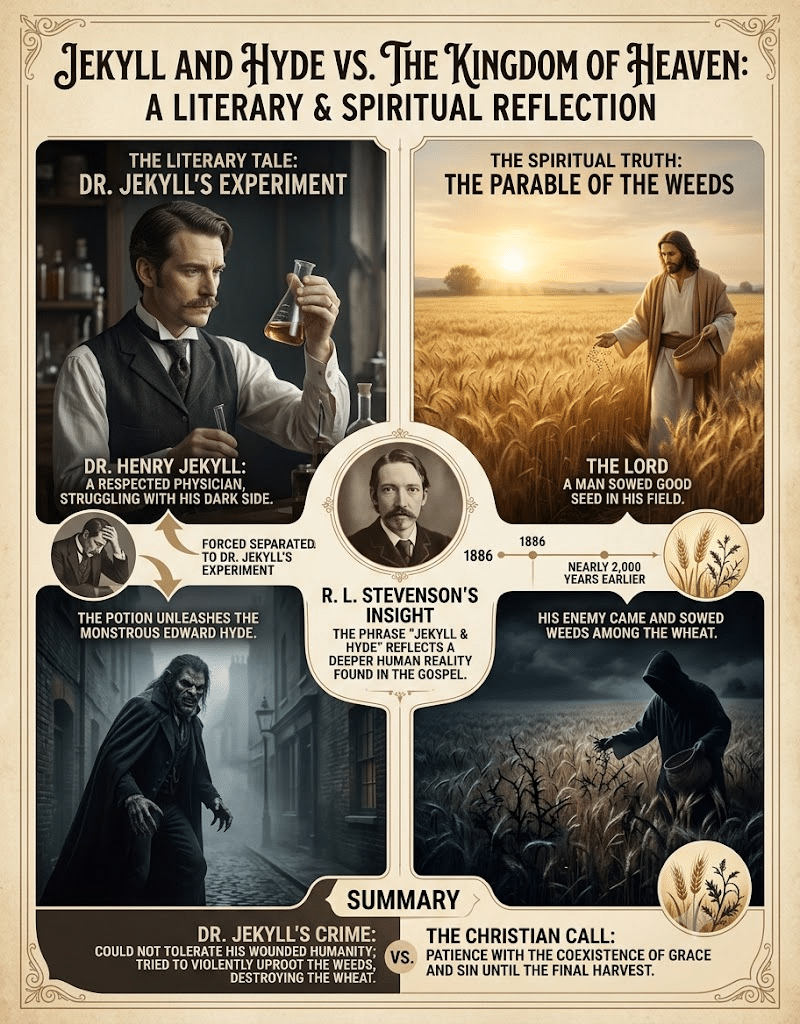
Looking for a powerful way to begin your homily? Use the anecdotes below, and feature one of the infographics above in your parish bulletin. It’s an excellent visual reminder to help your congregation carry the message of The Word This Week home with them. Non-profits have permission to reproduce them freely.
In 1886, a Scottish writer named Robert Louis Stevenson published a story that would forever change how we speak about the human soul. You’ve probably heard someone described as being “a bit Jekyll and Hyde,” haven’t you? We use the phrase so casually now that we forget the terrifying truth behind it.
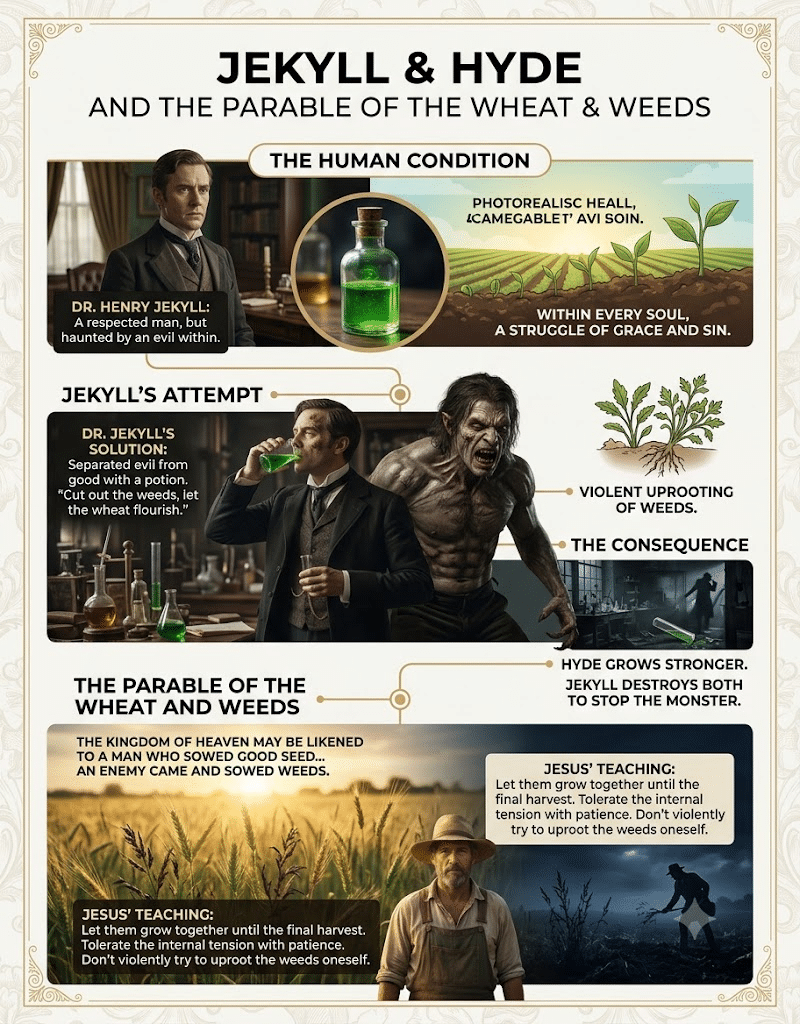
In Stevenson’s novella, Dr. Henry Jekyll is a respected physician, a pillar of society, a good man. But Jekyll is haunted. He is painfully aware of a dark side within himself, and he grows sick of the duplicity of his own life. So he does something extraordinary. He creates a potion to separate the evil in him from the good, freeing that evil to walk the earth as another man, the monstrous Edward Hyde. Jekyll believes that if he can just cut out the weeds within him, the wheat will finally flourish in peace. We know how the story ends. Hyde grows stronger. Jekyll transforms without even taking the potion. And in the end, unable to control the monster he unleashed, Dr. Jekyll takes his own life to save the world from Mr. Hyde.
The Connection: Stevenson stumbled upon something the Lord Jesus revealed nearly two thousand years earlier in the Gospel we just heard. “The kingdom of heaven may be likened to a man who sowed good seed in his field. While everyone was asleep his enemy came and sowed weeds all through the wheat.” There is the whole tension of the Christian life in one parable. Within the soul of every baptized Christian, the struggle between grace and sin continues until the final harvest. This is the truth that Dr. Jekyll could not accept. His crime was not that he had an evil side. His crime was that he could not bear to admit it, could not tolerate it, could not be patient with the mystery of his own wounded humanity. He wanted to be pure now, on his own terms, by his own hand. And so, in trying to violently uproot the weeds within himself, he destroyed the wheat as well.
The Legend of the Two Wolves
16th Sunday of Year A




Looking for a powerful way to begin your homily? Use the anecdotes below, and feature one of the infographics above in your parish bulletin. It’s an excellent visual reminder to help your congregation carry the message of The Word This Week home with them. Non-profits have permission to reproduce them freely.
Have you ever noticed that the people who are bad sometimes are the very same people who are good sometimes? It reminds us of a story called, “Two Wolves.” It goes like this: An old Cherokee is teaching his grandson about life. “A fight is going on inside me,” he said to the boy. “It is a terrible fight and it is between two wolves. One is evil – he is anger, envy, sorrow, regret, greed, arrogance, self-pity, guilt, resentment, inferiority, lies, false pride, superiority, and ego.” He continued, “The other is good – he is joy, peace, love, hope, serenity, humility, kindness, benevolence, empathy, generosity, truth, compassion, and faith. The same fight is going on inside you – and inside every other person, too.” The grandson thought about it for a minute and then asked his grandfather, “Which wolf will win?” The old Cherokee simply replied, “The one you feed.” (Anonymous)
The Connection: Today’s Gospel parable reminds us that we are a mixture of good and evil and, hence, instead of judging others we have to lead exemplary Christian lives and leave the judgment to God.
Historical Elimination of Weeds
16th Sunday of Year A




Looking for a powerful way to begin your homily? Use the anecdotes below, and feature one of the infographics above in your parish bulletin. It’s an excellent visual reminder to help your congregation carry the message of The Word This Week home with them. Non-profits have permission to reproduce them freely.
In the Holocaust, an act of unique horror, Adolf Hitler attempted to definitively separate and annihilate every Jewish person in order to construct what he perceived to be a superior race. When he was finally stopped in 1945, only 3,000,000 out of a population of 9,000,000 Jews in Europe remained alive. Millions of non-Jews were also killed during the third Reich, their only crime being the fact that they were judged as different and therefore lesser than their persecutors.
In the infamous witch trials, which swept Europe from the thirteenth to the early eighteenth century and crossed the Atlantic to take hold in the Americas in the seventeenth century. Religious intolerance led to the torture and deaths both of actual practitioners of black magic, necromancy, etc. and of others who were accused simply because they happened to have red hair, were learned in herb lore, or who, because of nervousness may have stumbled through the Lord’s Prayer. (Patricia Datchuck Sánchez).
The Connection: Segregation and the separation of peoples because of their different ideas, or social mores, has been a blight on the visage of humanity for centuries. The readings for today’s liturgy proffer a challenge to this gathered assembly that this blight should be eradicated.
The Sower, the Seed, and
the Soil of the Heart
Today’s readings tell us about a very patient and compassionate God Who is hopeful that the so-called “weeds” among us will be converted. They warn us that we should not be in a hurry to eliminate such elements from the Church, or society, or the family, based on unwarranted and/or hasty judgment.
Wisdom 12:13, 16-19
The first reading from the Book of Wisdom shows us a merciful and patient God, rather than the disciplining, punishing God presented in the book of Genesis.
Romans 8:26-27
The second reading, taken from Paul’s letter to the Romans, reminds us that the Spirit of God constantly empowers us in our prayers and in our weakness. So, we should be patient with ourselves and with others.
Matthew 13:24-43
In the Gospel Parable of the wheat and the weeds, Jesus presents a wise and patient God who allows the good and the evil to coexist in the world until the harvest, and blesses the evil ones for the little good they may have done, so that they may come to conversion before their time ends: “Let the wheat and the weeds [darnel] grow together till the harvest time.”In other words, God is “delaying” the end of the world for repentant sinners, giving them more time, and offering them the graces of strength and good will so that they may get reconciled with Him. God calmly recognizes that there is evil in the world, but He sees that evil is no excuse for the good people not to do good with the power of God at their disposal. Through the Parable of the wheat and the weeds in today’s Gospel, Jesus calls us to be patient with those who seem to us to fail to meet the high ethical standard expected of a Christian.
Leave Judgment to God, and
Focus on Self-Examination
This parable was told so that we might not go around judging others as “weeds” or wheat. Judgment is the prerogative of God alone. Instead, the parable asks us to take a close look at our own life with the understanding that, with God’s grace, one can judge one’s own heart, then repent and bear good fruit. It is a time to look at our own sins and at the way we conduct our own life, then to make a decision about our own repentance so that, with God’s grace, we can turn around and bear fruit for Jesus. Our Gospel lesson asks us whether we are secure in our Faith life. Are we secure in the knowledge that one day we will be judged as wheat or “weed”? How often have we been a “weed” in the garden of the Lord? Would we, knowing what we know now, like to have been plucked up at those times? God is so merciful that He allows evil to exist in order that what is good may grow. He allows evil to exist because He can turn it into good. Through the power of the Holy Spirit, God can change even the ugliest thorn into a blossom of Faith. In God’s field we have two responsibilities: to grow in grace as we do His will, and to share His Word and love with others.

Keeping Our Spiritual Soil Free from Weeds
We live in a violent and impassioned culture. Christians often appear self-righteous, suggesting that those who disagree with them are the “weeds” in the garden of life. Some they judge as “too radical” and others as too “old-fashioned” and “traditional.” Some they judge as holding embracing doctrinal errors, others not having any doctrine at all. Some they condemn for not caring for the poor, others, for caring for them too much. We often forget that appearances can be deceptive. The old saying, “If it looks like a duck, walks like a duck, quacks like a duck, it’s a duck,” may be true in the secular realm, but not in the Kingdom of God. If one talks like a Christian, sings like a Christian, etc. it doesn’t necessarily mean he or she is a real Christian. While we do our best to exercise right judgment as to what is or isn’t correct (Jn 13:35; I Jn 2:5, 3:10), the final determination will be made by God. Evil will coexist with good until the second coming of Jesus. The Good News is that growth and maturity are probably the most effective forms of “weed control.” In the end, it’s enough to know that we are “seeds” who have been planted by the “Son of Man,” and that we’re part of a healthy harvest that will someday be reaped by the angels of God.