
Related Podcasts


Prayers of the
Faithful
The Church
Governing Authorities and Salvation of the World
Those Burdened by Adversity or Difficulties
The Local Community
Jn 6:24-35 Hunger and
the Work of God
TRANSCRIPT
FR. DON: Thank you for joining us. It’s great to be here with all of our listeners, today, isn’t it Tonya?
TONYA: It’s always a pleasure. In this segment, we are going to look at the Gospel of John, chapter 6, verses 24-35. It follows the miracle of the multiplication of loaves and fishes, where Jesus fed the 5,000.
FR. DON: It’s a powerful passage that highlights the difference between earthly and spiritual nourishment.
TONYA: In this passage, Jesus warns against working for food that perishes and encourages the people to strive for the food that endures for eternal life. That’s an important distinction. Father, can you elaborate on what Jesus means by “food that endures for eternal life”?
FR. DON: Jesus uses the metaphor of bread or food to represent spiritual nourishment. In this context, he uses it to talk about faith in Himself, the Bread of Life. But we have to be careful here. Although he is using a metaphor, the Eucharist which satisfies our deepest hunger and leads to salvation, is much more than that. For our purposes here, then, we first want to make the distinction between physical and spiritual hunger.
In our day-to-day lives, we often get caught up in seeking temporary satisfaction, like the people who followed Jesus for the loaves and fishes.
TONYA: Yep, that’s me. I had a boyfriend once that tried to corrupt me through what St. Paul described in the second reading with “deceitful desire.” But one thing I have learned is that sex, money, and power don’t cut it. They are finite things.
FR. DON: And you wanted something beyond measuring, right? Something infinite.
TONYA: Yes. Deep down, inside me, I did. I am never satisfied. But, I have no one to blame but myself. I expect God to fulfill my wishes like a genie in a bottle.
FR. DON: I think we all do that from time to time.

This is how Father Bob Warren, SA describes it in his homily. “If we just see God as a sugar daddy,” he says, “as a magician, or an aspirin, we miss the point. One can have all the material goods of this world: health and wealth, and still have nothing. None of these automatically brings peace or security.”
TONYA: So, Jesus is not just talking about physical bread but the profound fulfillment that comes from a relationship with him.
FR. DON: Exactly! Sunday mass is a reminder to prioritize our spiritual well-being and nurture our relationship with God. It is our hunger for God that ultimately leads to salvation. We do this by consuming the body and blood of Christ.
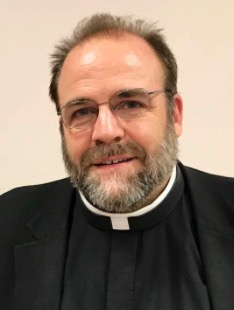
TONYA: Did you read Monsignor Pope‘s homily? This week it’s about hunger, healing, and heart. Words that all begin with the letter H. Monsignor also gives us three directives from the Lord.
- Fix your focus.
- Firm up your faith.
- Find your food.
Did you catch all the double F’s. Isn’t that clever?
FR. DON: Yeah. He’s very creative. Some people find the alliteration distracting. But I don’t find it contrived or silly. Probably, because I’m focused on the meaning of what he is saying. So what was meaningful for you?
TONYA: Basically, he said we’re so caught up in the temporary things of this world that we forget what really matters. We stress over things that won’t last, and we ignore the one person who can actually help us: Jesus. It’s like being on the Titanic and worrying about our cabin or the furniture. Jesus is telling us to pay attention and focus on Him because He’s the only one who can save us.
FR. DON: In other words, we need to stop getting distracted by all the temporary stuff and listen to Him.
Deacon Peter McCulloch says in his homily that many people today “have everything they need, but they still feel empty inside. They hunger for something more, but just don’t know what it is. So, they keep searching for the latest ‘thing’.”
TONYA: I am constantly scrolling through social media, trying to keep up with the current challenges, viral videos, or trending topics. Double C, double V, double T. Did you catch the alliteration, Father?
FR. DON: Yes. Monsignor.
And I, too, am always wanting the latest exciting, cutting-edge smartphone, gadget, or device. And if you insist—diverse designs.
TONYA: Double D!
FR. DON: Now, that’s distracting.
TONYA: I’m like so into the newest fashion trends, buying all these designer brands and stuff, and I just feel like I need to change up my closet every season just to keep up with what’s in style. It’s a lot, but I love it.
FR. DON: But admit it. We will never be satisfied, if in the process we ignore our souls and what they truly hunger for: God.
TONYA: Let’s switch gears. I’ve got something I’m wondering about…
FR. DON: Okay. What is it?
TONYA: In the Gospel, the people ask Jesus what works they must perform to do the works of God. What’s the significance of their question and Jesus’ response?
FR. DON: Let’s read that part of the Gospel. The crowd asks Jesus this question. “What can we do to accomplish the works of God?” Jesus then answers them by saying, “This is the work of God, that you believe in the one he sent.”
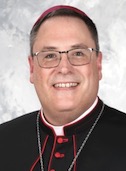
Bishop Frank Schuster, in his homily, emphasizes the importance of focusing on the eternal aspects of life, rather than the temporary and material. Engaging in good deeds, improving society, and pursuing personal achievements are all valuable pursuits, but these efforts should be motivated by the desire to glorify God and spread the message of Christ. He mentions that our actions in this life may not be remembered in a century, but by sharing our faith and cultivating a relationship with Jesus, we connect with what he calls “a legacy” that spans generations touching countless lives.
TONYA: How can we be so sure that our impact endures beyond our physical lives?
FR. DON: The answer lies in working for “food that endures for eternal life,” as Jesus describes. This entails prioritizing spiritual nourishment and nurturing a deep connection with Christ, which can then be shared with others. Our motivation should not be centered on obtaining recognition or worldly rewards, but rather on furthering God’s kingdom and extending His love to others.
TONYA: Just like the Christians did when they shared their faith and worked to spread the Gospel. By doing this they created a foundation for the billions of believers who followed.
FR. DON: The true measure of our impact lies not in the tangible accomplishments we amass or the accolades we receive, but in the spiritual legacy we leave behind.
We can look at this from a different perspective, too. Viewing our primary “work” as having faith in Christ and cultivating a relationship with Him underscores the importance of Catholic devotion. Prayer, sacraments, and various devotional practices help foster a personal connection with Jesus.
TONYA: So you are referring to the Rosary, Eucharistic Adoration, the Stations of the Cross, veneration of saints, novenas, pilgrimages, and the like?
FR. DON: Yes. All these devotions serve as a means for Catholics to grow in faith, express their love for God, and deepen their relationship with Christ, which is at the heart of Jesus’ message. But it isn’t about checking off a list of accomplishments or actions.
TONYA: I get it. It’s not about the “what,” but the “who.” It’s about Jesus. He is the one who gave us life by dying on the cross, and he is the one who gives us the only thing we will ever need, Himself. We don’t need all the other stuff.
FR. DON: No. That’s not true. The what is still important. It is all good. After all, Jesus did teach His followers to pray the Lord’s Prayer, did he not. Incidentally, notice that in the “Our Father” Jesus has us asking God to give us each day our daily bread.
So, keep in mind that doing good things and taking part in religious practices are important in the Catholic faith, but they’re not the whole deal when it comes to being saved. What’s key is having faith in Jesus and building a real, authentic relationship with Him. That’s what ultimately saves us. There are tons of devotional practices in the Catholic Church that can help us grow in our faith and connect with Christ on a deeper level. By participating in these devotions, we’re better equipped to do “the work of God.”
I think that is all for today. We want to keep each segment under 15 minutes.
TONYA: I agree. Thanks to everyone for joining us. We hope our conversation has inspired you to reflect on your spiritual journey and deepen your relationship with Christ. Tune in for the next segment where we will be looking more closely at the first reading.